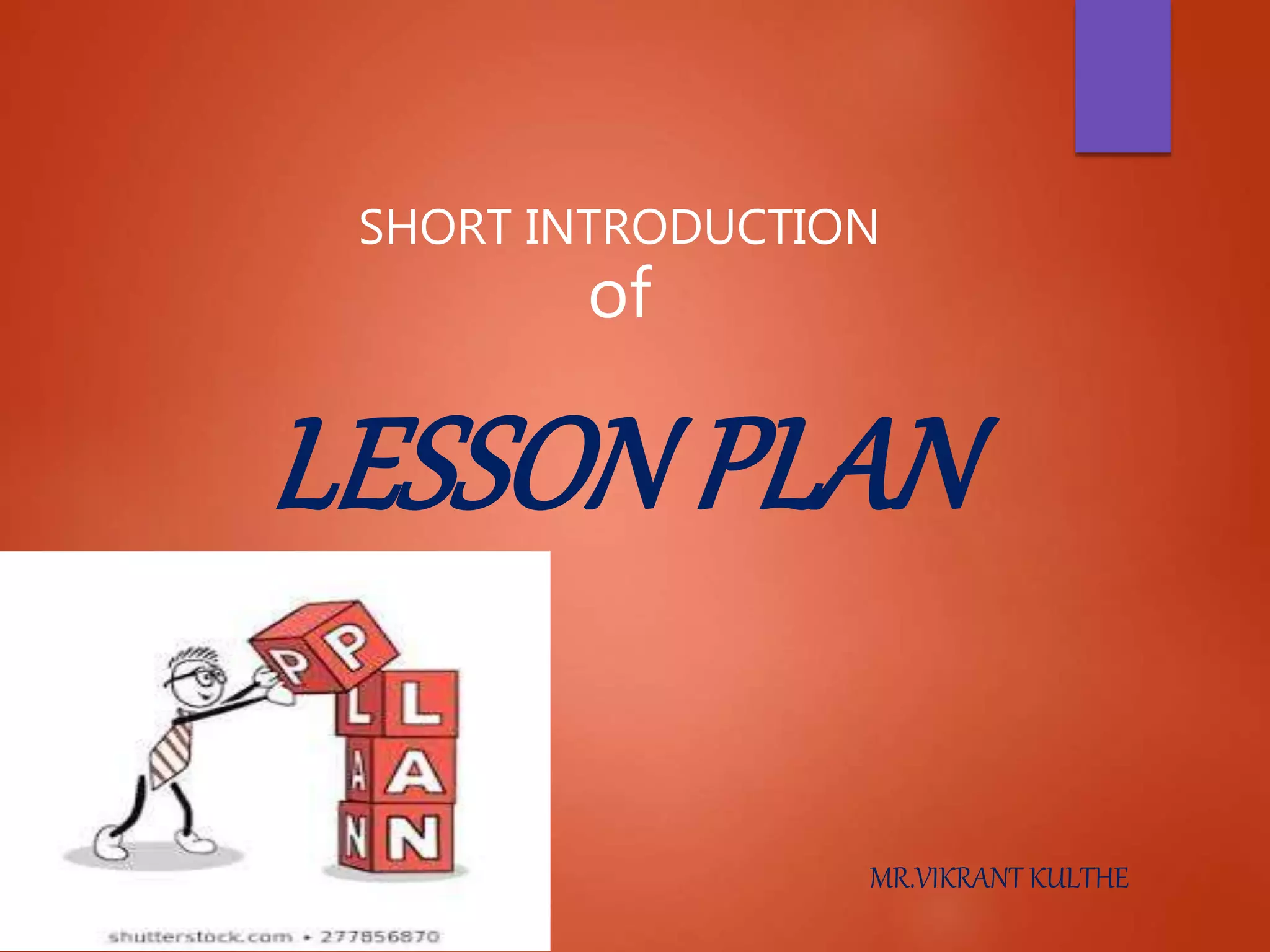
SHORT INTRODUCTION
of
LESSONPLAN
MR.VIKRANT KULTHE
LESSON PLAN
Definition by Lester:
Lesson plan is a plan of action which includes
 Working philosophy of the teacher
 His or her knowledge of the material to be taught
 His ability to utilize effective method
2
PURPOSES
1. It provides guidelines to the teacher in teaching learning
process
2. Adequate consideration of goals & objectives.
3. It provides confidence & self reliance to the teacher to engage
class.
4. It provides frame work to carry out the teaching at a suitable
rate.
5. Helps teacher to carry out the teaching activity in a systematic &
orderly fashion.
6. It keeps teacher on track.
7. Develops the reasoning , imagination, decision making ability of
the teacher.
8. In totality it helps the teacher in effective teaching.
3
ESSENTIALS OF A LESSON PLAN:
1. It should be written & should have clear aims
2. A flexible plan should be clear
& specific
3. It should cover the exact scope
4. It should follow the maxims of teaching.
5. The new ideas should be related to learners
6. It should contain the suitable subject matter.
7. It enables the teacher to know the most desirable types of teaching
method.
8. Provides continuity in teaching g process
9. Illustrative aids have to be prepaid.
4
PRINCIPLES:
The lesson plan is composed of 6 principles, they are.
1. The plan is to be made as a GUIDE rather than as a rule of thumb
rule.
2. Mastery of subject
3. Acquainted with new methods and technique of teaching
4. Active student participation
5. Organize the teaching material in a psychological way rather than
merely a logical thinking
6. Avoid monotony.
5
PRE-REQUISITES FOR GOOD
LESSON PLAN
1. Mastery of subject.
2. Principle of teaching & learning .
3. Awareness of individual difference.
4. Adequate training in the topic.
5. Two way teaching method.
6
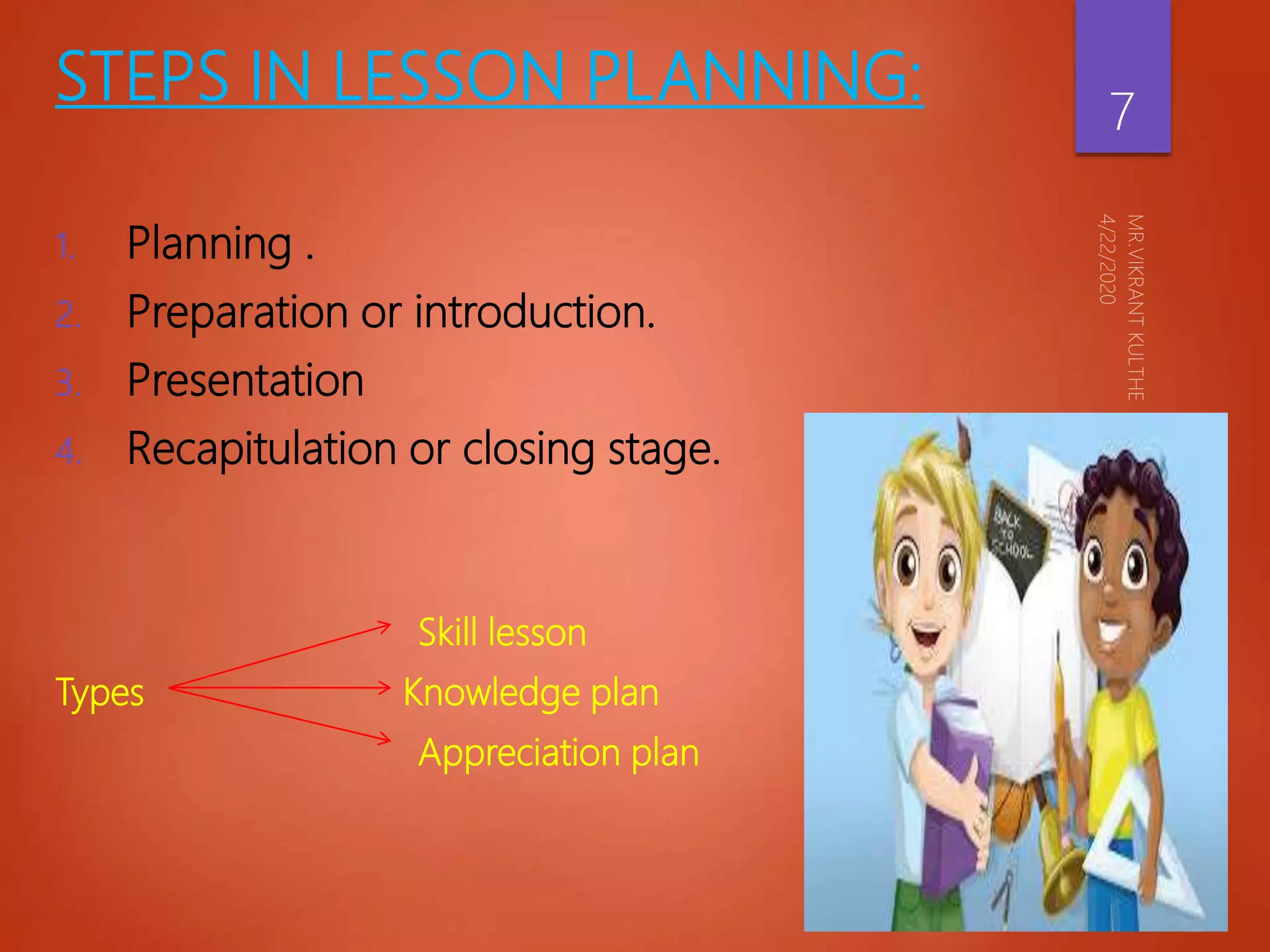
STEPS IN LESSON PLANNING:
1. Planning .
2. Preparation or introduction.
3. Presentation
4. Recapitulation or closing stage.
Skill lesson
Types Knowledge plan
Appreciation plan
7
SKILL LESSON
 No impression without expression!!!!
 Here skills are taught by 2 methods, they are:
Demonstrations
Verbal instruction
Effective skill lesson includes :
1. Showing good exhibitions & museums & by giving assignment to
learners to do project.
2. Clear aim to every lesson plan is essential.
3. By showing the process with the help of A.V.aids
4. Proficiency in the skills depends upon the success of individual
practice.
5. Rules restricts activity & endangers freedom & spontaneity.
8
KNOWLEDGE LESSON
 It is also called as herbartian lesson.
STEPS:
 Preparation
 Presentation
 Association/comparison
 Generalization
 Application
 Recapitulation .
9
APPRECIATION LESSON
 It helps in development of aesthetic skills like enable the
pupil to appreciate beauty which can be in sounds, color
and any other form.
STEPS:
1. Preparation
2. Presentation
3. Contemplation
4. Application .
10
11

Lesson plan short introduction.

  • 1.
  • 2.
    LESSON PLAN Definition byLester: Lesson plan is a plan of action which includes  Working philosophy of the teacher  His or her knowledge of the material to be taught  His ability to utilize effective method 2
  • 3.
    PURPOSES 1. It providesguidelines to the teacher in teaching learning process 2. Adequate consideration of goals & objectives. 3. It provides confidence & self reliance to the teacher to engage class. 4. It provides frame work to carry out the teaching at a suitable rate. 5. Helps teacher to carry out the teaching activity in a systematic & orderly fashion. 6. It keeps teacher on track. 7. Develops the reasoning , imagination, decision making ability of the teacher. 8. In totality it helps the teacher in effective teaching. 3
  • 4.
    ESSENTIALS OF ALESSON PLAN: 1. It should be written & should have clear aims 2. A flexible plan should be clear & specific 3. It should cover the exact scope 4. It should follow the maxims of teaching. 5. The new ideas should be related to learners 6. It should contain the suitable subject matter. 7. It enables the teacher to know the most desirable types of teaching method. 8. Provides continuity in teaching g process 9. Illustrative aids have to be prepaid. 4
  • 5.
    PRINCIPLES: The lesson planis composed of 6 principles, they are. 1. The plan is to be made as a GUIDE rather than as a rule of thumb rule. 2. Mastery of subject 3. Acquainted with new methods and technique of teaching 4. Active student participation 5. Organize the teaching material in a psychological way rather than merely a logical thinking 6. Avoid monotony. 5
  • 6.
    PRE-REQUISITES FOR GOOD LESSONPLAN 1. Mastery of subject. 2. Principle of teaching & learning . 3. Awareness of individual difference. 4. Adequate training in the topic. 5. Two way teaching method. 6
  • 7.
    STEPS IN LESSONPLANNING: 1. Planning . 2. Preparation or introduction. 3. Presentation 4. Recapitulation or closing stage. Skill lesson Types Knowledge plan Appreciation plan 7
  • 8.
    SKILL LESSON  Noimpression without expression!!!!  Here skills are taught by 2 methods, they are: Demonstrations Verbal instruction Effective skill lesson includes : 1. Showing good exhibitions & museums & by giving assignment to learners to do project. 2. Clear aim to every lesson plan is essential. 3. By showing the process with the help of A.V.aids 4. Proficiency in the skills depends upon the success of individual practice. 5. Rules restricts activity & endangers freedom & spontaneity. 8
  • 9.
    KNOWLEDGE LESSON  Itis also called as herbartian lesson. STEPS:  Preparation  Presentation  Association/comparison  Generalization  Application  Recapitulation . 9
  • 10.
    APPRECIATION LESSON  Ithelps in development of aesthetic skills like enable the pupil to appreciate beauty which can be in sounds, color and any other form. STEPS: 1. Preparation 2. Presentation 3. Contemplation 4. Application . 10
  • 11.