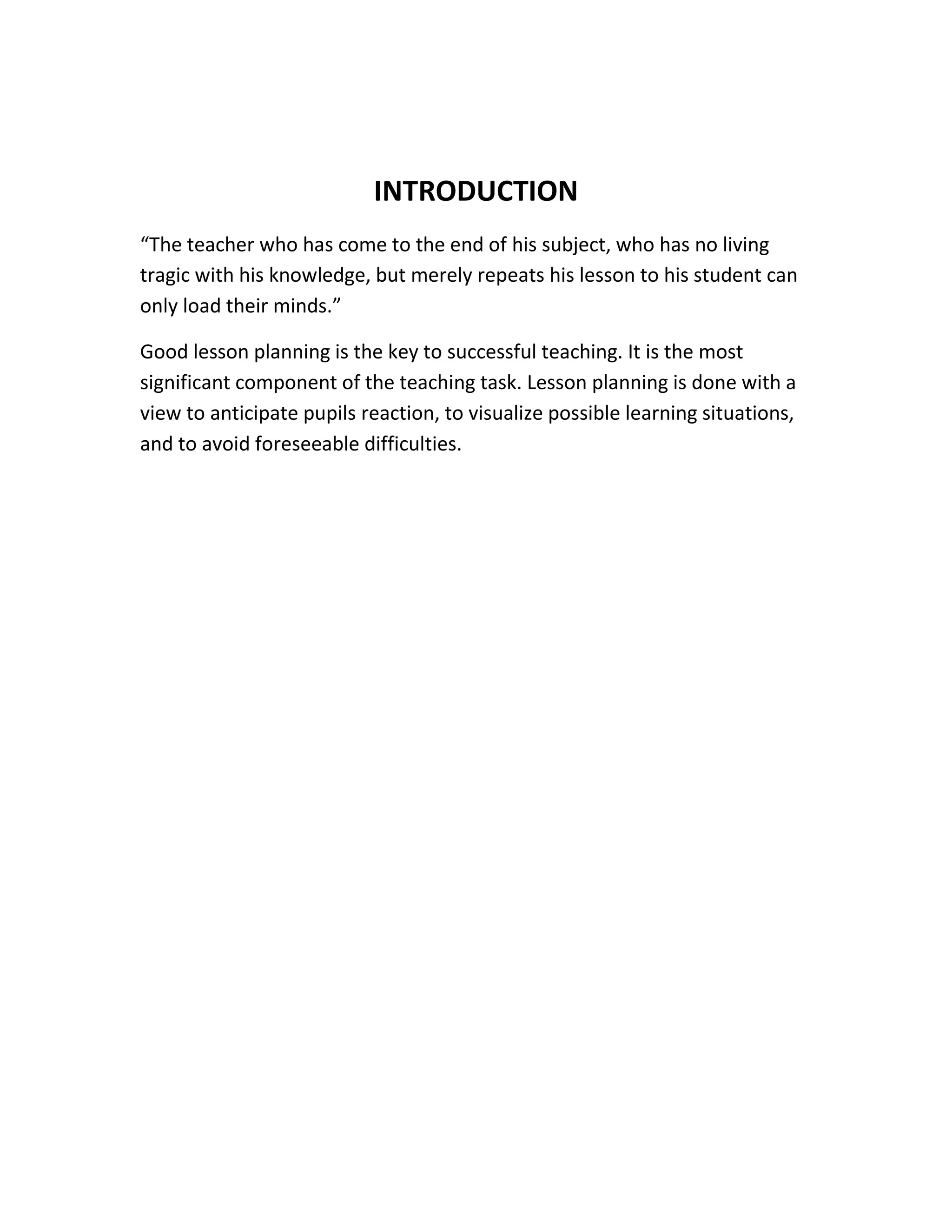
INTRODUCTION 
“The teacher who has come to the end of his subject, who has no living 
tragic with his knowledge, but merely repeats his lesson to his student can 
only load their minds.” 
Good lesson planning is the key to successful teaching. It is the most 
significant component of the teaching task. Lesson planning is done with a 
view to anticipate pupils reaction, to visualize possible learning situations, 
and to avoid foreseeable difficulties.
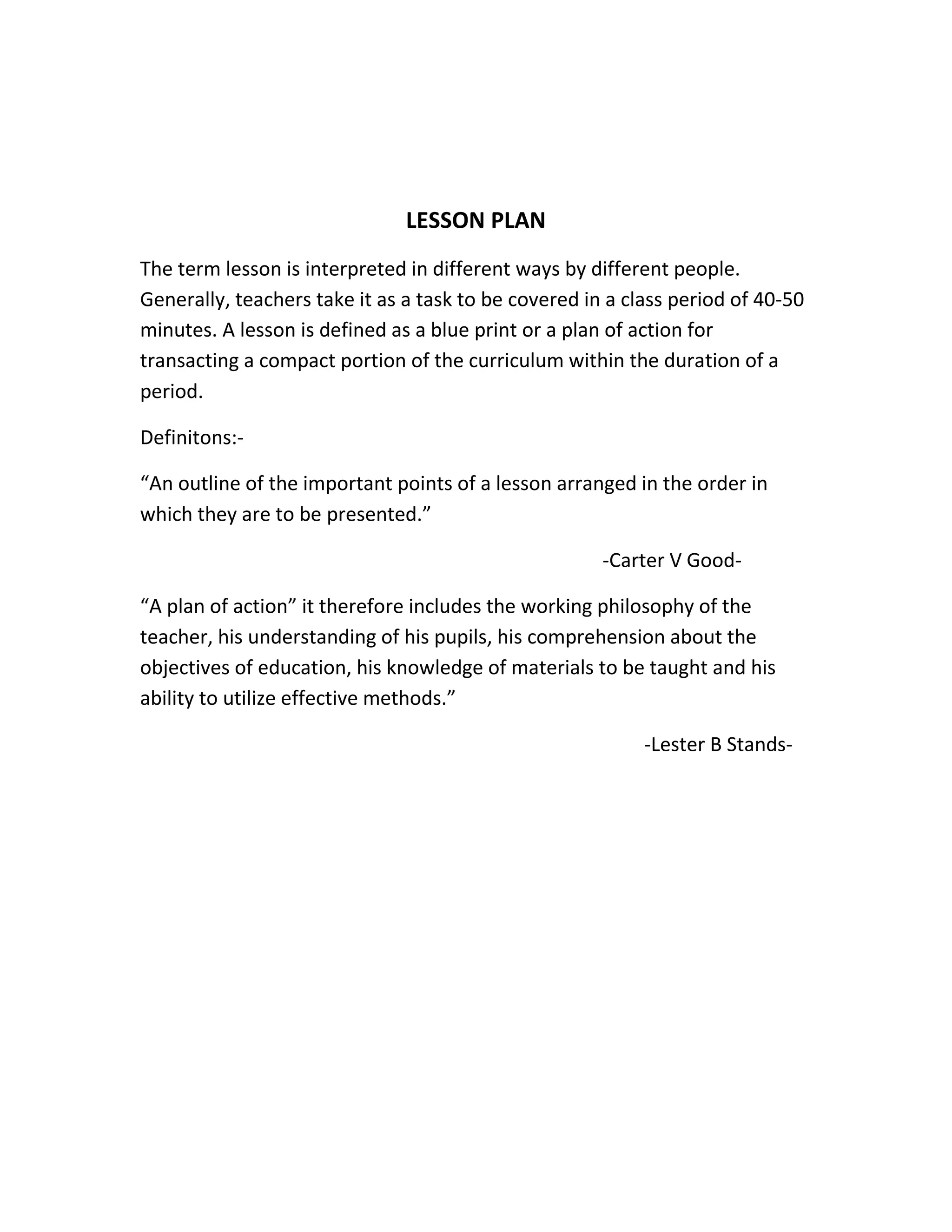
LESSON PLAN 
The term lesson is interpreted in different ways by different people. 
Generally, teachers take it as a task to be covered in a class period of 40-50 
minutes. A lesson is defined as a blue print or a plan of action for 
transacting a compact portion of the curriculum within the duration of a 
period. 
Definitons:- 
“An outline of the important points of a lesson arranged in the order in 
which they are to be presented.” 
-Carter V Good- 
“A plan of action” it therefore includes the working philosophy of the 
teacher, his understanding of his pupils, his comprehension about the 
objectives of education, his knowledge of materials to be taught and his 
ability to utilize effective methods.” 
-Lester B Stands-
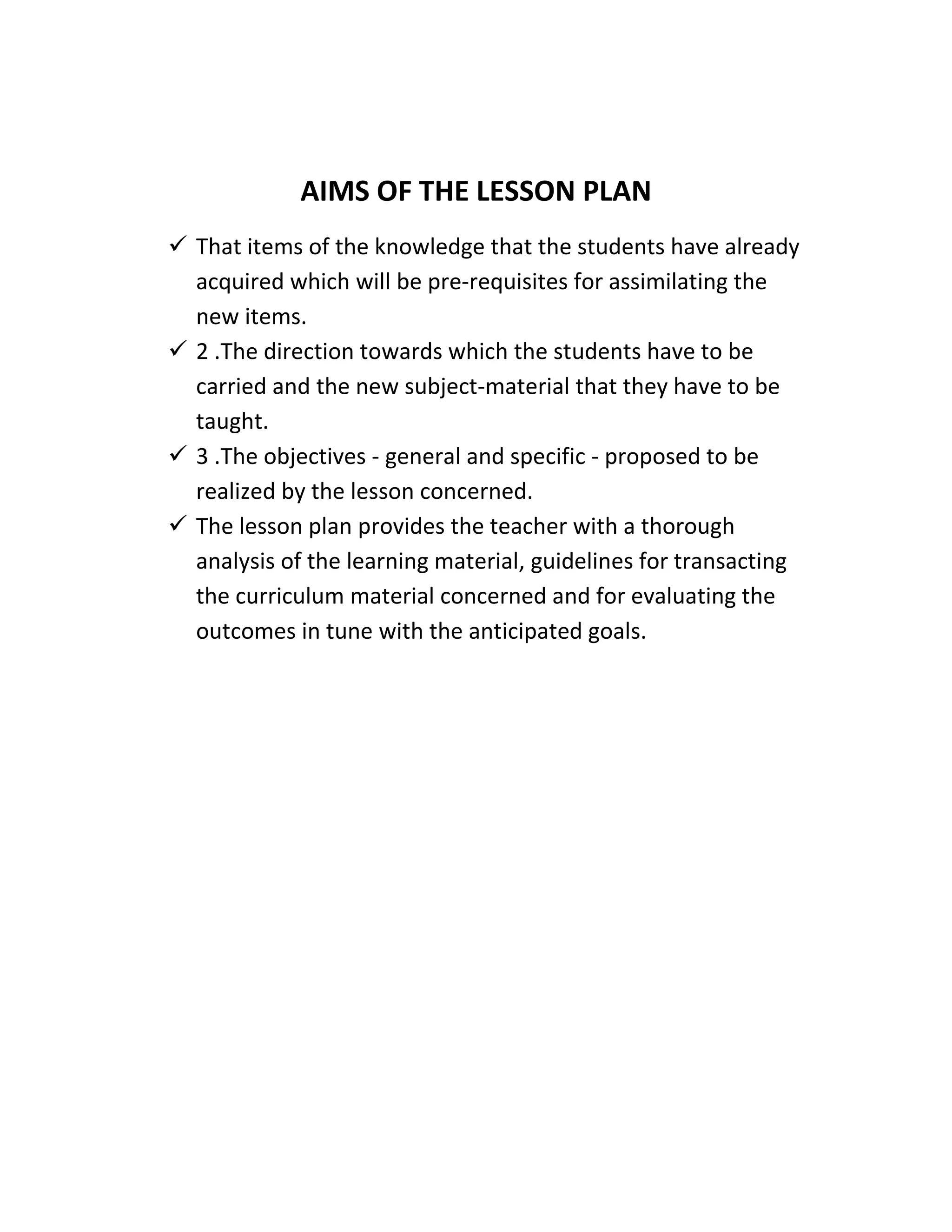
AIMS OF THE LESSON PLAN 
 That items of the knowledge that the students have already 
acquired which will be pre-requisites for assimilating the 
new items. 
 2 .The direction towards which the students have to be 
carried and the new subject-material that they have to be 
taught. 
 3 .The objectives - general and specific - proposed to be 
realized by the lesson concerned. 
 The lesson plan provides the teacher with a thorough 
analysis of the learning material, guidelines for transacting 
the curriculum material concerned and for evaluating the 
outcomes in tune with the anticipated goals.
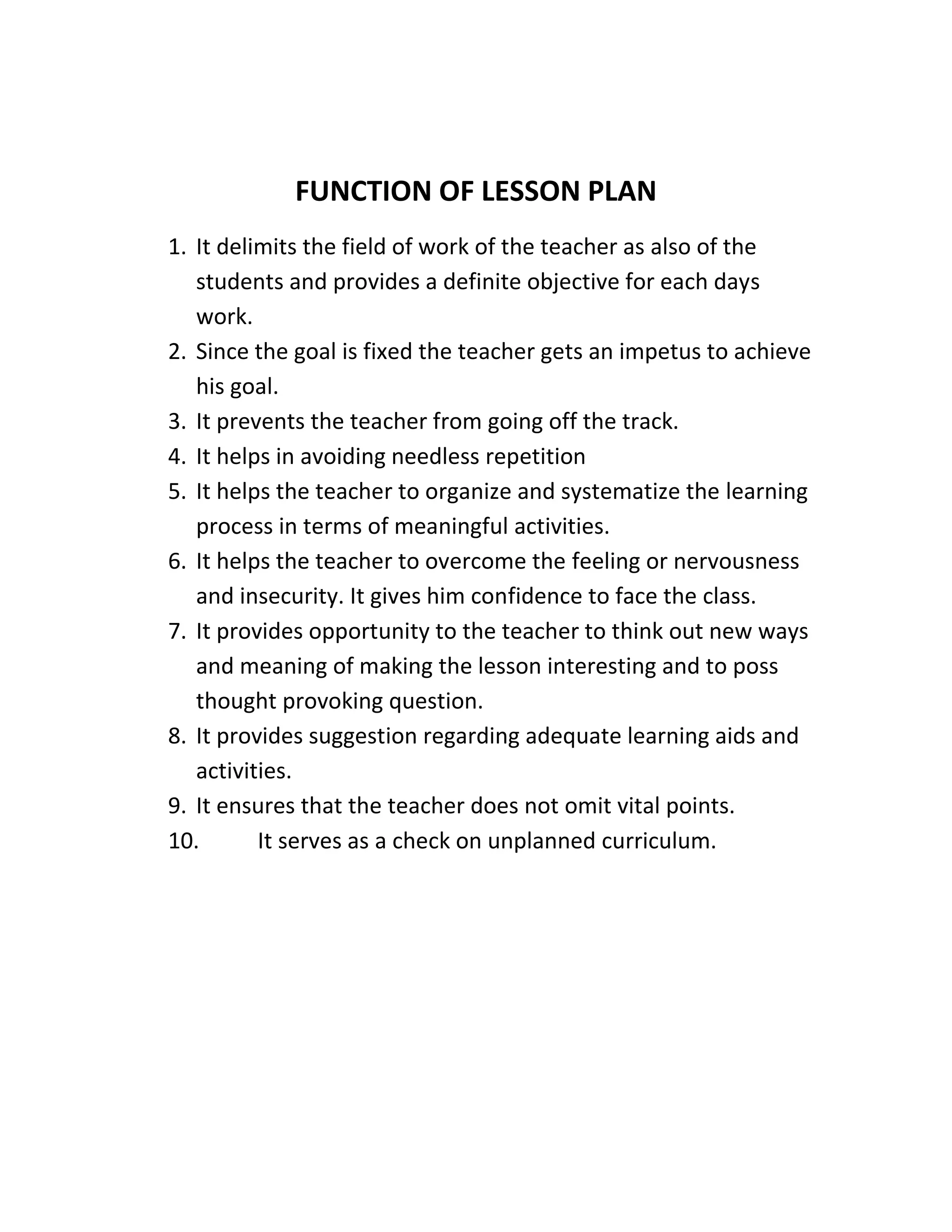
FUNCTION OF LESSON PLAN 
1. It delimits the field of work of the teacher as also of the 
students and provides a definite objective for each days 
work. 
2. Since the goal is fixed the teacher gets an impetus to achieve 
his goal. 
3. It prevents the teacher from going off the track. 
4. It helps in avoiding needless repetition 
5. It helps the teacher to organize and systematize the learning 
process in terms of meaningful activities. 
6. It helps the teacher to overcome the feeling or nervousness 
and insecurity. It gives him confidence to face the class. 
7. It provides opportunity to the teacher to think out new ways 
and meaning of making the lesson interesting and to poss 
thought provoking question. 
8. It provides suggestion regarding adequate learning aids and 
activities. 
9. It ensures that the teacher does not omit vital points. 
10. It serves as a check on unplanned curriculum.
PRINCIPLES OF LESSON- PLANNING 
1. The teacher should prepare a careful but flexible plan . 
2. The teacher must have mastery of the content area from which items 
have been selected for the lesson. 
3. The teacher must be fully conversant with new methods, 
approaches, strategies, techniques and models of teaching social 
science and these should be clearly indicated. 
4. The teacher must know his pupils thoroughly and organize the 
materials in a psychological rather than a merely logical fashion. 
5. The teacher must ensure active pupil participation. 
6. Activities should be taken up during a lesson should be varied., 
particularly if pupils are comparatively young so as to eliminate 
monotony. This variety of work may be ensured at different stages of 
lesson in the same period, by way of observation, close listening, 
speaking, writing and engaging in an action, by the learners
CONCLUSION 
As we all know that for a successful teaching a lesson plan is needed as a 
lesson plan is considered as plan of action which helps the teacher to 
transact his lesson to leaner in a meaningful way. A lesson plan is also 
known as plan of action. 
REFERENCE 
1. Dr. k. Sivarajan, Social Science Education methodology of 
teaching and pedagogic analysis.
Lesso plan assignmntn

Lesso plan assignmntn

  • 1.
    INTRODUCTION “The teacherwho has come to the end of his subject, who has no living tragic with his knowledge, but merely repeats his lesson to his student can only load their minds.” Good lesson planning is the key to successful teaching. It is the most significant component of the teaching task. Lesson planning is done with a view to anticipate pupils reaction, to visualize possible learning situations, and to avoid foreseeable difficulties.
  • 2.
    LESSON PLAN Theterm lesson is interpreted in different ways by different people. Generally, teachers take it as a task to be covered in a class period of 40-50 minutes. A lesson is defined as a blue print or a plan of action for transacting a compact portion of the curriculum within the duration of a period. Definitons:- “An outline of the important points of a lesson arranged in the order in which they are to be presented.” -Carter V Good- “A plan of action” it therefore includes the working philosophy of the teacher, his understanding of his pupils, his comprehension about the objectives of education, his knowledge of materials to be taught and his ability to utilize effective methods.” -Lester B Stands-
  • 3.
    AIMS OF THELESSON PLAN  That items of the knowledge that the students have already acquired which will be pre-requisites for assimilating the new items.  2 .The direction towards which the students have to be carried and the new subject-material that they have to be taught.  3 .The objectives - general and specific - proposed to be realized by the lesson concerned.  The lesson plan provides the teacher with a thorough analysis of the learning material, guidelines for transacting the curriculum material concerned and for evaluating the outcomes in tune with the anticipated goals.
  • 4.
    FUNCTION OF LESSONPLAN 1. It delimits the field of work of the teacher as also of the students and provides a definite objective for each days work. 2. Since the goal is fixed the teacher gets an impetus to achieve his goal. 3. It prevents the teacher from going off the track. 4. It helps in avoiding needless repetition 5. It helps the teacher to organize and systematize the learning process in terms of meaningful activities. 6. It helps the teacher to overcome the feeling or nervousness and insecurity. It gives him confidence to face the class. 7. It provides opportunity to the teacher to think out new ways and meaning of making the lesson interesting and to poss thought provoking question. 8. It provides suggestion regarding adequate learning aids and activities. 9. It ensures that the teacher does not omit vital points. 10. It serves as a check on unplanned curriculum.
  • 5.
    PRINCIPLES OF LESSON-PLANNING 1. The teacher should prepare a careful but flexible plan . 2. The teacher must have mastery of the content area from which items have been selected for the lesson. 3. The teacher must be fully conversant with new methods, approaches, strategies, techniques and models of teaching social science and these should be clearly indicated. 4. The teacher must know his pupils thoroughly and organize the materials in a psychological rather than a merely logical fashion. 5. The teacher must ensure active pupil participation. 6. Activities should be taken up during a lesson should be varied., particularly if pupils are comparatively young so as to eliminate monotony. This variety of work may be ensured at different stages of lesson in the same period, by way of observation, close listening, speaking, writing and engaging in an action, by the learners
  • 6.
    CONCLUSION As weall know that for a successful teaching a lesson plan is needed as a lesson plan is considered as plan of action which helps the teacher to transact his lesson to leaner in a meaningful way. A lesson plan is also known as plan of action. REFERENCE 1. Dr. k. Sivarajan, Social Science Education methodology of teaching and pedagogic analysis.