Deductive vs Inductive Method
Republic of the Philippines
MINDANAO STATE UNIVERSITY
College of Education
Fatima, General Santos City
Class Schedule : MTH/ 9 – 10:30am
Presented to
Dr. Ava Claire Marie O. Robles
Presented by
Erinio C. Mahusay Jr.
Learning Outcomes
• To define the Inductive and Deductive methods
• To differentiate the Inductive from the Deductive
procedure
• To find out what pedagogical advantages and
disadvantages do Inductive and Deductive approach
have
References
• Amparo S. Lardizabal,Alicia S. Bustos, Luz C. Bucu and
Maura G. Tangco (1999) ‘Principles and Methods of
Teaching’
• Blenda B. Corpuz, Ph.D, Gloria G. Salandanan, Ph.D.
Dalisay V. Rigor, Ph.D. and Lorimar publishing Inc.
(2006) ‘Principles of Teaching 2’
Deductive Method
A deductive approach to instruction is a
more teacher-centered approach. This means
that the teacher gives the students a new
concept, explains it, and then has the students
practice using the concept, it is also called a
deductive instruction.
Deductive Method
Note:
The Deductive approach is teacher-
dominated. It begins with abstract rule,
generalization, principle and ends with specific
examples, and concrete details.
Blenda B. Corpuz, Ph.D, Gloria G. Salandanan, Ph.D. Dalisay V. Rigor, Ph.D.
and Lorimar publishing Inc. (2006) ‘Principles of Teaching 2’
Advantages of the Deductive Method
Coverage of a wider scope of subject matter –
because our instruction is direct by starting the
rule or the principle at the beginning of the class,
we cover more subject matter over a period of
time
No bother on the part of the teacher to lead
learners to the formulation of generalization or
rule – we ourselves give the generalization at the
beginning of the lesson
Blenda B. Corpuz, Ph.D, Gloria G. Salandanan, Ph.D. Dalisay V. Rigor, Ph.D.
and Lorimar publishing Inc. (2006) ‘Principles of Teaching 2’
Disadvantages of the Deductive Method
It is not supportive of thee principle that
learning is an active process. There is less
involvement on the part of the learners.
Lesson appears uninteresting at first. We begin
our lesson with the abstract, with what the
learners do not know so at the outset our lesson
will look irrelevant and uninteresting
Blenda B. Corpuz, Ph.D, Gloria G. Salandanan, Ph.D. Dalisay V. Rigor, Ph.D.
and Lorimar publishing Inc. (2006) ‘Principles of Teaching 2’
Deductive method
According to Bob Adamson, “The deductive
method is often criticized because:
a) it teaches grammar in an isolated way;
b) little attention is paid to meaning;
c) practice is often mechanical.” This method
can, however, be a viable option in certain
situations; for example, when dealing with
highly motivated students, teaching a
particularly difficult concept, or for
preparing students to write exams.
Inductive method
In contrast with the deductive method,
inductive instruction makes use of student
“noticing”. Instead of explaining a given
concept and following this explanation with
examples, the teacher presents students with
many examples showing how the concept is
used. The intent is for students to “notice”, by
way of the examples, how the concept works,
it is also called a inductive instruction.
Inductive method
Note;
The Inductive method is less teacher –
directed than the Deductive method. It begins
with specific details, concrete data and
examples and ends with generalization rule, or
principle
Blenda B. Corpuz, Ph.D, Gloria G. Salandanan, Ph.D. Dalisay V. Rigor, Ph.D.
and Lorimar publishing Inc. (2006) ‘Principles of Teaching 2’
Advantages of the Inductive method
The learners are more engaged in the teaching –
learning process. With our facilitating skills, the
learners formulate the generalization or rule.
Learning becomes more interesting at the
outset because we begin with the experience of
our students. We begin with what they know.
It helps the development of our learners’
higher-order thinking skills(HOTS). To see patterns
and analyze the same in order to arrive at
generalization requires analytical thinking.
Blenda B. Corpuz, Ph.D, Gloria G. Salandanan, Ph.D. Dalisay V. Rigor, Ph.D.
and Lorimar publishing Inc. (2006) ‘Principles of Teaching 2’
Disadvantages of the Inductive method
It requires more time and so less subject matter
will be covered. We need much to lead our
students to the formulation of generalization.
It demands expert facilitating skills on the part
of the teacher. We’ve got to ask the right questions,
organize answers and comments to pave the way to
the derivation of generalization.
Blenda B. Corpuz, Ph.D, Gloria G. Salandanan, Ph.D. Dalisay V. Rigor, Ph.D.
and Lorimar publishing Inc. (2006) ‘Principles of Teaching 2’
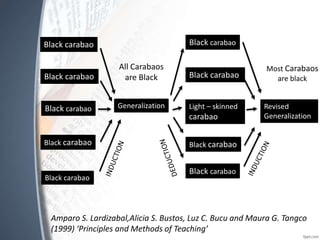
Amparo S. Lardizabal,Alicia S. Bustos, Luz C. Bucu and Maura G. Tangco
(1999) ‘Principles and Methods of Teaching’
Black carabao
Black carabao
Black carabao
Black carabao
Black carabao
Generalization
All Carabaos
are Black
Black carabao
Black carabao
Light – skinned
carabao
Black carabao
Black carabao
Revised
Generalization
Most Carabaos
are black
How can teachers help their students
practice ‘noticing’?
In the 1990s researchers explored the role
that ‘noticing’ a grammatical construct played
in learning that structure. They hypothesized
that learners needed to notice a structure in
order to hold it in their short- or long-term
memory.
What is noticing?
Noticing is the process of students
becoming aware of something in particular; as
mentioned above in the inductive approach.
• When teachers speak at a more advanced level, they
are giving the students constant opportunities to
notice the differences between the teacher’s speech
and theirs. This way each student can become aware of
the differences at his own pace.
• Teachers can provide students with opportunities for
noticing simply by putting posters up in the classroom
in the target language. As before, when the students
are ready to notice the difference, they will.
• Language ladders are also to promote students’
noticing skills. Once they understand what each rung
on the ladder means, they can understand how they all
fit together and how they differ.
How can a teacher decide which
method is the best choice for a given
topic?
Both deductive and inductive sequences are
valuable for teaching concepts, generalizations,
processes, and skills.
How personalized should the learning be?
Students will usually be more involved in the
learning experience and tend to participate more
actively when an inductive approach is used. If a
deductive approach is chosen, it is important to
structure the learning experience in order to draw
on students' prior experiences and learning, and
to provide for their active involvement.
Should learning experiences be predictable?
The deductive approach is more predictable
because the teacher selects the information and
the sequence of presentation.
What depth of understanding and rate of
retention is desired?
Students tend to understand and remember
more when learning occurs inductively.
How much time is available to teach the
material?
The deductive approach is faster and can be an
efficient way to teach large numbers of facts and
concrete concepts.
THANK YOU!!!

Inductive vs Deductive Method

  • 1.
    Deductive vs InductiveMethod Republic of the Philippines MINDANAO STATE UNIVERSITY College of Education Fatima, General Santos City Class Schedule : MTH/ 9 – 10:30am Presented to Dr. Ava Claire Marie O. Robles Presented by Erinio C. Mahusay Jr.
  • 2.
    Learning Outcomes • Todefine the Inductive and Deductive methods • To differentiate the Inductive from the Deductive procedure • To find out what pedagogical advantages and disadvantages do Inductive and Deductive approach have
  • 3.
    References • Amparo S.Lardizabal,Alicia S. Bustos, Luz C. Bucu and Maura G. Tangco (1999) ‘Principles and Methods of Teaching’ • Blenda B. Corpuz, Ph.D, Gloria G. Salandanan, Ph.D. Dalisay V. Rigor, Ph.D. and Lorimar publishing Inc. (2006) ‘Principles of Teaching 2’
  • 4.
    Deductive Method A deductiveapproach to instruction is a more teacher-centered approach. This means that the teacher gives the students a new concept, explains it, and then has the students practice using the concept, it is also called a deductive instruction.
  • 5.
    Deductive Method Note: The Deductiveapproach is teacher- dominated. It begins with abstract rule, generalization, principle and ends with specific examples, and concrete details. Blenda B. Corpuz, Ph.D, Gloria G. Salandanan, Ph.D. Dalisay V. Rigor, Ph.D. and Lorimar publishing Inc. (2006) ‘Principles of Teaching 2’
  • 6.
    Advantages of theDeductive Method Coverage of a wider scope of subject matter – because our instruction is direct by starting the rule or the principle at the beginning of the class, we cover more subject matter over a period of time No bother on the part of the teacher to lead learners to the formulation of generalization or rule – we ourselves give the generalization at the beginning of the lesson Blenda B. Corpuz, Ph.D, Gloria G. Salandanan, Ph.D. Dalisay V. Rigor, Ph.D. and Lorimar publishing Inc. (2006) ‘Principles of Teaching 2’
  • 7.
    Disadvantages of theDeductive Method It is not supportive of thee principle that learning is an active process. There is less involvement on the part of the learners. Lesson appears uninteresting at first. We begin our lesson with the abstract, with what the learners do not know so at the outset our lesson will look irrelevant and uninteresting Blenda B. Corpuz, Ph.D, Gloria G. Salandanan, Ph.D. Dalisay V. Rigor, Ph.D. and Lorimar publishing Inc. (2006) ‘Principles of Teaching 2’
  • 8.
    Deductive method According toBob Adamson, “The deductive method is often criticized because: a) it teaches grammar in an isolated way; b) little attention is paid to meaning; c) practice is often mechanical.” This method can, however, be a viable option in certain situations; for example, when dealing with highly motivated students, teaching a particularly difficult concept, or for preparing students to write exams.
  • 9.
    Inductive method In contrastwith the deductive method, inductive instruction makes use of student “noticing”. Instead of explaining a given concept and following this explanation with examples, the teacher presents students with many examples showing how the concept is used. The intent is for students to “notice”, by way of the examples, how the concept works, it is also called a inductive instruction.
  • 10.
    Inductive method Note; The Inductivemethod is less teacher – directed than the Deductive method. It begins with specific details, concrete data and examples and ends with generalization rule, or principle Blenda B. Corpuz, Ph.D, Gloria G. Salandanan, Ph.D. Dalisay V. Rigor, Ph.D. and Lorimar publishing Inc. (2006) ‘Principles of Teaching 2’
  • 11.
    Advantages of theInductive method The learners are more engaged in the teaching – learning process. With our facilitating skills, the learners formulate the generalization or rule. Learning becomes more interesting at the outset because we begin with the experience of our students. We begin with what they know. It helps the development of our learners’ higher-order thinking skills(HOTS). To see patterns and analyze the same in order to arrive at generalization requires analytical thinking. Blenda B. Corpuz, Ph.D, Gloria G. Salandanan, Ph.D. Dalisay V. Rigor, Ph.D. and Lorimar publishing Inc. (2006) ‘Principles of Teaching 2’
  • 12.
    Disadvantages of theInductive method It requires more time and so less subject matter will be covered. We need much to lead our students to the formulation of generalization. It demands expert facilitating skills on the part of the teacher. We’ve got to ask the right questions, organize answers and comments to pave the way to the derivation of generalization. Blenda B. Corpuz, Ph.D, Gloria G. Salandanan, Ph.D. Dalisay V. Rigor, Ph.D. and Lorimar publishing Inc. (2006) ‘Principles of Teaching 2’
  • 13.
    Amparo S. Lardizabal,AliciaS. Bustos, Luz C. Bucu and Maura G. Tangco (1999) ‘Principles and Methods of Teaching’ Black carabao Black carabao Black carabao Black carabao Black carabao Generalization All Carabaos are Black Black carabao Black carabao Light – skinned carabao Black carabao Black carabao Revised Generalization Most Carabaos are black
  • 14.
    How can teachershelp their students practice ‘noticing’? In the 1990s researchers explored the role that ‘noticing’ a grammatical construct played in learning that structure. They hypothesized that learners needed to notice a structure in order to hold it in their short- or long-term memory.
  • 15.
    What is noticing? Noticingis the process of students becoming aware of something in particular; as mentioned above in the inductive approach.
  • 16.
    • When teachersspeak at a more advanced level, they are giving the students constant opportunities to notice the differences between the teacher’s speech and theirs. This way each student can become aware of the differences at his own pace. • Teachers can provide students with opportunities for noticing simply by putting posters up in the classroom in the target language. As before, when the students are ready to notice the difference, they will. • Language ladders are also to promote students’ noticing skills. Once they understand what each rung on the ladder means, they can understand how they all fit together and how they differ.
  • 17.
    How can ateacher decide which method is the best choice for a given topic? Both deductive and inductive sequences are valuable for teaching concepts, generalizations, processes, and skills.
  • 18.
    How personalized shouldthe learning be? Students will usually be more involved in the learning experience and tend to participate more actively when an inductive approach is used. If a deductive approach is chosen, it is important to structure the learning experience in order to draw on students' prior experiences and learning, and to provide for their active involvement.
  • 19.
    Should learning experiencesbe predictable? The deductive approach is more predictable because the teacher selects the information and the sequence of presentation. What depth of understanding and rate of retention is desired? Students tend to understand and remember more when learning occurs inductively. How much time is available to teach the material? The deductive approach is faster and can be an efficient way to teach large numbers of facts and concrete concepts.
  • 20.