PEER GROUP PRESENTATION
MANEERA GULZAR
M.Sc. Nursing 1st
year
Medical Surgical Nursing
Presentation Topic:- Lesson Plan
Subject:-Nursing Education
Submitted to:- Mrs. Zareefa Mam
Mr. Ayoub Sir.
College:- Madre-Meharbaan Institute of Nursing Science and Research, SKIMS,
Soura.
Introduction
• Teaching is a complex activity. It needs proper preparation and planning.
• Lesson plan is the blueprint of those teaching activities that are to be done in the classroom.
• Every teacher tries to plan the content in his own style so that he can teach systematically and
effectively at the right moment.
LESSON PLAN
DEFINITIONS:-
1. “A Lesson plan is actually a plan of action. It therefore includes the
working philosophy of the teacher, her knowledge of philosophy, her
information about and understanding of her pupils, her
comprehension of the objectives of education, her knowledge of the
material to be taught and her ability to utilize effective method”.
(Lester)
2. Lesson plan is the teacher’s mental and emotional visualization of the
class room experience as he plans it to occur.
3. Lesson plan is the blue print of what a teacher is going to do.
MEANING OF LESSON PLAN

A Lesson plan is the organization of pupil learning activities and resources
that are needed for a specific period of time in such a way that maximum
learning will result from the experiences.
 Lesson plan is a guide which gives security to a teacher and direction to the
students.
 It provides opportunities to a teacher to experiment his own ideas.
 A Lesson plan is a detailed plan prepared by the teacher in advance for the
daily teaching. It helps the teacher in systematic and effective teaching.
Purposes of Lesson plan
 It guides the teacher in presentation of subject matter.
 It focuses on consideration of:-
• Goals and objectives,
• Selection of subject matter,
• Selection of procedure,
• The planning of activities
• The preparation of test of progress.
 It keeps the teacher on the track.
 It creates confidence in teacher in conducting a class.
Purposes of Lesson Plan
 It prevents haphazard teaching.
 It avoids repetition.
 It minimizes the chance of omitting some vital point of information.
 It provides basis for evaluation.
 It helps to keep good classroom management.
 It develops reasoning, imagination and decision making
ability of the teacher.
Lesson Plan
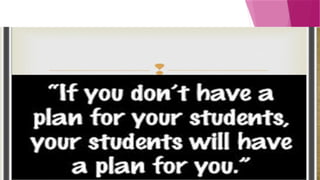
AS A TEACHER DO WE REALLY NEED
A LESSON PLAN?
Lesson Plan
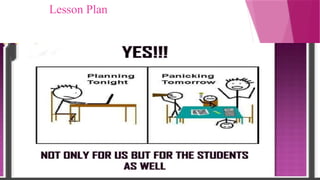
Planning
 Planning a lesson helps a teacher to reduce uncertainty or panic and
gives confidence and clarity.
 It reminds a teacher to prepare materials beforehand, and makes it
easier to organize the time and activities in the class.
 For students, evidence of a lesson plan shows them the teacher has
devoted time to think about the class.
 It is a way to help gain the respect of your students.
 It suggests professionalism and commitment.
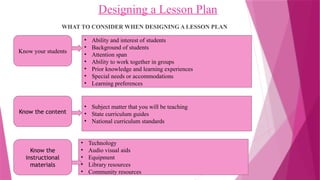
Designing a Lesson Plan
WHAT TO CONSIDER WHEN DESIGNING A LESSON PLAN
Know your students
• Ability and interest of students
• Background of students
• Attention span
• Ability to work together in groups
• Prior knowledge and learning experiences
• Special needs or accommodations
• Learning preferences
Know the content
• Subject matter that you will be teaching
• State curriculum guides
• National curriculum standards
Know the
instructional
materials
• Technology
• Audio visual aids
• Equipment
• Library resources
• Community resources
Characteristics of Good Lesson Plan
 It should have clearly stated objectives.
 It should be linked with previous knowledge of students.
 It should show and specify illustrative aids.
 It should contain suitable organized subject matter.
 It should be divided into units.
 It should not make the students passive learners.
Characteristics Of Good Lesson Plan
 It should include the summary of the whole lesson.
 The lesson plan should be in such a way that it should provide full justification
to all students.
 Should plan for student assignments.
 There should be flexibility in changing lesson plan.
 It must have plan for self criticism and self evaluation of the lesson.
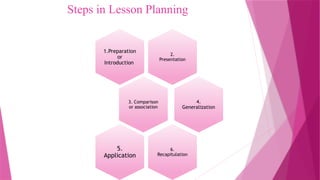
Steps in Lesson Planning
2.
Presentation
1.Preparation
or
Introduction
3. Comparison
or association
4.
Generalization
6.
Recapitulation
5.
Application
1. Preparation or introduction
 Exploration of the student’s knowledge which helps to lead them on to the lesson.
 The teacher needs to prepare the students to receive new knowledge.
 The teacher introduces the lesson by testing previous knowledge of the student by
questioning.
 It arouses interest and curiosity to learn new matter.
 Introduction should be brief and to the point.
2.Presentation
Aim of the lesson should be clearly stated before the presentation of
the subject matter.
In the teaching learning process, both learner and the teacher should
actively participate.
The teacher has to present the topic in enthusiastic manner so that the
learner will be motivated and get interest to learn.
3. Comparison or Association
 Quote examples.
 Associate facts with the examples so that learner can understand very easily and
arrive at generalization on their own.
4. Generalization
 It involves reflective thinking.
 Knowledge presented by the teacher should be thought provoking.
 Knowledge presented by the teacher should be innovating and stimulating to
assist the students to generalize the situation.
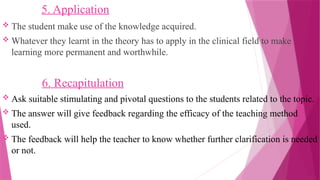
5. Application
 The student make use of the knowledge acquired.
 Whatever they learnt in the theory has to apply in the clinical field to make
learning more permanent and worthwhile.
6. Recapitulation
 Ask suitable stimulating and pivotal questions to the students related to the topic.
 The answer will give feedback regarding the efficacy of the teaching method
used.
 The feedback will help the teacher to know whether further clarification is needed
or not.
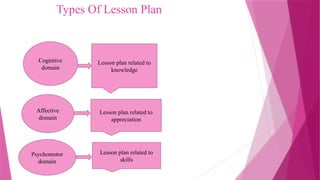
Types Of Lesson Plan
Cognitive
domain
Lesson plan related to
knowledge
Affective
domain
Lesson plan related to
appreciation
Psychomotor
domain
Lesson plan related to
skills
Types of lesson plan
 Cognitive domain:- it is related with acquisition of knowledge. The aim of this
method is to achieve more knowledge.
 Affective domain:- it is related with feelings and emotions. This method affects
the feelings directly, like a class of drawing or music.
 Psycho Motor domain:- It is related to manipulation of skills. It gives students’
a sense of satisfaction and pleasure.
Approaches to Lesson Planning
The main approaches to lesson planning are the following:-
1. The Herbartian approach
2. Gloverian approach
3. The Evaluation approach
4. Project approach
5. RCEM approach
1. Herbartian Approach
J. F Herbart (1776-1841) and his disciples developed five steps approach to lesson
planning.
1. Preparation
2. Presentation
3. Association and comparison
4. Generalization
5. Application
1. Preparation (Herbartian Approach)
 The teacher should know what the students have already learnt .
 The students must be made to realize what they do not know which would create interest among them to learn.
 The better the teacher knows his/her class, the more accurately and quickly can he/she do this.
How to start a lesson?
• Lessons can be started with few interesting questions.
• Lesson can be started with projecting some of the aids.
• Lesson can be started with the question related to the previous class.
 The aim of the lesson should be clear and concise.
 It is necessary for both teacher and students to know the general and specific aims of the lesson.
2. Presentation and Development (Herbartian Approach)
 The teacher should observe the following principles in the presentation stage. They are:-
1. Principle of selection and division:- The lesson material should be presented wisely. It
should be divided into different sections.
2. Principle of successive sequence:- The different sections should be well connected and
should maintain a proper sequence. It is the responsibility of the teacher to ensure that the
preceding class and succeeding class has a sequence and is clear to students.
3. Principle of absorption and integration:- Separation of the parts of the concepts in the end
should be followed by combination of the understanding of the whole.
3.Association and Comparison (Herbartian Approach)
 New knowledge should be presented to the students in a way it is associated with
the previous classes, knowledge or facts.
 The student should compare new knowledge with another set of facts and
knowledge which is taught to them before.
 This aids them to associate with the old and turn it into something new.
4.Generalization (Herbartian Approach)
 Comparison and contrast lead to generalization
 The students with the help of teachers must be led to make his/her generalizations for himself
or herself.
5. Application
 Knowledge is the power only when it is used and tested.
 Knowledge when it is put to use and verified, becomes clear.
 Application serves the purpose of recapitulation and revision.
 Application requires a good deal of mental activity to think and apply the principles learnt to new situations.
 Examples of application are problem solving, practical sessions etc.
Merits of Herbartian Approach
Merits
• It assists in systematic teaching.
• It prevents unnecessary repetition.
• It is useful in achieving cognitive object of teaching.
• It makes use of previous knowledge of the students for imparting new
knowledge.
Demerits of Herbartian Approach
• It is suited to knowledge lessons only.
• There is more emphasis on teaching rather than learning.
• Generalization is not so simple process as is envisaged by Herbart.
• This scheme does not provide much thinking on part of the students.
Gloverian approach
 A. H. T. Glover’s approach is based on four points. They are:-
1. Questioning
2. Discussion
3. Investigation
4. Expression
Gloverian Approach
1. Questioning:
 Through the art of questioning an intelligent teacher can lead his/her students through unfamiliar regions to
desired destinations.
 The teacher should ask questions at different stages of the lesson.
 Teacher should also encourage the students to ask questions.
2. Discussion:
 For this purpose it is better to divide into groups.
 The discussion should be directed in such a way as students are encouraged to express their ideas freely.
 Discussion should help the students to treat difficulties.
3. Investigation:
 It may be individual or group investigation.
 The students are required to investigate on the topic selected.
Gloverain Approach
4. Expression:
 This should be in the form of practical activities
 Glover classifies these as;
i. Passive : observing and listening
ii. Active : hard work, craft work, gardening etc.
iii. Artistic : dancing, music and acting.
iv. Organizational : individual or group committee organization of above activities.
The Evaluation Approach
 B.S Bloom is the originator of this approach.
 According to this approach teaching activities must be objective centred rather than content
centred.
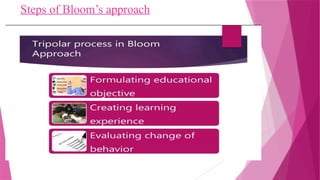
 Bloom considers education as a tripolar process , educational objectives, learning experiences
and change of behaviour.
 His approach of lesson planning is termed as Evaluative approach.
Features of Bloom’s Approach
 All educational activities are objective centred.
 The teaching and testing should be objective centred.
 The term evaluation concerns with all activities of teaching and testing.
 It does not confine to the students’ achievements only.
 It evaluates the teaching, learning objectives, methods and devices of providing learning
experiences.
 The student performances are evaluated in terms of learning objectives and not the
achievement of the content.
Steps of Bloom’s approach
Merits of Bloom’s Approach
• The objectives are written in behavioural terms.
• It clearly states the activities of the teachers and the students.
• The specific aid material, methods and strategies used for realization of the
predetermined objectives.
• It emphasizes on the evaluation of the desired behavioural changes.
• It is based on psychological and scientific principles.
Demerits of Bloom’s Approach
• It is highly structured and mechanized and does not provide opportunity for
creativity and originality.
• It is dominated by the role of the teacher in teaching-learning process.
• This approach makes the task of lesson planning quite rigid and mechanical.
• It doesn’t take into account the mental processes for writing the educational
objectives.
4. Project Approach
 This approach is developed W. H Kilpatrick and John Dewey .
 This approach emphasizes self-activity , social activities and real life activities.
 The project approach refers to a set of teaching strategies that enable teachers to
guide students through in-depth studies of real world topics.
 When teachers implement the approach successfully, students feel highly
motivated and actively involved in their own learning, leading them to produce
high quality work .
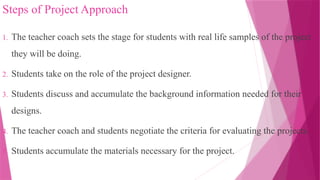
Steps of Project Approach
1. The teacher coach sets the stage for students with real life samples of the project
they will be doing.
2. Students take on the role of the project designer.
3. Students discuss and accumulate the background information needed for their
designs.
4. The teacher coach and students negotiate the criteria for evaluating the projects.
5. Students accumulate the materials necessary for the project.
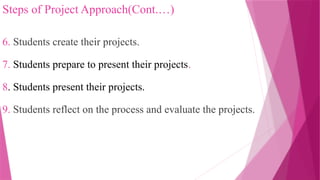
Steps of Project Approach(Cont.…)
6. Students create their projects.
7. Students prepare to present their projects.
8. Students present their projects.
9. Students reflect on the process and evaluate the projects.
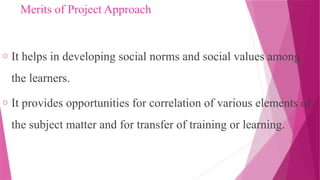
Merits of Project Approach
o It helps in developing social norms and social values among
the learners.
o It provides opportunities for correlation of various elements of
the subject matter and for transfer of training or learning.
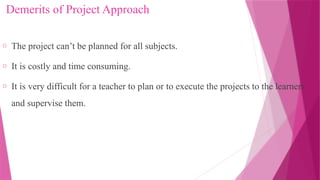
Demerits of Project Approach
o The project can’t be planned for all subjects.
o It is costly and time consuming.
o It is very difficult for a teacher to plan or to execute the projects to the learners
and supervise them.
5. RCEM Approach
 This approach to lesson planning has been developed by Regional College of Education ,
Mysore and is known as RCEM approach.
 The main 3 steps of this approach are: Input , Process and Output.
Input: It is concerned with identification and specification of the educational objectives.
• It resembles to Introduction step.
Process: it resembles to the presentation step of Herbartian approach.
• It represents the interaction process of classroom.
• It includes activities of the teacher as well as the students and teaching strategies.
Output : It is concerned with the evaluation phase of the lesson.
Merits of RCEM Approach
 It is more suitable to Indian system of education.
 Objectives are stated in terms of measurable abilities and mental processes.
 Teaching-learning situations, strategies, aids and materials are clearly stated.
 Evaluation aspect is adequately taken care of.
Demerits of RCEM Approach
 It is very boring to write lesson plan of this type.
 It is time consuming.
 Very little literature is available on this approach.
Importance of lesson plan
 It is a well thought out scheme according to which an activity is brought to completion .
 It is an organized sequential mental rehearsal of all the phases of the activity.
 It is an advanced arrangement for doing something in a proper way.
 It inculcates self confidence in a teacher.
 It integrates different lessons to provide consistency and continuity in teaching process.
 It provides satisfaction to students and teachers.
 It provides the chance of self improvement to the teacher.
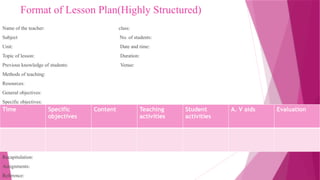
Format of Lesson Plan(Highly Structured)
Name of the teacher: class:
Subject No. of students:
Unit: Date and time:
Topic of lesson: Duration:
Previous knowledge of students: Venue:
Methods of teaching:
Resources:
General objectives:
Specific objectives:
Recapitulation:
Assignments:
Reference:
Time Specific
objectives
Content Teaching
activities
Student
activities
A. V aids Evaluation
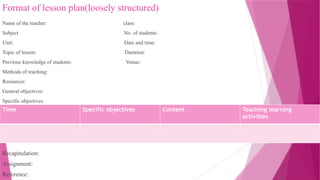
Format of lesson plan(loosely structured)
Name of the teacher: class:
Subject No. of students:
Unit: Date and time:
Topic of lesson: Duration:
Previous knowledge of students: Venue:
Methods of teaching:
Resources:
General objectives:
Specific objectives:
Recapitulation:
Assignment:
Reference:
Time Specific objectives Content Teaching learning
activities
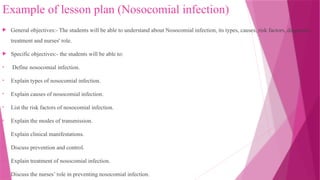
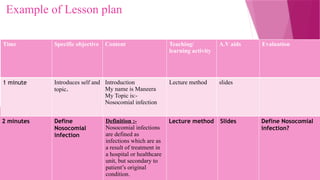
Example of lesson plan (Nosocomial infection)
 General objectives:- The students will be able to understand about Nosocomial infection, its types, causes, risk factors, diagnosis ,
treatment and nurses' role.
 Specific objectives:- the students will be able to:
• Define nosocomial infection.
• Explain types of nosocomial infection.
• Explain causes of nosocomial infection.
• List the risk factors of nosocomial infection.
• Explain the modes of transmission.
• Explain clinical manifestations.
• Discuss prevention and control.
• Explain treatment of nosocomial infection.
• Discuss the nurses’ role in preventing nosocomial infection.
Example of Lesson plan
Time Specific objective Content Teaching/
learning activity
A.V aids Evaluation
1 minute Introduces self and
topic.
Introduction
My name is Maneera
My Topic is:-
Nosocomial infection
Lecture method slides
2 minutes Define
Nosocomial
infection
Definition :-
Nosocomial infections
are defined as
infections which are as
a result of treatment in
a hospital or healthcare
unit, but secondary to
patient’s original
condition.
Lecture method Slides Define Nosocomial
infection?
Advantages of lesson planning
For teacher:
• The teacher can plan the presentation in advance, helping in making the teaching
effective.
• Helps in apparent time saving and avoids unnecessary repetition.
• Teacher can integrate the subject matter.
• It enables the teacher to present a large amount of information in a short time.
• It acts as a plan for self criticisms and self evaluation.
• It improves results.
Disadvantages of Lesson planning
For Teacher:
• The main emphasis is given to presentation.
• It confines the teaching up to memory level only
Advantages of Lesson planning
For students
• A well presented class may increase the student’s motivation.
• Greater scope for improving and modifying the learning experience.
Disadvantages of lesson planning
For students:
• Students’ attention may want the presentation to suit the level of understanding of all students.
• Poor planning and lack of direction of teaching may result in wasting the time of students.
• Poor lesson plan can make the students a mere passive learner.
Summary And Conclusion.
 A lesson plan is a document used to plan how the teacher will achieve the goals or objectives of the lesson.
 Lesson plans are important because they provide a clear understanding of what will be taught, how it will be
taught and evaluated, and how much time can be dedicated to each objective.
 It provides an in-depth look into the lesson to ensure the content is approached in a logical and organised manner.
 A daily lesson plan is developed by a teacher to guide class learning. Details will vary depending on the
preference of the teacher, subject being covered, and the needs of the students.
 Precise preparation must allow for flexible delivery.
 During actual classroom interaction, the instructor needs to make adaptations and to add artistry to each lesson
plan and classroom delivery
 We discussed about:-
• Introduction, Definition of lesson plan, Meaning of lesson plan.
• Purposes of lesson plan.
• Planning and Designing of lesson plan.
• Characteristics of good lesson plan.
• Steps in Lesson planning, Types of lesson planning.
• Approaches to lesson planning: Herbartian approach, Gloverian approach, The Evaluation approach, Project approach
and RCEM approach.
• Importance of lesson planning.
• Format of lesson plan.
• Advantages and disadvantages of lesson plan.
Bibliography
1. Bhaskar. N. Text Book of Nursing Education. 3rd
edition. Bangalore: EMMESS Medical Publishers; p. 112-115.
2. Sodhi. JK. Comprehensive Textbook of Nursing Education. 1st
edition. Jay Pee brothers Medical Publishers; p. 517-523.
3. Pramilaa. R. Nursing Communication and Educational Technology. 1st
edition. Jay Pee brothers Medical Publishers; p. 190-
198.
4. Basvanthappa. BT. Nursing Education. 2nd
edition. Jay Pee brothers Medical Publishers; p. 422-448.
5. Neeraja. KP. Text Book of Nursing Education. 1st
edition. Jay Pee brothers Medical Publishers; p. 430-438.
6. Technology(2010) What to consider when writing a lesson plan. Retrieved on 14th
June
2021.http://www.technology.com/tutorials/teaching/lesson plan.
7. Stix. A, Hrbek. T. The Nine Steps Of Project Based Learning(2006).Retrieved on 14th
June 2021.
www.ascd.org/publication/books.
Lesson planning.pptx

Lesson planning.pptx

  • 2.
    PEER GROUP PRESENTATION MANEERAGULZAR M.Sc. Nursing 1st year Medical Surgical Nursing
  • 3.
    Presentation Topic:- LessonPlan Subject:-Nursing Education Submitted to:- Mrs. Zareefa Mam Mr. Ayoub Sir. College:- Madre-Meharbaan Institute of Nursing Science and Research, SKIMS, Soura.
  • 4.
    Introduction • Teaching isa complex activity. It needs proper preparation and planning. • Lesson plan is the blueprint of those teaching activities that are to be done in the classroom. • Every teacher tries to plan the content in his own style so that he can teach systematically and effectively at the right moment.
  • 5.
    LESSON PLAN DEFINITIONS:- 1. “ALesson plan is actually a plan of action. It therefore includes the working philosophy of the teacher, her knowledge of philosophy, her information about and understanding of her pupils, her comprehension of the objectives of education, her knowledge of the material to be taught and her ability to utilize effective method”. (Lester) 2. Lesson plan is the teacher’s mental and emotional visualization of the class room experience as he plans it to occur. 3. Lesson plan is the blue print of what a teacher is going to do.
  • 6.
    MEANING OF LESSONPLAN  A Lesson plan is the organization of pupil learning activities and resources that are needed for a specific period of time in such a way that maximum learning will result from the experiences.  Lesson plan is a guide which gives security to a teacher and direction to the students.  It provides opportunities to a teacher to experiment his own ideas.  A Lesson plan is a detailed plan prepared by the teacher in advance for the daily teaching. It helps the teacher in systematic and effective teaching.
  • 7.
    Purposes of Lessonplan  It guides the teacher in presentation of subject matter.  It focuses on consideration of:- • Goals and objectives, • Selection of subject matter, • Selection of procedure, • The planning of activities • The preparation of test of progress.  It keeps the teacher on the track.  It creates confidence in teacher in conducting a class.
  • 8.
    Purposes of LessonPlan  It prevents haphazard teaching.  It avoids repetition.  It minimizes the chance of omitting some vital point of information.  It provides basis for evaluation.  It helps to keep good classroom management.  It develops reasoning, imagination and decision making ability of the teacher.
  • 9.
    Lesson Plan AS ATEACHER DO WE REALLY NEED A LESSON PLAN?
  • 10.
  • 11.
    Planning  Planning alesson helps a teacher to reduce uncertainty or panic and gives confidence and clarity.  It reminds a teacher to prepare materials beforehand, and makes it easier to organize the time and activities in the class.  For students, evidence of a lesson plan shows them the teacher has devoted time to think about the class.  It is a way to help gain the respect of your students.  It suggests professionalism and commitment.
  • 12.
    Designing a LessonPlan WHAT TO CONSIDER WHEN DESIGNING A LESSON PLAN Know your students • Ability and interest of students • Background of students • Attention span • Ability to work together in groups • Prior knowledge and learning experiences • Special needs or accommodations • Learning preferences Know the content • Subject matter that you will be teaching • State curriculum guides • National curriculum standards Know the instructional materials • Technology • Audio visual aids • Equipment • Library resources • Community resources
  • 13.
    Characteristics of GoodLesson Plan  It should have clearly stated objectives.  It should be linked with previous knowledge of students.  It should show and specify illustrative aids.  It should contain suitable organized subject matter.  It should be divided into units.  It should not make the students passive learners.
  • 14.
    Characteristics Of GoodLesson Plan  It should include the summary of the whole lesson.  The lesson plan should be in such a way that it should provide full justification to all students.  Should plan for student assignments.  There should be flexibility in changing lesson plan.  It must have plan for self criticism and self evaluation of the lesson.
  • 15.
    Steps in LessonPlanning 2. Presentation 1.Preparation or Introduction 3. Comparison or association 4. Generalization 6. Recapitulation 5. Application
  • 16.
    1. Preparation orintroduction  Exploration of the student’s knowledge which helps to lead them on to the lesson.  The teacher needs to prepare the students to receive new knowledge.  The teacher introduces the lesson by testing previous knowledge of the student by questioning.  It arouses interest and curiosity to learn new matter.  Introduction should be brief and to the point.
  • 17.
    2.Presentation Aim of thelesson should be clearly stated before the presentation of the subject matter. In the teaching learning process, both learner and the teacher should actively participate. The teacher has to present the topic in enthusiastic manner so that the learner will be motivated and get interest to learn.
  • 18.
    3. Comparison orAssociation  Quote examples.  Associate facts with the examples so that learner can understand very easily and arrive at generalization on their own. 4. Generalization  It involves reflective thinking.  Knowledge presented by the teacher should be thought provoking.  Knowledge presented by the teacher should be innovating and stimulating to assist the students to generalize the situation.
  • 19.
    5. Application  Thestudent make use of the knowledge acquired.  Whatever they learnt in the theory has to apply in the clinical field to make learning more permanent and worthwhile. 6. Recapitulation  Ask suitable stimulating and pivotal questions to the students related to the topic.  The answer will give feedback regarding the efficacy of the teaching method used.  The feedback will help the teacher to know whether further clarification is needed or not.
  • 20.
    Types Of LessonPlan Cognitive domain Lesson plan related to knowledge Affective domain Lesson plan related to appreciation Psychomotor domain Lesson plan related to skills
  • 21.
    Types of lessonplan  Cognitive domain:- it is related with acquisition of knowledge. The aim of this method is to achieve more knowledge.  Affective domain:- it is related with feelings and emotions. This method affects the feelings directly, like a class of drawing or music.  Psycho Motor domain:- It is related to manipulation of skills. It gives students’ a sense of satisfaction and pleasure.
  • 22.
    Approaches to LessonPlanning The main approaches to lesson planning are the following:- 1. The Herbartian approach 2. Gloverian approach 3. The Evaluation approach 4. Project approach 5. RCEM approach
  • 23.
    1. Herbartian Approach J.F Herbart (1776-1841) and his disciples developed five steps approach to lesson planning. 1. Preparation 2. Presentation 3. Association and comparison 4. Generalization 5. Application
  • 24.
    1. Preparation (HerbartianApproach)  The teacher should know what the students have already learnt .  The students must be made to realize what they do not know which would create interest among them to learn.  The better the teacher knows his/her class, the more accurately and quickly can he/she do this. How to start a lesson? • Lessons can be started with few interesting questions. • Lesson can be started with projecting some of the aids. • Lesson can be started with the question related to the previous class.  The aim of the lesson should be clear and concise.  It is necessary for both teacher and students to know the general and specific aims of the lesson.
  • 25.
    2. Presentation andDevelopment (Herbartian Approach)  The teacher should observe the following principles in the presentation stage. They are:- 1. Principle of selection and division:- The lesson material should be presented wisely. It should be divided into different sections. 2. Principle of successive sequence:- The different sections should be well connected and should maintain a proper sequence. It is the responsibility of the teacher to ensure that the preceding class and succeeding class has a sequence and is clear to students. 3. Principle of absorption and integration:- Separation of the parts of the concepts in the end should be followed by combination of the understanding of the whole.
  • 26.
    3.Association and Comparison(Herbartian Approach)  New knowledge should be presented to the students in a way it is associated with the previous classes, knowledge or facts.  The student should compare new knowledge with another set of facts and knowledge which is taught to them before.  This aids them to associate with the old and turn it into something new.
  • 27.
    4.Generalization (Herbartian Approach) Comparison and contrast lead to generalization  The students with the help of teachers must be led to make his/her generalizations for himself or herself. 5. Application  Knowledge is the power only when it is used and tested.  Knowledge when it is put to use and verified, becomes clear.  Application serves the purpose of recapitulation and revision.  Application requires a good deal of mental activity to think and apply the principles learnt to new situations.  Examples of application are problem solving, practical sessions etc.
  • 28.
    Merits of HerbartianApproach Merits • It assists in systematic teaching. • It prevents unnecessary repetition. • It is useful in achieving cognitive object of teaching. • It makes use of previous knowledge of the students for imparting new knowledge.
  • 29.
    Demerits of HerbartianApproach • It is suited to knowledge lessons only. • There is more emphasis on teaching rather than learning. • Generalization is not so simple process as is envisaged by Herbart. • This scheme does not provide much thinking on part of the students.
  • 30.
    Gloverian approach  A.H. T. Glover’s approach is based on four points. They are:- 1. Questioning 2. Discussion 3. Investigation 4. Expression
  • 31.
    Gloverian Approach 1. Questioning: Through the art of questioning an intelligent teacher can lead his/her students through unfamiliar regions to desired destinations.  The teacher should ask questions at different stages of the lesson.  Teacher should also encourage the students to ask questions. 2. Discussion:  For this purpose it is better to divide into groups.  The discussion should be directed in such a way as students are encouraged to express their ideas freely.  Discussion should help the students to treat difficulties. 3. Investigation:  It may be individual or group investigation.  The students are required to investigate on the topic selected.
  • 32.
    Gloverain Approach 4. Expression: This should be in the form of practical activities  Glover classifies these as; i. Passive : observing and listening ii. Active : hard work, craft work, gardening etc. iii. Artistic : dancing, music and acting. iv. Organizational : individual or group committee organization of above activities.
  • 33.
    The Evaluation Approach B.S Bloom is the originator of this approach.  According to this approach teaching activities must be objective centred rather than content centred.  Bloom considers education as a tripolar process , educational objectives, learning experiences and change of behaviour.  His approach of lesson planning is termed as Evaluative approach.
  • 34.
    Features of Bloom’sApproach  All educational activities are objective centred.  The teaching and testing should be objective centred.  The term evaluation concerns with all activities of teaching and testing.  It does not confine to the students’ achievements only.  It evaluates the teaching, learning objectives, methods and devices of providing learning experiences.  The student performances are evaluated in terms of learning objectives and not the achievement of the content.
  • 35.
  • 36.
    Merits of Bloom’sApproach • The objectives are written in behavioural terms. • It clearly states the activities of the teachers and the students. • The specific aid material, methods and strategies used for realization of the predetermined objectives. • It emphasizes on the evaluation of the desired behavioural changes. • It is based on psychological and scientific principles.
  • 37.
    Demerits of Bloom’sApproach • It is highly structured and mechanized and does not provide opportunity for creativity and originality. • It is dominated by the role of the teacher in teaching-learning process. • This approach makes the task of lesson planning quite rigid and mechanical. • It doesn’t take into account the mental processes for writing the educational objectives.
  • 38.
    4. Project Approach This approach is developed W. H Kilpatrick and John Dewey .  This approach emphasizes self-activity , social activities and real life activities.  The project approach refers to a set of teaching strategies that enable teachers to guide students through in-depth studies of real world topics.  When teachers implement the approach successfully, students feel highly motivated and actively involved in their own learning, leading them to produce high quality work .
  • 39.
    Steps of ProjectApproach 1. The teacher coach sets the stage for students with real life samples of the project they will be doing. 2. Students take on the role of the project designer. 3. Students discuss and accumulate the background information needed for their designs. 4. The teacher coach and students negotiate the criteria for evaluating the projects. 5. Students accumulate the materials necessary for the project.
  • 40.
    Steps of ProjectApproach(Cont.…) 6. Students create their projects. 7. Students prepare to present their projects. 8. Students present their projects. 9. Students reflect on the process and evaluate the projects.
  • 41.
    Merits of ProjectApproach o It helps in developing social norms and social values among the learners. o It provides opportunities for correlation of various elements of the subject matter and for transfer of training or learning.
  • 42.
    Demerits of ProjectApproach o The project can’t be planned for all subjects. o It is costly and time consuming. o It is very difficult for a teacher to plan or to execute the projects to the learners and supervise them.
  • 43.
    5. RCEM Approach This approach to lesson planning has been developed by Regional College of Education , Mysore and is known as RCEM approach.  The main 3 steps of this approach are: Input , Process and Output. Input: It is concerned with identification and specification of the educational objectives. • It resembles to Introduction step. Process: it resembles to the presentation step of Herbartian approach. • It represents the interaction process of classroom. • It includes activities of the teacher as well as the students and teaching strategies. Output : It is concerned with the evaluation phase of the lesson.
  • 44.
    Merits of RCEMApproach  It is more suitable to Indian system of education.  Objectives are stated in terms of measurable abilities and mental processes.  Teaching-learning situations, strategies, aids and materials are clearly stated.  Evaluation aspect is adequately taken care of.
  • 45.
    Demerits of RCEMApproach  It is very boring to write lesson plan of this type.  It is time consuming.  Very little literature is available on this approach.
  • 46.
    Importance of lessonplan  It is a well thought out scheme according to which an activity is brought to completion .  It is an organized sequential mental rehearsal of all the phases of the activity.  It is an advanced arrangement for doing something in a proper way.  It inculcates self confidence in a teacher.  It integrates different lessons to provide consistency and continuity in teaching process.  It provides satisfaction to students and teachers.  It provides the chance of self improvement to the teacher.
  • 48.
    Format of LessonPlan(Highly Structured) Name of the teacher: class: Subject No. of students: Unit: Date and time: Topic of lesson: Duration: Previous knowledge of students: Venue: Methods of teaching: Resources: General objectives: Specific objectives: Recapitulation: Assignments: Reference: Time Specific objectives Content Teaching activities Student activities A. V aids Evaluation
  • 49.
    Format of lessonplan(loosely structured) Name of the teacher: class: Subject No. of students: Unit: Date and time: Topic of lesson: Duration: Previous knowledge of students: Venue: Methods of teaching: Resources: General objectives: Specific objectives: Recapitulation: Assignment: Reference: Time Specific objectives Content Teaching learning activities
  • 50.
    Example of lessonplan (Nosocomial infection)  General objectives:- The students will be able to understand about Nosocomial infection, its types, causes, risk factors, diagnosis , treatment and nurses' role.  Specific objectives:- the students will be able to: • Define nosocomial infection. • Explain types of nosocomial infection. • Explain causes of nosocomial infection. • List the risk factors of nosocomial infection. • Explain the modes of transmission. • Explain clinical manifestations. • Discuss prevention and control. • Explain treatment of nosocomial infection. • Discuss the nurses’ role in preventing nosocomial infection.
  • 51.
    Example of Lessonplan Time Specific objective Content Teaching/ learning activity A.V aids Evaluation 1 minute Introduces self and topic. Introduction My name is Maneera My Topic is:- Nosocomial infection Lecture method slides 2 minutes Define Nosocomial infection Definition :- Nosocomial infections are defined as infections which are as a result of treatment in a hospital or healthcare unit, but secondary to patient’s original condition. Lecture method Slides Define Nosocomial infection?
  • 53.
    Advantages of lessonplanning For teacher: • The teacher can plan the presentation in advance, helping in making the teaching effective. • Helps in apparent time saving and avoids unnecessary repetition. • Teacher can integrate the subject matter. • It enables the teacher to present a large amount of information in a short time. • It acts as a plan for self criticisms and self evaluation. • It improves results.
  • 54.
    Disadvantages of Lessonplanning For Teacher: • The main emphasis is given to presentation. • It confines the teaching up to memory level only
  • 55.
    Advantages of Lessonplanning For students • A well presented class may increase the student’s motivation. • Greater scope for improving and modifying the learning experience. Disadvantages of lesson planning For students: • Students’ attention may want the presentation to suit the level of understanding of all students. • Poor planning and lack of direction of teaching may result in wasting the time of students. • Poor lesson plan can make the students a mere passive learner.
  • 56.
    Summary And Conclusion. A lesson plan is a document used to plan how the teacher will achieve the goals or objectives of the lesson.  Lesson plans are important because they provide a clear understanding of what will be taught, how it will be taught and evaluated, and how much time can be dedicated to each objective.  It provides an in-depth look into the lesson to ensure the content is approached in a logical and organised manner.  A daily lesson plan is developed by a teacher to guide class learning. Details will vary depending on the preference of the teacher, subject being covered, and the needs of the students.  Precise preparation must allow for flexible delivery.  During actual classroom interaction, the instructor needs to make adaptations and to add artistry to each lesson plan and classroom delivery
  • 57.
     We discussedabout:- • Introduction, Definition of lesson plan, Meaning of lesson plan. • Purposes of lesson plan. • Planning and Designing of lesson plan. • Characteristics of good lesson plan. • Steps in Lesson planning, Types of lesson planning. • Approaches to lesson planning: Herbartian approach, Gloverian approach, The Evaluation approach, Project approach and RCEM approach. • Importance of lesson planning. • Format of lesson plan. • Advantages and disadvantages of lesson plan.

  • 58.
    Bibliography 1. Bhaskar. N.Text Book of Nursing Education. 3rd edition. Bangalore: EMMESS Medical Publishers; p. 112-115. 2. Sodhi. JK. Comprehensive Textbook of Nursing Education. 1st edition. Jay Pee brothers Medical Publishers; p. 517-523. 3. Pramilaa. R. Nursing Communication and Educational Technology. 1st edition. Jay Pee brothers Medical Publishers; p. 190- 198. 4. Basvanthappa. BT. Nursing Education. 2nd edition. Jay Pee brothers Medical Publishers; p. 422-448. 5. Neeraja. KP. Text Book of Nursing Education. 1st edition. Jay Pee brothers Medical Publishers; p. 430-438. 6. Technology(2010) What to consider when writing a lesson plan. Retrieved on 14th June 2021.http://www.technology.com/tutorials/teaching/lesson plan. 7. Stix. A, Hrbek. T. The Nine Steps Of Project Based Learning(2006).Retrieved on 14th June 2021. www.ascd.org/publication/books.