Bossing :
Bossing: A lesson plan is an organised
A lesson plan is an organised
statement of general and specific goals together
statement of general and specific goals together
with the specific means by which these goals are to
with the specific means by which these goals are to
be attained by learner under the guidance of the
be attained by learner under the guidance of the
teacher on a given day.
teacher on a given day.
Kant :
Kant : Lesson plan is the teacher’s mental and
Lesson plan is the teacher’s mental and
intellectual visualisation of the class room
intellectual visualisation of the class room
experience as he plans it to occur.
experience as he plans it to occur.
4.
Thus alesson plan consists of:
Thus a lesson plan consists of:
Broader objectives of the subject
Broader objectives of the subject
Defining the class room objectives of
Defining the class room objectives of
the lesson
the lesson
Organisation of the subject matter
Organisation of the subject matter
The decision about the way of
The decision about the way of
presenting the subject matter,
presenting the subject matter,
teaching strategies and tactics, class
teaching strategies and tactics, class
room interaction and management.
room interaction and management.
Appropriate provision for evaluation
Appropriate provision for evaluation
and feedback.
and feedback.
5.
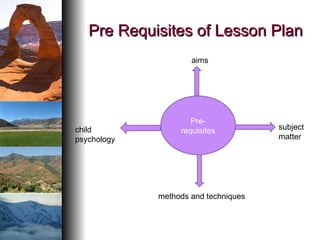
Pre-
requisites
Pre Requisites ofLesson Plan
Pre Requisites of Lesson Plan
aims
subject
matter
child
psychology
methods and techniques
6.
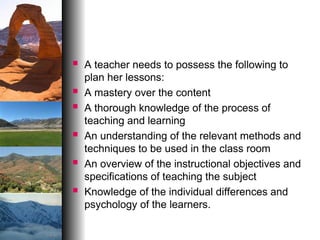
A teacherneeds to possess the following to
plan her lessons:
A mastery over the content
A thorough knowledge of the process of
teaching and learning
An understanding of the relevant methods and
techniques to be used in the class room
An overview of the instructional objectives and
specifications of teaching the subject
Knowledge of the individual differences and
psychology of the learners.
7.
Need of LessonPlanning
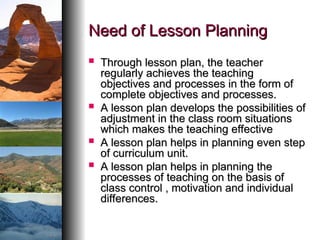
Need of Lesson Planning
Through lesson plan, the teacher
Through lesson plan, the teacher
regularly achieves the teaching
regularly achieves the teaching
objectives and processes in the form of
objectives and processes in the form of
complete objectives and processes.
complete objectives and processes.
A lesson plan develops the possibilities of
A lesson plan develops the possibilities of
adjustment in the class room situations
adjustment in the class room situations
which makes the teaching effective
which makes the teaching effective
A lesson plan helps in planning even step
A lesson plan helps in planning even step
of curriculum unit.
of curriculum unit.
A lesson plan helps in planning the
A lesson plan helps in planning the
processes of teaching on the basis of
processes of teaching on the basis of
class control , motivation and individual
class control , motivation and individual
differences.
differences.
8.
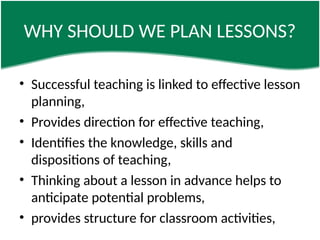
WHY SHOULD WEPLAN LESSONS?
• Successful teaching is linked to effective lesson
planning,
• Provides direction for effective teaching,
• Identifies the knowledge, skills and
dispositions of teaching,
• Thinking about a lesson in advance helps to
anticipate potential problems,
• provides structure for classroom activities,
9.
WHY SHOULD WEPLAN LESSONS?
• Lesson Plans are records that can be used to
plan for assessment (quizzes, tests, etc)
• Lesson Plans can be used by other teachers
when the class teacher is absent.
• provides a record of what has been taught
• Provides security for novice teachers
• To help with classroom management by
keeping students on-task and engaged
10.
WHY SHOULD WEPLAN LESSONS?
• Plans are developed to provide
students with meaningful learning
experiences,
• Encourages reflection, refinement,
and improvement,
• Enhances student achievement.
11.
WHY SHOULD WEPLAN LESSONS?
The greater the structure of a lesson
and the more precise the directions
on what is to be accomplished, the
higher the achievement rate.
12.
Characteristics of anIdeal
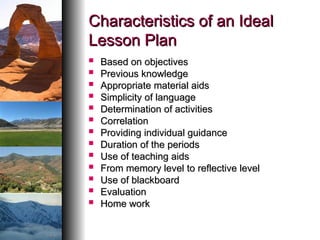
Characteristics of an Ideal
Lesson Plan
Lesson Plan
Based on objectives
Based on objectives
Previous knowledge
Previous knowledge
Appropriate material aids
Appropriate material aids
Simplicity of language
Simplicity of language
Determination of activities
Determination of activities
Correlation
Correlation
Providing individual guidance
Providing individual guidance
Duration of the periods
Duration of the periods
Use of teaching aids
Use of teaching aids
From memory level to reflective level
From memory level to reflective level
Use of blackboard
Use of blackboard
Evaluation
Evaluation
Home work
Home work
13.
Advantages of Lesson
Advantagesof Lesson
Planning
Planning
Based on Previous knowledge
Based on Previous knowledge
Suitable environment
Suitable environment
Basis on Psychological teaching
Basis on Psychological teaching
Use of theoretical knowledge in teaching
Use of theoretical knowledge in teaching
Teaching with confidence
Teaching with confidence
Discipline in the class
Discipline in the class
Developing in thinking
Developing in thinking
Developing teaching skills
Developing teaching skills
Preparation of material aids
Preparation of material aids
Limit of subject matter
Limit of subject matter
Makes the teaching activities
Makes the teaching activities
Save time and energy
Save time and energy
Revision of the lesson provision of evaluation
Revision of the lesson provision of evaluation
14.
Demerits of lessonplanning
Lesson planning makes the teaching
Lesson planning makes the teaching
process more difficult because of
process more difficult because of
complicated lesson planning process.
complicated lesson planning process.
More time is always needed by teacher to
More time is always needed by teacher to
plan a lesson
plan a lesson
Sometimes, simple subject-matter
Sometimes, simple subject-matter
becomes more complicated
becomes more complicated
It has no flexibility and puts the fresh
It has no flexibility and puts the fresh
teacher in new helpless situations
teacher in new helpless situations
Teacher cannot teach a lesson
Teacher cannot teach a lesson
independently
independently
15.
Steps in lessonplanning
Steps in lesson planning
1) Write aims and objectives in behavioral terms
1) Write aims and objectives in behavioral terms
2) Devise plan of instruction and select instructional
2) Devise plan of instruction and select instructional
material, Organise in short logical steps, Grade in
material, Organise in short logical steps, Grade in
order of difficulty
order of difficulty
3) Select teaching aids
3) Select teaching aids
4) Decide teaching method and techniques
4) Decide teaching method and techniques
5) Deciding previous knowledge
5) Deciding previous knowledge
6) Motivation through introduction
6) Motivation through introduction
7) Statement of aim or topic
7) Statement of aim or topic
8) Presentation
8) Presentation
Introduce material at appropriate level
Introduce material at appropriate level
Involve student by active participation and allow them to learn
Involve student by active participation and allow them to learn
at their own pace
at their own pace
Developmentary questions
Developmentary questions
Narration
Narration
Evaluation questions or testing questions
Evaluation questions or testing questions
B.B.summary
B.B.summary
9) Recapitulation-Evaluation of objectives
9) Recapitulation-Evaluation of objectives
10) Home assignment
10) Home assignment
16.
Herbartian Approach
Themajor contribution of the Herbartian movement
was the class lesson plan suitable for any class size
or organization.
According to Herbart, the best method of instruction
is to present material that is related to a previous
interest of the student.
17.
Five stepsof Herbartian teaching
Five steps of Herbartian teaching
1a) Preparation
1a) Preparation
1b) Statement of Aim
1b) Statement of Aim
2) Presentation
2) Presentation
3) Comparison and association
3) Comparison and association
4) Generalization
4) Generalization
5) Application
5) Application
18.
Preparation orIntroduction:
This helps in bridging to gap and leaders a student towards the aim of the
lesson of teacher can do this.
By analyzing the previous knowledge of the student of the student and
introducing the new lesson by explaining aims and objectives.
By asking relevant questions that exposes their ignorance and arouse
interest and curiosity to learn more and something new.
By using different types of teaching aids such as charts, maps or pictures.
The teacher should keep in mind that this step should be short and concise
and the duration of this step should not exceed five minutes.
How can a teacher start the lesson?
By asking two or three interesting questions with the help of aids that is
pictures, charts or models.
By asking questions from the content – matter previously taught.
By discussing a situation and illustration it with the help of a relevant story.
19.
Presentation:
Presentationof content-matter should be preceded with
the mention of the aim of lesson. Once the aim of lesson
is made clear to the students of the classroom, both the
students and the teacher have a common focal point to
concentrate, that is to reach the objective of the lesson.
This is the step where there is equal participation of
students and the teacher in the teaching-learning
process.
Questioning becomes one of the most important devices
that is used in this method. Use of other teaching aids
can enhance the interest of the students towards the
lesson and it can be made comprehensive.
Development of black board summary is also necessary.
20.
Comparison orAbstraction:
Some illustration are given to the students and they are
asked to compare them from other illustrations or facts.
This is one of the important steps, which compels a
student to draw a generalization or a definition based on
the result of the comparison and abstraction.
Generalization or Definition:
This step is as a result of the reflective thinking of the
students.
This knowledge gained in the earlier steps is used in this
step to draw generalizations, formulations and rules with
the help of comparison or abstraction.
21.
Application:
Thevalidity of the generalization is determined, whether it is temporary or
permanent. The generalization stays in the minds of the students and do
not leave their consciousness soon.
Forms of application:
Solving problems
Writing on essay or an article
Drawing maps or charts
Preparing some models
Doing some practical work
Getting of new type tests.
Recapitulation:
This is last step. Putting some suitable questions on the topic to the
students can test the understanding and comprehension of the subject
matter by the teacher. This will also help the teacher to find out whether
his method of teaching is effective and successful or not.
22.
Merits of Herbartianfive
Merits of Herbartian five
steps approach
steps approach
It follows logical and psychological aspects and
therefore incorporate the basic principles of learning
It is an easy and simple approach of lesson planning
Content matter is given utmost importance
It employs deductive thinking in learning
It is the method that can be used to teach any subject
of the school-science subjects, social studies and
languages.
It uses previous knowledge of the students to impart
the new knowledge
This approach can be used to any size of the class or
organization
23.
Demerits of Herbartianfive
Demerits of Herbartian five
steps approach
steps approach
Useful in knowledge lesson
Useful in knowledge lesson
only
only
No need of generalization
No need of generalization
Mechanical method of
Mechanical method of
teaching
teaching
Uninteresting
Uninteresting
No place for individual
No place for individual
differences
differences
Teacher more active
Teacher more active
Difficulty of correlation
Difficulty of correlation
24.
Outline of Herbartlesson
Outline of Herbart lesson
plan
plan
Subject, topic, class and date
Subject, topic, class and date
General objectives of teaching
General objectives of teaching
Specific objectives
Specific objectives
Teaching aids
Teaching aids
Introduction
Introduction
Statement of aim
Statement of aim
Presentation
Presentation
Explanation
Explanation
Blackboard summary
Blackboard summary
Recapitulatory questions
Recapitulatory questions
Home work
Home work



![CTEV [ clubfoot] DR ARUN LAL ,DR MOHAMED ASHRAF travancore medical college k...](https://cdn.slidesharecdn.com/ss_thumbnails/ctevclubfootdrarunlaldrmohamedashraftravancoremedicalcollegekollamkeralaindia-260208063247-18fc466c-thumbnail.jpg?width=640&height=640&fit=bounds)


![PERI-PROSTHETIC FRACTURE NAIL-PLATE CONSTRUCT [NPC].pptx](https://cdn.slidesharecdn.com/ss_thumbnails/drarunkumardrmohamedashrafperiprostheticfrasturenail-plateconstructnpc-260209164459-7e9d15a1-thumbnail.jpg?width=640&height=640&fit=bounds)


