LESSON PLANNING
DR. C. BEULAH JAYARANI
M.Sc., M.A, M.Ed, M.Phil (Edn), M.Phil (ZOO), NET, Ph.D (Edn)
ASST. PROFESSOR,
LOYOLA COLLEGE OF EDUCATION, CHENNAI - 34
INTRODUCTION
The lesson plan stimulates the teacher to think in an organized manner.
It helps the teacher to outline the objectives properly.
The lesson plan helps in creating the interest of pupils towards the lesson.
A proper correlation is established between the new and old lesson.
The lesson plan provides guidance to the teacher as to what and how he should teach.
02-08-2021 Dr. C. Beulah Jayarani 2
Contd.,
This compels the teacher to think about using teaching aids.
This helps the teacher to choose the best teaching method.
The lesson plan inspires the teacher to ask proper and important questions. This
helps the teacher to teach, keeping in the mind the individual differences.
The subject matter is organized in a time frame and with proper sequence.
This develops self-confidence in the teacher.
This helps the teacher in evaluating his teaching.
02-08-2021 Dr. C. Beulah Jayarani 3
DEfINITION Of LESSON PLAN
• “A lesson plan is an organized statement of general and specific goals together with
the specific means by which these goals are to be attained by the learner under the
guidance of the teacher on a given day.”
- Bossing
• “A lesson plan is actually a plan of action. It includes the working philosophy of the
teacher, his knowledge of philosophy, his knowledge about students, objectives,
material to be taught and his ability to utilize effective methods.”
- Lester B.
• “A teacher should plan his tools and techniques, which may help him in moulding his
materials that is students in the right way. In other words, it is a window through
which teacher can see his originality and teaching talents”.
- Dexterous Craftsman
02-08-2021 Dr. C. Beulah Jayarani 4
COmPONENTS Of A LESSON PLAN
• Teacher should follow
specific steps in writing
lesson plans. J.F. Herbart and
other educationists after him
have emphasized the
following steps. These steps
are called as Herbartian
Formal steps.
1. Preparation or Introduction
2. Presentation
3. Comparison or Association
4. Generalization
5. Application
6. Recapitulation
02-08-2021 Dr. C. Beulah Jayarani 5
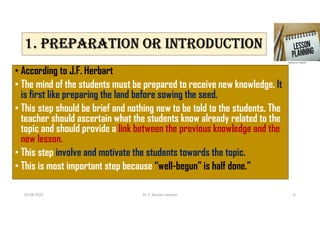
1. PREPARATION OR INTRODUCTION
• According to J.F. Herbart
• The mind of the students must be prepared to receive new knowledge. It
is first like preparing the land before sowing the seed.
• This step should be brief and nothing new to be told to the students. The
teacher should ascertain what the students know already related to the
topic and should provide a link between the previous knowledge and the
new lesson.
• This step involve and motivate the students towards the topic.
• This is most important step because “well-begun” is half done.”
02-08-2021 Dr. C. Beulah Jayarani 6
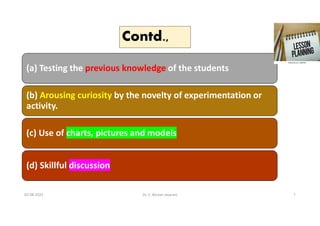
Contd.,
(a) Testing the previous knowledge of the students
(b) Arousing curiosity by the novelty of experimentation or
activity.
(c) Use of charts, pictures and models
(d) Skillful discussion
02-08-2021 Dr. C. Beulah Jayarani 7
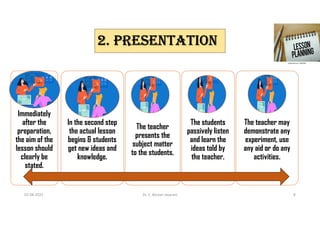
2. PRESENTATION
Immediately
after the
preparation,
the aim of the
lesson should
clearly be
stated.
In the second step
the actual lesson
begins & students
get new ideas and
knowledge.
The teacher
presents the
subject matter
to the students.
The students
passively listen
and learn the
ideas told by
the teacher.
The teacher may
demonstrate any
experiment, use
any aid or do any
activities.
02-08-2021 Dr. C. Beulah Jayarani 8
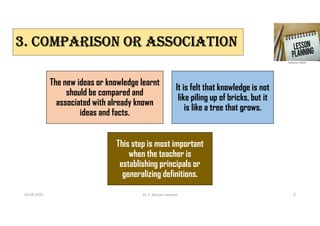
3. COmPARISON OR ASSOCIATION
The new ideas or knowledge learnt
should be compared and
associated with already known
ideas and facts.
It is felt that knowledge is not
like piling up of bricks, but it
is like a tree that grows.
This step is most important
when the teacher is
establishing principals or
generalizing definitions.
02-08-2021 Dr. C. Beulah Jayarani 9
4. GENERALIzATION
• In most of the science lessons teachers have to arrive at certain
generalizations.
• Formulas, principles or law are to be established.
• As far as possible the students should draw out the conclusion
themselves.
• Sometimes the student’s generalizations may be incomplete or
irrelevant.
• At this time the teacher should guide them to make corrections.
02-08-2021 Dr. C. Beulah Jayarani 10
5. APPLICATION
• A lesson of science will be incomplete if the rules or formulas are not
applied to new life situations.
• It is always the desire of the students to make use of generalizations and
to verify whether they really work in new situations or not.
• Knowledge becomes clear and meaningful in this stage
02-08-2021 Dr. C. Beulah Jayarani 11
6. RECAPITULATION
• This is the last step in the process. Here the teacher ascertains whether
the students have understood and grasped the subject matter or not.
• It is generally done by on of the following ways:
(a) Asking suitable questions on the topic taught.
(b) Applying a short objective type test.
(c) Asking the students to label the unlabeled sketch.
02-08-2021 Dr. C. Beulah Jayarani 12
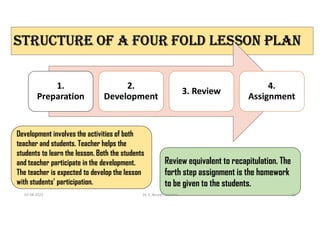
STRUCTURE Of A fOUR fOLD LESSON PLAN
1.
Preparation
2.
Development
3. Review
4.
Assignment
Development involves the activities of both
teacher and students. Teacher helps the
students to learn the lesson. Both the students
and teacher participate in the development.
The teacher is expected to develop the lesson
with students’ participation.
Review equivalent to recapitulation. The
forth step assignment is the homework
to be given to the students.
02-08-2021 Dr. C. Beulah Jayarani 13
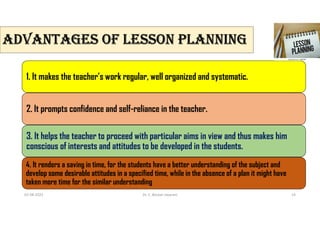
1. It makes the teacher’s work regular, well organized and systematic.
2. It prompts confidence and self-reliance in the teacher.
3. It helps the teacher to proceed with particular aims in view and thus makes him
conscious of interests and attitudes to be developed in the students.
4. It renders a saving in time, for the students have a better understanding of the subject and
develop some desirable attitudes in a specified time, while in the absence of a plan it might have
taken more time for the similar understanding
ADvANTAGES Of LESSON PLANNING
02-08-2021 Dr. C. Beulah Jayarani 14
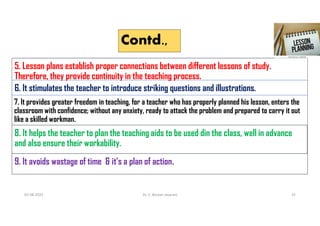
Contd.,
5. Lesson plans establish proper connections between different lessons of study.
Therefore, they provide continuity in the teaching process.
6. It stimulates the teacher to introduce striking questions and illustrations.
7. It provides greater freedom in teaching, for a teacher who has properly planned his lesson, enters the
classroom with confidence; without any anxiety, ready to attack the problem and prepared to carry it out
like a skilled workman.
8. It helps the teacher to plan the teaching aids to be used din the class, well in advance
and also ensure their workability.
9. It avoids wastage of time & it’s a plan of action.
02-08-2021 Dr. C. Beulah Jayarani 15
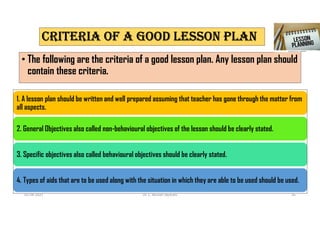
CRITERIA Of A GOOD LESSON PLAN
• The following are the criteria of a good lesson plan. Any lesson plan should
contain these criteria.
1. A lesson plan should be written and well prepared assuming that teacher has gone through the matter from
all aspects.
2. General Objectives also called non-behavioural objectives of the lesson should be clearly stated.
3. Specific objectives also called behavioural objectives should be clearly stated.
4. Types of aids that are to be used along with the situation in which they are able to be used should be used.
02-08-2021 Dr. C. Beulah Jayarani 16
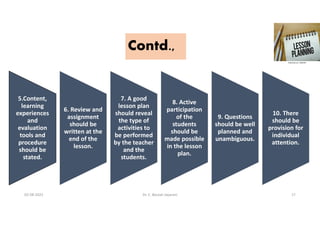
Contd.,
5.Content,
learning
experiences
and
evaluation
tools and
procedure
should be
stated.
6. Review and
assignment
should be
written at the
end of the
lesson.
7. A good
lesson plan
should reveal
the type of
activities to
be performed
by the teacher
and the
students.
8. Active
participation
of the
students
should be
made possible
in the lesson
plan.
9. Questions
should be well
planned and
unambiguous.
10. There
should be
provision for
individual
attention.
02-08-2021 Dr. C. Beulah Jayarani 17
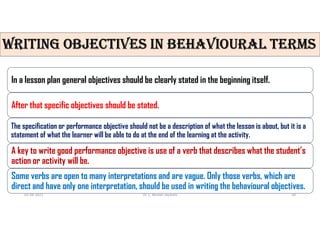
WRITING ObjECTIvES IN bEhAvIOURAL TERmS
In a lesson plan general objectives should be clearly stated in the beginning itself.
After that specific objectives should be stated.
The specification or performance objective should not be a description of what the lesson is about, but it is a
statement of what the learner will be able to do at the end of the learning at the activity.
A key to write good performance objective is use of a verb that describes what the student’s
action or activity will be.
Some verbs are open to many interpretations and are vague. Only those verbs, which are
direct and have only one interpretation, should be used in writing the behavioural objectives.
02-08-2021 Dr. C. Beulah Jayarani 18
STRUCTURE Of A fOUR fOLD
LESSON PLAN
CONTENT
• The teacher elicit the content to be taught to the students in the classroom
• The students develop skills in terms of cognitive, affective and psychomotor
domain after attending the teaching session of this content.
02-08-2021 Dr. C. Beulah Jayarani 19
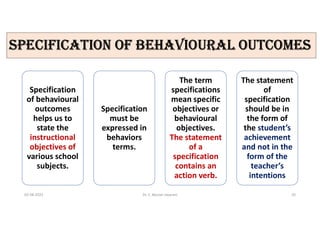
SPECIfICATION Of bEhAvIOURAL OUTCOmES
Specification
of behavioural
outcomes
helps us to
state the
instructional
objectives of
various school
subjects.
Specification
must be
expressed in
behaviors
terms.
The term
specifications
mean specific
objectives or
behavioural
objectives.
The statement
of a
specification
contains an
action verb.
The statement
of
specification
should be in
the form of
the student’s
achievement
and not in the
form of the
teacher’s
intentions
02-08-2021 Dr. C. Beulah Jayarani 20
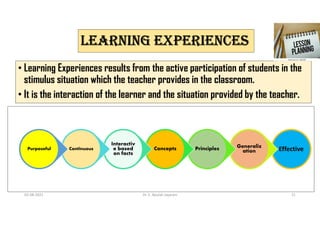
LEARNING ExPERIENCES
• Learning Experiences results from the active participation of students in the
stimulus situation which the teacher provides in the classroom.
• It is the interaction of the learner and the situation provided by the teacher.
Effective
Generaliz
ation
Principles
Concepts
Interactiv
e based
on facts
Continuous
Purposeful
02-08-2021 Dr. C. Beulah Jayarani 21
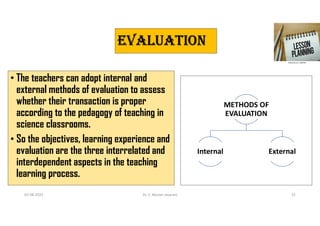
EvALUATION
• The teachers can adopt internal and
external methods of evaluation to assess
whether their transaction is proper
according to the pedagogy of teaching in
science classrooms.
• So the objectives, learning experience and
evaluation are the three interrelated and
interdependent aspects in the teaching
learning process.
METHODS OF
EVALUATION
Internal External
02-08-2021 Dr. C. Beulah Jayarani 22
ChECK ThE mODEL LESSON PLAN
WORD DOCUmENT IN PDf
• SUBJECT : SCIENCE- BOTANY
• UNIT : RESPIRATIN IN PLANTS
• TOPIC : TRANSPIRATION
• CLASS : VIII
02-08-2021 Dr. C. Beulah Jayarani 23
• SUBJECT : SCIENCE- ZOOLOGY
• UNIT : HUMAN BODY ORGAN SYSTEM
• TOPIC : CIRCULATORY SYSTEM
• CLASS : IX
02-08-2021 Dr. C. Beulah Jayarani 24
ChECK ThE mODEL LESSON
PLAN WORD DOCUmENT IN PDf
CONCLUSION
• Planning is essential in any sort of activity and more so when a teacher
is going to a classroom for teaching a subject. Especially for a science
teacher, it is absolutely essential that he plans the topic well in advance
so as to make his teaching interesting and efficient by organizing simple
demonstration experiments and other activities. Science is doing and
children should learn science as a fun. Teachers should avoid reading
the science text book in class room. Planning helps the teacher in
systematic presentation of subject matter. The teacher has to plan
every step and should go to the classroom with a written plan.
REfERENCE
TNTEU – Study Material
Ram Publications
Sri Krishna Publications
Kaviyamala Publications
Google Images
02-08-2021 Dr. C. Beulah Jayarani 26

Lesson planning

  • 1.
    LESSON PLANNING DR. C.BEULAH JAYARANI M.Sc., M.A, M.Ed, M.Phil (Edn), M.Phil (ZOO), NET, Ph.D (Edn) ASST. PROFESSOR, LOYOLA COLLEGE OF EDUCATION, CHENNAI - 34
  • 2.
    INTRODUCTION The lesson planstimulates the teacher to think in an organized manner. It helps the teacher to outline the objectives properly. The lesson plan helps in creating the interest of pupils towards the lesson. A proper correlation is established between the new and old lesson. The lesson plan provides guidance to the teacher as to what and how he should teach. 02-08-2021 Dr. C. Beulah Jayarani 2
  • 3.
    Contd., This compels theteacher to think about using teaching aids. This helps the teacher to choose the best teaching method. The lesson plan inspires the teacher to ask proper and important questions. This helps the teacher to teach, keeping in the mind the individual differences. The subject matter is organized in a time frame and with proper sequence. This develops self-confidence in the teacher. This helps the teacher in evaluating his teaching. 02-08-2021 Dr. C. Beulah Jayarani 3
  • 4.
    DEfINITION Of LESSONPLAN • “A lesson plan is an organized statement of general and specific goals together with the specific means by which these goals are to be attained by the learner under the guidance of the teacher on a given day.” - Bossing • “A lesson plan is actually a plan of action. It includes the working philosophy of the teacher, his knowledge of philosophy, his knowledge about students, objectives, material to be taught and his ability to utilize effective methods.” - Lester B. • “A teacher should plan his tools and techniques, which may help him in moulding his materials that is students in the right way. In other words, it is a window through which teacher can see his originality and teaching talents”. - Dexterous Craftsman 02-08-2021 Dr. C. Beulah Jayarani 4
  • 5.
    COmPONENTS Of ALESSON PLAN • Teacher should follow specific steps in writing lesson plans. J.F. Herbart and other educationists after him have emphasized the following steps. These steps are called as Herbartian Formal steps. 1. Preparation or Introduction 2. Presentation 3. Comparison or Association 4. Generalization 5. Application 6. Recapitulation 02-08-2021 Dr. C. Beulah Jayarani 5
  • 6.
    1. PREPARATION ORINTRODUCTION • According to J.F. Herbart • The mind of the students must be prepared to receive new knowledge. It is first like preparing the land before sowing the seed. • This step should be brief and nothing new to be told to the students. The teacher should ascertain what the students know already related to the topic and should provide a link between the previous knowledge and the new lesson. • This step involve and motivate the students towards the topic. • This is most important step because “well-begun” is half done.” 02-08-2021 Dr. C. Beulah Jayarani 6
  • 7.
    Contd., (a) Testing theprevious knowledge of the students (b) Arousing curiosity by the novelty of experimentation or activity. (c) Use of charts, pictures and models (d) Skillful discussion 02-08-2021 Dr. C. Beulah Jayarani 7
  • 8.
    2. PRESENTATION Immediately after the preparation, theaim of the lesson should clearly be stated. In the second step the actual lesson begins & students get new ideas and knowledge. The teacher presents the subject matter to the students. The students passively listen and learn the ideas told by the teacher. The teacher may demonstrate any experiment, use any aid or do any activities. 02-08-2021 Dr. C. Beulah Jayarani 8
  • 9.
    3. COmPARISON ORASSOCIATION The new ideas or knowledge learnt should be compared and associated with already known ideas and facts. It is felt that knowledge is not like piling up of bricks, but it is like a tree that grows. This step is most important when the teacher is establishing principals or generalizing definitions. 02-08-2021 Dr. C. Beulah Jayarani 9
  • 10.
    4. GENERALIzATION • Inmost of the science lessons teachers have to arrive at certain generalizations. • Formulas, principles or law are to be established. • As far as possible the students should draw out the conclusion themselves. • Sometimes the student’s generalizations may be incomplete or irrelevant. • At this time the teacher should guide them to make corrections. 02-08-2021 Dr. C. Beulah Jayarani 10
  • 11.
    5. APPLICATION • Alesson of science will be incomplete if the rules or formulas are not applied to new life situations. • It is always the desire of the students to make use of generalizations and to verify whether they really work in new situations or not. • Knowledge becomes clear and meaningful in this stage 02-08-2021 Dr. C. Beulah Jayarani 11
  • 12.
    6. RECAPITULATION • Thisis the last step in the process. Here the teacher ascertains whether the students have understood and grasped the subject matter or not. • It is generally done by on of the following ways: (a) Asking suitable questions on the topic taught. (b) Applying a short objective type test. (c) Asking the students to label the unlabeled sketch. 02-08-2021 Dr. C. Beulah Jayarani 12
  • 13.
    STRUCTURE Of AfOUR fOLD LESSON PLAN 1. Preparation 2. Development 3. Review 4. Assignment Development involves the activities of both teacher and students. Teacher helps the students to learn the lesson. Both the students and teacher participate in the development. The teacher is expected to develop the lesson with students’ participation. Review equivalent to recapitulation. The forth step assignment is the homework to be given to the students. 02-08-2021 Dr. C. Beulah Jayarani 13
  • 14.
    1. It makesthe teacher’s work regular, well organized and systematic. 2. It prompts confidence and self-reliance in the teacher. 3. It helps the teacher to proceed with particular aims in view and thus makes him conscious of interests and attitudes to be developed in the students. 4. It renders a saving in time, for the students have a better understanding of the subject and develop some desirable attitudes in a specified time, while in the absence of a plan it might have taken more time for the similar understanding ADvANTAGES Of LESSON PLANNING 02-08-2021 Dr. C. Beulah Jayarani 14
  • 15.
    Contd., 5. Lesson plansestablish proper connections between different lessons of study. Therefore, they provide continuity in the teaching process. 6. It stimulates the teacher to introduce striking questions and illustrations. 7. It provides greater freedom in teaching, for a teacher who has properly planned his lesson, enters the classroom with confidence; without any anxiety, ready to attack the problem and prepared to carry it out like a skilled workman. 8. It helps the teacher to plan the teaching aids to be used din the class, well in advance and also ensure their workability. 9. It avoids wastage of time & it’s a plan of action. 02-08-2021 Dr. C. Beulah Jayarani 15
  • 16.
    CRITERIA Of AGOOD LESSON PLAN • The following are the criteria of a good lesson plan. Any lesson plan should contain these criteria. 1. A lesson plan should be written and well prepared assuming that teacher has gone through the matter from all aspects. 2. General Objectives also called non-behavioural objectives of the lesson should be clearly stated. 3. Specific objectives also called behavioural objectives should be clearly stated. 4. Types of aids that are to be used along with the situation in which they are able to be used should be used. 02-08-2021 Dr. C. Beulah Jayarani 16
  • 17.
    Contd., 5.Content, learning experiences and evaluation tools and procedure should be stated. 6.Review and assignment should be written at the end of the lesson. 7. A good lesson plan should reveal the type of activities to be performed by the teacher and the students. 8. Active participation of the students should be made possible in the lesson plan. 9. Questions should be well planned and unambiguous. 10. There should be provision for individual attention. 02-08-2021 Dr. C. Beulah Jayarani 17
  • 18.
    WRITING ObjECTIvES INbEhAvIOURAL TERmS In a lesson plan general objectives should be clearly stated in the beginning itself. After that specific objectives should be stated. The specification or performance objective should not be a description of what the lesson is about, but it is a statement of what the learner will be able to do at the end of the learning at the activity. A key to write good performance objective is use of a verb that describes what the student’s action or activity will be. Some verbs are open to many interpretations and are vague. Only those verbs, which are direct and have only one interpretation, should be used in writing the behavioural objectives. 02-08-2021 Dr. C. Beulah Jayarani 18
  • 19.
    STRUCTURE Of AfOUR fOLD LESSON PLAN CONTENT • The teacher elicit the content to be taught to the students in the classroom • The students develop skills in terms of cognitive, affective and psychomotor domain after attending the teaching session of this content. 02-08-2021 Dr. C. Beulah Jayarani 19
  • 20.
    SPECIfICATION Of bEhAvIOURALOUTCOmES Specification of behavioural outcomes helps us to state the instructional objectives of various school subjects. Specification must be expressed in behaviors terms. The term specifications mean specific objectives or behavioural objectives. The statement of a specification contains an action verb. The statement of specification should be in the form of the student’s achievement and not in the form of the teacher’s intentions 02-08-2021 Dr. C. Beulah Jayarani 20
  • 21.
    LEARNING ExPERIENCES • LearningExperiences results from the active participation of students in the stimulus situation which the teacher provides in the classroom. • It is the interaction of the learner and the situation provided by the teacher. Effective Generaliz ation Principles Concepts Interactiv e based on facts Continuous Purposeful 02-08-2021 Dr. C. Beulah Jayarani 21
  • 22.
    EvALUATION • The teacherscan adopt internal and external methods of evaluation to assess whether their transaction is proper according to the pedagogy of teaching in science classrooms. • So the objectives, learning experience and evaluation are the three interrelated and interdependent aspects in the teaching learning process. METHODS OF EVALUATION Internal External 02-08-2021 Dr. C. Beulah Jayarani 22
  • 23.
    ChECK ThE mODELLESSON PLAN WORD DOCUmENT IN PDf • SUBJECT : SCIENCE- BOTANY • UNIT : RESPIRATIN IN PLANTS • TOPIC : TRANSPIRATION • CLASS : VIII 02-08-2021 Dr. C. Beulah Jayarani 23
  • 24.
    • SUBJECT :SCIENCE- ZOOLOGY • UNIT : HUMAN BODY ORGAN SYSTEM • TOPIC : CIRCULATORY SYSTEM • CLASS : IX 02-08-2021 Dr. C. Beulah Jayarani 24 ChECK ThE mODEL LESSON PLAN WORD DOCUmENT IN PDf
  • 25.
    CONCLUSION • Planning isessential in any sort of activity and more so when a teacher is going to a classroom for teaching a subject. Especially for a science teacher, it is absolutely essential that he plans the topic well in advance so as to make his teaching interesting and efficient by organizing simple demonstration experiments and other activities. Science is doing and children should learn science as a fun. Teachers should avoid reading the science text book in class room. Planning helps the teacher in systematic presentation of subject matter. The teacher has to plan every step and should go to the classroom with a written plan.
  • 26.
    REfERENCE TNTEU – StudyMaterial Ram Publications Sri Krishna Publications Kaviyamala Publications Google Images 02-08-2021 Dr. C. Beulah Jayarani 26