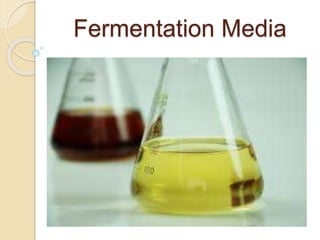
Fermentation Media
Fermentation
 Fermentation is the process in which a substance
breaks down into a simpler substance by using
microorganism.
 According to the industrial microbiologist,
fermentation is a process to produce a products
by the mass culture of microorganisms.
Fermentation media Types
1. Carbon sources
 Molasses
 Malt Extract
 Starch & Dextrins
 Sulphite Waste Liquor
 Cellulose
 Whey
 Alkaens & Alcohol
 Fats and Oils
2. Nitrogen sources
 Corn steep liquor
 Yeast Extract
 Peptones
 Soya Bean Meal
3. Water
4. Minerals
5. Vitamins & Growth Factors
6. Precursors
7. Inducers and Elicitor
8. Inhibitors
9. Cell Permeability modifiers
10. Oxygen
11. Antifoams
12. Animal Cell Culture Media
13. Plant Cell Culture Media
14. Culture maintenance media
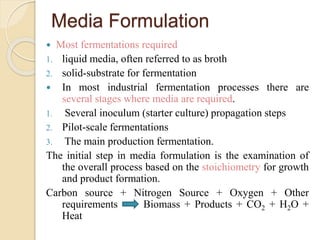
Media Formulation
 Most fermentations required
1. liquid media, often referred to as broth
2. solid-substrate for fermentation
 In most industrial fermentation processes there are
several stages where media are required.
1. Several inoculum (starter culture) propagation steps
2. Pilot-scale fermentations
3. The main production fermentation.
The initial step in media formulation is the examination of
the overall process based on the stoichiometry for growth
and product formation.
Carbon source + Nitrogen Source + Oxygen + Other
requirements Biomass + Products + CO2 + H2O +
Heat
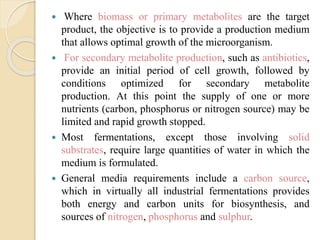
 Where biomass or primary metabolites are the target
product, the objective is to provide a production medium
that allows optimal growth of the microorganism.
 For secondary metabolite production, such as antibiotics,
provide an initial period of cell growth, followed by
conditions optimized for secondary metabolite
production. At this point the supply of one or more
nutrients (carbon, phosphorus or nitrogen source) may be
limited and rapid growth stopped.
 Most fermentations, except those involving solid
substrates, require large quantities of water in which the
medium is formulated.
 General media requirements include a carbon source,
which in virtually all industrial fermentations provides
both energy and carbon units for biosynthesis, and
sources of nitrogen, phosphorus and sulphur.
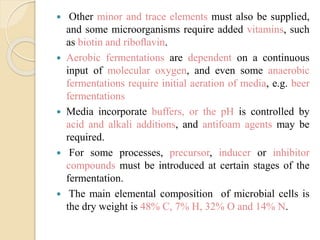
 Other minor and trace elements must also be supplied,
and some microorganisms require added vitamins, such
as biotin and riboflavin.
 Aerobic fermentations are dependent on a continuous
input of molecular oxygen, and even some anaerobic
fermentations require initial aeration of media, e.g. beer
fermentations
 Media incorporate buffers, or the pH is controlled by
acid and alkali additions, and antifoam agents may be
required.
 For some processes, precursor, inducer or inhibitor
compounds must be introduced at certain stages of the
fermentation.
 The main elemental composition of microbial cells is
the dry weight is 48% C, 7% H, 32% O and 14% N.
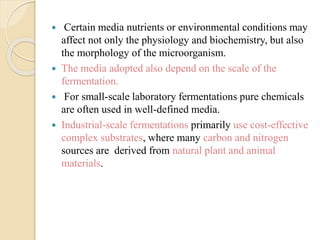
 Certain media nutrients or environmental conditions may
affect not only the physiology and biochemistry, but also
the morphology of the microorganism.
 The media adopted also depend on the scale of the
fermentation.
 For small-scale laboratory fermentations pure chemicals
are often used in well-defined media.
 Industrial-scale fermentations primarily use cost-effective
complex substrates, where many carbon and nitrogen
sources are derived from natural plant and animal
materials.
The main factors that affect the
final choice of individual raw
materials1. Cost and availability
2. Easy of handling in solid or liquid forms, along with
associated transport and storage costs, e.g. requirements
for temperature control.
3. Sterilization requirements and any potential
denaturation problems.
4. Formulation, mixing, complexing and viscosity
characteristics that may influence agitation, aeration and
foaming during fermentation and downstream
processing stages.
5. The concentration of target product attained, its rate of
formation and yield per gram of substrate utilized.
6. The levels and range of impurities, and the potential
for generating further undesired products during the
process.
7. Overall health and safety implications.
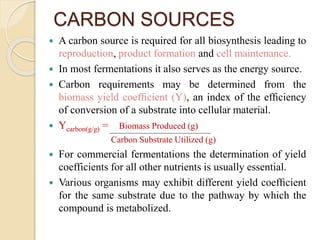
CARBON SOURCES
 A carbon source is required for all biosynthesis leading to
reproduction, product formation and cell maintenance.
 In most fermentations it also serves as the energy source.
 Carbon requirements may be determined from the
biomass yield coefficient (Y), an index of the efficiency
of conversion of a substrate into cellular material.
 Ycarbon(g/g) = Biomass Produced (g)
Carbon Substrate Utilized (g)
 For commercial fermentations the determination of yield
coefficients for all other nutrients is usually essential.
 Various organisms may exhibit different yield coefficient
for the same substrate due to the pathway by which the
compound is metabolized.
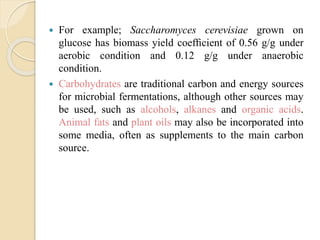
 For example; Saccharomyces cerevisiae grown on
glucose has biomass yield coefficient of 0.56 g/g under
aerobic condition and 0.12 g/g under anaerobic
condition.
 Carbohydrates are traditional carbon and energy sources
for microbial fermentations, although other sources may
be used, such as alcohols, alkanes and organic acids.
Animal fats and plant oils may also be incorporated into
some media, often as supplements to the main carbon
source.
Molasses
 Pure glucose and sucrose are rarely used for industrial
scale fermentations, primarily due to cost. Molasses, a by
product of cane and beet sugar production, is a cheaper
and more usual source of sucrose.
 It is a dark coloured viscous syrup containing 50–60%
(w/v) carbohydrates, primarily sucrose, with 2% (w/v)
nitrogenous substances, along with some vitamins and
minerals.
 Overall composition varies depending upon the plant
source, the location of the crop, the climatic conditions
under which it was grown and the factory where it was
processed.
 Hydrol molasses, can also be used. This byproduct of
maize starch processing primarily contains glucose.
Malt Extract
 Aqueous extracts of malted barley can be concentrated to
form syrups that are particularly useful carbon sources
for the cultivation of filamentous fungi, yeasts and
actinomycetes.
 Malt extract contain about 90% carbohydrate on dry
weight basis. This comprises 20% hexoses (glucose and
small amounts of fructose), 55% disaccharides (mainly
maltose and traces of sucrose).
 In addition, these products contain a range of branched
and unbranched dextrins (15–20%), which may or may
not be metabolized, depending upon the microorganism.
 Malt extracts also contain some vitamins and
approximately 5% nitrogenous substances, proteins,
peptides and amino acids.
 Sterilization of media containing malt extract must be
carefully controlled to prevent over-heating.
 The constituent reducing sugars and amino acids are
prone to generating Maillard reaction products when
heated at low pH.
 These are brown condensation products resulting from
the reaction of amino groups of amines, amino acids and
proteins with the carbonyl groups of reducing sugars,
ketones and aldehydes.
 Not only does this cause colour change, but it also
results in loss of fermentable materials and some
reaction products may inhibit microbial growth.
Starch & Dextrins
 These polysaccharides are not as readily utilized as
monosaccharides and disaccharides, but can be directly
metabolized by amylase-producing microorganisms,
particularly filamentous fungi.
 Extracellular enzyme of fungi hydrolyse the substrate to
a mixture of glucose, maltose or maltotriose to produce
a sugar.
 Maize starch is most widely used, but it may also be
obtained from other cereal and root crops.
 It is widely used in fermentation to converted into sugar
syrup which contain mainly glucose.
 Starch firstly gelatinized and then hydrolysed by dilute
acids or amylolytic enzymes, often microbial
glucoamylases that operate at elevated temperatures.
Sulphite waste Liquor
 It is a by product in the manufacture of wood pulp by the
suphite process.
 The Sugar containing wastes derived from the paper
pulping which possess mixture of hexoses (80%) and
pentoses (20%).
 Hexoses include glucose, mannose and galactose,
whereas the pentose sugars are mostly xylose and
arabinose.
 Usually the liquor requires processing before use as it
contains sulphur dioxide.
 The low pH is adjusted with calcium hydroxide or
calcium carbonate, and these liquors are supplemented
with sources of nitrogen and phosphorus.
Cellulose
 Cellulose is predominantly found as lignocellulose in
plant cell walls, which is composed of three polymers:
cellulose, hemicellulose and lignin.
 Lignocellulose is available from agricultural, forestry,
industrial and domestic wastes.
 Few microorganisms can utilize it directly, as it is
difficult to hydrolyse.
 It is potentially a very valuable renewable source of
fermentable sugars once hydrolysed, particularly in the
bioconversion to ethanol for fuel use.
Whey
 Whey is an aqueous by product of the dairy industry.
This material is expensive to store and transport.
 Therefore, lactose concentrates are often prepared for
later fermentation by evaporation of the whey,
following removal of milk proteins for use as food
supplements.
 Lactose is generally less useful as a fermentation
feedstock than sucrose, as it is metabolized by fewer
organisms, for example i.e. S. cerevisiae, does not
ferment lactose.
 This disaccharide was formerly used extensively in
penicillin fermentations and it is still employed for
producing ethanol, single cell protein, lactic acid,
xanthan gum, vitamin B12 and gibberellic acid.
Alkanes & Alcohol
 n-Alkanes of chain length C10–C20 are readily
metabolized by certain microorganisms. Mixtures, are
usually most suitable for microbial fermentations.
 Methane is utilized as a carbon source by a few
microorganisms.
METHANOL:
 Methanol has a high per cent carbon content and is
relatively cheap, although only a limited number of
organisms will metabolize it.
 Only low concentrations, 0.1–1% (v/v), are tolerated by
microorganisms, higher levels being toxic. During
fermentations of methanol, the oxygen demand and heat
of fermentation are high.
ETHANOL:
 Ethanol is less toxic than methanol and is used as a sole
or co-substrate by many microorganisms, but it is too
expensive for general use as a carbon source.
 However, its biotransformation to acetic acid by acetic
acid bacteria remains a major fermentation process.
Fats & Oils
 Hard animal fats that are mostly composed of glycerides
of palmitic and stearic acids are rarely used in
fermentations.
 Plant oils (primarily from cotton seed, linseed, maize,
olive, palm, rape seed and soya) and occasionally fish
oil, may be used as the primary or supplementary carbon
source, especially in antibiotic production.
 Plant oils are mostly composed of oleic and linoleic
acids, but linseed and soya oil also have a substantial
amount of linolenic acid.
 The oils contain more energy per unit weight than
carbohydrates.

Fermentation media part 1

  • 1.
  • 2.
    Fermentation  Fermentation isthe process in which a substance breaks down into a simpler substance by using microorganism.  According to the industrial microbiologist, fermentation is a process to produce a products by the mass culture of microorganisms.
  • 3.
    Fermentation media Types 1.Carbon sources  Molasses  Malt Extract  Starch & Dextrins  Sulphite Waste Liquor  Cellulose  Whey  Alkaens & Alcohol  Fats and Oils 2. Nitrogen sources  Corn steep liquor  Yeast Extract  Peptones  Soya Bean Meal
  • 4.
    3. Water 4. Minerals 5.Vitamins & Growth Factors 6. Precursors 7. Inducers and Elicitor 8. Inhibitors 9. Cell Permeability modifiers 10. Oxygen 11. Antifoams 12. Animal Cell Culture Media 13. Plant Cell Culture Media 14. Culture maintenance media
  • 5.
    Media Formulation  Mostfermentations required 1. liquid media, often referred to as broth 2. solid-substrate for fermentation  In most industrial fermentation processes there are several stages where media are required. 1. Several inoculum (starter culture) propagation steps 2. Pilot-scale fermentations 3. The main production fermentation. The initial step in media formulation is the examination of the overall process based on the stoichiometry for growth and product formation. Carbon source + Nitrogen Source + Oxygen + Other requirements Biomass + Products + CO2 + H2O + Heat
  • 6.
     Where biomassor primary metabolites are the target product, the objective is to provide a production medium that allows optimal growth of the microorganism.  For secondary metabolite production, such as antibiotics, provide an initial period of cell growth, followed by conditions optimized for secondary metabolite production. At this point the supply of one or more nutrients (carbon, phosphorus or nitrogen source) may be limited and rapid growth stopped.  Most fermentations, except those involving solid substrates, require large quantities of water in which the medium is formulated.  General media requirements include a carbon source, which in virtually all industrial fermentations provides both energy and carbon units for biosynthesis, and sources of nitrogen, phosphorus and sulphur.
  • 7.
     Other minorand trace elements must also be supplied, and some microorganisms require added vitamins, such as biotin and riboflavin.  Aerobic fermentations are dependent on a continuous input of molecular oxygen, and even some anaerobic fermentations require initial aeration of media, e.g. beer fermentations  Media incorporate buffers, or the pH is controlled by acid and alkali additions, and antifoam agents may be required.  For some processes, precursor, inducer or inhibitor compounds must be introduced at certain stages of the fermentation.  The main elemental composition of microbial cells is the dry weight is 48% C, 7% H, 32% O and 14% N.
  • 8.
     Certain medianutrients or environmental conditions may affect not only the physiology and biochemistry, but also the morphology of the microorganism.  The media adopted also depend on the scale of the fermentation.  For small-scale laboratory fermentations pure chemicals are often used in well-defined media.  Industrial-scale fermentations primarily use cost-effective complex substrates, where many carbon and nitrogen sources are derived from natural plant and animal materials.
  • 9.
    The main factorsthat affect the final choice of individual raw materials1. Cost and availability 2. Easy of handling in solid or liquid forms, along with associated transport and storage costs, e.g. requirements for temperature control. 3. Sterilization requirements and any potential denaturation problems. 4. Formulation, mixing, complexing and viscosity characteristics that may influence agitation, aeration and foaming during fermentation and downstream processing stages. 5. The concentration of target product attained, its rate of formation and yield per gram of substrate utilized.
  • 10.
    6. The levelsand range of impurities, and the potential for generating further undesired products during the process. 7. Overall health and safety implications.
  • 11.
    CARBON SOURCES  Acarbon source is required for all biosynthesis leading to reproduction, product formation and cell maintenance.  In most fermentations it also serves as the energy source.  Carbon requirements may be determined from the biomass yield coefficient (Y), an index of the efficiency of conversion of a substrate into cellular material.  Ycarbon(g/g) = Biomass Produced (g) Carbon Substrate Utilized (g)  For commercial fermentations the determination of yield coefficients for all other nutrients is usually essential.  Various organisms may exhibit different yield coefficient for the same substrate due to the pathway by which the compound is metabolized.
  • 12.
     For example;Saccharomyces cerevisiae grown on glucose has biomass yield coefficient of 0.56 g/g under aerobic condition and 0.12 g/g under anaerobic condition.  Carbohydrates are traditional carbon and energy sources for microbial fermentations, although other sources may be used, such as alcohols, alkanes and organic acids. Animal fats and plant oils may also be incorporated into some media, often as supplements to the main carbon source.
  • 13.
    Molasses  Pure glucoseand sucrose are rarely used for industrial scale fermentations, primarily due to cost. Molasses, a by product of cane and beet sugar production, is a cheaper and more usual source of sucrose.  It is a dark coloured viscous syrup containing 50–60% (w/v) carbohydrates, primarily sucrose, with 2% (w/v) nitrogenous substances, along with some vitamins and minerals.  Overall composition varies depending upon the plant source, the location of the crop, the climatic conditions under which it was grown and the factory where it was processed.  Hydrol molasses, can also be used. This byproduct of maize starch processing primarily contains glucose.
  • 14.
    Malt Extract  Aqueousextracts of malted barley can be concentrated to form syrups that are particularly useful carbon sources for the cultivation of filamentous fungi, yeasts and actinomycetes.  Malt extract contain about 90% carbohydrate on dry weight basis. This comprises 20% hexoses (glucose and small amounts of fructose), 55% disaccharides (mainly maltose and traces of sucrose).  In addition, these products contain a range of branched and unbranched dextrins (15–20%), which may or may not be metabolized, depending upon the microorganism.  Malt extracts also contain some vitamins and approximately 5% nitrogenous substances, proteins, peptides and amino acids.
  • 15.
     Sterilization ofmedia containing malt extract must be carefully controlled to prevent over-heating.  The constituent reducing sugars and amino acids are prone to generating Maillard reaction products when heated at low pH.  These are brown condensation products resulting from the reaction of amino groups of amines, amino acids and proteins with the carbonyl groups of reducing sugars, ketones and aldehydes.  Not only does this cause colour change, but it also results in loss of fermentable materials and some reaction products may inhibit microbial growth.
  • 16.
    Starch & Dextrins These polysaccharides are not as readily utilized as monosaccharides and disaccharides, but can be directly metabolized by amylase-producing microorganisms, particularly filamentous fungi.  Extracellular enzyme of fungi hydrolyse the substrate to a mixture of glucose, maltose or maltotriose to produce a sugar.  Maize starch is most widely used, but it may also be obtained from other cereal and root crops.  It is widely used in fermentation to converted into sugar syrup which contain mainly glucose.  Starch firstly gelatinized and then hydrolysed by dilute acids or amylolytic enzymes, often microbial glucoamylases that operate at elevated temperatures.
  • 17.
    Sulphite waste Liquor It is a by product in the manufacture of wood pulp by the suphite process.  The Sugar containing wastes derived from the paper pulping which possess mixture of hexoses (80%) and pentoses (20%).  Hexoses include glucose, mannose and galactose, whereas the pentose sugars are mostly xylose and arabinose.  Usually the liquor requires processing before use as it contains sulphur dioxide.  The low pH is adjusted with calcium hydroxide or calcium carbonate, and these liquors are supplemented with sources of nitrogen and phosphorus.
  • 18.
    Cellulose  Cellulose ispredominantly found as lignocellulose in plant cell walls, which is composed of three polymers: cellulose, hemicellulose and lignin.  Lignocellulose is available from agricultural, forestry, industrial and domestic wastes.  Few microorganisms can utilize it directly, as it is difficult to hydrolyse.  It is potentially a very valuable renewable source of fermentable sugars once hydrolysed, particularly in the bioconversion to ethanol for fuel use.
  • 19.
    Whey  Whey isan aqueous by product of the dairy industry. This material is expensive to store and transport.  Therefore, lactose concentrates are often prepared for later fermentation by evaporation of the whey, following removal of milk proteins for use as food supplements.  Lactose is generally less useful as a fermentation feedstock than sucrose, as it is metabolized by fewer organisms, for example i.e. S. cerevisiae, does not ferment lactose.  This disaccharide was formerly used extensively in penicillin fermentations and it is still employed for producing ethanol, single cell protein, lactic acid, xanthan gum, vitamin B12 and gibberellic acid.
  • 20.
    Alkanes & Alcohol n-Alkanes of chain length C10–C20 are readily metabolized by certain microorganisms. Mixtures, are usually most suitable for microbial fermentations.  Methane is utilized as a carbon source by a few microorganisms. METHANOL:  Methanol has a high per cent carbon content and is relatively cheap, although only a limited number of organisms will metabolize it.  Only low concentrations, 0.1–1% (v/v), are tolerated by microorganisms, higher levels being toxic. During fermentations of methanol, the oxygen demand and heat of fermentation are high.
  • 21.
    ETHANOL:  Ethanol isless toxic than methanol and is used as a sole or co-substrate by many microorganisms, but it is too expensive for general use as a carbon source.  However, its biotransformation to acetic acid by acetic acid bacteria remains a major fermentation process.
  • 22.
    Fats & Oils Hard animal fats that are mostly composed of glycerides of palmitic and stearic acids are rarely used in fermentations.  Plant oils (primarily from cotton seed, linseed, maize, olive, palm, rape seed and soya) and occasionally fish oil, may be used as the primary or supplementary carbon source, especially in antibiotic production.  Plant oils are mostly composed of oleic and linoleic acids, but linseed and soya oil also have a substantial amount of linolenic acid.  The oils contain more energy per unit weight than carbohydrates.

Editor's Notes

  • #6 Stoichiometry: Quantitative relationship or ratio between two or more substances under going a physical or chemical changes