FERMENTATION
Punnya. N
Introduction
Fermentation
It is the metabolic process that produces chemical changes in
organic substances through the action of enzymes.
◦ Fermentation reactions are effected on the absence of oxygen or
low oxygen concentration.
Fermentation technology
Which utilizes the microorganisms and enzymes to produce
that use in pharmaceutical, Chemical and food industries etc.
Process of fermentation
◦ Fermentation is an anaerobic biochemical process. In
fermentation, the first process is the same as cellular
respiration, which is the formation of pyruvic acid by
glycolysis where net 2 ATP molecules are synthesized. In the
next step, pyruvate is reduced to lactic acid, ethanol or other
products. Here NAD+ is formed which is re-utilized back in
the glycolysis process.
Types of fermentation
◦ Homo fermentation :only one type of product formation.
◦ Hetero fermentation :more than one product formed .
On the basis of end product formed, fermentation can be
categorized as follows :
1.Lactic acid fermentation
◦ Lactic acid is formed from pyruvate produced in glycolysis.
NAD+is hearted from NADH. Enzyme lactate dehydrogenase
Catalyses this reaction.
◦ Lactobacillus bacteria prepare curd from milk via this type of
fermentation.
◦ During intense exercise When oxygen supply is
inadequate,muscles derive energy by producing lactic acid, which
gets accumulated in the cells causing fatigue.
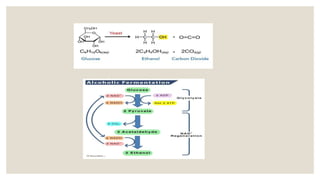
2.Alcohol fermentation
◦ It is used in the industrial production of wine, beer,biofuel etc.
◦ The end product is alcohol and carbon dioxide Is released.
◦ In the next step, Ethanol is formed from acetaldehyde .
◦ NAD+ is also formed from NADH utilized in glycolysis.
◦ Yeast and some bacteria carry out this reaction.
◦ Pyruvic acid decarboxylase and alcohol dehydrogenase catalyse
the reactions.
3.Acetic acid fermentation
◦ Vinegar is formed from this process .This is a two step
process
◦ First step is the formation of ethyl alcohol from sugar
anaerobically using yeast.
◦ Second step,ethyl alcohol is further oxidized to form acetic
acid using Acetobacter bacteria .
◦ Microbial oxidation of alcohol to acid Is an aerobic process.
4.Butyric acid fermentation
◦ This type of fermentation is characteristic of obligate
anaerobic bacteria of genus clostridium.
◦ Sugar is first oxidized to pyruvate by the process of
glycolysis and then pyruvate is further oxidized to form
acetyl-CoA by the oxidoreductase enzyme system with the
production of H2 and CO2. Acetyl-CoA is further reduced to
form butyric acid. This type of fermentation leads to a
relatively higher yield of energy. 3 molecules of ATP are
formed.
Stages of fermentation
◦ A fermentation process Consists of three main stages. They
are :-
1.Upstream stage
2.Fermentation stage
3.Downstream stage
1.Upstream stage
◦ This is the pre-fermentation stage.
◦ Microbes gets isolated and improved to produce productive
strains by classical recombinations, mutations ,cell fusion and
gene cloning methods.
◦ In the next step, productive strain is propagated in a suitable
culture medium for producing inoculum or stock Culture .
◦ After establishing introduced a suitable culture media for
fermentation.
2 .Fermentation stage
◦ This stage involves the culture of industrial
organism(productive strain) in the fermenter for the
fermentative production of the product of interest.
3.Downstream stage
◦ The downstream stage includes isolation and purification of
products from the culture fluid and storage of the products. It is
also known as downstream processing.
◦ It includes the following steps:
1. Microbial Strain Improvement
◦ The development Of industrial strains, that can tolerate
cultural environment and produce the desired metabolite in
large amounts, from wild type strains is called strain
improvement.
2.Media design
◦ For large scale fermentation, a suitable medium has to be design to have a
high product bio mass yield.
◦ The designed medium should favour for high product concentration,high rate
of product turnover, low level of unwanted product.
◦ A proper medium should be formulated for culturing the microbes in the
fermenter.
◦ Designing a medium containing all media components in suitable proportions
is called Medium formulation.
◦ There are three methods for medium formulation they are traditional method,
complete factorial design, fractional factorial design.
3.Sterilization
◦ Sterilization is the destruction or removal of microbes which
would interfere with the fermentation process.
4.Bioreactors
◦ An ideal bioreactor should provide aerobic or anaerobic
environment as required for the growth of the selected
microbe.
◦ Stanbury and Whitaker(1984)suggested ideas to be
considered while designing bioreacters.
◦ Several types of bioreactors have been designed on the
basis of the criteria. They are stirred tank fermentation, Air
lift bioreactor, Tower fermented, Cyclone column bioreactor,
Hollow fibre bioreactor, etc.
5.Culture of microorganisms
◦ In order to culture into a microbe in fermentors,to provide
nutrients and suitable environmental factors required for its
growth and product turnover.
◦ Microbial culture is suitably to have maximum biomass and
product .
◦ There are three culture techniques, they are:
*Batch culture
*Continuous culture
*Fed-batch culture
*Batch culture
◦ The culture of micro organisms in a liquid medium until
anyone of the component is completely exhausted or a toxic
product is acumalated to inhibit the growth is called batch
culture .
◦ In batch cultures,microbes pass through four faces of growth
they are lag phase, log phase, stationary phase and decline
phase.
*Continous culture
◦ Maintenance of microbial cultures at exponential growth for
indefinite time by providing fresh medium to culture vessel is
called continuos culture.
◦ Growth occurs at a constant rate for prolonged time .
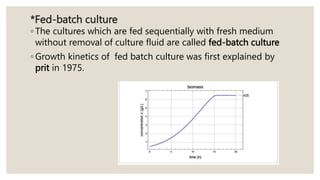
*Fed-batch culture
◦ The cultures which are fed sequentially with fresh medium
without removal of culture fluid are called fed-batch culture
◦ Growth kinetics of fed batch culture was first explained by
prit in 1975.
6.Downstream process
◦ Downstream processing refers to the purification and recovery of
desired products from biological sources like fermentation broths or cell
cultures.
◦ It involves a series of steps such as :
*Separation of bio mass
*Cell Desruption
*Concentration of broth
*Separation of metabolites
*Metabolite specific purification
Advantages of fermentation
◦ It improves digestion and helps to maintain intestinal bacteria
◦ It has an anti cancer affect
◦ Improves immunes system
◦ Reduces lactose in tolerance
◦
◦ Thank you… ….

fermentation -types of fermentation, pathways, process, applicationpptx

  • 1.
  • 2.
    Introduction Fermentation It is themetabolic process that produces chemical changes in organic substances through the action of enzymes. ◦ Fermentation reactions are effected on the absence of oxygen or low oxygen concentration. Fermentation technology Which utilizes the microorganisms and enzymes to produce that use in pharmaceutical, Chemical and food industries etc.
  • 3.
    Process of fermentation ◦Fermentation is an anaerobic biochemical process. In fermentation, the first process is the same as cellular respiration, which is the formation of pyruvic acid by glycolysis where net 2 ATP molecules are synthesized. In the next step, pyruvate is reduced to lactic acid, ethanol or other products. Here NAD+ is formed which is re-utilized back in the glycolysis process.
  • 5.
    Types of fermentation ◦Homo fermentation :only one type of product formation. ◦ Hetero fermentation :more than one product formed . On the basis of end product formed, fermentation can be categorized as follows :
  • 6.
    1.Lactic acid fermentation ◦Lactic acid is formed from pyruvate produced in glycolysis. NAD+is hearted from NADH. Enzyme lactate dehydrogenase Catalyses this reaction. ◦ Lactobacillus bacteria prepare curd from milk via this type of fermentation. ◦ During intense exercise When oxygen supply is inadequate,muscles derive energy by producing lactic acid, which gets accumulated in the cells causing fatigue.
  • 8.
    2.Alcohol fermentation ◦ Itis used in the industrial production of wine, beer,biofuel etc. ◦ The end product is alcohol and carbon dioxide Is released. ◦ In the next step, Ethanol is formed from acetaldehyde . ◦ NAD+ is also formed from NADH utilized in glycolysis. ◦ Yeast and some bacteria carry out this reaction. ◦ Pyruvic acid decarboxylase and alcohol dehydrogenase catalyse the reactions.
  • 10.
    3.Acetic acid fermentation ◦Vinegar is formed from this process .This is a two step process ◦ First step is the formation of ethyl alcohol from sugar anaerobically using yeast. ◦ Second step,ethyl alcohol is further oxidized to form acetic acid using Acetobacter bacteria . ◦ Microbial oxidation of alcohol to acid Is an aerobic process.
  • 11.
    4.Butyric acid fermentation ◦This type of fermentation is characteristic of obligate anaerobic bacteria of genus clostridium. ◦ Sugar is first oxidized to pyruvate by the process of glycolysis and then pyruvate is further oxidized to form acetyl-CoA by the oxidoreductase enzyme system with the production of H2 and CO2. Acetyl-CoA is further reduced to form butyric acid. This type of fermentation leads to a relatively higher yield of energy. 3 molecules of ATP are formed.
  • 12.
    Stages of fermentation ◦A fermentation process Consists of three main stages. They are :- 1.Upstream stage 2.Fermentation stage 3.Downstream stage
  • 13.
    1.Upstream stage ◦ Thisis the pre-fermentation stage. ◦ Microbes gets isolated and improved to produce productive strains by classical recombinations, mutations ,cell fusion and gene cloning methods. ◦ In the next step, productive strain is propagated in a suitable culture medium for producing inoculum or stock Culture . ◦ After establishing introduced a suitable culture media for fermentation.
  • 14.
    2 .Fermentation stage ◦This stage involves the culture of industrial organism(productive strain) in the fermenter for the fermentative production of the product of interest.
  • 15.
    3.Downstream stage ◦ Thedownstream stage includes isolation and purification of products from the culture fluid and storage of the products. It is also known as downstream processing. ◦ It includes the following steps:
  • 16.
    1. Microbial StrainImprovement ◦ The development Of industrial strains, that can tolerate cultural environment and produce the desired metabolite in large amounts, from wild type strains is called strain improvement.
  • 17.
    2.Media design ◦ Forlarge scale fermentation, a suitable medium has to be design to have a high product bio mass yield. ◦ The designed medium should favour for high product concentration,high rate of product turnover, low level of unwanted product. ◦ A proper medium should be formulated for culturing the microbes in the fermenter. ◦ Designing a medium containing all media components in suitable proportions is called Medium formulation. ◦ There are three methods for medium formulation they are traditional method, complete factorial design, fractional factorial design.
  • 18.
    3.Sterilization ◦ Sterilization isthe destruction or removal of microbes which would interfere with the fermentation process. 4.Bioreactors ◦ An ideal bioreactor should provide aerobic or anaerobic environment as required for the growth of the selected microbe. ◦ Stanbury and Whitaker(1984)suggested ideas to be considered while designing bioreacters. ◦ Several types of bioreactors have been designed on the basis of the criteria. They are stirred tank fermentation, Air lift bioreactor, Tower fermented, Cyclone column bioreactor, Hollow fibre bioreactor, etc.
  • 19.
    5.Culture of microorganisms ◦In order to culture into a microbe in fermentors,to provide nutrients and suitable environmental factors required for its growth and product turnover. ◦ Microbial culture is suitably to have maximum biomass and product . ◦ There are three culture techniques, they are: *Batch culture *Continuous culture *Fed-batch culture
  • 20.
    *Batch culture ◦ Theculture of micro organisms in a liquid medium until anyone of the component is completely exhausted or a toxic product is acumalated to inhibit the growth is called batch culture . ◦ In batch cultures,microbes pass through four faces of growth they are lag phase, log phase, stationary phase and decline phase.
  • 22.
    *Continous culture ◦ Maintenanceof microbial cultures at exponential growth for indefinite time by providing fresh medium to culture vessel is called continuos culture. ◦ Growth occurs at a constant rate for prolonged time .
  • 23.
    *Fed-batch culture ◦ Thecultures which are fed sequentially with fresh medium without removal of culture fluid are called fed-batch culture ◦ Growth kinetics of fed batch culture was first explained by prit in 1975.
  • 24.
    6.Downstream process ◦ Downstreamprocessing refers to the purification and recovery of desired products from biological sources like fermentation broths or cell cultures. ◦ It involves a series of steps such as : *Separation of bio mass *Cell Desruption *Concentration of broth *Separation of metabolites *Metabolite specific purification
  • 25.
    Advantages of fermentation ◦It improves digestion and helps to maintain intestinal bacteria ◦ It has an anti cancer affect ◦ Improves immunes system ◦ Reduces lactose in tolerance
  • 26.