MEDIA FORMULATION
Presented by:- SACHIN .B .H
Biotechnology Skill Enhancement Program (BiSEP)
Domain: Fermentation and Bio-processing
Seminar Presentation
Department of Biotechnology, GUK
SYNOPSIS
 Introduction
 Types
 Essential characterstics of formulated media
 Requirements
• Carbon source
• oxygen source
• Water
• Hydrocarbon and their derivatives
• Nitrogen source
• Minerals
• Growth factor
• Antifoams
• Antifoaming agents
Introduction
Media:-
Nutritional , hormonal and substrate requirement of
cell.
1.Complex media
2.Synthetic media
1.Complex media
It is a complex or natural media such as
molasses, meat extract etc , are not completely define
chemically however they are the media of choice in
industrial fermentations.
2.Synthetic media
Synthetic media is prepaird by using chemicals or
using naturaly available substances for carbon source ,
nitrogen source, vitamins , growth factor and hormones.
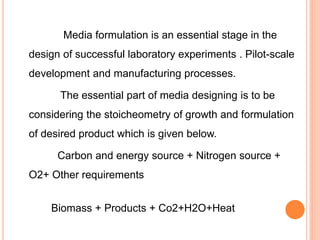
Media formulation is an essential stage in the
design of successful laboratory experiments . Pilot-scale
development and manufacturing processes.
The essential part of media designing is to be
considering the stoicheometry of growth and formulation
of desired product which is given below.
Carbon and energy source + Nitrogen source +
O2+ Other requirements
Biomass + Products + Co2+H2O+Heat
Defined media can be easily reproduced , have
low foaming tendency , show translucency and allow
easy product recovery and purification.
Essential characteristics of media
formulated
 It should produce the maximum yield
 Minimum yield of undesired product.
 It should have minimal problems during recovery of
desired product biomass especially during aeration and
agitation , extraction , purification and waste treatment.
 It should also have minimal problem during media
desighning .
REQUIREMENTS
Carbon sources
 Molasses
 By-product of sugar cane production.
 A dark viscous syrup containing 50% sucrose with 2% nitrogen
, vitamins and minerals.
 Malt extract
 Use aqueous extract of malted barley to produce carbon
source for cultivation of fungi and yeasts.
 Contain 90% of sucrose, 5% of nitrogen and proteins, peptides
and amino acid.
 Whey
 Aqueous by-product of dairy industry contains lactose and milk
proteins.
 Many mo’s wont metabolize lactose but whey used in production
of penicillin, ethanol.
corn steep liquor is a by-product after starch extraction
from maize . Although primarily used as nitrogen source . It
does contain lactic acid , small amount of reducing sugar.
Oxygen sources
 Oxygen is always provided in water.
 Some organism require molecular oxygen as terminal oxidizing
agent to fulfil their energetic needs through aerobic respiration.
 Some organisms are facultative anaerobes and can grow with
or without molecular oxygen.
 Some organisms are obligatorily aerobic for obligate anaerobes
molecular O2 is toxic substance.
Water
 When assesing the suitability of a water supply it is important to
consider PH , dissolved salt and effluent contamination.
 Hard water containing high CaS04 concentrations are better
for the English Burton bitter beers and pilsen types lagers.
 Water with high carbonate content are better for the darker
beers such as stouts.
Ancillary services
Heating , cooling , cleaning and rinsing.
Brewing
mineral content of the water.
Hydrocarbon and their derivatives
 Methane , methanol and n- alkanes substrate for biomass
production.
 N- alkanes for the production of organic acid, amino acids,
vitamins and co-factor, nucleic acid, antibiotics, enzymes and
proteins.
Nitrogen source
 Chemicaly defined amino acids media devoid of protein are
neccessory in the production of certain vaccines when they
are intended for human use.
 Mos generally can use inorganic or organic source.
 Organic Source
Amino acids, proteins and urea.
 Inorganic source
Ammonia, ammonium salt ,nitrates.
 Proteinaceous nitrogen compound.
Corn steep liquor.
Yeast extract.
Peptone.
Soya bean meal.
Cotton seed meal.
BEST NITROGEN SOURCE FOR SOME
SECONDARY METABOLITES
 CSL (corn steep liquor)
 Peanut granules.
 Pancreatic digest of gelatine.
 Soya bean meal.
 Cotton seed meal.
 Distillers soluble.
 Ammonia has been used for pH control and as the
major nitrogen source for the commercial
production of human serum albumin by
Saccharomyes cerivisiae.
 In lysin production methionin and threonine are obtained
from soybean hydrolysate.
Minerals
 All microorganism requires certain mineral elements for
growth and metabolism.
 In many media magnesium, phosphorus, potassium,
sulphur calcium and because of the concentration required
they must be added as distinct components.
 Other such as cobalt, copper, iron, manganese,
molybdenum and zinc.
GROWTH FACTOR
 Some micro-organism cannot synthesize a full
complement of cell components and therefore require
preformed compounds like growth factor.
 The growth factor commonly required are vitamins , amino
acids, fatty acids , sterols.
 Calcium pantothenate-vinegar production.
 Biotin- Glutamic acid production.
Buffers
 Calcium carbonate.
 Phosphates.
 Balanced use of C/N ratio controls pH.
 pH controlled externally by adding ammonia or sodium
hydroxide and sulfuric acid.
 High phosphate concentration are critical in the
production of many secondary metabolites.
Antifoams
 In most microbiological processes foaming is problem. It
may cause due to protein in the medium such as corn
steep liquor, peanut in the meal soybean meal yeast
extract.
 The foaming can cause removal of cells from medium
which lead to autolysis.
 Reduction in the working volume of the fermenter due to
oxygen exhausted gas bubbles circulating in the system.
 The biological problem include deposition of cell in upper
part of the fermenter.
 Problem of sterile operation with the air filter exists of the
fermenter becoming wet and there is danger of microbial
infection.
Characteristics of Antifoams
 It should disperse readily and have fast action on an
existing foam.
 Should be heat sterilizable.
 Should be cheap.
 Should be non-toxic to microbes, humans and animals.
 Should be metabolized by the microorganis.
 Should not cause any handling hezards.
 Should be active at low concentration.
 Should be long acting in preventing new foam formation.
ANTIFOAMING AGENTS
 Antifoams act as surface active agents and reduce the
O2 transfer rate.
 Antifoaming agents are defoamer are often used
interchangebly.
 Commnly used agents are insoluble oils, polydimethyl
siloxanes and other silicones, certain alcohols, stearates
and glycols.
 The additives is used to prevent formation of foam or is
added to break a foam already formed.
THANK
you

MEDIA FORMULATION

  • 1.
    MEDIA FORMULATION Presented by:-SACHIN .B .H Biotechnology Skill Enhancement Program (BiSEP) Domain: Fermentation and Bio-processing Seminar Presentation Department of Biotechnology, GUK
  • 2.
    SYNOPSIS  Introduction  Types Essential characterstics of formulated media  Requirements • Carbon source • oxygen source • Water • Hydrocarbon and their derivatives • Nitrogen source • Minerals • Growth factor • Antifoams • Antifoaming agents
  • 3.
    Introduction Media:- Nutritional , hormonaland substrate requirement of cell. 1.Complex media 2.Synthetic media
  • 4.
    1.Complex media It isa complex or natural media such as molasses, meat extract etc , are not completely define chemically however they are the media of choice in industrial fermentations. 2.Synthetic media Synthetic media is prepaird by using chemicals or using naturaly available substances for carbon source , nitrogen source, vitamins , growth factor and hormones.
  • 5.
    Media formulation isan essential stage in the design of successful laboratory experiments . Pilot-scale development and manufacturing processes. The essential part of media designing is to be considering the stoicheometry of growth and formulation of desired product which is given below. Carbon and energy source + Nitrogen source + O2+ Other requirements Biomass + Products + Co2+H2O+Heat
  • 6.
    Defined media canbe easily reproduced , have low foaming tendency , show translucency and allow easy product recovery and purification. Essential characteristics of media formulated  It should produce the maximum yield  Minimum yield of undesired product.  It should have minimal problems during recovery of desired product biomass especially during aeration and agitation , extraction , purification and waste treatment.  It should also have minimal problem during media desighning .
  • 7.
    REQUIREMENTS Carbon sources  Molasses By-product of sugar cane production.  A dark viscous syrup containing 50% sucrose with 2% nitrogen , vitamins and minerals.  Malt extract  Use aqueous extract of malted barley to produce carbon source for cultivation of fungi and yeasts.  Contain 90% of sucrose, 5% of nitrogen and proteins, peptides and amino acid.
  • 8.
     Whey  Aqueousby-product of dairy industry contains lactose and milk proteins.  Many mo’s wont metabolize lactose but whey used in production of penicillin, ethanol. corn steep liquor is a by-product after starch extraction from maize . Although primarily used as nitrogen source . It does contain lactic acid , small amount of reducing sugar. Oxygen sources  Oxygen is always provided in water.
  • 9.
     Some organismrequire molecular oxygen as terminal oxidizing agent to fulfil their energetic needs through aerobic respiration.  Some organisms are facultative anaerobes and can grow with or without molecular oxygen.  Some organisms are obligatorily aerobic for obligate anaerobes molecular O2 is toxic substance. Water  When assesing the suitability of a water supply it is important to consider PH , dissolved salt and effluent contamination.
  • 10.
     Hard watercontaining high CaS04 concentrations are better for the English Burton bitter beers and pilsen types lagers.  Water with high carbonate content are better for the darker beers such as stouts. Ancillary services Heating , cooling , cleaning and rinsing. Brewing mineral content of the water.
  • 11.
    Hydrocarbon and theirderivatives  Methane , methanol and n- alkanes substrate for biomass production.  N- alkanes for the production of organic acid, amino acids, vitamins and co-factor, nucleic acid, antibiotics, enzymes and proteins. Nitrogen source  Chemicaly defined amino acids media devoid of protein are neccessory in the production of certain vaccines when they are intended for human use.  Mos generally can use inorganic or organic source.
  • 12.
     Organic Source Aminoacids, proteins and urea.  Inorganic source Ammonia, ammonium salt ,nitrates.  Proteinaceous nitrogen compound. Corn steep liquor. Yeast extract. Peptone. Soya bean meal. Cotton seed meal.
  • 13.
    BEST NITROGEN SOURCEFOR SOME SECONDARY METABOLITES  CSL (corn steep liquor)  Peanut granules.  Pancreatic digest of gelatine.  Soya bean meal.  Cotton seed meal.  Distillers soluble.  Ammonia has been used for pH control and as the major nitrogen source for the commercial production of human serum albumin by Saccharomyes cerivisiae.
  • 14.
     In lysinproduction methionin and threonine are obtained from soybean hydrolysate. Minerals  All microorganism requires certain mineral elements for growth and metabolism.  In many media magnesium, phosphorus, potassium, sulphur calcium and because of the concentration required they must be added as distinct components.  Other such as cobalt, copper, iron, manganese, molybdenum and zinc.
  • 15.
    GROWTH FACTOR  Somemicro-organism cannot synthesize a full complement of cell components and therefore require preformed compounds like growth factor.  The growth factor commonly required are vitamins , amino acids, fatty acids , sterols.  Calcium pantothenate-vinegar production.  Biotin- Glutamic acid production. Buffers  Calcium carbonate.  Phosphates.  Balanced use of C/N ratio controls pH.
  • 16.
     pH controlledexternally by adding ammonia or sodium hydroxide and sulfuric acid.  High phosphate concentration are critical in the production of many secondary metabolites. Antifoams  In most microbiological processes foaming is problem. It may cause due to protein in the medium such as corn steep liquor, peanut in the meal soybean meal yeast extract.  The foaming can cause removal of cells from medium which lead to autolysis.
  • 17.
     Reduction inthe working volume of the fermenter due to oxygen exhausted gas bubbles circulating in the system.  The biological problem include deposition of cell in upper part of the fermenter.  Problem of sterile operation with the air filter exists of the fermenter becoming wet and there is danger of microbial infection. Characteristics of Antifoams  It should disperse readily and have fast action on an existing foam.  Should be heat sterilizable.
  • 18.
     Should becheap.  Should be non-toxic to microbes, humans and animals.  Should be metabolized by the microorganis.  Should not cause any handling hezards.  Should be active at low concentration.  Should be long acting in preventing new foam formation.
  • 19.
    ANTIFOAMING AGENTS  Antifoamsact as surface active agents and reduce the O2 transfer rate.  Antifoaming agents are defoamer are often used interchangebly.  Commnly used agents are insoluble oils, polydimethyl siloxanes and other silicones, certain alcohols, stearates and glycols.  The additives is used to prevent formation of foam or is added to break a foam already formed.
  • 20.