Fermentation
By:
Vasundhara S. Kakade
Assistant Professor
NES Navsahyadri Institute of Pharmacy, Nasarapur Pune.
09/04/2020 1NES NIPT.Y. B.Pharm
Introduction
• Fermentation defined as process of growing micro-organism in
nutrient media by maintaining physicochemical conditions & there
by converting feed into desired product .
• It is biochemical process in which micro-organism act as
biocatalysts.
• Various fermented product are antibiotics, vitamins, enzymes etc.
• Micro-organism used in fermentation are bacteria, actinomycetes,
viruses, fungi etc.
• The vessels or containers where fermentation carried out called
fermenter or bioreactor.
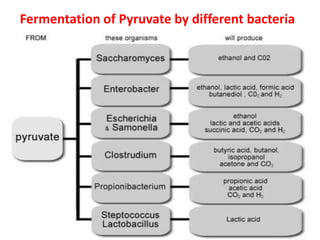
Fermentation of Pyruvate by different bacteria
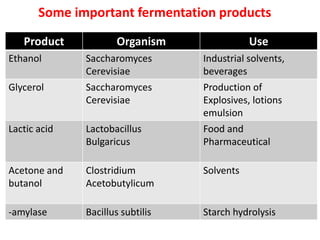
Some important fermentation products
Product Organism Use
Ethanol Saccharomyces
Cerevisiae
Industrial solvents,
beverages
Glycerol Saccharomyces
Cerevisiae
Production of
Explosives, lotions
emulsion
Lactic acid Lactobacillus
Bulgaricus
Food and
Pharmaceutical
Acetone and
butanol
Clostridium
Acetobutylicum
Solvents
-amylase Bacillus subtilis Starch hydrolysis
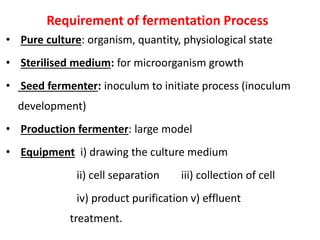
Requirement of fermentation Process
• Pure culture: organism, quantity, physiological state
• Sterilised medium: for microorganism growth
• Seed fermenter: inoculum to initiate process (inoculum
development)
• Production fermenter: large model
• Equipment i) drawing the culture medium
ii) cell separation iii) collection of cell
iv) product purification v) effluent
treatment.
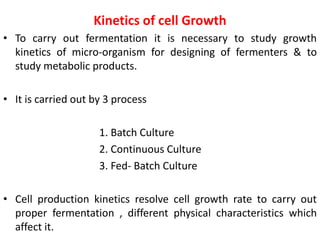
Kinetics of cell Growth
• To carry out fermentation it is necessary to study growth
kinetics of micro-organism for designing of fermenters & to
study metabolic products.
• It is carried out by 3 process
1. Batch Culture
2. Continuous Culture
3. Fed- Batch Culture
• Cell production kinetics resolve cell growth rate to carry out
proper fermentation , different physical characteristics which
affect it.
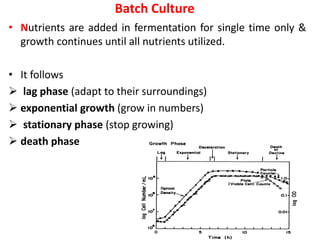
Batch Culture
• Nutrients are added in fermentation for single time only &
growth continues until all nutrients utilized.
• It follows
 lag phase (adapt to their surroundings)
 exponential growth (grow in numbers)
 stationary phase (stop growing)
 death phase
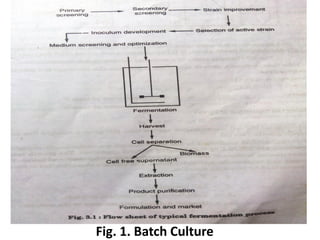
Fig. 1. Batch Culture
Continuous Cell Culture
• Growth rate & physiological condition of micro-organism maintained
by continuous culture. Fresh medium is added continuously at
appropriate rate & vessel is fitted with overflow device so that
culture is displaced by adding fresh culture medium.
• Dilution rate is ratio of inflowing amount of medium to volume of
culture.
D=F/V
Where , D-Dilution rate, F- Flow rate, V-volume
• Cell concentration get change at particular time period expressed by
dx/dt = growth- output (ux-Dx)
• In continuous culture output and growth same (u=D)
dx/dt=D
Fed Batch Culture
• This is an intermediate between batch & continuous growth
culture.
• Nutrient are fed continuously without removal of culture fluid.
• The volume of fed batch culture increases with time.
• Dilution rate decreases with time as per following equation
D=F/Vo+Ft
• Where D- Dilution rate,
F- Flow rate,
Vo –Initial volume of culture,
Ft- time from onset of fed batch
• Growth rate decrease time and system is not steady.
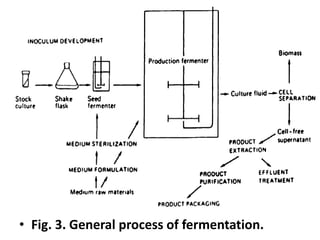
• Fig. 3. General process of fermentation.
Inoculum development for large scale
fermentation
• Microbial cells are required to add in large quantity in
fermenter we requires large quantity of microbial cells.
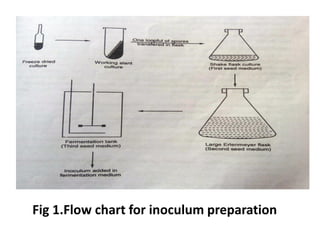
• Hence inoculum is prepared by fig.2. The main objective of
inoculum development is to produce active biomass of cells
and production medium to produce required fermented
product. Size of inoculum is 1 to 10 percent of production
medium.
• It should be free from contaminants, mutation & actively
growing.
• Selection of inoculum media depends on micro-organism.
Fig 1.Flow chart for inoculum preparation
Fermentation Media
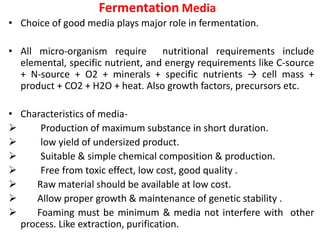
• Choice of good media plays major role in fermentation.
• All micro-organism require nutritional requirements include
elemental, specific nutrient, and energy requirements like C-source
+ N-source + O2 + minerals + specific nutrients → cell mass +
product + CO2 + H2O + heat. Also growth factors, precursors etc.
• Characteristics of media-
 Production of maximum substance in short duration.
 low yield of undersized product.
 Suitable & simple chemical composition & production.
 Free from toxic effect, low cost, good quality .
 Raw material should be available at low cost.
 Allow proper growth & maintenance of genetic stability .
 Foaming must be minimum & media not interfere with other
process. Like extraction, purification.
Constituents of medium
1. Water
2. Carbon source / Nitrogen source / Sources of phosphorous
and sulfur / Minor and trace elements / Vitamins such as
biotin and riboflavin
3. Oxygen: even some anaerobic fermentations require initial
aeration, e.g. beer fermentations
4. Buffers or controlled by acid and alkali additions
5. Antifoam agents
6. Precursor, inducer or inhibitor compounds
Considerations in media design
• Nutritional Requirements
• Environmental Requirements
• Techno-economic Factors
Nutritional requirements
• Nutritional requirements include elemental, specific nutrient, and
energy requirements
• Elemental requirements : the stoichiometry for growth and
product formation
• C-source + N-source + O2 + minerals + specific nutrients → cell
mass + product + CO2 + H2O + heat
• Specific nutrient requirements:
Auxotroph: To use a complex medium or to identify the specific
nutrient
Environmental requirements
• Effect of growth temperature on cell yield / below optimal
temperature for growth.
• Combined effect of temperature and pH on growth and
production is not always the same.
• Environmental effect of substrate
Techno-economic Factor
• Cost: transport and storage, e.g. temperature control
• Availability: consistent quality and year round availability
• Ease of handling: solid or liquid forms
• Sterilization: thermal damage and inhibitory by product
• Operational characteristics: formulation, mixing, complexing
and viscosity characteristics that may influence agitation,
aeration, foaming and recovery
• Supply: the concentration of target product attained, its rate
of formation and yield per gram of substrate utilized
• Purification: levels and range of impurities, potential for
generating undesired products
• Pollution control
• Health and safety implications
• Water: It is an basic solvent for fermentation due to its ideal
characteristics. For cleaning also.
• Carbon Source: e.g. starch, fructose, sucrose, molasses,
dextrin , etc.
Molasses are cheapest source .
Also sucrose, glucose , fructose are expensive than
molasses but gives clear media.
Starch used for synthesis of secondary metabolites.
• Nitrogen source: e.g. yeast, peptone ammonia, meal, corn
steep liquor etc.
Corn steep liquor is first used N –source for media
during penicillin fermentation.
• Buffer: Added due to their buffering capacity.
During microbial fermentation pH get change due to
acidic or basic product.
For maintenance of neutral or required pH during
fermentation buffers are added.
• Antifoams -1
Foaming is largely due to media proteins that become attached
to the air-broth interface where they denature to form a stable
foam.
If foaming is minimized, then throughputs can be increased.
Chemical antifoams are surface-active agents which reduce
the surface tension that binds the foam together.
Three approaches to controlling foam production:
modification of medium composition, use of mechanical
foam breakers and addition of chemical antifoams
• Minerals: Micro-organism require mineral for growth .
e.g. potassium, sulfur, copper, phosphorus, iron, cobalt,
magnesium, zinc etc.
• Precursors: This substances used to increase yield & quality
of fermentation product.
Phenylacteic acid added in fermentation medium of
penicillin G & Inorganic cobalt added in medium vitamin
B12 precursor
Fermenter
• Micro-organism require to grow in large vessel containing
nutrients media by maintaining favorable condition. This
containers called fermenters.
• It provide optimum growth & metabolism process for
production of desired product. It is also known as bioreactor.
• Characteristics of Fermenter:
 Provide best possible growth.
 Free from contamination, pH, temperature, agitation, aeration,
all aseptic condition maintained, at time of withdrawal &
addition, withstand pressure& toxicity of media etc.
 Provide facility for addition of antifoaming agent, nutrient etc.
 Easy to clean. Consume less power & evaporation.
• Fermenter- Used for growth of prokaryotic cells
• Bacteria, actinomycetes.
• Bioreactor- Used for growth of eukaryotic cells
• Mammalian cell, insects.
• Fermenter also differ from bioreactor in there part like agitator, &
mixer.
• Selection of good culture medium plays major role in fermentation.
• It provides the following facilities contamination free environment,
specific temperature, agitation and aeration, pH control, monitoring
Dissolved Oxygen (DO), ports for nutrient and reagent feeding, ports
for inoculation and sampling growth facility for wide range of
organisms.
Types of fermenter
• Fermenters available in different size & size determine
capacity of fermenter.
• It is classified as follows:
1. Small laboratory & Research fermenter:1 – 50 liters
2. Pilot plant fermenter: 50- 1000 liters
3. Large scale fermenter: more than 1000 liter
Depend on media used fermenter are of two type
Surface (solid state) Submersion techniques
Microorganisms cultivated on the
surface of a liquid or solid
substrate.
microorganisms grow in a
liquid medium.
complicated and rarely
used in industry.
e.g. Bread ,Mushroom .
biomass, protein, antibiotics,
enzymes and sewage treatment
done in this techniques.
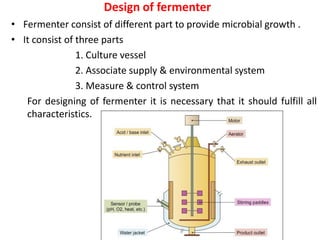
Design of fermenter
• Fermenter consist of different part to provide microbial growth .
• It consist of three parts
1. Culture vessel
2. Associate supply & environmental system
3. Measure & control system
For designing of fermenter it is necessary that it should fulfill all
characteristics.
• It is made up of stainless steel or borosilicate glass. They are
non-toxic , non-corrosive, easily cleanable.
• Head part provide entry of nutrient media, gas input & waste
outlet & also other accessories are fitted.
• Aeration & agitation occur by stirrers , baffles, paddles etc. it
is major requirement of fermenter.
• Measurement , environment control & biological variable
called fermentation monitoring now a days developed by
computers.
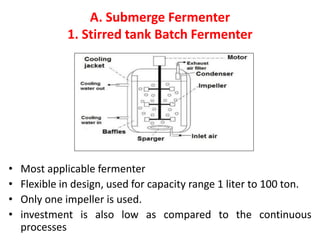
A. Submerge Fermenter
1. Stirred tank Batch Fermenter
• Most applicable fermenter
• Flexible in design, used for capacity range 1 liter to 100 ton.
• Only one impeller is used.
• investment is also low as compared to the continuous
processes
• Disadvantages:
Low productivity due to time require for sterilizing,
filling, cooling etc.
More expensess require for subculturing of innoculum &
process cantrol
Large industrial hygeine risk.
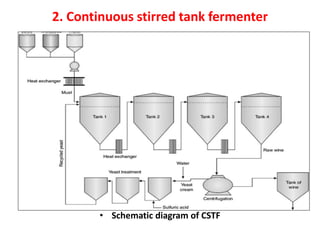
2. Continuous stirred tank fermenter
• Schematic diagram of CSTF
• In this method fresh medium added continuously in vessel &
in other end medium is withdraw.
• In this method single fermenter is inoculated & then kept in
continuous operation by balancing input & output culture
media.
• In recycle type of CSTF withdrawal culture is recycle in
fermentation vessel.
• In multistage fermentation technique it involves two or more
stage which is operate in sequence.
• Advantages:
Less labor expenses
Less toxicity risk to operator by toxin
High yield of good quality product
• Disadvantage:
Uniformity in media quality requires to process remain
continue.
High investment cost
Slight variation may occurs.
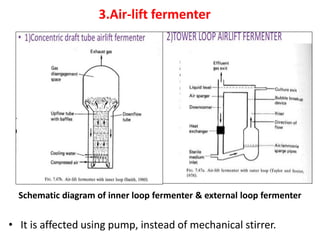
3.Air-lift fermenter
Schematic diagram of inner loop fermenter & external loop fermenter
• It is affected using pump, instead of mechanical stirrer.
• It involve liquid movement & gas entertainer.
• Gas distribution device is a vessel , where liquid saturated
with gas circulated by force convection into fermenter vessel.
• In internal loop fermenter internal liquid circulation in
vessel is achieved by sparing vessel with gas.
• Fluid volume in vessel divided into interconnected zone by
draught tube.
• Air passed through bottom of central draught tube that
control circulation of air & medium.
• In external air lift filter circulation of air & liquid carried out
in vessel.
• It consist of riser & external downcomer, which connected at
bottom & top respectively.
• Air injected at bottom of riser create gas bubble that rise
through tank & heavier solution descends through
downcomer .
Advantages:
High flexibility
Simple design without moving parts like agitators
Easy metainance, easy sterilization
Control flow & efficient mixing
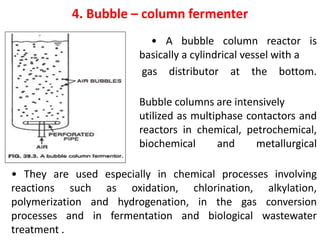
4. Bubble – column fermenter
• • A bubble column reactor is
basically a cylindrical vessel with a
gas distributor at the bottom.
• Bubble columns are intensively
utilized as multiphase contactors and
reactors in chemical, petrochemical,
biochemical and metallurgical
industries .
• They are used especially in chemical processes involving
reactions such as oxidation, chlorination, alkylation,
polymerization and hydrogenation, in the gas conversion
processes and in fermentation and biological wastewater
treatment .
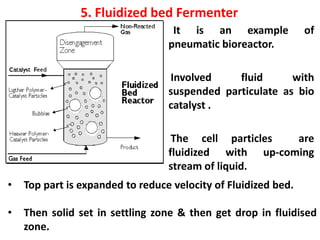
5. Fluidized bed Fermenter
• It is an example of
pneumatic bioreactor.
•
• Involved fluid with
suspended particulate as bio
catalyst .
•
• The cell particles are
fluidized with up-coming
stream of liquid.
• Top part is expanded to reduce velocity of Fluidized bed.
• Then solid set in settling zone & then get drop in fluidised
zone.
Advantages of Submerged Fermentation
• Short period, low cost and high yield.
• Purification of products is easier.
• In liquid culture the control of the fermentation is simpler.
• Reductions in fermentation times can be achieved.
• Benefit the production of many secondary metabolites and
decrease production costs by reducing the labor.
Limitations of Submerged Fermentation
• More effluent generation.
• Complex fermentation Equipments.
B. Surface Fermentation
• Microbial cell cultured on surface of media which is held in
tray or dish called as surface fermenters.
• This technique generally used for production of citric acid
from Aspergillus niger & nicotinic acid production from
Aspergillus terrus.
• Microbial bed is grown on surface of packaging media.
• It forms fixed bed, stones or plastic sheet
• This system is commonly used in biological waste water
treatment.
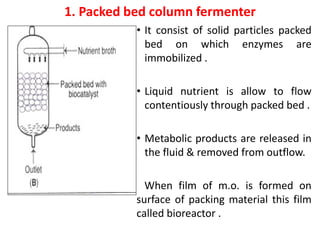
1. Packed bed column fermenter
• It consist of solid particles packed
bed on which enzymes are
immobilized .
• Liquid nutrient is allow to flow
contentiously through packed bed .
• Metabolic products are released in
the fluid & removed from outflow.
When film of m.o. is formed on
surface of packing material this film
called bioreactor .
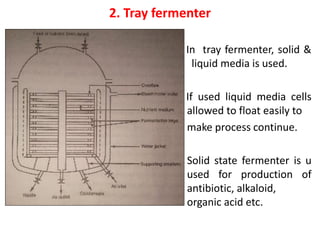
2. Tray fermenter
In tray fermenter, solid &
li liquid media is used.
If used liquid media cells
allowed to float easily to
make process continue.
Solid state fermenter is u
used for production of
antibiotic, alkaloid,
organic acid etc.
• Advantages of SSF:
It produce higher yeild .
Possibility of contamination by bacteria & yeast less.
Media is very simple.
Simple fermenter.
Inoculation is uniform.
• Disadvantage:
Cause problem in monitoring.( pH, oxygen content,
substrate)
Biomass determination is difficult.
Aeration is difficult.
Process after fermentation
• After fermentation the following steps are performed
Pre-treatment
Cell disruption by homogenizer, agitation, Sonication.
Adjustment of pH
Stabilization
Separation of cells from fermentation broth
Filtration, Sedimentation, Centrifugation
Isolation of impure product
By extraction, precipitation, evaporation
Purification
Chromatography, Adsorption, Crystallization.
Final processing
Drying, Selection of dosage form, QC & QA test.
• Questions
1. What is submerge fermentation? Explain any one fermenter.
2. List out different types of fermenter. Explain about surface
fermentation.
3. Discus different factors require for carry out fermentation.
Reference
1. Pharmaceutical Biotechnology by C. R. Kokare Nirali
Publication
THANK YOU

Ferementation

  • 1.
    Fermentation By: Vasundhara S. Kakade AssistantProfessor NES Navsahyadri Institute of Pharmacy, Nasarapur Pune. 09/04/2020 1NES NIPT.Y. B.Pharm
  • 2.
    Introduction • Fermentation definedas process of growing micro-organism in nutrient media by maintaining physicochemical conditions & there by converting feed into desired product . • It is biochemical process in which micro-organism act as biocatalysts. • Various fermented product are antibiotics, vitamins, enzymes etc. • Micro-organism used in fermentation are bacteria, actinomycetes, viruses, fungi etc. • The vessels or containers where fermentation carried out called fermenter or bioreactor.
  • 3.
    Fermentation of Pyruvateby different bacteria
  • 4.
    Some important fermentationproducts Product Organism Use Ethanol Saccharomyces Cerevisiae Industrial solvents, beverages Glycerol Saccharomyces Cerevisiae Production of Explosives, lotions emulsion Lactic acid Lactobacillus Bulgaricus Food and Pharmaceutical Acetone and butanol Clostridium Acetobutylicum Solvents -amylase Bacillus subtilis Starch hydrolysis
  • 5.
    Requirement of fermentationProcess • Pure culture: organism, quantity, physiological state • Sterilised medium: for microorganism growth • Seed fermenter: inoculum to initiate process (inoculum development) • Production fermenter: large model • Equipment i) drawing the culture medium ii) cell separation iii) collection of cell iv) product purification v) effluent treatment.
  • 6.
    Kinetics of cellGrowth • To carry out fermentation it is necessary to study growth kinetics of micro-organism for designing of fermenters & to study metabolic products. • It is carried out by 3 process 1. Batch Culture 2. Continuous Culture 3. Fed- Batch Culture • Cell production kinetics resolve cell growth rate to carry out proper fermentation , different physical characteristics which affect it.
  • 7.
    Batch Culture • Nutrientsare added in fermentation for single time only & growth continues until all nutrients utilized. • It follows  lag phase (adapt to their surroundings)  exponential growth (grow in numbers)  stationary phase (stop growing)  death phase
  • 8.
  • 9.
    Continuous Cell Culture •Growth rate & physiological condition of micro-organism maintained by continuous culture. Fresh medium is added continuously at appropriate rate & vessel is fitted with overflow device so that culture is displaced by adding fresh culture medium. • Dilution rate is ratio of inflowing amount of medium to volume of culture. D=F/V Where , D-Dilution rate, F- Flow rate, V-volume • Cell concentration get change at particular time period expressed by dx/dt = growth- output (ux-Dx) • In continuous culture output and growth same (u=D) dx/dt=D
  • 10.
    Fed Batch Culture •This is an intermediate between batch & continuous growth culture. • Nutrient are fed continuously without removal of culture fluid. • The volume of fed batch culture increases with time. • Dilution rate decreases with time as per following equation D=F/Vo+Ft • Where D- Dilution rate, F- Flow rate, Vo –Initial volume of culture, Ft- time from onset of fed batch • Growth rate decrease time and system is not steady.
  • 11.
    • Fig. 3.General process of fermentation.
  • 12.
    Inoculum development forlarge scale fermentation • Microbial cells are required to add in large quantity in fermenter we requires large quantity of microbial cells. • Hence inoculum is prepared by fig.2. The main objective of inoculum development is to produce active biomass of cells and production medium to produce required fermented product. Size of inoculum is 1 to 10 percent of production medium. • It should be free from contaminants, mutation & actively growing. • Selection of inoculum media depends on micro-organism.
  • 13.
    Fig 1.Flow chartfor inoculum preparation
  • 14.
    Fermentation Media • Choiceof good media plays major role in fermentation. • All micro-organism require nutritional requirements include elemental, specific nutrient, and energy requirements like C-source + N-source + O2 + minerals + specific nutrients → cell mass + product + CO2 + H2O + heat. Also growth factors, precursors etc. • Characteristics of media-  Production of maximum substance in short duration.  low yield of undersized product.  Suitable & simple chemical composition & production.  Free from toxic effect, low cost, good quality .  Raw material should be available at low cost.  Allow proper growth & maintenance of genetic stability .  Foaming must be minimum & media not interfere with other process. Like extraction, purification.
  • 15.
    Constituents of medium 1.Water 2. Carbon source / Nitrogen source / Sources of phosphorous and sulfur / Minor and trace elements / Vitamins such as biotin and riboflavin 3. Oxygen: even some anaerobic fermentations require initial aeration, e.g. beer fermentations 4. Buffers or controlled by acid and alkali additions 5. Antifoam agents 6. Precursor, inducer or inhibitor compounds
  • 16.
    Considerations in mediadesign • Nutritional Requirements • Environmental Requirements • Techno-economic Factors
  • 17.
    Nutritional requirements • Nutritionalrequirements include elemental, specific nutrient, and energy requirements • Elemental requirements : the stoichiometry for growth and product formation • C-source + N-source + O2 + minerals + specific nutrients → cell mass + product + CO2 + H2O + heat • Specific nutrient requirements: Auxotroph: To use a complex medium or to identify the specific nutrient
  • 18.
    Environmental requirements • Effectof growth temperature on cell yield / below optimal temperature for growth. • Combined effect of temperature and pH on growth and production is not always the same. • Environmental effect of substrate
  • 19.
    Techno-economic Factor • Cost:transport and storage, e.g. temperature control • Availability: consistent quality and year round availability • Ease of handling: solid or liquid forms • Sterilization: thermal damage and inhibitory by product • Operational characteristics: formulation, mixing, complexing and viscosity characteristics that may influence agitation, aeration, foaming and recovery • Supply: the concentration of target product attained, its rate of formation and yield per gram of substrate utilized • Purification: levels and range of impurities, potential for generating undesired products • Pollution control • Health and safety implications
  • 20.
    • Water: Itis an basic solvent for fermentation due to its ideal characteristics. For cleaning also. • Carbon Source: e.g. starch, fructose, sucrose, molasses, dextrin , etc. Molasses are cheapest source . Also sucrose, glucose , fructose are expensive than molasses but gives clear media. Starch used for synthesis of secondary metabolites. • Nitrogen source: e.g. yeast, peptone ammonia, meal, corn steep liquor etc. Corn steep liquor is first used N –source for media during penicillin fermentation.
  • 21.
    • Buffer: Addeddue to their buffering capacity. During microbial fermentation pH get change due to acidic or basic product. For maintenance of neutral or required pH during fermentation buffers are added. • Antifoams -1 Foaming is largely due to media proteins that become attached to the air-broth interface where they denature to form a stable foam. If foaming is minimized, then throughputs can be increased. Chemical antifoams are surface-active agents which reduce the surface tension that binds the foam together.
  • 22.
    Three approaches tocontrolling foam production: modification of medium composition, use of mechanical foam breakers and addition of chemical antifoams • Minerals: Micro-organism require mineral for growth . e.g. potassium, sulfur, copper, phosphorus, iron, cobalt, magnesium, zinc etc. • Precursors: This substances used to increase yield & quality of fermentation product. Phenylacteic acid added in fermentation medium of penicillin G & Inorganic cobalt added in medium vitamin B12 precursor
  • 23.
    Fermenter • Micro-organism requireto grow in large vessel containing nutrients media by maintaining favorable condition. This containers called fermenters. • It provide optimum growth & metabolism process for production of desired product. It is also known as bioreactor. • Characteristics of Fermenter:  Provide best possible growth.  Free from contamination, pH, temperature, agitation, aeration, all aseptic condition maintained, at time of withdrawal & addition, withstand pressure& toxicity of media etc.  Provide facility for addition of antifoaming agent, nutrient etc.  Easy to clean. Consume less power & evaporation.
  • 24.
    • Fermenter- Usedfor growth of prokaryotic cells • Bacteria, actinomycetes. • Bioreactor- Used for growth of eukaryotic cells • Mammalian cell, insects. • Fermenter also differ from bioreactor in there part like agitator, & mixer. • Selection of good culture medium plays major role in fermentation. • It provides the following facilities contamination free environment, specific temperature, agitation and aeration, pH control, monitoring Dissolved Oxygen (DO), ports for nutrient and reagent feeding, ports for inoculation and sampling growth facility for wide range of organisms.
  • 25.
    Types of fermenter •Fermenters available in different size & size determine capacity of fermenter. • It is classified as follows: 1. Small laboratory & Research fermenter:1 – 50 liters 2. Pilot plant fermenter: 50- 1000 liters 3. Large scale fermenter: more than 1000 liter Depend on media used fermenter are of two type Surface (solid state) Submersion techniques Microorganisms cultivated on the surface of a liquid or solid substrate. microorganisms grow in a liquid medium. complicated and rarely used in industry. e.g. Bread ,Mushroom . biomass, protein, antibiotics, enzymes and sewage treatment done in this techniques.
  • 26.
    Design of fermenter •Fermenter consist of different part to provide microbial growth . • It consist of three parts 1. Culture vessel 2. Associate supply & environmental system 3. Measure & control system For designing of fermenter it is necessary that it should fulfill all characteristics.
  • 27.
    • It ismade up of stainless steel or borosilicate glass. They are non-toxic , non-corrosive, easily cleanable. • Head part provide entry of nutrient media, gas input & waste outlet & also other accessories are fitted. • Aeration & agitation occur by stirrers , baffles, paddles etc. it is major requirement of fermenter. • Measurement , environment control & biological variable called fermentation monitoring now a days developed by computers.
  • 28.
    A. Submerge Fermenter 1.Stirred tank Batch Fermenter • Most applicable fermenter • Flexible in design, used for capacity range 1 liter to 100 ton. • Only one impeller is used. • investment is also low as compared to the continuous processes
  • 29.
    • Disadvantages: Low productivitydue to time require for sterilizing, filling, cooling etc. More expensess require for subculturing of innoculum & process cantrol Large industrial hygeine risk.
  • 30.
    2. Continuous stirredtank fermenter • Schematic diagram of CSTF
  • 31.
    • In thismethod fresh medium added continuously in vessel & in other end medium is withdraw. • In this method single fermenter is inoculated & then kept in continuous operation by balancing input & output culture media. • In recycle type of CSTF withdrawal culture is recycle in fermentation vessel. • In multistage fermentation technique it involves two or more stage which is operate in sequence.
  • 32.
    • Advantages: Less laborexpenses Less toxicity risk to operator by toxin High yield of good quality product • Disadvantage: Uniformity in media quality requires to process remain continue. High investment cost Slight variation may occurs.
  • 33.
    3.Air-lift fermenter Schematic diagramof inner loop fermenter & external loop fermenter • It is affected using pump, instead of mechanical stirrer.
  • 34.
    • It involveliquid movement & gas entertainer. • Gas distribution device is a vessel , where liquid saturated with gas circulated by force convection into fermenter vessel. • In internal loop fermenter internal liquid circulation in vessel is achieved by sparing vessel with gas. • Fluid volume in vessel divided into interconnected zone by draught tube. • Air passed through bottom of central draught tube that control circulation of air & medium.
  • 35.
    • In externalair lift filter circulation of air & liquid carried out in vessel. • It consist of riser & external downcomer, which connected at bottom & top respectively. • Air injected at bottom of riser create gas bubble that rise through tank & heavier solution descends through downcomer . Advantages: High flexibility Simple design without moving parts like agitators Easy metainance, easy sterilization Control flow & efficient mixing
  • 36.
    4. Bubble –column fermenter • • A bubble column reactor is basically a cylindrical vessel with a gas distributor at the bottom. • Bubble columns are intensively utilized as multiphase contactors and reactors in chemical, petrochemical, biochemical and metallurgical industries . • They are used especially in chemical processes involving reactions such as oxidation, chlorination, alkylation, polymerization and hydrogenation, in the gas conversion processes and in fermentation and biological wastewater treatment .
  • 37.
    5. Fluidized bedFermenter • It is an example of pneumatic bioreactor. • • Involved fluid with suspended particulate as bio catalyst . • • The cell particles are fluidized with up-coming stream of liquid. • Top part is expanded to reduce velocity of Fluidized bed. • Then solid set in settling zone & then get drop in fluidised zone.
  • 38.
    Advantages of SubmergedFermentation • Short period, low cost and high yield. • Purification of products is easier. • In liquid culture the control of the fermentation is simpler. • Reductions in fermentation times can be achieved. • Benefit the production of many secondary metabolites and decrease production costs by reducing the labor. Limitations of Submerged Fermentation • More effluent generation. • Complex fermentation Equipments.
  • 39.
    B. Surface Fermentation •Microbial cell cultured on surface of media which is held in tray or dish called as surface fermenters. • This technique generally used for production of citric acid from Aspergillus niger & nicotinic acid production from Aspergillus terrus. • Microbial bed is grown on surface of packaging media. • It forms fixed bed, stones or plastic sheet • This system is commonly used in biological waste water treatment.
  • 40.
    1. Packed bedcolumn fermenter • It consist of solid particles packed bed on which enzymes are immobilized . • Liquid nutrient is allow to flow contentiously through packed bed . • Metabolic products are released in the fluid & removed from outflow. When film of m.o. is formed on surface of packing material this film called bioreactor .
  • 41.
    2. Tray fermenter Intray fermenter, solid & li liquid media is used. If used liquid media cells allowed to float easily to make process continue. Solid state fermenter is u used for production of antibiotic, alkaloid, organic acid etc.
  • 42.
    • Advantages ofSSF: It produce higher yeild . Possibility of contamination by bacteria & yeast less. Media is very simple. Simple fermenter. Inoculation is uniform. • Disadvantage: Cause problem in monitoring.( pH, oxygen content, substrate) Biomass determination is difficult. Aeration is difficult.
  • 43.
    Process after fermentation •After fermentation the following steps are performed Pre-treatment Cell disruption by homogenizer, agitation, Sonication. Adjustment of pH Stabilization Separation of cells from fermentation broth Filtration, Sedimentation, Centrifugation Isolation of impure product By extraction, precipitation, evaporation Purification Chromatography, Adsorption, Crystallization. Final processing Drying, Selection of dosage form, QC & QA test.
  • 44.
    • Questions 1. Whatis submerge fermentation? Explain any one fermenter. 2. List out different types of fermenter. Explain about surface fermentation. 3. Discus different factors require for carry out fermentation. Reference 1. Pharmaceutical Biotechnology by C. R. Kokare Nirali Publication THANK YOU