Fermentation
Dept. Of Processing And Food Engineering
Presented by :
Potdar Pratik Pandit
L-2019-AE-162-D
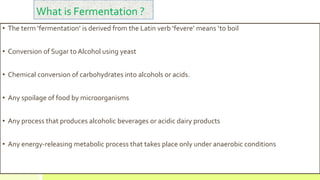
• The term ‘fermentation’ is derived from the Latin verb ‘fevere’ means ‘to boil
• Conversion of Sugar to Alcohol using yeast
• Chemical conversion of carbohydrates into alcohols or acids.
• Any spoilage of food by microorganisms
• Any process that produces alcoholic beverages or acidic dairy products
• Any energy-releasing metabolic process that takes place only under anaerobic conditions
What is Fermentation ?
However, Fermentation has come to have different meanings to Biochemists and to Industrial
Microbiologists.
Its Biochemical meaning relates to the generation of energy by the catabolism of organic
compounds,
Where as Its meaning in Industrial Microbiology tends to be much broader.
In Microbial sense, Fermentation may be defined as process of growing of a culture of
microorganism in a nutrient medium and thereby converting feed into a desired
product.
Some examples of fermentation products are : Ethanol, lactic acid, beer, wine etc.

HISTORY OF FERMENTATION
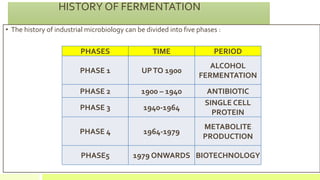
• The history of industrial microbiology can be divided into five phases :
PHASES TIME PERIOD
PHASE 1 UPTO 1900
ALCOHOL
FERMENTATION
PHASE 2 1900 – 1940 ANTIBIOTIC
PHASE 3 1940-1964
SINGLE CELL
PROTEIN
PHASE 4 1964-1979
METABOLITE
PRODUCTION
PHASE5 1979 ONWARDS BIOTECHNOLOGY
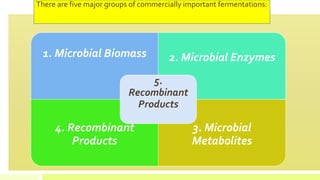
There are five major groups of commercially important fermentations:
1. Microbial Biomass 2. Microbial Enzymes
4. Recombinant
Products
3. Microbial
Metabolites
5.
Recombinant
Products
Two major processes;The production of yeast to be used in the baking industry and the
production of microbial cells to be used as human or animal food(e.g. SCP).

Baker’s yeast has been produced on large scale sincethe early 1900s and yeast was produced
as human food in Germany during theWorldWar
1. Microbial Biomass
Enzymes has been produced commercially from plant,animal and microbial sources.
Commercially produced microbial enzymes are used in the food and related
industries.such as- Steptokinase from bacteria used as anti-blood clotting agent in
pharmaceutical.
2. Microbial Enzymes
Primary metabolites:Those product that are produced in primary metabolism(During
Trophophase) e,g, Amino acid,Vitamims,Ethanol,Polysaccharide.
Secondary metabolites:Those product that are produced in secondary metabolism(During
the deceleration & Stationary phase) e.g. Penicillin
3. Microbial Metabolites
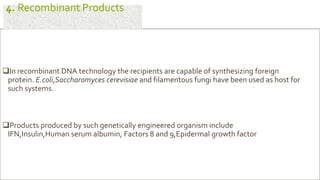
In recombinant DNA technology the recipients are capable of synthesizing foreign
protein. E.coli,Saccharomyces cerevisiae and filamentous fungi have been used as host for
such systems.
Products produced by such genetically engineered organism include
IFN,Insulin,Human serum albumin, Factors 8 and 9,Epidermal growth factor
4. Recombinant Products
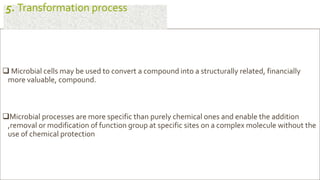
 Microbial cells may be used to convert a compound into a structurally related, financially
more valuable, compound.
Microbial processes are more specific than purely chemical ones and enable the addition
,removal or modification of function group at specific sites on a complex molecule without the
use of chemical protection
5. Transformation process
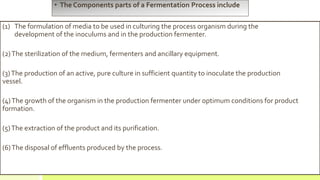
• The Components parts of a Fermentation Process include
(1) The formulation of media to be used in culturing the process organism during the
development of the inoculums and in the production fermenter.
(2)The sterilization of the medium, fermenters and ancillary equipment.
(3)The production of an active, pure culture in sufficient quantity to inoculate the production
vessel.
(4)The growth of the organism in the production fermenter under optimum conditions for product
formation.
(5)The extraction of the product and its purification.
(6)The disposal of effluents produced by the process.
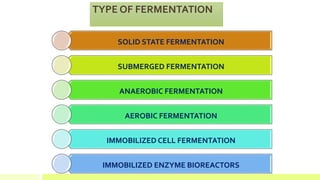
TYPE OF FERMENTATION
SOLID STATE FERMENTATION
SUBMERGED FERMENTATION
ANAEROBIC FERMENTATION
AEROBIC FERMENTATION
IMMOBILIZED CELL FERMENTATION
IMMOBILIZED ENZYME BIOREACTORS
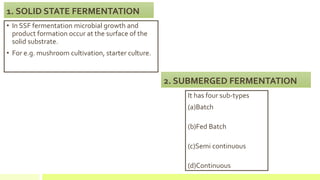
1. SOLID STATE FERMENTATION
• In SSF fermentation microbial growth and
product formation occur at the surface of the
solid substrate.
• For e.g. mushroom cultivation, starter culture.
2. SUBMERGED FERMENTATION
It has four sub-types
(a)Batch
(b)Fed Batch
(c)Semi continuous
(d)Continuous
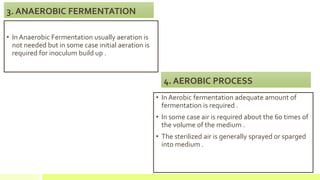
3. ANAEROBIC FERMENTATION
• In Anaerobic Fermentation usually aeration is
not needed but in some case initial aeration is
required for inoculum build up .
4. AEROBIC PROCESS
• In Aerobic fermentation adequate amount of
fermentation is required .
• In some case air is required about the 60 times of
the volume of the medium .
• The sterilized air is generally sprayed or sparged
into medium .
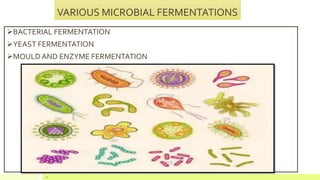
BACTERIAL FERMENTATION
YEAST FERMENTATION
MOULD AND ENZYME FERMENTATION
16
VARIOUS MICROBIAL FERMENTATIONS
BACTERIAL FERMENTATION
# LACTIC ACID BACTERIA
(PICKLE OR SAURKERAUT)
# ACETIC ACID BACTERIA
(VINEGAR)
# CARBON DIOXIDE BACTERIA
(EDAM, GOUDA, SWISS)
# PROTEOLYTIC BACTERIA
(COCOA, CHOCOLATE)
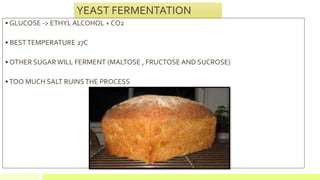
YEAST FERMENTATION
• GLUCOSE -> ETHYL ALCOHOL + CO2
• BESTTEMPERATURE 27C
• OTHER SUGAR WILL FERMENT (MALTOSE , FRUCTOSE AND SUCROSE)
•TOO MUCH SALT RUINSTHE PROCESS
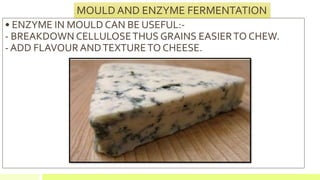
MOULD AND ENZYME FERMENTATION
• ENZYME IN MOULD CAN BE USEFUL:-
- BREAKDOWN CELLULOSETHUS GRAINS EASIERTO CHEW.
- ADD FLAVOURANDTEXTURETO CHEESE.
FACTORS AFFECTING FERMENTATION
• Physical factors- Temperature, pH, osmotic pressure,
hydrostatic pressure and radiation.
• Chemical factors- Oxygen, carbon, nitrogen,
phosphorus, sulfur, etc
1) TEMPERATURE
• Temperature is the most important factor that determines the rate of growth, multiplication,
survival, and death of all living organisms.
• High temperatures may reduce fermentation process because of damage microbes by
denaturing enzymes, transport carriers, and other proteins.
• Microbial membrane are disrupted by extreme temperatures .
• At very low temperatures fermentation process may also be reduced because membranes of
bacteria may also solidify and enzymes also do not function properly.
PHYSICAL FACTORS
2) pH
• pH refers to negative logarithm of hydrogen ion concentration.
• Fermentation process may also be affected by pH because microbial growth is strongly affected
by the pH of the medium.
• If a drastic variations in cytoplasmic pH occurs then it may disrupt the plasma membrane or
inhibit the activity of enzymes and membrane transport proteins.
PHYSICAL FACTORS
3) OSMOTIC PRESSURE
• Osmotic pressure is the minimum pressure which needs to be applied to a solution to prevent the
inward flow of water across a SPM.
• Solution may be : 1. Hypotonic 2. Isotonic 3. Hypertonic.
• Classification of bacteria according to osmotic pressure
1. Osmotolerant are those microorganisms which can grow at relatively high salt
concentration. Examples: Aeromonas spp., Staphylococcus spp, etc.
2. Halophiles- Grow in the presence of salt at conc. Above 0.2 to 0.6. Examples:
Halobacterium halobium
PHYSICAL FACTORS
4) HYDROSTATIC PRESSURE
• This the force acting per unit area.
• Classification of bacteria on the basis of hydrostatic pressure are as:
- Barophiles/ Piezophiles- Bacteria which grow at moderately high hydrostatic
pressures. Examples: Halomonas salaria, xenophyophores, etc.
- Barotolerant–Does not get affected by increased pressure.
PHYSICAL FACTORS
5) RADIATION
• Sunlight is the major source of heat.
• Infrared is the major source of Earth’s heat. Ionizing rays can produce mutations which may
result in death.
• Visible light is beneficial because it is the source of energy for photosynthesis.
PHYSICAL FACTORS
1) CARBON
• Simple to Complex carbohydrates can be added to media in fermentation as a source of carbon.
• Different sugars like mannitol, sorbitol, organic acids, fatty acids, protein peptides can be
added.
• The selection of carbon source depend upon the availability as well as cost of the material.
• In most of the fermentation media, crude source of carbon is added.
• Example of simple carbohydrates are black strap molasses. Corn molasses, beet molasses,
sulphite waste liquor etc.
• Carbohydrates are starch, corn, rice, potatoes etc.
CHEMICAL FACTORS
2) NITROGEN
• Nitrogen source are required for most organelle to synthesize protein, nucleic acid and other
cellular compounds.
• Nitrogen may be provided as a bulk protein, such as Soya meal; as predigested polypeptides,
such as peptone or tryptone, or as Ammonia or nitrate salts.
• Salts of Urea, Ammonia and nitrate can be used as as nitrogen source.
• When fermentation organisms are non proteolytic in nature pure form of Urea, Ammonia and
nitrates are used as a source of Nitrogen.
• When fermentation organisms are proteolytic in nature, animal and plant raw material is used,
like casein, cereal grains, peptones etc.
CHEMICAL FACTORS
3) OXYGEN
• Depending upon the amount of the oxygen required by the organisms, it may be supplied in the
form of AIR containing about 21% volume by volume oxygen or occasionally as a pure oxygen
requirements are particularly High.
• The organism’s oxygen requirements in may vary widely depending upon the carbon source.
• For most of the fermentation process, filtered sterilized air is supplied into the bioreactor.
CHEMICAL FACTORS
4) WATER
• All fermentation process, accept solid state fermentation required vast quantity of water.
• Water is not only a major component of all media but it is important for ancillary services like
heating cooling, cleaning and rinsing.
• A reliable source of large quantities of clean water of consistent composition is therefore
essential.
• Important factor to considered when assessing suitability of water supply are pH dissolved
solids and effluent contamination.
CHEMICAL FACTORS
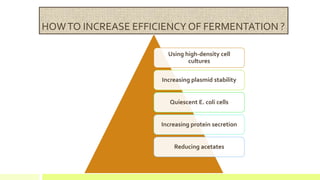
HOWTO INCREASE EFFICIENCY OF FERMENTATION ?
Using high-density cell
cultures
Increasing plasmid stability
Quiescent E. coli cells
Increasing protein secretion
Reducing acetates
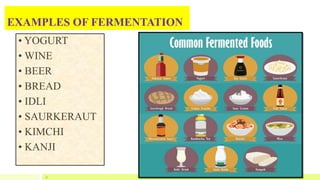
EXAMPLES OF FERMENTATION
• YOGURT
• WINE
• BEER
• BREAD
• IDLI
• SAURKERAUT
• KIMCHI
• KANJI
31
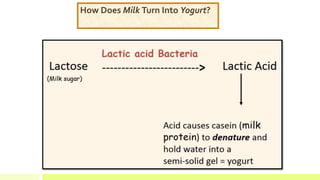
How Does Milk Turn Into Yogurt?
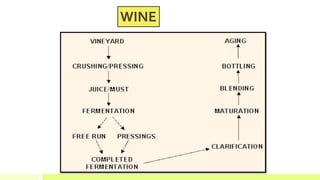
WINE
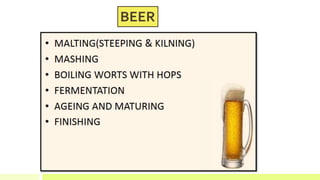
BEER
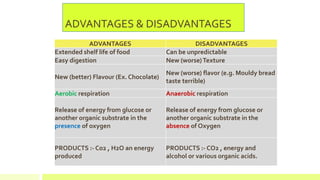
ADVANTAGES & DISADVANTAGES
ADVANTAGES DISADVANTAGES
Extended shelf life of food Can be unpredictable
Easy digestion New (worse)Texture
New (better) Flavour (Ex. Chocolate)
New (worse) flavor (e.g. Mouldy bread
taste terrible)
Aerobic respiration Anaerobic respiration
Release of energy from glucose or
another organic substrate in the
presence of oxygen
Release of energy from glucose or
another organic substrate in the
absence of Oxygen
PRODUCTS :- Co2 , H2O an energy
produced
PRODUCTS :- CO2 , energy and
alcohol or various organic acids.
36

Fermentation pratik potdar

  • 1.
    Fermentation Dept. Of ProcessingAnd Food Engineering Presented by : Potdar Pratik Pandit L-2019-AE-162-D
  • 2.
    • The term‘fermentation’ is derived from the Latin verb ‘fevere’ means ‘to boil • Conversion of Sugar to Alcohol using yeast • Chemical conversion of carbohydrates into alcohols or acids. • Any spoilage of food by microorganisms • Any process that produces alcoholic beverages or acidic dairy products • Any energy-releasing metabolic process that takes place only under anaerobic conditions What is Fermentation ?
  • 3.
    However, Fermentation hascome to have different meanings to Biochemists and to Industrial Microbiologists. Its Biochemical meaning relates to the generation of energy by the catabolism of organic compounds, Where as Its meaning in Industrial Microbiology tends to be much broader. In Microbial sense, Fermentation may be defined as process of growing of a culture of microorganism in a nutrient medium and thereby converting feed into a desired product. Some examples of fermentation products are : Ethanol, lactic acid, beer, wine etc.
  • 4.
    HISTORY OF FERMENTATION •The history of industrial microbiology can be divided into five phases : PHASES TIME PERIOD PHASE 1 UPTO 1900 ALCOHOL FERMENTATION PHASE 2 1900 – 1940 ANTIBIOTIC PHASE 3 1940-1964 SINGLE CELL PROTEIN PHASE 4 1964-1979 METABOLITE PRODUCTION PHASE5 1979 ONWARDS BIOTECHNOLOGY
  • 6.
    There are fivemajor groups of commercially important fermentations: 1. Microbial Biomass 2. Microbial Enzymes 4. Recombinant Products 3. Microbial Metabolites 5. Recombinant Products
  • 7.
    Two major processes;Theproduction of yeast to be used in the baking industry and the production of microbial cells to be used as human or animal food(e.g. SCP).  Baker’s yeast has been produced on large scale sincethe early 1900s and yeast was produced as human food in Germany during theWorldWar 1. Microbial Biomass
  • 8.
    Enzymes has beenproduced commercially from plant,animal and microbial sources. Commercially produced microbial enzymes are used in the food and related industries.such as- Steptokinase from bacteria used as anti-blood clotting agent in pharmaceutical. 2. Microbial Enzymes
  • 9.
    Primary metabolites:Those productthat are produced in primary metabolism(During Trophophase) e,g, Amino acid,Vitamims,Ethanol,Polysaccharide. Secondary metabolites:Those product that are produced in secondary metabolism(During the deceleration & Stationary phase) e.g. Penicillin 3. Microbial Metabolites
  • 10.
    In recombinant DNAtechnology the recipients are capable of synthesizing foreign protein. E.coli,Saccharomyces cerevisiae and filamentous fungi have been used as host for such systems. Products produced by such genetically engineered organism include IFN,Insulin,Human serum albumin, Factors 8 and 9,Epidermal growth factor 4. Recombinant Products
  • 11.
     Microbial cellsmay be used to convert a compound into a structurally related, financially more valuable, compound. Microbial processes are more specific than purely chemical ones and enable the addition ,removal or modification of function group at specific sites on a complex molecule without the use of chemical protection 5. Transformation process
  • 12.
    • The Componentsparts of a Fermentation Process include (1) The formulation of media to be used in culturing the process organism during the development of the inoculums and in the production fermenter. (2)The sterilization of the medium, fermenters and ancillary equipment. (3)The production of an active, pure culture in sufficient quantity to inoculate the production vessel. (4)The growth of the organism in the production fermenter under optimum conditions for product formation. (5)The extraction of the product and its purification. (6)The disposal of effluents produced by the process.
  • 13.
    TYPE OF FERMENTATION SOLIDSTATE FERMENTATION SUBMERGED FERMENTATION ANAEROBIC FERMENTATION AEROBIC FERMENTATION IMMOBILIZED CELL FERMENTATION IMMOBILIZED ENZYME BIOREACTORS
  • 14.
    1. SOLID STATEFERMENTATION • In SSF fermentation microbial growth and product formation occur at the surface of the solid substrate. • For e.g. mushroom cultivation, starter culture. 2. SUBMERGED FERMENTATION It has four sub-types (a)Batch (b)Fed Batch (c)Semi continuous (d)Continuous
  • 15.
    3. ANAEROBIC FERMENTATION •In Anaerobic Fermentation usually aeration is not needed but in some case initial aeration is required for inoculum build up . 4. AEROBIC PROCESS • In Aerobic fermentation adequate amount of fermentation is required . • In some case air is required about the 60 times of the volume of the medium . • The sterilized air is generally sprayed or sparged into medium .
  • 16.
    BACTERIAL FERMENTATION YEAST FERMENTATION MOULDAND ENZYME FERMENTATION 16 VARIOUS MICROBIAL FERMENTATIONS
  • 17.
    BACTERIAL FERMENTATION # LACTICACID BACTERIA (PICKLE OR SAURKERAUT) # ACETIC ACID BACTERIA (VINEGAR) # CARBON DIOXIDE BACTERIA (EDAM, GOUDA, SWISS) # PROTEOLYTIC BACTERIA (COCOA, CHOCOLATE)
  • 18.
    YEAST FERMENTATION • GLUCOSE-> ETHYL ALCOHOL + CO2 • BESTTEMPERATURE 27C • OTHER SUGAR WILL FERMENT (MALTOSE , FRUCTOSE AND SUCROSE) •TOO MUCH SALT RUINSTHE PROCESS
  • 19.
    MOULD AND ENZYMEFERMENTATION • ENZYME IN MOULD CAN BE USEFUL:- - BREAKDOWN CELLULOSETHUS GRAINS EASIERTO CHEW. - ADD FLAVOURANDTEXTURETO CHEESE.
  • 20.
    FACTORS AFFECTING FERMENTATION •Physical factors- Temperature, pH, osmotic pressure, hydrostatic pressure and radiation. • Chemical factors- Oxygen, carbon, nitrogen, phosphorus, sulfur, etc
  • 21.
    1) TEMPERATURE • Temperatureis the most important factor that determines the rate of growth, multiplication, survival, and death of all living organisms. • High temperatures may reduce fermentation process because of damage microbes by denaturing enzymes, transport carriers, and other proteins. • Microbial membrane are disrupted by extreme temperatures . • At very low temperatures fermentation process may also be reduced because membranes of bacteria may also solidify and enzymes also do not function properly. PHYSICAL FACTORS
  • 22.
    2) pH • pHrefers to negative logarithm of hydrogen ion concentration. • Fermentation process may also be affected by pH because microbial growth is strongly affected by the pH of the medium. • If a drastic variations in cytoplasmic pH occurs then it may disrupt the plasma membrane or inhibit the activity of enzymes and membrane transport proteins. PHYSICAL FACTORS
  • 23.
    3) OSMOTIC PRESSURE •Osmotic pressure is the minimum pressure which needs to be applied to a solution to prevent the inward flow of water across a SPM. • Solution may be : 1. Hypotonic 2. Isotonic 3. Hypertonic. • Classification of bacteria according to osmotic pressure 1. Osmotolerant are those microorganisms which can grow at relatively high salt concentration. Examples: Aeromonas spp., Staphylococcus spp, etc. 2. Halophiles- Grow in the presence of salt at conc. Above 0.2 to 0.6. Examples: Halobacterium halobium PHYSICAL FACTORS
  • 24.
    4) HYDROSTATIC PRESSURE •This the force acting per unit area. • Classification of bacteria on the basis of hydrostatic pressure are as: - Barophiles/ Piezophiles- Bacteria which grow at moderately high hydrostatic pressures. Examples: Halomonas salaria, xenophyophores, etc. - Barotolerant–Does not get affected by increased pressure. PHYSICAL FACTORS
  • 25.
    5) RADIATION • Sunlightis the major source of heat. • Infrared is the major source of Earth’s heat. Ionizing rays can produce mutations which may result in death. • Visible light is beneficial because it is the source of energy for photosynthesis. PHYSICAL FACTORS
  • 26.
    1) CARBON • Simpleto Complex carbohydrates can be added to media in fermentation as a source of carbon. • Different sugars like mannitol, sorbitol, organic acids, fatty acids, protein peptides can be added. • The selection of carbon source depend upon the availability as well as cost of the material. • In most of the fermentation media, crude source of carbon is added. • Example of simple carbohydrates are black strap molasses. Corn molasses, beet molasses, sulphite waste liquor etc. • Carbohydrates are starch, corn, rice, potatoes etc. CHEMICAL FACTORS
  • 27.
    2) NITROGEN • Nitrogensource are required for most organelle to synthesize protein, nucleic acid and other cellular compounds. • Nitrogen may be provided as a bulk protein, such as Soya meal; as predigested polypeptides, such as peptone or tryptone, or as Ammonia or nitrate salts. • Salts of Urea, Ammonia and nitrate can be used as as nitrogen source. • When fermentation organisms are non proteolytic in nature pure form of Urea, Ammonia and nitrates are used as a source of Nitrogen. • When fermentation organisms are proteolytic in nature, animal and plant raw material is used, like casein, cereal grains, peptones etc. CHEMICAL FACTORS
  • 28.
    3) OXYGEN • Dependingupon the amount of the oxygen required by the organisms, it may be supplied in the form of AIR containing about 21% volume by volume oxygen or occasionally as a pure oxygen requirements are particularly High. • The organism’s oxygen requirements in may vary widely depending upon the carbon source. • For most of the fermentation process, filtered sterilized air is supplied into the bioreactor. CHEMICAL FACTORS
  • 29.
    4) WATER • Allfermentation process, accept solid state fermentation required vast quantity of water. • Water is not only a major component of all media but it is important for ancillary services like heating cooling, cleaning and rinsing. • A reliable source of large quantities of clean water of consistent composition is therefore essential. • Important factor to considered when assessing suitability of water supply are pH dissolved solids and effluent contamination. CHEMICAL FACTORS
  • 30.
    HOWTO INCREASE EFFICIENCYOF FERMENTATION ? Using high-density cell cultures Increasing plasmid stability Quiescent E. coli cells Increasing protein secretion Reducing acetates
  • 31.
    EXAMPLES OF FERMENTATION •YOGURT • WINE • BEER • BREAD • IDLI • SAURKERAUT • KIMCHI • KANJI 31
  • 32.
    How Does MilkTurn Into Yogurt?
  • 33.
  • 34.
  • 35.
    ADVANTAGES & DISADVANTAGES ADVANTAGESDISADVANTAGES Extended shelf life of food Can be unpredictable Easy digestion New (worse)Texture New (better) Flavour (Ex. Chocolate) New (worse) flavor (e.g. Mouldy bread taste terrible) Aerobic respiration Anaerobic respiration Release of energy from glucose or another organic substrate in the presence of oxygen Release of energy from glucose or another organic substrate in the absence of Oxygen PRODUCTS :- Co2 , H2O an energy produced PRODUCTS :- CO2 , energy and alcohol or various organic acids.
  • 36.