G.KEERTHANAGOPAL,
I - M.SC MICROBIOLOGY,
DEPARTMENT OF MICROBIOLOGY,
VIVEKANADHA ARTS AND SCIENCE COLLEGE FOR WOMEN,
SANKAGIRI,SALEM,TAMILNADHU.
SUBJECT : MICROALGAL TECHNOLOGY
DEFINITION OF PHOTOBIOREACTOR
 A photobioreactor is a term that’s used to refer to any process or device which
makes use of solar light to transform organic material into biomass.
 This technology is widely used in wastewater treatment systems to eliminate
nutrients from the wastewater.
 Additionally it has been discovered that certain species of algae can produce
important compounds like pigments, proteins, lipids carbohydrate, vitamins,
polysaccharides, and more.
TYPES OF PBR
OPEN SYSTEM CLOSED SYSTEMS
 The first method of controlled production of phototrophic species was to use a natural
open pond (also known as artificial raceway) pond.
 The cultivation suspension that has all of the essential nutrients and carbon dioxide
moved around in a continuous cycle that is illuminated directly by sunlight through its
surface.
 Raceway ponds continue to be employed in industries because of their lower operational
costs when compared with closed PBRs.
 They do however offer inadequate control over the reaction conditions because they rely
on light sources from the environment, and carbon dioxide as well as the potential for
contamination by other microorganisms.
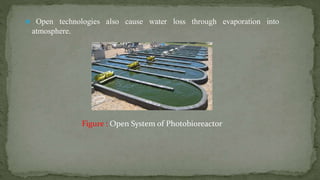
 Open technologies also cause water loss through evaporation into
atmosphere.
Figure : Open System of Photobioreactor
 Closed PBR construction reduces the risk of losses in water from the system, and the
chance of contamination is diminished.
 Although closed systems are more efficient in performance than open systems because of
the benefits mentioned above but they must be upgraded to make them appropriate for the
production of commodities with low prices because cell density is still insufficient due to
various limitation aspects.
 Modern photobioreactors have attempted to achieve a balance with a very thin film
suspension of culture, optimal lighting, less use of energy for pumps, and capital expense
and the purity of the microbial population
 However, light attenuation as well as an increase in CO2 demands with the growth are
two of the most likely changes to phototrophic cultures , which severely limit the
efficiency of photobioreactors.
 The accumulation of oxygen from photosynthetic sources as microalgae grow in
photobioreactors is believed to be a key element but it has been demonstrated by using
dynamic models that levels of dissolved oxygen that exceed 400% air saturation aren’t
inhibiting when the cell density is sufficiently high to block the light intensity in the later
stages of microalgal culture.
 Numerous different methods have been evaluated, however only a handful of approaches
could be used on large scale
Types of Closed systems Photo bioreactors :
There are present Five types of Closed systems Photo bioreactors such as;
1. TUBULAR PHOTOBIOREACTORS
2. CHRISTMAS TREE PHOTOBIOREACTOR
3. PLATE PHOTOBIOREACTOR
4. HORIZONTAL PHOTOBIOREACTOR
5. FOIL PHOTOBIOREACTOR
 Made up of glass or plastic tubes, this photobioreactor is working well at a production
scale.
 The tubes are laid either vertically or horizontally.
 They are connected to a central utility installation that includes sensors, pumps as well
as CO2 and nutrients.
 Photobioreactors with tubular structures are used worldwide from the laboratory to the
manufacturing scales,
e.g. to make the carotenoid Astaxanthine from the green algae Haematococcus p.
or to produce food supplements from the algae Chlorella vulgaris.
 Photo bioreactors benefit of the purity levels and their high-efficiency outputs.
 The production of biomass is accomplished at a top quality level, and the high biomass
content at the conclusion of the production permits an energy efficient downstream
processing
Figure : Tubular Photobioreactor
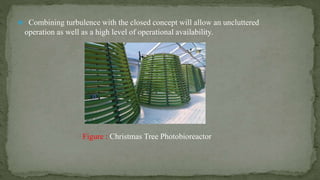
 A different approach is demonstrated by a photo bioreactor that is constructed in the
shape of a tapered geometrical structure and is equipped with a helically connected to a
transparent double hose system.
 This creates a design like the Christmas tree.
 Tubular systems are built in modules, and could theoretically be adapted outdoors to an
agricultural scale.
 The location of the dedicated area isn’t essential, as is the case with the other systems
that are closed, therefore, non-arable land can be used also.
 The material selection should stop biofouling as well as ensure high end biomass levels.
 Combining turbulence with the closed concept will allow an uncluttered
operation as well as a high level of operational availability.
Figure : Christmas Tree Photobioreactor
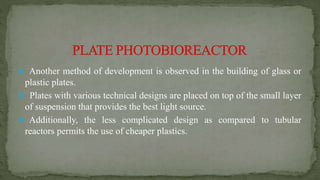
 Another method of development is observed in the building of glass or
plastic plates.
 Plates with various technical designs are placed on top of the small layer
of suspension that provides the best light source.
 Additionally, the less complicated design as compared to tubular
reactors permits the use of cheaper plastics.
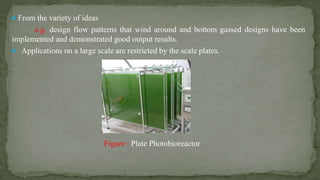
 From the variety of ideas
e.g. design flow patterns that wind around and bottom gassed designs have been
implemented and demonstrated good output results.
 Applications on a large scale are restricted by the scale plates.
Figure : Plate Photobioreactor
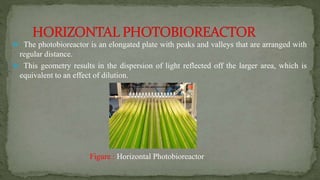
 The photobioreactor is an elongated plate with peaks and valleys that are arranged with
regular distance.
 This geometry results in the dispersion of light reflected off the larger area, which is
equivalent to an effect of dilution.
Figure : Horizontal Photobioreactor
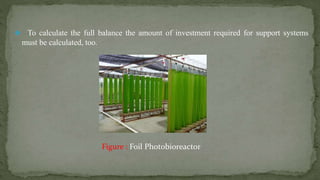
 The pressure from market prices has led to the development of photobioreactors
based on foils.
 Cheap PVC as well as PE foils are positioned into vessels or bags that cover algae
suspensions as well as expose them sunlight.
 The prices of photobioreactors has been increased by using foil systems.
 It is important to keep in the mind that these systems have an insufficient lifespan
since the foils must be replaced on a regular basic time.
 To calculate the full balance the amount of investment required for support systems
must be calculated, too.
Figure : Foil Photobioreactor
 There is no need for any other carbon resource.
 It is suitable to perform large-scale applications.
 It is suitable to create high density and low density ones.
 It is possible to use microalgae for development in the open air.
 Simple operation and maintenance.
 Low cost.
 Capital costs are very high.
 The production and productivity costs in certain enclosed photobioreactor
systems aren’t much different from open-pond bioreactors.
 The technical challenge in sterilization .
photobioreactor pptx

photobioreactor pptx

  • 1.
    G.KEERTHANAGOPAL, I - M.SCMICROBIOLOGY, DEPARTMENT OF MICROBIOLOGY, VIVEKANADHA ARTS AND SCIENCE COLLEGE FOR WOMEN, SANKAGIRI,SALEM,TAMILNADHU. SUBJECT : MICROALGAL TECHNOLOGY
  • 2.
    DEFINITION OF PHOTOBIOREACTOR A photobioreactor is a term that’s used to refer to any process or device which makes use of solar light to transform organic material into biomass.  This technology is widely used in wastewater treatment systems to eliminate nutrients from the wastewater.  Additionally it has been discovered that certain species of algae can produce important compounds like pigments, proteins, lipids carbohydrate, vitamins, polysaccharides, and more.
  • 3.
    TYPES OF PBR OPENSYSTEM CLOSED SYSTEMS
  • 4.
     The firstmethod of controlled production of phototrophic species was to use a natural open pond (also known as artificial raceway) pond.  The cultivation suspension that has all of the essential nutrients and carbon dioxide moved around in a continuous cycle that is illuminated directly by sunlight through its surface.  Raceway ponds continue to be employed in industries because of their lower operational costs when compared with closed PBRs.  They do however offer inadequate control over the reaction conditions because they rely on light sources from the environment, and carbon dioxide as well as the potential for contamination by other microorganisms.
  • 5.
     Open technologiesalso cause water loss through evaporation into atmosphere. Figure : Open System of Photobioreactor
  • 6.
     Closed PBRconstruction reduces the risk of losses in water from the system, and the chance of contamination is diminished.  Although closed systems are more efficient in performance than open systems because of the benefits mentioned above but they must be upgraded to make them appropriate for the production of commodities with low prices because cell density is still insufficient due to various limitation aspects.  Modern photobioreactors have attempted to achieve a balance with a very thin film suspension of culture, optimal lighting, less use of energy for pumps, and capital expense and the purity of the microbial population
  • 7.
     However, lightattenuation as well as an increase in CO2 demands with the growth are two of the most likely changes to phototrophic cultures , which severely limit the efficiency of photobioreactors.  The accumulation of oxygen from photosynthetic sources as microalgae grow in photobioreactors is believed to be a key element but it has been demonstrated by using dynamic models that levels of dissolved oxygen that exceed 400% air saturation aren’t inhibiting when the cell density is sufficiently high to block the light intensity in the later stages of microalgal culture.  Numerous different methods have been evaluated, however only a handful of approaches could be used on large scale
  • 8.
    Types of Closedsystems Photo bioreactors : There are present Five types of Closed systems Photo bioreactors such as; 1. TUBULAR PHOTOBIOREACTORS 2. CHRISTMAS TREE PHOTOBIOREACTOR 3. PLATE PHOTOBIOREACTOR 4. HORIZONTAL PHOTOBIOREACTOR 5. FOIL PHOTOBIOREACTOR
  • 9.
     Made upof glass or plastic tubes, this photobioreactor is working well at a production scale.  The tubes are laid either vertically or horizontally.  They are connected to a central utility installation that includes sensors, pumps as well as CO2 and nutrients.  Photobioreactors with tubular structures are used worldwide from the laboratory to the manufacturing scales, e.g. to make the carotenoid Astaxanthine from the green algae Haematococcus p. or to produce food supplements from the algae Chlorella vulgaris.
  • 10.
     Photo bioreactorsbenefit of the purity levels and their high-efficiency outputs.  The production of biomass is accomplished at a top quality level, and the high biomass content at the conclusion of the production permits an energy efficient downstream processing Figure : Tubular Photobioreactor
  • 11.
     A differentapproach is demonstrated by a photo bioreactor that is constructed in the shape of a tapered geometrical structure and is equipped with a helically connected to a transparent double hose system.  This creates a design like the Christmas tree.  Tubular systems are built in modules, and could theoretically be adapted outdoors to an agricultural scale.  The location of the dedicated area isn’t essential, as is the case with the other systems that are closed, therefore, non-arable land can be used also.  The material selection should stop biofouling as well as ensure high end biomass levels.
  • 12.
     Combining turbulencewith the closed concept will allow an uncluttered operation as well as a high level of operational availability. Figure : Christmas Tree Photobioreactor
  • 13.
     Another methodof development is observed in the building of glass or plastic plates.  Plates with various technical designs are placed on top of the small layer of suspension that provides the best light source.  Additionally, the less complicated design as compared to tubular reactors permits the use of cheaper plastics.
  • 14.
     From thevariety of ideas e.g. design flow patterns that wind around and bottom gassed designs have been implemented and demonstrated good output results.  Applications on a large scale are restricted by the scale plates. Figure : Plate Photobioreactor
  • 15.
     The photobioreactoris an elongated plate with peaks and valleys that are arranged with regular distance.  This geometry results in the dispersion of light reflected off the larger area, which is equivalent to an effect of dilution. Figure : Horizontal Photobioreactor
  • 16.
     The pressurefrom market prices has led to the development of photobioreactors based on foils.  Cheap PVC as well as PE foils are positioned into vessels or bags that cover algae suspensions as well as expose them sunlight.  The prices of photobioreactors has been increased by using foil systems.  It is important to keep in the mind that these systems have an insufficient lifespan since the foils must be replaced on a regular basic time.
  • 17.
     To calculatethe full balance the amount of investment required for support systems must be calculated, too. Figure : Foil Photobioreactor
  • 18.
     There isno need for any other carbon resource.  It is suitable to perform large-scale applications.  It is suitable to create high density and low density ones.  It is possible to use microalgae for development in the open air.  Simple operation and maintenance.  Low cost.
  • 19.
     Capital costsare very high.  The production and productivity costs in certain enclosed photobioreactor systems aren’t much different from open-pond bioreactors.  The technical challenge in sterilization .