Introduction to
ERP Concept
Dr. Kamal Gulati
Introduction to ERP
Concept
Concept
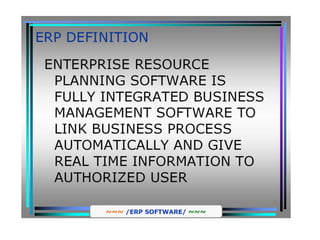
• ERP is short of Enterprise Resource
Planning, which is business management
system that integrates all facts of the
business such as manufacturing
operations, supply chain, customers,
human resource & finance.
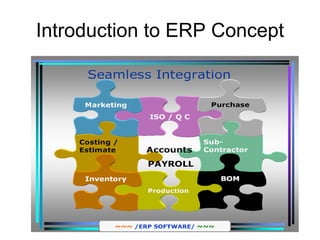
Introduction to ERP Concept
Welingkar’s Distance Learning Division
We Learn – A Continuous Learning Forum
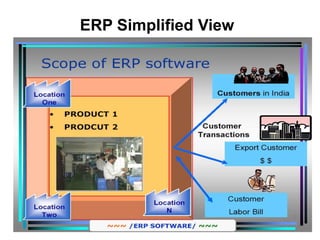
ERP Simplified ViewP
Simplified view
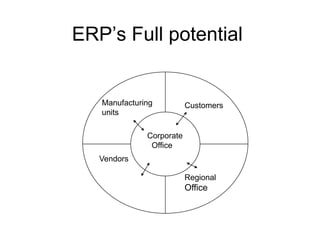
ERP’s Full potential
Corporate
Office
Regional
Office
Customers
Vendors
Manufacturing
units
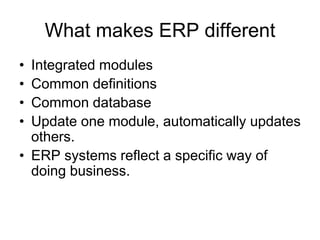
What makes ERP different
• Integrated modules
• Common definitions
• Common database
• Update one module, automatically updates
others.
• ERP systems reflect a specific way of
doing business.
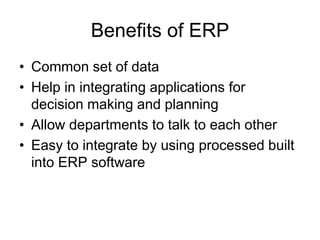
Benefits of ERP
• Common set of data
• Help in integrating applications for
decision making and planning
• Allow departments to talk to each other
• Easy to integrate by using processed built
into ERP software
Common Pitfalls
• It is very expensive to purchase and
even more so to customize.
• Implementation may require major
changes in the company and its
processes.
• It is so complex that many companies
cannot adjust to it.
• It involves an ongoing, possibly never
ending, process for implementation
Vendors
What is SAP
• SAP = Systems, Applications and Products in
Data Processing
• German Based Company
• 3rd Largest Independent Software Vendor in the
World
• SAP: ERP Market Leader
• 80% Fortune 500 Companies use SAP
• Over 18,500 Co’s using SAP in 120+ Countries
• Over 12 million users
What is SAP
• Client/Server Technology
• Highly Customizable
• Based on Industry Specific Best Practices
• Multi-lingual: International
• Based on Open Standards
• Integrated Applications System: Modular in
design
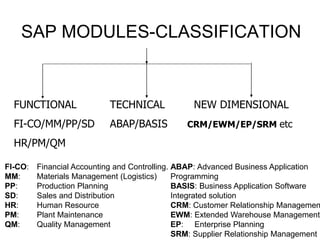
SAP MODULES-CLASSIFICATION
FUNCTIONAL TECHNICAL NEW DIMENSIONAL
FI-CO/MM/PP/SD ABAP/BASIS CRM/EWM/EP/SRM etc
HR/PM/QM
FI-CO: Financial Accounting and Controlling.
MM: Materials Management (Logistics)
PP: Production Planning
SD: Sales and Distribution
HR: Human Resource
PM: Plant Maintenance
QM: Quality Management
ABAP: Advanced Business Application
Programming
BASIS: Business Application Software
Integrated solution
CRM: Customer Relationship Managemen
EWM: Extended Warehouse Management
EP: Enterprise Planning
SRM: Supplier Relationship Management
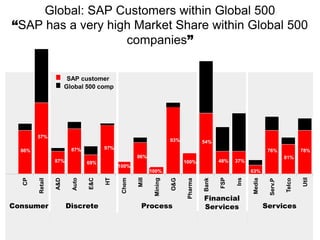
Global: SAP Customers within Global 500
“SAP has a very high Market Share within Global 500
companies”
78%
81%
76%
63%
37%48%
54%
100%
93%
100%
86%
100%
97%
69%
87%
87%
57%
86%
CP
Retail
A&D
Auto
E&C
HT
Chem
Mill
Mining
O&G
Pharma
Bank
FSP
Ins
Media
Serv.P
Telco
Util
Consumer Discrete Process
Financial
Services Services
SAP customer
Global 500 comp
Architecture
• Central relational database (e.g., Oracle )
• Client/Server—three-tiered
SAP 3 – Tier Architecture
USER PCs
USER PCs
Application
Server
Application
Server
Application
Server
Application
Server
Database
Server
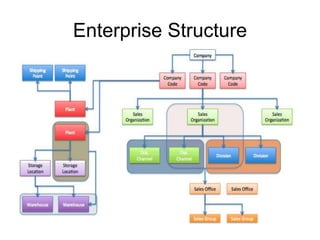
Enterprise Structure
Landscape
• Landscape means layout of servers.
• Types of landscape in SAP
– Single tier architecture
– Two tier architecture
– Three tier architecture
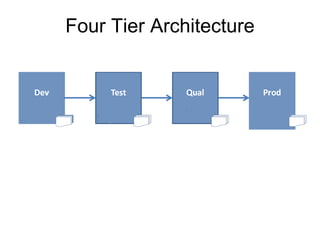
– Four tier architecture
Four Tier Architecture
TYPES OF PROJECTS
• Implementation Project
A project to implement SAP solution as a part of regular
implementation. This is considered for single-site
implementations.
• Upgrade Project
A project to upgrade existing SAP systems. An upgrade
project can be a technical upgrade or functional upgrade
or a strategy upgrade
• Support project
This project is to maintain a solution during Change
Request Management. The project contains all
maintenance activities and urgent corrections of a
solution.
• Rollout project
Say a company is having branches in 3 to 4
countries. In one country they have already
implemented SAP if wants to implement the same
SAP in other countries of their branches they will
simply follow the same SAP implementation policy.
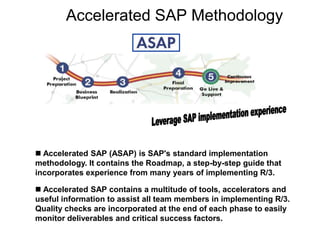
Accelerated SAP Methodology
 Accelerated SAP (ASAP) is SAP's standard implementation
methodology. It contains the Roadmap, a step-by-step guide that
incorporates experience from many years of implementing R/3.
 Accelerated SAP contains a multitude of tools, accelerators and
useful information to assist all team members in implementing R/3.
Quality checks are incorporated at the end of each phase to easily
monitor deliverables and critical success factors.
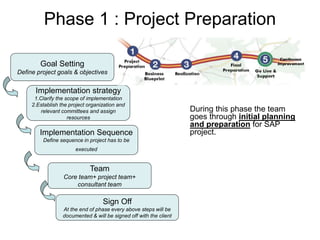
Phase 1 : Project Preparation
Goal Setting
Define project goals & objectives
Implementation strategy
1.Clarify the scope of implementation
2.Establish the project organization and
relevant committees and assign
resources
Implementation Sequence
Define sequence in project has to be
executed
Team
Core team+ project team+
consultant team
Sign Off
At the end of phase every above steps will be
documented & will be signed off with the client
During this phase the team
goes through initial planning
and preparation for SAP
project.
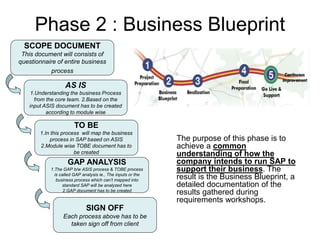
Phase 2 : Business Blueprint
SCOPE DOCUMENT
This document will consists of
questionnaire of entire business
process
AS IS
1.Understanding the business Process
from the core team. 2.Based on the
input ASIS document has to be created
according to module wise
TO BE
1.In this process will map the business
process in SAP based on ASIS
2.Module wise TOBE document has to
be created
GAP ANALYSIS
1.The GAP b/w ASIS process & TOBE process
is called GAP analysis ie., The inputs or the
business process which can’t mapped into
standard SAP will be analyzed here
2.GAP document has to be created
SIGN OFF
Each process above has to be
taken sign off from client
The purpose of this phase is to
achieve a common
understanding of how the
company intends to run SAP to
support their business. The
result is the Business Blueprint, a
detailed documentation of the
results gathered during
requirements workshops.
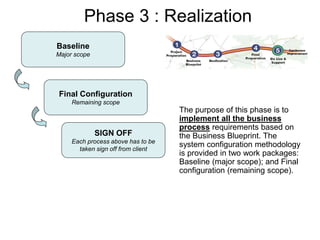
Phase 3 : Realization
Baseline
Major scope
Final Configuration
Remaining scope
SIGN OFF
Each process above has to be
taken sign off from client
The purpose of this phase is to
implement all the business
process requirements based on
the Business Blueprint. The
system configuration methodology
is provided in two work packages:
Baseline (major scope); and Final
configuration (remaining scope).
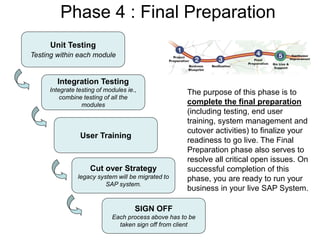
Phase 4 : Final Preparation
Unit Testing
Testing within each module
Integration Testing
Integrate testing of modules ie.,
combine testing of all the
modules
User Training
The purpose of this phase is to
complete the final preparation
(including testing, end user
training, system management and
cutover activities) to finalize your
readiness to go live. The Final
Preparation phase also serves to
resolve all critical open issues. On
successful completion of this
phase, you are ready to run your
business in your live SAP System.
Cut over Strategy
legacy system will be migrated to
SAP system.
SIGN OFF
Each process above has to be
taken sign off from client
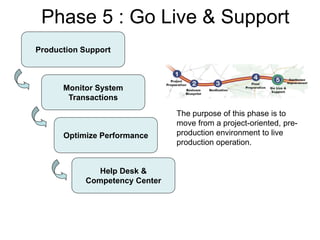
Phase 5 : Go Live & Support
Production Support
Monitor System
Transactions
Optimize Performance
The purpose of this phase is to
move from a project-oriented, pre-
production environment to live
production operation.
Help Desk &
Competency Center
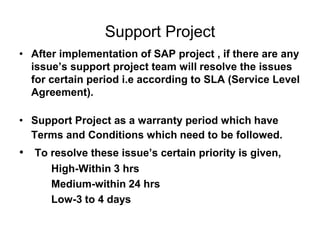
Support Project
• After implementation of SAP project , if there are any
issue’s support project team will resolve the issues
for certain period i.e according to SLA (Service Level
Agreement).
• Support Project as a warranty period which have
Terms and Conditions which need to be followed.
• To resolve these issue’s certain priority is given,
High-Within 3 hrs
Medium-within 24 hrs
Low-3 to 4 days
Tools Used in Support Projects
Tools will be categorized on the basis of following
parameters:
a) Tools Provided by SAP :
-- Solution Manager.
b) Third Party Tools approved by SAP :
-- SMS
-- REMEDY
-- DOLPHIN
-- PERIGRIM
Solution Manager
• SAP solution manager supports the customer and the
implementation partner through out the entire life cycle
of the solution, from the business blueprint to the
configuration and go-live stages.
• SAP solution manager is a separate system providing
both implementation and operational tools. It provides
central access to tools methods and preconfigured
content, that you can use during the evaluation,
implementation, and productive operation of your
systems.
Advantages of using SAP
• It allows bridging some barriers like currency exchange
rates, language, and culture automatically.
• It provides real time information.
• It reduces the possibility of redundancy errors.
• By using it the company or enterprise have more efficient
work environment.
• It provides a good knowledge like an expert about
building and implementation of a system.
Disadvantages of using SAP
• A contract is required to sign by the company to use
SAP software and it holds that companies to the vendor
until the expiry of the contract.
• It is inflexible because sometimes the vendor package
does not fit a company’s business model.
• To implement and use SAP can be very expensive.
• This is not secure as a risk of project failure is there.
Dr. Kamal Gulati
Associate Professor |
University Quality Support Head
Mentoring Programme Coordinator &
Exam Superintendent |
[Ph. D., M.Sc. (Computer Science), M.C.A., M.B.A]
Professional Certifications:
• Certified Microsoft Innovative Educator
• Data Science 101 Certification from Big Data University
• R Language 101 Certification from Big Data University
• SQL Certification from SOLOLEARN.com
• Certified IBM Big Data 101 from Big Data University
• R Program & Python Certified from DataCamp
• Wiley Certified Big Data Analyst [WCBDA]
• Certification on DBMS from IIT Mumbai
• Certified Cisco Certified Network Associate [CCNA]
• Certified Microsoft Certified Professional [MCP]
• Certified Brainbench in (MS Access, MS Project, MySQL 5.7 Administration, Computer
Fundamentals, Advanced Ms. Excel & Windows OS)
• Real-time Advertising Fundamentals Certified from RTA Academy
• Worked as Visiting Professor with Stratford University, USA for six months from
Jan’2016 to June’2016.
• Also worked at Bahrain University in Kingdom of Bahrain Sr. I.T. Faculty (Computer
Science Department) for Period of 2 Years.
• Have rich experience in the field of teaching and research in Computer Science and
Information Technology for almost 16+ years in Academia.
• Having experience of working with both private and public institutions and
universities as the lecturer and self-instruction material writer for Information
Technology courses.
• Had number of research papers published in national and international journals and
conference proceedings in IEEE and Scopus Index.
• Also chaired various National and International Conferences of repute and
associated with various International Journals as Editorial Board Member for
International and National, Academic Adviser and Research Paper Reviewer.
• My current area of interest: Big Data Analytics, R Software, Internet & Web
Technology, IT Project Management, Decision Support System, Business Analytics,
Management Information System, Database Management System, Data Networking,
R Software and Advanced Excel with Visual Basic Macros.
• Country Visited: USA, Canada, UAE, Bahrain, Oman (Mostly for Teaching and Research
Purpose)
Profile of Dr. Kamal Gulati
Profile Contd….• Technical Program Committee for International Conference on Data, Engineering and
Applications 2017 (IDEA-2k17) which would be on October 28-29, 2017 at Bhopal.
http://www.ideaconference.in
• Advisory Board Committee Member for International Conference on Energy,
Communication, Data Analytics and Soft Computing (ICECDS) which would be on 1-2
August 2017 at SKR Engineering College, Poonamallee, Tamil Nadu, India.
http://ecds.org.in
• Advisory Committee Member for International Conference on Innovative Research in
Engineering and Science which would be on 16-17 June 2017 at Asian Institute of
Technology Conference Center Thailand. http://www.iresconf.org
• Advisory Committee Member for International Conference on Cloud Computing and
Internet of everything which held on 10-11 Feb’2016 at Delhi-NCR. http://www.ccioet.org
• Technical Committee member for InCITe-2016 (International Conference on Information
Technology) Theme - Internet of Things: Connect Your Worlds, IT Summit, Amity
University 2016 which held on 06-07 Oct, 2016. http://www.amity.edu/incite2016
• Technical Speaker for Global perspective on IT business “The Changing Scenario” – Big
Data on International Students Conference New Delhi (ISCND) which held on 14-15 Oct,
2016 http://iscnd.com
• Advisory Committee Member for International Conference on Sustainable Computing
Techniques in Engineering, Science and Management which has held on 09-10 Sep’2016 at
Delhi-NCR. http://www.scesm.org
• Technical Program Committee Member for Program Committee Member for International
Conference on Recent Trends IN ICT, Jaipur, India, Aug 18-19, 2017 http://rtict.org
• Program Committee Member for International Conference on Recent Advancement in
Computer and Communication Bhopal, India, (IC-RAC-2017) May 26-27, 2017
http://www.icrac.co.in
Profile Contd….
• Editorial Board member for the following International Journals:
– International Journal of Computer Science and Innovation
http://www.infinitysciences.org
– International Journal of Latest Research in Engineering and
Technology http://www.ijlret.com
– International Journal of Latest Trends in Engineering and
Technology http://www.ijltet.org
– International Journal of Application or
Innovation in Engineering & Management
http://www.ijaiem.org
– International Journal for Management http://www.ijm-apm.com
– The International Journal of Emerging Engineering and Embedded
Systems http://www.ijeees.org
– Conference Info http://conferenceinfo.org/tpc.php
• Expert Speaker for Program “Insurance Beyond Doubt” Presented by
Oriental Insurance Co Ltd.
https://www.youtube.com/watch?v=GrvJkN_Zn3Q
BOOK, CHAPTER, and CASE STUDY
Published
• Published Book on “A Study of Changing Trends in E-CRM of
Indian Insurance Industry” Published by LAP Lambert Academic
Publishing, one of the top researchers and renowned scientists of
Germany with ISBN: 3330009543, 9783330009547. The Book
available at Amazon.com.
• Published Real Case Study on “IoT Security Considerations for
Higher Education” published on Business Cases - RENVOI 2017
BOOK (The Case Centre, UK) with ISBN: 978-1-4828-8840-9, Page
63-70. The Book available at the various online website: Amazon,
AbeBooks, Chegg, Barnes & Noble.
• Published Chapter on "Role of eWorld in Insurance Innovation"
Published by Insurance Institute of India (III), 60 Years Diamond
Jubilee, Compendium, Nov 2016 – (Magazine) – One of the
premium Insurance Institute of India.
Contact Details
• Email : drkamalgulati@gmail.com
• Website : http://mybigdataanalytics.com
• LinkedIn :
https://in.linkedin.com/in/drkamalgulati
• Twitter : @DrKamalGulati
• Skype : kamalgulati7
• Phone: +91-9718361928

Introduction to ERP Concept

  • 1.
  • 2.
    Introduction to ERP Concept Concept •ERP is short of Enterprise Resource Planning, which is business management system that integrates all facts of the business such as manufacturing operations, supply chain, customers, human resource & finance.
  • 3.
  • 4.
    Welingkar’s Distance LearningDivision We Learn – A Continuous Learning Forum ERP Simplified ViewP Simplified view
  • 6.
  • 7.
    What makes ERPdifferent • Integrated modules • Common definitions • Common database • Update one module, automatically updates others. • ERP systems reflect a specific way of doing business.
  • 8.
    Benefits of ERP •Common set of data • Help in integrating applications for decision making and planning • Allow departments to talk to each other • Easy to integrate by using processed built into ERP software
  • 9.
    Common Pitfalls • Itis very expensive to purchase and even more so to customize. • Implementation may require major changes in the company and its processes. • It is so complex that many companies cannot adjust to it. • It involves an ongoing, possibly never ending, process for implementation
  • 10.
  • 11.
    What is SAP •SAP = Systems, Applications and Products in Data Processing • German Based Company • 3rd Largest Independent Software Vendor in the World • SAP: ERP Market Leader • 80% Fortune 500 Companies use SAP • Over 18,500 Co’s using SAP in 120+ Countries • Over 12 million users
  • 12.
    What is SAP •Client/Server Technology • Highly Customizable • Based on Industry Specific Best Practices • Multi-lingual: International • Based on Open Standards • Integrated Applications System: Modular in design
  • 14.
    SAP MODULES-CLASSIFICATION FUNCTIONAL TECHNICALNEW DIMENSIONAL FI-CO/MM/PP/SD ABAP/BASIS CRM/EWM/EP/SRM etc HR/PM/QM FI-CO: Financial Accounting and Controlling. MM: Materials Management (Logistics) PP: Production Planning SD: Sales and Distribution HR: Human Resource PM: Plant Maintenance QM: Quality Management ABAP: Advanced Business Application Programming BASIS: Business Application Software Integrated solution CRM: Customer Relationship Managemen EWM: Extended Warehouse Management EP: Enterprise Planning SRM: Supplier Relationship Management
  • 15.
    Global: SAP Customerswithin Global 500 “SAP has a very high Market Share within Global 500 companies” 78% 81% 76% 63% 37%48% 54% 100% 93% 100% 86% 100% 97% 69% 87% 87% 57% 86% CP Retail A&D Auto E&C HT Chem Mill Mining O&G Pharma Bank FSP Ins Media Serv.P Telco Util Consumer Discrete Process Financial Services Services SAP customer Global 500 comp
  • 16.
    Architecture • Central relationaldatabase (e.g., Oracle ) • Client/Server—three-tiered
  • 17.
    SAP 3 –Tier Architecture USER PCs USER PCs Application Server Application Server Application Server Application Server Database Server
  • 18.
  • 19.
    Landscape • Landscape meanslayout of servers. • Types of landscape in SAP – Single tier architecture – Two tier architecture – Three tier architecture – Four tier architecture
  • 20.
  • 21.
    TYPES OF PROJECTS •Implementation Project A project to implement SAP solution as a part of regular implementation. This is considered for single-site implementations. • Upgrade Project A project to upgrade existing SAP systems. An upgrade project can be a technical upgrade or functional upgrade or a strategy upgrade
  • 22.
    • Support project Thisproject is to maintain a solution during Change Request Management. The project contains all maintenance activities and urgent corrections of a solution. • Rollout project Say a company is having branches in 3 to 4 countries. In one country they have already implemented SAP if wants to implement the same SAP in other countries of their branches they will simply follow the same SAP implementation policy.
  • 23.
    Accelerated SAP Methodology Accelerated SAP (ASAP) is SAP's standard implementation methodology. It contains the Roadmap, a step-by-step guide that incorporates experience from many years of implementing R/3.  Accelerated SAP contains a multitude of tools, accelerators and useful information to assist all team members in implementing R/3. Quality checks are incorporated at the end of each phase to easily monitor deliverables and critical success factors.
  • 24.
    Phase 1 :Project Preparation Goal Setting Define project goals & objectives Implementation strategy 1.Clarify the scope of implementation 2.Establish the project organization and relevant committees and assign resources Implementation Sequence Define sequence in project has to be executed Team Core team+ project team+ consultant team Sign Off At the end of phase every above steps will be documented & will be signed off with the client During this phase the team goes through initial planning and preparation for SAP project.
  • 25.
    Phase 2 :Business Blueprint SCOPE DOCUMENT This document will consists of questionnaire of entire business process AS IS 1.Understanding the business Process from the core team. 2.Based on the input ASIS document has to be created according to module wise TO BE 1.In this process will map the business process in SAP based on ASIS 2.Module wise TOBE document has to be created GAP ANALYSIS 1.The GAP b/w ASIS process & TOBE process is called GAP analysis ie., The inputs or the business process which can’t mapped into standard SAP will be analyzed here 2.GAP document has to be created SIGN OFF Each process above has to be taken sign off from client The purpose of this phase is to achieve a common understanding of how the company intends to run SAP to support their business. The result is the Business Blueprint, a detailed documentation of the results gathered during requirements workshops.
  • 26.
    Phase 3 :Realization Baseline Major scope Final Configuration Remaining scope SIGN OFF Each process above has to be taken sign off from client The purpose of this phase is to implement all the business process requirements based on the Business Blueprint. The system configuration methodology is provided in two work packages: Baseline (major scope); and Final configuration (remaining scope).
  • 27.
    Phase 4 :Final Preparation Unit Testing Testing within each module Integration Testing Integrate testing of modules ie., combine testing of all the modules User Training The purpose of this phase is to complete the final preparation (including testing, end user training, system management and cutover activities) to finalize your readiness to go live. The Final Preparation phase also serves to resolve all critical open issues. On successful completion of this phase, you are ready to run your business in your live SAP System. Cut over Strategy legacy system will be migrated to SAP system. SIGN OFF Each process above has to be taken sign off from client
  • 28.
    Phase 5 :Go Live & Support Production Support Monitor System Transactions Optimize Performance The purpose of this phase is to move from a project-oriented, pre- production environment to live production operation. Help Desk & Competency Center
  • 29.
    Support Project • Afterimplementation of SAP project , if there are any issue’s support project team will resolve the issues for certain period i.e according to SLA (Service Level Agreement). • Support Project as a warranty period which have Terms and Conditions which need to be followed. • To resolve these issue’s certain priority is given, High-Within 3 hrs Medium-within 24 hrs Low-3 to 4 days
  • 30.
    Tools Used inSupport Projects Tools will be categorized on the basis of following parameters: a) Tools Provided by SAP : -- Solution Manager. b) Third Party Tools approved by SAP : -- SMS -- REMEDY -- DOLPHIN -- PERIGRIM
  • 31.
    Solution Manager • SAPsolution manager supports the customer and the implementation partner through out the entire life cycle of the solution, from the business blueprint to the configuration and go-live stages. • SAP solution manager is a separate system providing both implementation and operational tools. It provides central access to tools methods and preconfigured content, that you can use during the evaluation, implementation, and productive operation of your systems.
  • 32.
    Advantages of usingSAP • It allows bridging some barriers like currency exchange rates, language, and culture automatically. • It provides real time information. • It reduces the possibility of redundancy errors. • By using it the company or enterprise have more efficient work environment. • It provides a good knowledge like an expert about building and implementation of a system.
  • 33.
    Disadvantages of usingSAP • A contract is required to sign by the company to use SAP software and it holds that companies to the vendor until the expiry of the contract. • It is inflexible because sometimes the vendor package does not fit a company’s business model. • To implement and use SAP can be very expensive. • This is not secure as a risk of project failure is there.
  • 34.
    Dr. Kamal Gulati AssociateProfessor | University Quality Support Head Mentoring Programme Coordinator & Exam Superintendent | [Ph. D., M.Sc. (Computer Science), M.C.A., M.B.A] Professional Certifications: • Certified Microsoft Innovative Educator • Data Science 101 Certification from Big Data University • R Language 101 Certification from Big Data University • SQL Certification from SOLOLEARN.com • Certified IBM Big Data 101 from Big Data University • R Program & Python Certified from DataCamp • Wiley Certified Big Data Analyst [WCBDA] • Certification on DBMS from IIT Mumbai • Certified Cisco Certified Network Associate [CCNA] • Certified Microsoft Certified Professional [MCP] • Certified Brainbench in (MS Access, MS Project, MySQL 5.7 Administration, Computer Fundamentals, Advanced Ms. Excel & Windows OS) • Real-time Advertising Fundamentals Certified from RTA Academy
  • 35.
    • Worked asVisiting Professor with Stratford University, USA for six months from Jan’2016 to June’2016. • Also worked at Bahrain University in Kingdom of Bahrain Sr. I.T. Faculty (Computer Science Department) for Period of 2 Years. • Have rich experience in the field of teaching and research in Computer Science and Information Technology for almost 16+ years in Academia. • Having experience of working with both private and public institutions and universities as the lecturer and self-instruction material writer for Information Technology courses. • Had number of research papers published in national and international journals and conference proceedings in IEEE and Scopus Index. • Also chaired various National and International Conferences of repute and associated with various International Journals as Editorial Board Member for International and National, Academic Adviser and Research Paper Reviewer. • My current area of interest: Big Data Analytics, R Software, Internet & Web Technology, IT Project Management, Decision Support System, Business Analytics, Management Information System, Database Management System, Data Networking, R Software and Advanced Excel with Visual Basic Macros. • Country Visited: USA, Canada, UAE, Bahrain, Oman (Mostly for Teaching and Research Purpose) Profile of Dr. Kamal Gulati
  • 36.
    Profile Contd….• TechnicalProgram Committee for International Conference on Data, Engineering and Applications 2017 (IDEA-2k17) which would be on October 28-29, 2017 at Bhopal. http://www.ideaconference.in • Advisory Board Committee Member for International Conference on Energy, Communication, Data Analytics and Soft Computing (ICECDS) which would be on 1-2 August 2017 at SKR Engineering College, Poonamallee, Tamil Nadu, India. http://ecds.org.in • Advisory Committee Member for International Conference on Innovative Research in Engineering and Science which would be on 16-17 June 2017 at Asian Institute of Technology Conference Center Thailand. http://www.iresconf.org • Advisory Committee Member for International Conference on Cloud Computing and Internet of everything which held on 10-11 Feb’2016 at Delhi-NCR. http://www.ccioet.org • Technical Committee member for InCITe-2016 (International Conference on Information Technology) Theme - Internet of Things: Connect Your Worlds, IT Summit, Amity University 2016 which held on 06-07 Oct, 2016. http://www.amity.edu/incite2016 • Technical Speaker for Global perspective on IT business “The Changing Scenario” – Big Data on International Students Conference New Delhi (ISCND) which held on 14-15 Oct, 2016 http://iscnd.com • Advisory Committee Member for International Conference on Sustainable Computing Techniques in Engineering, Science and Management which has held on 09-10 Sep’2016 at Delhi-NCR. http://www.scesm.org • Technical Program Committee Member for Program Committee Member for International Conference on Recent Trends IN ICT, Jaipur, India, Aug 18-19, 2017 http://rtict.org • Program Committee Member for International Conference on Recent Advancement in Computer and Communication Bhopal, India, (IC-RAC-2017) May 26-27, 2017 http://www.icrac.co.in
  • 37.
    Profile Contd…. • EditorialBoard member for the following International Journals: – International Journal of Computer Science and Innovation http://www.infinitysciences.org – International Journal of Latest Research in Engineering and Technology http://www.ijlret.com – International Journal of Latest Trends in Engineering and Technology http://www.ijltet.org – International Journal of Application or Innovation in Engineering & Management http://www.ijaiem.org – International Journal for Management http://www.ijm-apm.com – The International Journal of Emerging Engineering and Embedded Systems http://www.ijeees.org – Conference Info http://conferenceinfo.org/tpc.php • Expert Speaker for Program “Insurance Beyond Doubt” Presented by Oriental Insurance Co Ltd. https://www.youtube.com/watch?v=GrvJkN_Zn3Q
  • 38.
    BOOK, CHAPTER, andCASE STUDY Published • Published Book on “A Study of Changing Trends in E-CRM of Indian Insurance Industry” Published by LAP Lambert Academic Publishing, one of the top researchers and renowned scientists of Germany with ISBN: 3330009543, 9783330009547. The Book available at Amazon.com. • Published Real Case Study on “IoT Security Considerations for Higher Education” published on Business Cases - RENVOI 2017 BOOK (The Case Centre, UK) with ISBN: 978-1-4828-8840-9, Page 63-70. The Book available at the various online website: Amazon, AbeBooks, Chegg, Barnes & Noble. • Published Chapter on "Role of eWorld in Insurance Innovation" Published by Insurance Institute of India (III), 60 Years Diamond Jubilee, Compendium, Nov 2016 – (Magazine) – One of the premium Insurance Institute of India.
  • 39.
    Contact Details • Email: drkamalgulati@gmail.com • Website : http://mybigdataanalytics.com • LinkedIn : https://in.linkedin.com/in/drkamalgulati • Twitter : @DrKamalGulati • Skype : kamalgulati7 • Phone: +91-9718361928