Enterprise Resource Planning Presented by: Sandeep Tiwari  PGDM 3 rd  sem.
ERP – General Concepts 1.  What is ERP? 2.  Evolution 3.  Why ERP? 4.  Definition 5.  Expectations Enterprise Resource Planning
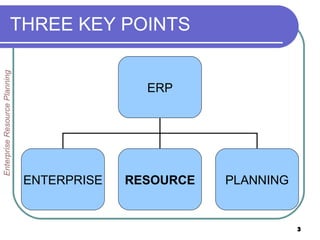
THREE KEY POINTS Enterprise Resource Planning ERP ENTERPRISE RESOURCE PLANNING
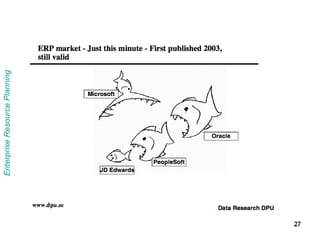
Enterprise resource planning (ERP) is the industry term used to describe a broad set of activities supported by multi-module application software that helps a manufacturer or other business manage the important parts of its business.  These parts can include product planning, parts purchasing, maintaining inventories, interacting with suppliers, providing customer service, and tracking orders.   ERP can also include application modules for the finance and human resources aspects of a business.  Some of the bigger players in the ERP outsourcing market are  SAP, Peoplesoft, and J. D. Edwards. New comers include Oracle, IBM, and Microsoft.  MEANING OF ERP Enterprise Resource Planning
What is ERP? ERP is a solution, which Enterprise Resource Planning facilitates company-wide integrated  information systems, covering all  functional areas performs core Corporate activities and  increases customer service augmenting  Corporate Image
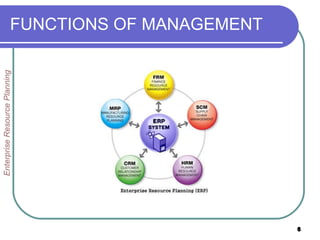
FUNCTIONS OF MANAGEMENT Enterprise Resource Planning
Why ERP? For Management – to know what is happening in the company One solution for better Management For cycle time reduction To achieve cost control & low working capital To marry latest technologies To shun the geographical gaps To satisfy the customers with high expectations To be Competitive & for survival Enterprise Resource Planning
ERP – Expectations Integrating all the functions Integrating the systems running in all the locations Transparency of information using a single data source across the organization Software must be responsive Modular Flexible Easy to add functionalities Provide growth path Enterprise Resource Planning
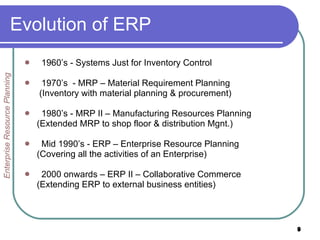
Evolution of ERP 1960’s - Systems Just for Inventory Control 1970’s  - MRP – Material Requirement Planning (Inventory with material planning & procurement) 1980’s - MRP II – Manufacturing Resources Planning (Extended MRP to shop floor & distribution Mgnt.) Mid 1990’s - ERP – Enterprise Resource Planning (Covering all the activities of an Enterprise) 2000 onwards – ERP II – Collaborative Commerce (Extending ERP to external business entities) Enterprise Resource Planning
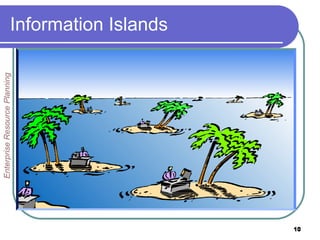
Information Islands Enterprise Resource Planning
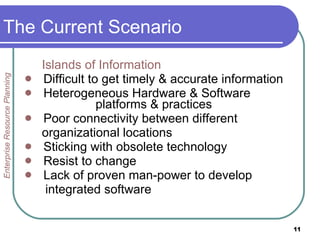
The Current Scenario Islands of Information Difficult to get timely & accurate information Heterogeneous Hardware & Software  platforms & practices Poor connectivity between different organizational locations Sticking with obsolete technology Resist to change Lack of proven man-power to develop integrated software Enterprise Resource Planning
ERP – Options  OPTION 1 – MAKE [Using Internal resources] Developing a custom-built ERP package, specific to the   requirements of the organization, with the help of the in-house IT department OPTION 2 - BUY Going for Tailor-made ERP packages available in the market like SAP, Oracle applications, Baan, PeopleSoft etc. OPTION 3 – MAKE [using External resources] Developing a custom-built ERP package, specific to the requirements of the organization, with the help of a software solution provider. Enterprise Resource Planning
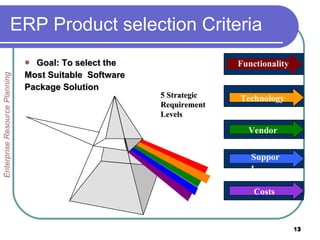
ERP Product selection Criteria Goal: To select the Most Suitable  Software  Package Solution 5 Strategic Requirement Levels Functionality Technology Vendor Support Costs Enterprise Resource Planning
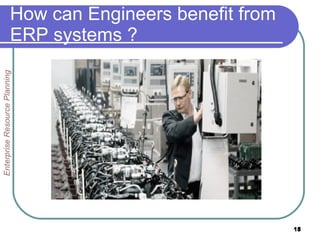
How can Engineers benefit from ERP systems ? Enterprise Resource Planning
Usesful SAP Modules for Engineers MM- Material Management Better Procurement Handling Org a nized Inventory Management Easy Purchase Organization Faster Storage Location  PM – Plant Maintenance Maintenance Order Management Equipment and Technical Objects Coordination Preventive Maintenance Workflow Scenarios  Work Clearance Management
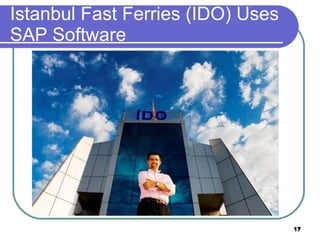
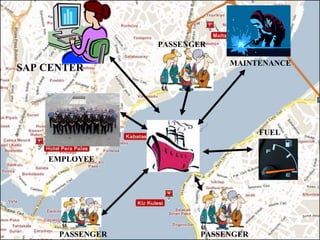
Istanbul Fast Ferries (IDO) Uses SAP Software
SAP CENTER EMPLOYEE PASS E NGER PASS E NGER PASS E NGER FUEL MAINTENANCE
Annually 91 million passanger Annually 5,5 million vehicles Daily 1,200 navigation capacity 90 Ships 82 Terminals 3,200 personel 314 Million YTL endorsement  Istanbul Fast Ferries (IDO) Enterprise Resource Planning
SAP Systems arranges  relationship between ; shipping condition s ,  route determination,  shipping point ,  employee conditions,  fuel supply,  maintenance  Enterprise Resource Planning
Controlling Module (CO)  IDO pass e nger can send SMS to IDO SAP system and get the information about shipping route times. This process is a service of Controlling Module. Enterprise Resource Planning
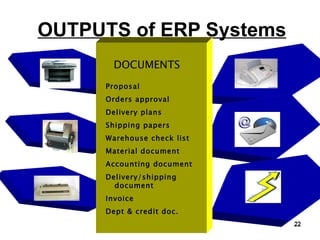
OUTPUTS  of ERP Systems DOCUMENTS Proposal Orders approval Delivery plans Shipping papers Warehouse check list Material document Accounting document Delivery/shipping document Invoice  Dept & credit doc.
The Cost of ERP Systems Major suppliers  are SAP AG, Peoplesoft, Oracle, and Baan. Also smaller PC based suppliers. Costs  for larger ERP systems range from hundreds of thousands to several million dollars. Outside consultants  are usually involved in selection, configuration, and implementation. Enterprise Resource Planning
The Cost of ERP Systems Consultant costs can run up to 3 times the cost of the system  itself according to a Gartner Group study. Added costs also include  additional people, new computer hardware, and the cost to develop a new, integrated database  Successful implementation requires  leadership  and  top management commitment to a vision for the business Enterprise Resource Planning
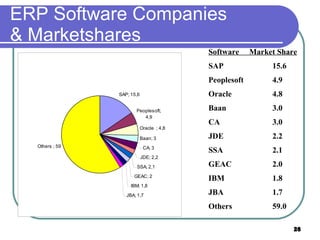
ERP Software Companies & Marketshares Software   Market Shar e SAP 15.6 Peoplesoft 4.9 Oracle  4.8 Baan 3.0 CA 3.0 JDE 2.2 SSA 2.1 GEAC 2.0 IBM 1.8 JBA 1.7 Others  59.0
Enterprise Resource Planning
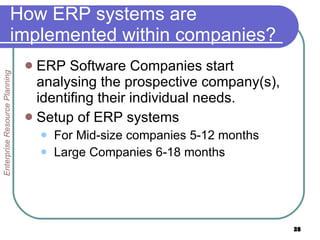
How ERP systems are implemented within companies? ERP Software Companies start analysing the prospective company(s), identifing their individual needs.  Setup of ERP systems For Mid-size companies 5-12 months  Large Companies 6-18 months Enterprise Resource Planning
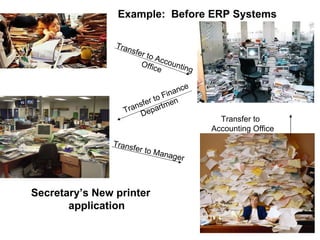
Secretary’s New printer application Transfer to Finance Departmen Transfer to Accounting Office Transfer to Manager Transfer to  Accounting Office Example:  Before ERP Systems
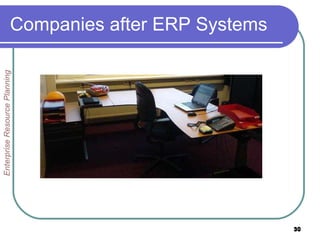
Companies after ERP Systems Enterprise Resource Planning
Prepare Base for ERP Do not start without Management commitment  Allocate sufficient funds  Identify Core Project Team Select specialists from all functional areas Evaluate and select  ERP package  Evaluate  Implementation Partner Make an Implementation Plan Present plan to Management Committee for sanctions Present plan to Employee groups for feedback/acceptability Plan for User Training Plan for Future upgrades
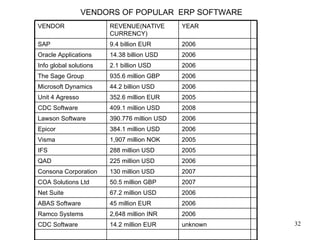
VENDORS OF POPULAR  ERP SOFTWARE unknown 14.2 million EUR  CDC Software 2006 2,648 million INR  Ramco Systems 2006 45 million EUR  ABAS Software 2006 67.2 million USD  Net Suite 2007 50.5 million GBP  COA Solutions Ltd 2007 130 million USD  Consona Corporation 2006 225 million USD  QAD 2005 288 million USD  IFS 2005 1,907 million NOK  Visma 2006 384.1 million USD  Epicor 2006 390.776 million USD  Lawson Software 2008 409.1 million USD  CDC Software 2005 352.6 million EUR  Unit 4 Agresso 2006 44.2 billion USD  Microsoft Dynamics 2006 935.6 million GBP  The Sage Group 2006 2.1 billion USD  Info global solutions 2006 14.38 billion USD  Oracle Applications 2006 9.4 billion EUR  SAP YEAR REVENUE(NATIVE CURRENCY) VENDOR
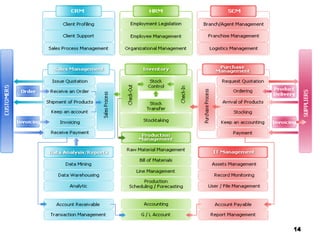
Solutions of ERP Financial Management Inventory Management Purchasing Sales Management Production Planning Advanced Visual Planning Manufacturing Management Enterprise Resource Planning
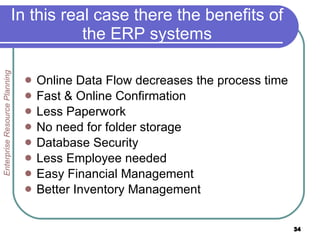
In this real case there the benefits of the ERP systems Online Data Flow decreases the process time Fast & Online Confirmation Less Paperwork No need for folder storage Database Security Less Employee needed  Easy Financial Management Better Inventory Management Enterprise Resource Planning
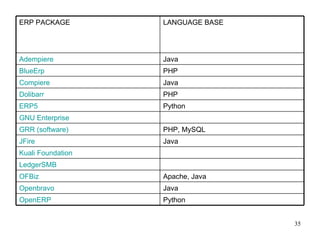
Python OpenERP   Java Openbravo   Apache, Java OFBiz   LedgerSMB Kuali Foundation   Java JFire PHP, MySQL  GRR (software)   GNU Enterprise   Python ERP5   PHP  Dolibarr   Java  Compiere   PHP  BlueErp Java  Adempiere   LANGUAGE BASE ERP PACKAGE
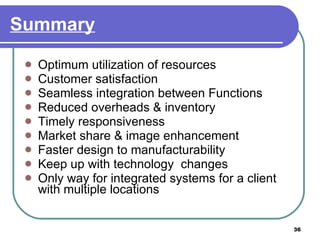
Summary Optimum utilization of resources Customer satisfaction Seamless integration between Functions Reduced overheads & inventory Timely responsiveness Market share & image enhancement Faster design to manufacturability Keep up with technology  changes Only way for integrated systems for a client with multiple locations
Open Session
Thanks for your Participation & Co-operation
THANK ‘U’

Enterprise Resource Planning

  • 1.
    Enterprise Resource PlanningPresented by: Sandeep Tiwari PGDM 3 rd sem.
  • 2.
    ERP – GeneralConcepts 1. What is ERP? 2. Evolution 3. Why ERP? 4. Definition 5. Expectations Enterprise Resource Planning
  • 3.
    THREE KEY POINTSEnterprise Resource Planning ERP ENTERPRISE RESOURCE PLANNING
  • 4.
    Enterprise resource planning(ERP) is the industry term used to describe a broad set of activities supported by multi-module application software that helps a manufacturer or other business manage the important parts of its business. These parts can include product planning, parts purchasing, maintaining inventories, interacting with suppliers, providing customer service, and tracking orders. ERP can also include application modules for the finance and human resources aspects of a business. Some of the bigger players in the ERP outsourcing market are SAP, Peoplesoft, and J. D. Edwards. New comers include Oracle, IBM, and Microsoft. MEANING OF ERP Enterprise Resource Planning
  • 5.
    What is ERP?ERP is a solution, which Enterprise Resource Planning facilitates company-wide integrated information systems, covering all functional areas performs core Corporate activities and increases customer service augmenting Corporate Image
  • 6.
    FUNCTIONS OF MANAGEMENTEnterprise Resource Planning
  • 7.
    Why ERP? ForManagement – to know what is happening in the company One solution for better Management For cycle time reduction To achieve cost control & low working capital To marry latest technologies To shun the geographical gaps To satisfy the customers with high expectations To be Competitive & for survival Enterprise Resource Planning
  • 8.
    ERP – ExpectationsIntegrating all the functions Integrating the systems running in all the locations Transparency of information using a single data source across the organization Software must be responsive Modular Flexible Easy to add functionalities Provide growth path Enterprise Resource Planning
  • 9.
    Evolution of ERP1960’s - Systems Just for Inventory Control 1970’s - MRP – Material Requirement Planning (Inventory with material planning & procurement) 1980’s - MRP II – Manufacturing Resources Planning (Extended MRP to shop floor & distribution Mgnt.) Mid 1990’s - ERP – Enterprise Resource Planning (Covering all the activities of an Enterprise) 2000 onwards – ERP II – Collaborative Commerce (Extending ERP to external business entities) Enterprise Resource Planning
  • 10.
  • 11.
    The Current ScenarioIslands of Information Difficult to get timely & accurate information Heterogeneous Hardware & Software platforms & practices Poor connectivity between different organizational locations Sticking with obsolete technology Resist to change Lack of proven man-power to develop integrated software Enterprise Resource Planning
  • 12.
    ERP – Options OPTION 1 – MAKE [Using Internal resources] Developing a custom-built ERP package, specific to the requirements of the organization, with the help of the in-house IT department OPTION 2 - BUY Going for Tailor-made ERP packages available in the market like SAP, Oracle applications, Baan, PeopleSoft etc. OPTION 3 – MAKE [using External resources] Developing a custom-built ERP package, specific to the requirements of the organization, with the help of a software solution provider. Enterprise Resource Planning
  • 13.
    ERP Product selectionCriteria Goal: To select the Most Suitable Software Package Solution 5 Strategic Requirement Levels Functionality Technology Vendor Support Costs Enterprise Resource Planning
  • 15.
    How can Engineersbenefit from ERP systems ? Enterprise Resource Planning
  • 16.
    Usesful SAP Modulesfor Engineers MM- Material Management Better Procurement Handling Org a nized Inventory Management Easy Purchase Organization Faster Storage Location PM – Plant Maintenance Maintenance Order Management Equipment and Technical Objects Coordination Preventive Maintenance Workflow Scenarios Work Clearance Management
  • 17.
    Istanbul Fast Ferries(IDO) Uses SAP Software
  • 18.
    SAP CENTER EMPLOYEEPASS E NGER PASS E NGER PASS E NGER FUEL MAINTENANCE
  • 19.
    Annually 91 millionpassanger Annually 5,5 million vehicles Daily 1,200 navigation capacity 90 Ships 82 Terminals 3,200 personel 314 Million YTL endorsement Istanbul Fast Ferries (IDO) Enterprise Resource Planning
  • 20.
    SAP Systems arranges relationship between ; shipping condition s , route determination, shipping point , employee conditions, fuel supply, maintenance Enterprise Resource Planning
  • 21.
    Controlling Module (CO) IDO pass e nger can send SMS to IDO SAP system and get the information about shipping route times. This process is a service of Controlling Module. Enterprise Resource Planning
  • 22.
    OUTPUTS ofERP Systems DOCUMENTS Proposal Orders approval Delivery plans Shipping papers Warehouse check list Material document Accounting document Delivery/shipping document Invoice Dept & credit doc.
  • 24.
    The Cost ofERP Systems Major suppliers are SAP AG, Peoplesoft, Oracle, and Baan. Also smaller PC based suppliers. Costs for larger ERP systems range from hundreds of thousands to several million dollars. Outside consultants are usually involved in selection, configuration, and implementation. Enterprise Resource Planning
  • 25.
    The Cost ofERP Systems Consultant costs can run up to 3 times the cost of the system itself according to a Gartner Group study. Added costs also include additional people, new computer hardware, and the cost to develop a new, integrated database Successful implementation requires leadership and top management commitment to a vision for the business Enterprise Resource Planning
  • 26.
    ERP Software Companies& Marketshares Software Market Shar e SAP 15.6 Peoplesoft 4.9 Oracle 4.8 Baan 3.0 CA 3.0 JDE 2.2 SSA 2.1 GEAC 2.0 IBM 1.8 JBA 1.7 Others 59.0
  • 27.
  • 28.
    How ERP systemsare implemented within companies? ERP Software Companies start analysing the prospective company(s), identifing their individual needs. Setup of ERP systems For Mid-size companies 5-12 months Large Companies 6-18 months Enterprise Resource Planning
  • 29.
    Secretary’s New printerapplication Transfer to Finance Departmen Transfer to Accounting Office Transfer to Manager Transfer to Accounting Office Example: Before ERP Systems
  • 30.
    Companies after ERPSystems Enterprise Resource Planning
  • 31.
    Prepare Base forERP Do not start without Management commitment Allocate sufficient funds Identify Core Project Team Select specialists from all functional areas Evaluate and select ERP package Evaluate Implementation Partner Make an Implementation Plan Present plan to Management Committee for sanctions Present plan to Employee groups for feedback/acceptability Plan for User Training Plan for Future upgrades
  • 32.
    VENDORS OF POPULAR ERP SOFTWARE unknown 14.2 million EUR CDC Software 2006 2,648 million INR Ramco Systems 2006 45 million EUR ABAS Software 2006 67.2 million USD Net Suite 2007 50.5 million GBP COA Solutions Ltd 2007 130 million USD Consona Corporation 2006 225 million USD QAD 2005 288 million USD IFS 2005 1,907 million NOK Visma 2006 384.1 million USD Epicor 2006 390.776 million USD Lawson Software 2008 409.1 million USD CDC Software 2005 352.6 million EUR Unit 4 Agresso 2006 44.2 billion USD Microsoft Dynamics 2006 935.6 million GBP The Sage Group 2006 2.1 billion USD Info global solutions 2006 14.38 billion USD Oracle Applications 2006 9.4 billion EUR SAP YEAR REVENUE(NATIVE CURRENCY) VENDOR
  • 33.
    Solutions of ERPFinancial Management Inventory Management Purchasing Sales Management Production Planning Advanced Visual Planning Manufacturing Management Enterprise Resource Planning
  • 34.
    In this realcase there the benefits of the ERP systems Online Data Flow decreases the process time Fast & Online Confirmation Less Paperwork No need for folder storage Database Security Less Employee needed Easy Financial Management Better Inventory Management Enterprise Resource Planning
  • 35.
    Python OpenERP Java Openbravo Apache, Java OFBiz LedgerSMB Kuali Foundation Java JFire PHP, MySQL GRR (software) GNU Enterprise Python ERP5 PHP Dolibarr Java Compiere PHP BlueErp Java Adempiere LANGUAGE BASE ERP PACKAGE
  • 36.
    Summary Optimum utilizationof resources Customer satisfaction Seamless integration between Functions Reduced overheads & inventory Timely responsiveness Market share & image enhancement Faster design to manufacturability Keep up with technology changes Only way for integrated systems for a client with multiple locations
  • 37.
  • 38.
    Thanks for yourParticipation & Co-operation
  • 39.

Editor's Notes