ENTERPRISE RESOURCE
     PLANNING
     TANIYA BANERJEE
       PRATAP SHEE
DEFINATION OF ERP
   Software solution that addresses the
    enterprise needs taking the process view
    of an organization to meet the
    organizational goals tightly integrating all
    functions of an enterprise.
WHAT IS ERP?
   ERP systems are the software tools used to
    manage enterprise data.
   Facilitates Company-wide integrated Information
    Systems Covering all functional Areas.
   Performs core corporate activities and increases
    customer service augmenting Corporate Image.
   Organizes & optimizes the data input
    methodologies systematically.
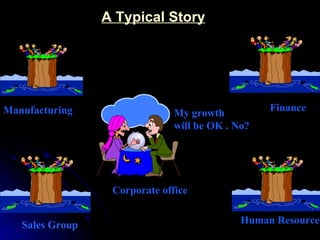
A Typical Story


Manufacturing                                     Finance
                               My growth
                               will be OK . No?


                  Corporate office


   Sales Group                               Human Resource
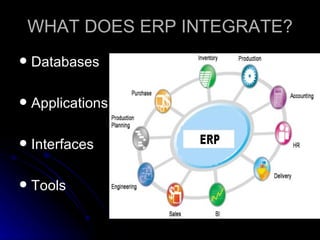
WHAT DOES ERP INTEGRATE?
   Databases

   Applications

   Interfaces

   Tools
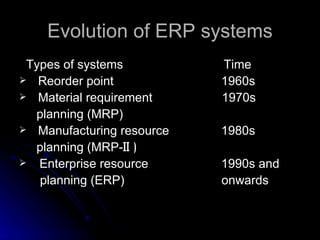
Evolution of ERP systems
 Types of systems          Time
 Reorder point            1960s
 Material requirement     1970s
  planning (MRP)
 Manufacturing resource   1980s
  planning (MRP-II )
 Enterprise resource      1990s and
   planning (ERP)          onwards
Why ERP ?
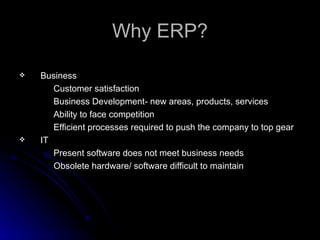
Why ERP?

   Business
       Customer satisfaction
       Business Development- new areas, products, services
       Ability to face competition
       Efficient processes required to push the company to top gear
   IT
       Present software does not meet business needs
       Obsolete hardware/ software difficult to maintain
ERP Implementation
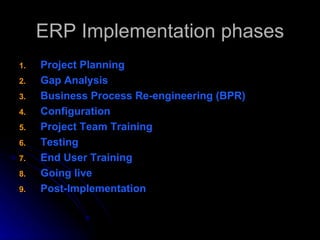
ERP Implementation phases
1.   Project Planning
2.   Gap Analysis
3.   Business Process Re-engineering (BPR)
4.   Configuration
5.   Project Team Training
6.   Testing
7.   End User Training
8.   Going live
9.   Post-Implementation
1. Project Planning
 Designs the implementation process
 Project plan is developed. Roles are
  identified and responsibilities are
  assigned.
 This phase will decide when to begin the
  project, how to do it and when the project
  is supposed to be completed.
2. Gap Analysis
   The gap between the existing company requirements
    and what the ERP package is offering is analyzed.

   When the ERP package does not meet the company’s
    full requirements then the company can simply agree to
    live without a particular function or one can opt for :-
     a) Upgrade, or
     b) Identifying a third party product that might fill
          the gap, or
     c) Altering the ERP source code.
4. Configuration
 A prototype of the actual business
  processes of the company is used for
  thorough testing of the model in a
  controlled environment.
 Configuring reveals not only the strengths
  of a company’s business process but also-
  and perhaps more importantly - its
  weaknesses.
3.Business Process Reengineering
   In-depth study of existing systems/processes is
    required before ERP is considered.
   This study brings out deficiencies of the existing
    system/process.
   BPR attempts to re-structure and re-organize the
    human resources, functional areas, Man-
    Machine interfaces in the organization.
   Hence BPR attempts to maximize productivity
5. Implementation Team Training
 This is the phase where the company
  trains its employees to implement and
  later, run the system.
 After implementation, the company to be
  self-sufficient in running the ERP system,
  it should have a good in-house team that
  can handle the various situations.
6. Testing
 This is the phase where one try to break
  the system.
 The test cases must be designed
  specifically to find the weak links in the
  system and these bugs should be fixed
  before going live.
7. End-user Training
 In this phase the actual users of the
  system will be given training on how to
  use the system.
 The employees who are going to use the
  new system are identified. Their current
  skills are noted and based on the current
  skill levels, they are divided into groups.
  Then each group is given training on the
  new system.
8. Going live
 The system is officially proclaimed
  operational.
 Once the system is ‘live’, the old system is
  removed, and the new system is used for
  doing business.
9. Post implementation phase
   There should be people, within the
    company, who have the technical prowess
    to make the necessary enhancements to
    the system as and when required. The
    system must be upgraded as and when
    new versions or new technologies are
    introduced.
Advantages Of ERP
BENEFITS OF ERP
   Reduction of lead time
   Reduction in cycle time
   Improve resource utilization
   Better customer satisfaction
   Improved supplier performance
   Increase flexibility
   Reduced quality costs
   On time delivery
   Better analysis and planning capabilities
DISADVANTAGES OF ERP
   Cost is very high for implementation of ERP
    package
   Time
      12-18 months implementation
       1-3 years real transformation
   Training
   Acceptance
        Everyone gets brought down to the same

       knowledge level
HOW ERP HAS AFFECTED
        CONSUMERS?
 Consumers demands are met by faster
  order to shipping dates
 Tracking information on orders is available
  to consumers
 Consumers can easily view inventory,
  sale prices, delivery dates from the
  company web page
 Painless electronic transactions
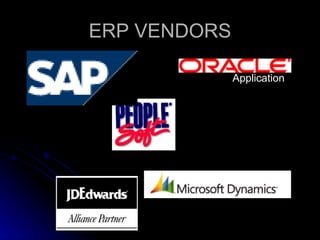
ERP VENDORS

              Application
SAP
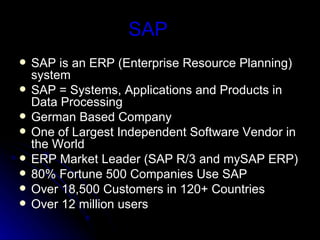
   SAP is an ERP (Enterprise Resource Planning)
    system
   SAP = Systems, Applications and Products in
    Data Processing
   German Based Company
   One of Largest Independent Software Vendor in
    the World
   ERP Market Leader (SAP R/3 and mySAP ERP)
   80% Fortune 500 Companies Use SAP
   Over 18,500 Customers in 120+ Countries
   Over 12 million users
SAP application modules
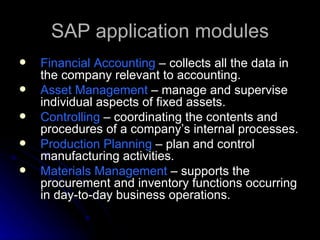
   Financial Accounting – collects all the data in
    the company relevant to accounting.
   Asset Management – manage and supervise
    individual aspects of fixed assets.
   Controlling – coordinating the contents and
    procedures of a company’s internal processes.
   Production Planning – plan and control
    manufacturing activities.
   Materials Management – supports the
    procurement and inventory functions occurring
    in day-to-day business operations.
SAP Application Modules
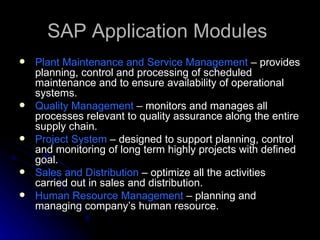
   Plant Maintenance and Service Management – provides
    planning, control and processing of scheduled
    maintenance and to ensure availability of operational
    systems.
   Quality Management – monitors and manages all
    processes relevant to quality assurance along the entire
    supply chain.
   Project System – designed to support planning, control
    and monitoring of long term highly projects with defined
    goal.
   Sales and Distribution – optimize all the activities
    carried out in sales and distribution.
   Human Resource Management – planning and
    managing company’s human resource.
System Wide Features of SAP
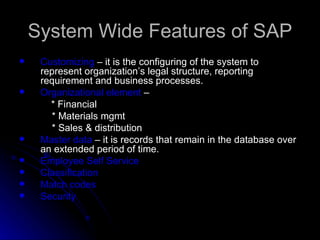
    Customizing – it is the configuring of the system to
     represent organization’s legal structure, reporting
     requirement and business processes.
    Organizational element –
       * Financial
       * Materials mgmt
       * Sales & distribution
    Master data – it is records that remain in the database over
     an extended period of time.
    Employee Self Service
    Classification
    Match codes
    Security
CONCLUSION
   ERP integrate all aspects of a company into one
    solution.
   There are both Pros and Cons, depending on
    the company one will out weigh the other.
   ERP is very time consuming and costly project.
   SAP is the major key vendor, with maximum
    market share.
   ERP has a strong future and will continue to
    grow.
Thank You

Enterprise resource-planning-erp-1218631405959212-8

  • 1.
    ENTERPRISE RESOURCE PLANNING TANIYA BANERJEE PRATAP SHEE
  • 2.
    DEFINATION OF ERP  Software solution that addresses the enterprise needs taking the process view of an organization to meet the organizational goals tightly integrating all functions of an enterprise.
  • 3.
    WHAT IS ERP?  ERP systems are the software tools used to manage enterprise data.  Facilitates Company-wide integrated Information Systems Covering all functional Areas.  Performs core corporate activities and increases customer service augmenting Corporate Image.  Organizes & optimizes the data input methodologies systematically.
  • 4.
    A Typical Story Manufacturing Finance My growth will be OK . No? Corporate office Sales Group Human Resource
  • 5.
    WHAT DOES ERPINTEGRATE?  Databases  Applications  Interfaces  Tools
  • 6.
    Evolution of ERPsystems Types of systems Time  Reorder point 1960s  Material requirement 1970s planning (MRP)  Manufacturing resource 1980s planning (MRP-II )  Enterprise resource 1990s and planning (ERP) onwards
  • 7.
  • 8.
    Why ERP?  Business Customer satisfaction Business Development- new areas, products, services Ability to face competition Efficient processes required to push the company to top gear  IT Present software does not meet business needs Obsolete hardware/ software difficult to maintain
  • 9.
  • 10.
    ERP Implementation phases 1. Project Planning 2. Gap Analysis 3. Business Process Re-engineering (BPR) 4. Configuration 5. Project Team Training 6. Testing 7. End User Training 8. Going live 9. Post-Implementation
  • 11.
    1. Project Planning Designs the implementation process  Project plan is developed. Roles are identified and responsibilities are assigned.  This phase will decide when to begin the project, how to do it and when the project is supposed to be completed.
  • 12.
    2. Gap Analysis  The gap between the existing company requirements and what the ERP package is offering is analyzed.  When the ERP package does not meet the company’s full requirements then the company can simply agree to live without a particular function or one can opt for :- a) Upgrade, or b) Identifying a third party product that might fill the gap, or c) Altering the ERP source code.
  • 13.
    4. Configuration  Aprototype of the actual business processes of the company is used for thorough testing of the model in a controlled environment.  Configuring reveals not only the strengths of a company’s business process but also- and perhaps more importantly - its weaknesses.
  • 14.
    3.Business Process Reengineering  In-depth study of existing systems/processes is required before ERP is considered.  This study brings out deficiencies of the existing system/process.  BPR attempts to re-structure and re-organize the human resources, functional areas, Man- Machine interfaces in the organization.  Hence BPR attempts to maximize productivity
  • 15.
    5. Implementation TeamTraining  This is the phase where the company trains its employees to implement and later, run the system.  After implementation, the company to be self-sufficient in running the ERP system, it should have a good in-house team that can handle the various situations.
  • 16.
    6. Testing  Thisis the phase where one try to break the system.  The test cases must be designed specifically to find the weak links in the system and these bugs should be fixed before going live.
  • 17.
    7. End-user Training In this phase the actual users of the system will be given training on how to use the system.  The employees who are going to use the new system are identified. Their current skills are noted and based on the current skill levels, they are divided into groups. Then each group is given training on the new system.
  • 18.
    8. Going live The system is officially proclaimed operational.  Once the system is ‘live’, the old system is removed, and the new system is used for doing business.
  • 19.
    9. Post implementationphase  There should be people, within the company, who have the technical prowess to make the necessary enhancements to the system as and when required. The system must be upgraded as and when new versions or new technologies are introduced.
  • 20.
  • 21.
    BENEFITS OF ERP  Reduction of lead time  Reduction in cycle time  Improve resource utilization  Better customer satisfaction  Improved supplier performance  Increase flexibility  Reduced quality costs  On time delivery  Better analysis and planning capabilities
  • 22.
    DISADVANTAGES OF ERP  Cost is very high for implementation of ERP package  Time 12-18 months implementation 1-3 years real transformation  Training  Acceptance Everyone gets brought down to the same knowledge level
  • 23.
    HOW ERP HASAFFECTED CONSUMERS?  Consumers demands are met by faster order to shipping dates  Tracking information on orders is available to consumers  Consumers can easily view inventory, sale prices, delivery dates from the company web page  Painless electronic transactions
  • 24.
    ERP VENDORS Application
  • 25.
    SAP  SAP is an ERP (Enterprise Resource Planning) system  SAP = Systems, Applications and Products in Data Processing  German Based Company  One of Largest Independent Software Vendor in the World  ERP Market Leader (SAP R/3 and mySAP ERP)  80% Fortune 500 Companies Use SAP  Over 18,500 Customers in 120+ Countries  Over 12 million users
  • 26.
    SAP application modules  Financial Accounting – collects all the data in the company relevant to accounting.  Asset Management – manage and supervise individual aspects of fixed assets.  Controlling – coordinating the contents and procedures of a company’s internal processes.  Production Planning – plan and control manufacturing activities.  Materials Management – supports the procurement and inventory functions occurring in day-to-day business operations.
  • 27.
    SAP Application Modules  Plant Maintenance and Service Management – provides planning, control and processing of scheduled maintenance and to ensure availability of operational systems.  Quality Management – monitors and manages all processes relevant to quality assurance along the entire supply chain.  Project System – designed to support planning, control and monitoring of long term highly projects with defined goal.  Sales and Distribution – optimize all the activities carried out in sales and distribution.  Human Resource Management – planning and managing company’s human resource.
  • 28.
    System Wide Featuresof SAP  Customizing – it is the configuring of the system to represent organization’s legal structure, reporting requirement and business processes.  Organizational element – * Financial * Materials mgmt * Sales & distribution  Master data – it is records that remain in the database over an extended period of time.  Employee Self Service  Classification  Match codes  Security
  • 29.
    CONCLUSION  ERP integrate all aspects of a company into one solution.  There are both Pros and Cons, depending on the company one will out weigh the other.  ERP is very time consuming and costly project.  SAP is the major key vendor, with maximum market share.  ERP has a strong future and will continue to grow.
  • 30.