ERP
FUNCTIONAL
 MODULES
What is ERP?
• Enterprise Resource Planning
• Support business through optimizing,
  maintaining, and tracking business functions
• Broken down into business processes
  –   HRM
  –   Distribution
  –   Financials
  –   Manufacturing
What makes ERP
      different?
 Integrated modules
 Common definitions
 Common database
 Update one module, automatically updates
  others
 ERP systems reflect a specific way of doing
  business
 Must look at your value chains, rather than
  functions
Benefits of ERP
Common set of data
Help in integrating applications for
 decision making and planning
Allow departments to talk to each other
Easy to integrate by using processed
 built into ERP software
A way to force BPR (reengineering)
VENDORS :-
•FUNCTIONAL
 MODULES
OF ERP SOFTWARE
ERP Modules
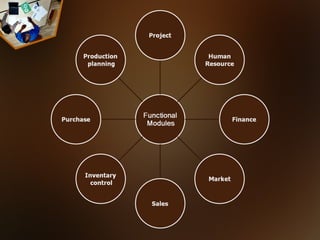
Common ERP modules include:-
 modules for product planning,
 parts and material purchasing,
 inventory control,
 product distribution,
 order tracking,
 finance,
 accounting,
 marketing, and
 HR.
ERP Modules
        It is scalable.

        It is customizable.

        It works on the Web.

        It is efficient and easy
         to use.

        It works with CRM and
          more.
Production Planning
       Module
• Production planning optimizes the
  utilization of:-
a)manufacturing capacity,
b)parts,
c)components and
d)material resources using historical
  production data and sales forecasting.
Purchasing Module
• It automates the processes of identifying:-
a) potential suppliers,
b) negotiating price,
c) billing processes , and
d) awarding purchase order to the supplier.
• Purchase module is tightly integrated with the
   inventory control and production planning modules.
• Purchasing module is often integrated with supply
   chain management software.
Inventory Control Module


 Inventory Control is a complete multi-location
  inventory management system that keeps track
  of stock levels and processes inventory receipts,
  shipments, returns, and adjustments.

 It includes functions to give us detailed, current
  information crucial for effective inventory
  management.
• Inventory module facilitates processes of
   maintaining the appropriate level of stock in
   a warehouse.
• The activities of inventory control involves
   in
a) identifying inventory requirements,
b) setting targets,
c) providing replenishment techniques and
d)options, monitoring item usages,
e)reconciling the inventory balances, and
f) reporting inventory status reports.
Sales Module
• Revenues from sales are live blood for
  commercial organizations.
• Sales module implements functions of
  order placement, order scheduling, shipping
  and invoicing.
• Sales module is closely integrated with
  organizations' ecommerce websites.
• Many ERP vendors offer online storefront
  as part of the sales module.
Marketing
        Module
• ERP marketing module supports
a) lead generation,
b)direct mailing campaign and more.
Financial
        Module
• Both for-profit organizations and non-
  profit organizations benefit from the
  implementation of ERP financial module.
• The financial module is the core of
  many ERP software systems.
• It can gather financial data from various
  functional departments, and generates
  valuable financial reports such balance
  sheet, general ledger, trail balance, and
  quarterly financial statements.
HR Module
• HR (Human Resources) is another widely
  implemented ERP module.
• HR module streamlines the management of
  human resources and human capitals.
• HR modules routinely maintain a complete
  employee database including contact
  information, salary details, attendance,
  performance evaluation and promotion of all
  employees.
Project Module
• This module provides an effective solution for
  project managers in construction, job service,
  and other professional industries who require a
  time-and-material system.
• It delivers the tools necessary to manage the
  simplest to most complex contract or job.
• It makes the estimating, tracking, costing, and
  billing of projects easy and manageable-
  simplifying cost control and planning.
• With the powerful features of
  Project and Job Costing we can
  identify potential issues and
  determine success factors for
  any project.
• The automated billing features in
  this software streamline
  customer invoicing, reducing the
  time spent managing this
  process.
ERP INTEGRATION
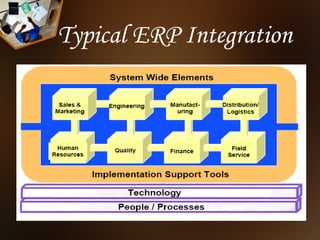
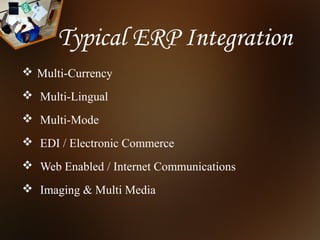
Typical ERP Integration
 Multi-Currency
 Multi-Lingual
 Multi-Mode
 EDI / Electronic Commerce
 Web Enabled / Internet Communications
 Imaging & Multi Media
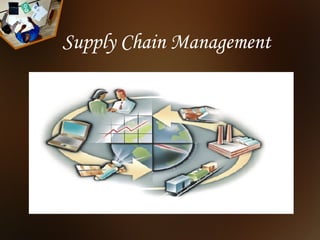
Supply Chain Management
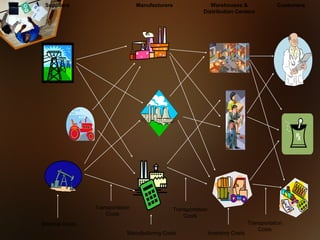
Suppliers                        Manufacturers                  Warehouses &                    Customers
                                                              Distribution Centers


                 Transportation                   Transportation
                     Costs                            Costs
Material Costs                                                                       Transportation
                                                                                         Costs
                             Manufacturing Costs                   Inventory Costs
What Is Supply Chain Management?
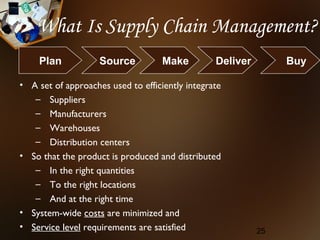
    Plan            Source          Make         Deliver        Buy

• A set of approaches used to efficiently integrate
   – Suppliers
   – Manufacturers
   – Warehouses
   – Distribution centers
• So that the product is produced and distributed
   – In the right quantities
   – To the right locations
   – And at the right time
• System-wide costs are minimized and
• Service level requirements are satisfied                 25
Mobile Supply Chain Applications
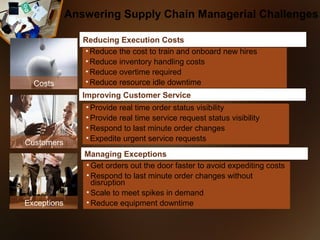
Answering Supply Chain Managerial Challenges

                Reducing Execution Costs
                • Reduce the cost to train and onboard new hires
                • Reduce inventory handling costs
                • Reduce overtime required
  Costs         • Reduce resource idle downtime
                Improving Customer Service
                • Provide real time order status visibility
                • Provide real time service request status visibility
                • Respond to last minute order changes
                • Expedite urgent service requests
Customers
                Managing Exceptions
                • Get orders out the door faster to avoid expediting costs
                • Respond to last minute order changes without
                  disruption
                • Scale to meet spikes in demand
Exceptions      • Reduce equipment downtime
Mobile Supply Chain Applications
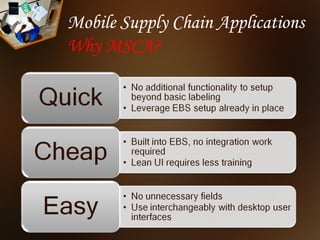
Why MSCA?
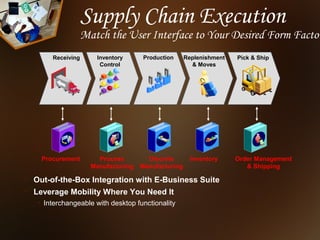
Supply Chain Execution
                   Match the User Interface to Your Desired Form Factor
       Receiving      Inventory      Production      Replenishment   Pick & Ship
                       Control                         & Moves


    Procurement        Process         Discrete        Inventory     Order Management
                     Manufacturing   Manufacturing                      & Shipping

 Out-of-the-Box Integration with E-Business Suite
 Leverage Mobility Where You Need It
   • Interchangeable with desktop functionality
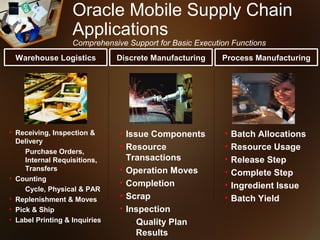
Oracle Mobile Supply Chain
                   Applications
                   Comprehensive Support for Basic Execution Functions
 Warehouse Logistics           Discrete Manufacturing     Process Manufacturing


• Receiving, Inspection &      • Issue Components          •   Batch Allocations
  Delivery
   – Purchase Orders,
                               • Resource                  •   Resource Usage
     Internal Requisitions,      Transactions              •   Release Step
     Transfers                 • Operation Moves           •   Complete Step
• Counting
                               • Completion                •   Ingredient Issue
   – Cycle, Physical & PAR
• Replenishment & Moves        • Scrap                     •   Batch Yield
• Pick & Ship                  • Inspection
• Label Printing & Inquiries       –Quality Plan
                                    Results
CUSTOMER RELATIONSHIP
MANAGENENT(CRM)
What is CRM?
CRM is a strategy by which companies optimise
profitability through enhanced customer satisfaction.

It is about automating and enhancing the customer-
centric business processes of Sales, Marketing, and
Service.

CRM not only deals with automating these processes, but
also focuses on ensuring that the front-office applications
improve customer satisfaction, resulting in added
customer loyalty that directly affects the organization’s
bottom line.
CRM APPLICATION

• Siebel Systems Inc.
  – Founded in 1993
  – Today: World’s Largest customer
    centric, eBusiness application software
    provider
  – 2000 Revenue: $1.79 billion
  – 100% value-adding customer
    information systems
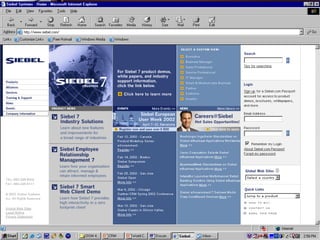
Siebel Systems Inc.
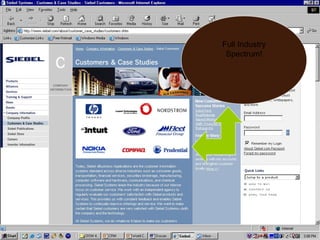
Full Industry
                    Spectrum!

Siebel Customers
Enterprise resource planning ppt

Enterprise resource planning ppt

  • 1.
  • 2.
    What is ERP? •Enterprise Resource Planning • Support business through optimizing, maintaining, and tracking business functions • Broken down into business processes – HRM – Distribution – Financials – Manufacturing
  • 3.
    What makes ERP different?  Integrated modules  Common definitions  Common database  Update one module, automatically updates others  ERP systems reflect a specific way of doing business  Must look at your value chains, rather than functions
  • 4.
    Benefits of ERP Commonset of data Help in integrating applications for decision making and planning Allow departments to talk to each other Easy to integrate by using processed built into ERP software A way to force BPR (reengineering)
  • 5.
  • 6.
  • 7.
    ERP Modules Common ERPmodules include:-  modules for product planning,  parts and material purchasing,  inventory control,  product distribution,  order tracking,  finance,  accounting,  marketing, and  HR.
  • 8.
    ERP Modules  It is scalable.  It is customizable.  It works on the Web.  It is efficient and easy to use.  It works with CRM and more.
  • 10.
    Production Planning Module • Production planning optimizes the utilization of:- a)manufacturing capacity, b)parts, c)components and d)material resources using historical production data and sales forecasting.
  • 11.
    Purchasing Module • Itautomates the processes of identifying:- a) potential suppliers, b) negotiating price, c) billing processes , and d) awarding purchase order to the supplier. • Purchase module is tightly integrated with the inventory control and production planning modules. • Purchasing module is often integrated with supply chain management software.
  • 12.
    Inventory Control Module Inventory Control is a complete multi-location inventory management system that keeps track of stock levels and processes inventory receipts, shipments, returns, and adjustments.  It includes functions to give us detailed, current information crucial for effective inventory management.
  • 13.
    • Inventory modulefacilitates processes of maintaining the appropriate level of stock in a warehouse. • The activities of inventory control involves in a) identifying inventory requirements, b) setting targets, c) providing replenishment techniques and d)options, monitoring item usages, e)reconciling the inventory balances, and f) reporting inventory status reports.
  • 14.
    Sales Module • Revenuesfrom sales are live blood for commercial organizations. • Sales module implements functions of order placement, order scheduling, shipping and invoicing. • Sales module is closely integrated with organizations' ecommerce websites. • Many ERP vendors offer online storefront as part of the sales module.
  • 15.
    Marketing Module • ERP marketing module supports a) lead generation, b)direct mailing campaign and more.
  • 16.
    Financial Module • Both for-profit organizations and non- profit organizations benefit from the implementation of ERP financial module. • The financial module is the core of many ERP software systems. • It can gather financial data from various functional departments, and generates valuable financial reports such balance sheet, general ledger, trail balance, and quarterly financial statements.
  • 17.
    HR Module • HR(Human Resources) is another widely implemented ERP module. • HR module streamlines the management of human resources and human capitals. • HR modules routinely maintain a complete employee database including contact information, salary details, attendance, performance evaluation and promotion of all employees.
  • 18.
    Project Module • Thismodule provides an effective solution for project managers in construction, job service, and other professional industries who require a time-and-material system. • It delivers the tools necessary to manage the simplest to most complex contract or job. • It makes the estimating, tracking, costing, and billing of projects easy and manageable- simplifying cost control and planning.
  • 19.
    • With thepowerful features of Project and Job Costing we can identify potential issues and determine success factors for any project. • The automated billing features in this software streamline customer invoicing, reducing the time spent managing this process.
  • 20.
  • 21.
  • 22.
    Typical ERP Integration Multi-Currency  Multi-Lingual  Multi-Mode  EDI / Electronic Commerce  Web Enabled / Internet Communications  Imaging & Multi Media
  • 23.
  • 24.
    Suppliers Manufacturers Warehouses & Customers Distribution Centers Transportation Transportation Costs Costs Material Costs Transportation Costs Manufacturing Costs Inventory Costs
  • 25.
    What Is SupplyChain Management? Plan Source Make Deliver Buy • A set of approaches used to efficiently integrate – Suppliers – Manufacturers – Warehouses – Distribution centers • So that the product is produced and distributed – In the right quantities – To the right locations – And at the right time • System-wide costs are minimized and • Service level requirements are satisfied 25
  • 26.
    Mobile Supply ChainApplications
  • 27.
    Answering Supply ChainManagerial Challenges Reducing Execution Costs • Reduce the cost to train and onboard new hires • Reduce inventory handling costs • Reduce overtime required Costs • Reduce resource idle downtime Improving Customer Service • Provide real time order status visibility • Provide real time service request status visibility • Respond to last minute order changes • Expedite urgent service requests Customers Managing Exceptions • Get orders out the door faster to avoid expediting costs • Respond to last minute order changes without disruption • Scale to meet spikes in demand Exceptions • Reduce equipment downtime
  • 28.
    Mobile Supply ChainApplications Why MSCA?
  • 29.
    Supply Chain Execution Match the User Interface to Your Desired Form Factor Receiving Inventory Production Replenishment Pick & Ship Control & Moves Procurement Process Discrete Inventory Order Management Manufacturing Manufacturing & Shipping  Out-of-the-Box Integration with E-Business Suite  Leverage Mobility Where You Need It • Interchangeable with desktop functionality
  • 30.
    Oracle Mobile SupplyChain Applications Comprehensive Support for Basic Execution Functions Warehouse Logistics Discrete Manufacturing Process Manufacturing • Receiving, Inspection & • Issue Components • Batch Allocations Delivery – Purchase Orders, • Resource • Resource Usage Internal Requisitions, Transactions • Release Step Transfers • Operation Moves • Complete Step • Counting • Completion • Ingredient Issue – Cycle, Physical & PAR • Replenishment & Moves • Scrap • Batch Yield • Pick & Ship • Inspection • Label Printing & Inquiries –Quality Plan Results
  • 31.
  • 32.
    What is CRM? CRMis a strategy by which companies optimise profitability through enhanced customer satisfaction. It is about automating and enhancing the customer- centric business processes of Sales, Marketing, and Service. CRM not only deals with automating these processes, but also focuses on ensuring that the front-office applications improve customer satisfaction, resulting in added customer loyalty that directly affects the organization’s bottom line.
  • 33.
    CRM APPLICATION • SiebelSystems Inc. – Founded in 1993 – Today: World’s Largest customer centric, eBusiness application software provider – 2000 Revenue: $1.79 billion – 100% value-adding customer information systems
  • 34.
  • 35.
    Full Industry Spectrum! Siebel Customers

Editor's Notes

  • #30 Complex MRO MEL/CDL* lists for acceptable flight configurations, including concessions Role-based UIs with configuration access control lists Rotable parts: planning linked to part reliability and flight schedules, serial number reservations *Minimum Equipment List, Configuration Deviation List
  • #35 Siebel Systems Inc. website.