Software Engineering
Dr. Kamal Gulati
(Part 2) – Models of SDLC
Contents
1. Software Lifecycle Models /
Software Development Models
2. Types of Software development
models
3. Waterfall Model
4. Features of Waterfall Model
5. Phase of Waterfall Model
6. Prototype Model
7. Advantages of Prototype Model
8. Disadvantages of Prototype model
9. V Model
10. Advantages of V-model
11. Disadvantages of V-model
12. When to use the V-model
13. Incremental Model
14. ITERATIVE AND INCREMENTAL
DEVELOPMENT
15. INCREMENTAL MODEL LIFE
CYCLE
16. When to use the Incremental
model
17. Rapid Application
Development RAD Model
18. phases in the rapid application
development (RAD) model
19. Advantages of the RAD model
20. Disadvantages of RAD model
21. When to use RAD model
22. Agile Model
23. Advantages of Agile model
24. Disadvantages of Agile model
25. When to use Agile model
Software Lifecycle Models /
Software Development Models
The development models are the various
processes or methodologies that are being
selected for the development of the project
depending on the project’s aims and goals.
There are many development life cycle models
that have been developed in order to achieve
different required objectives. The models
specify the various stages of the process and
the order in which they are carried out.
• The selection of model has very high impact
on the testing that is carried out. It will define
the what, where and when of our planned
testing, influence regression testing and
largely determines which test techniques to
use.
There are various Software development models
or methodologies. They are as follows:-
1. Waterfall Model
2. Prototype Model
3. V Model
4. Incremental model (Phased Development Model)
5. RAD model (Type of Incremental Model)
6. Agile model (Type of Incremental Model)
7. Iterative model
8. Prototyping Model
9. Spiral model (Similar to Incremental Model with
more risk analysis)
Waterfall
Model
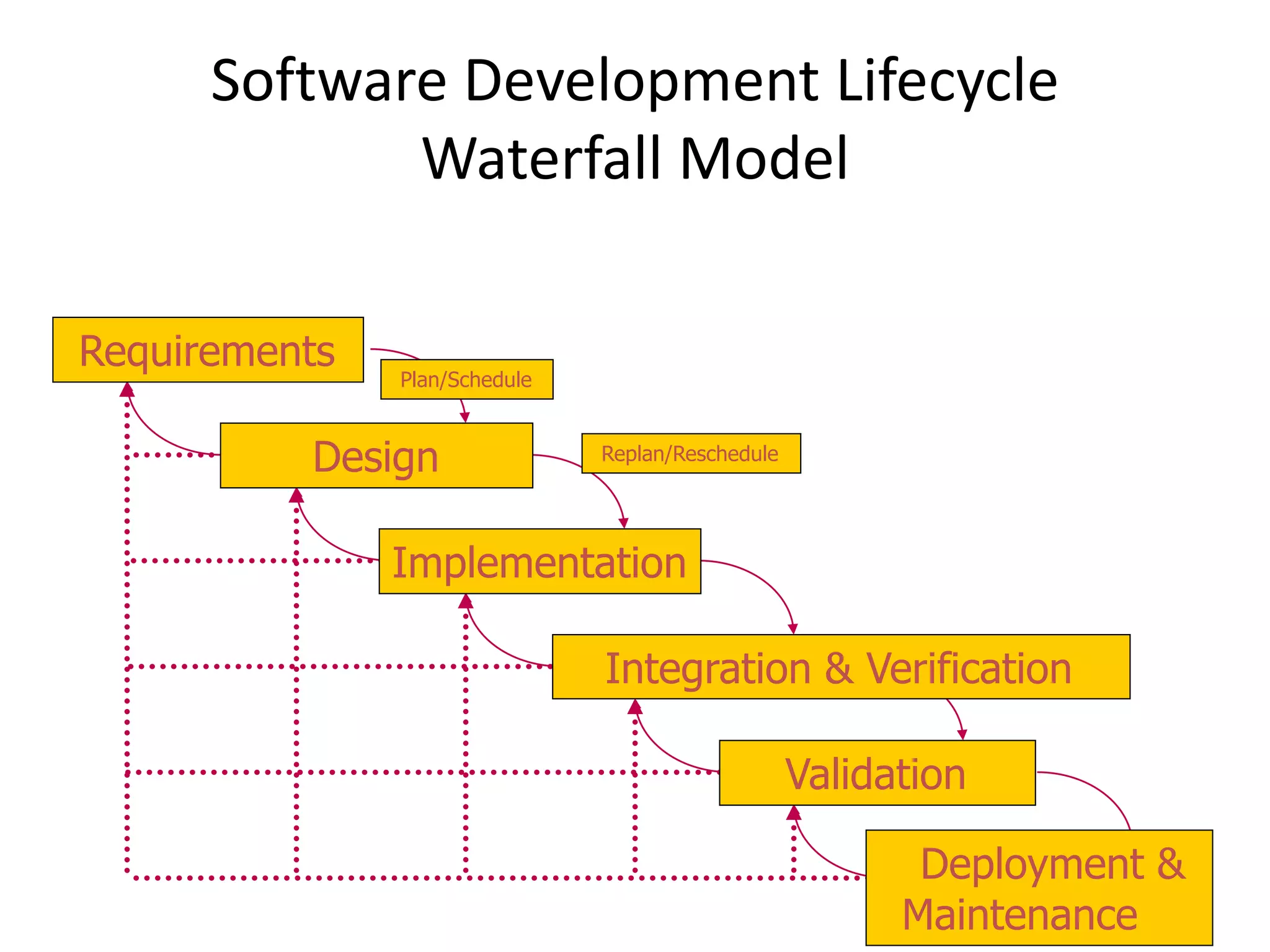
Software Development Lifecycle
Waterfall Model
Requirements
Design
Implementation
Integration & Verification
Validation
Deployment &
Maintenance
Plan/Schedule
Replan/Reschedule
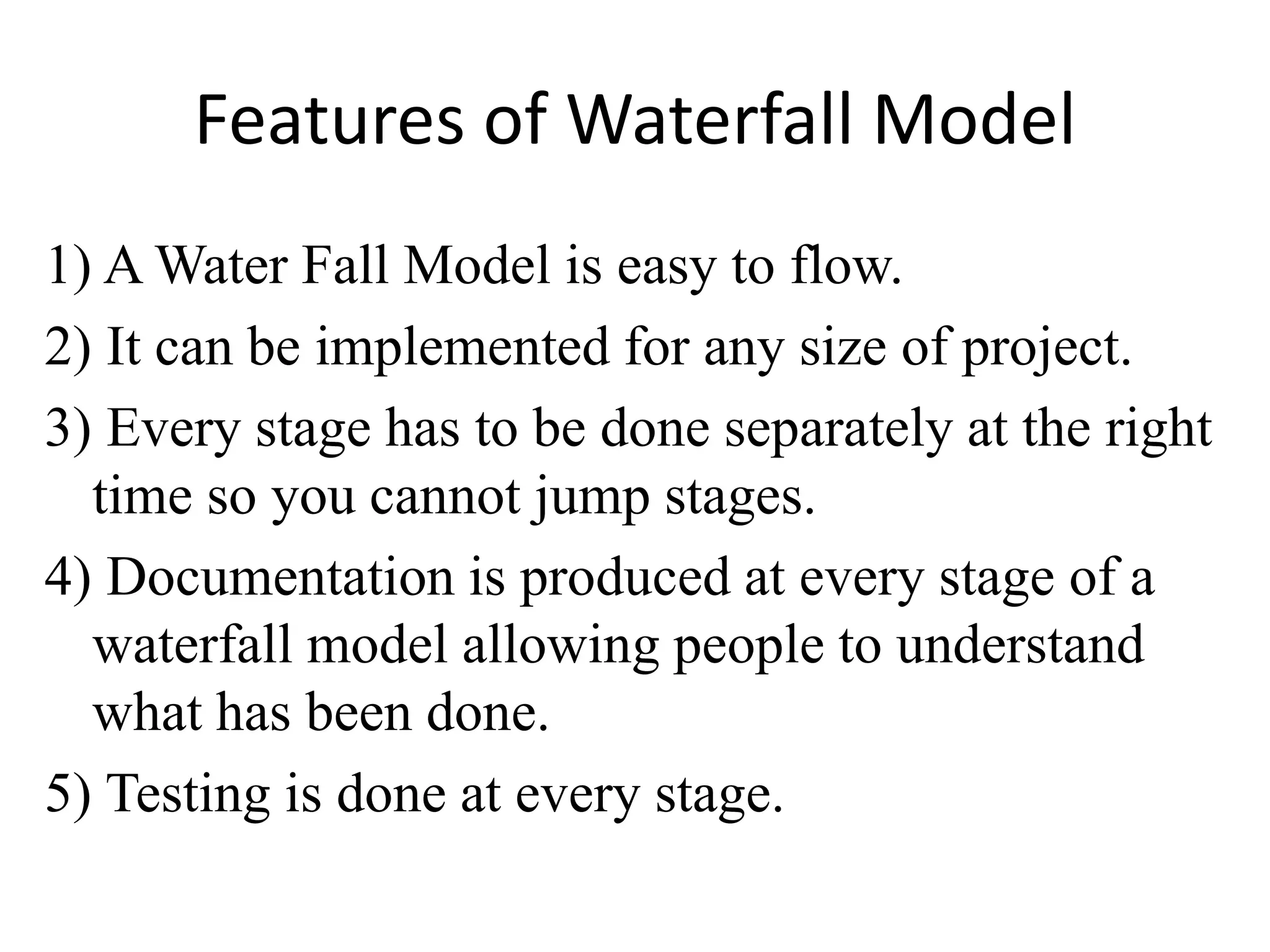
Features of Waterfall Model
1) A Water Fall Model is easy to flow.
2) It can be implemented for any size of project.
3) Every stage has to be done separately at the right
time so you cannot jump stages.
4) Documentation is produced at every stage of a
waterfall model allowing people to understand
what has been done.
5) Testing is done at every stage.
Phase of Waterfall Model
Waterfall model has 5 different phases, Which are
following.
1)Requirement gathering and Analysis.
2)Design.
3)Coding.
4)Testing.
5)Maintenance.
Description for Each Phase
1) Requirement gathering and Analysis.
 This is the first phase of waterfall model which
includes a meeting with the customer to understand his
requirements.
 This is the most crucial phase as any misinterpretation
at this stage may give rise to validation issues later.
 The software definition must be detailed and accurate
with no ambiguities.
 It is very important to understand the customer
requirements and expectations so that the end product
meets his specifications.
 Requirement gathering and Analysis phase
the basic requirements of the system must be
understood by software engineer, who is also
called ANALYST.
 All this requirements are then well
documented and discussed further with the
customer for reviewing.
• 2)Design.
 The customer requirements are broken down into
logical modules for the ease of implementation.
Hardware and software requirements for every module
are Identified and designed accordingly.
 Also the inter relation between the various logical
modules is established at this stage. Algorithms and
diagrams defining the scope and objective of each
logical model are developed.
 In short, this phase lays a fundamental for actual
programming and implementation
 It is a intermediate step between requirements analysis
and coding.
Design focuses on program attribute such as-
1) Data Structure.
2) Software Architecture.
3)Algorithm Details
 The requirements are translated in some easy to represent
form using which coding can be done effectively and
efficiently.
 The design needs to be documented for further use.
3.) Coding
 Coding is a step in which design is translated into machine-
readable form.
 If design is done in sufficient detail then coding can be done
effectively.
• Programs are created in this phase.
•
 In this phase all software divided into small module then
after doing coding for that small module rather than do
coding whole software.
 According to design programmers do code and make class
and structure of whole software.
4.) Testing
 In this stage, both individual components and the
integrated whole are
• methodically verified to ensure that they are error-
free and fully meet the requirements
• outlined in the first step.
 In this phase testing whole software into two parts 1)
HARDWARE & 2) SOFTWARE.
 Type of testing is 2-types
1) Inside test.
2) Outside test.
5)Maintenance.
 This is the final phase of the waterfall model, in which the
completed software product is handed over to the client
after alpha, beta testing.
 After the software has been deployed on the client site, it is
the duty of the software development team to undertake
routine maintenance activities by visiting the client site.
 If the customer suggests changes or enhancements the
software process has to be followed all over again right
from the first phase i.e requirement analysis.
• The usually the longest stage of the software. In this
phase the software is updated to:
a) Meet the changing customer needs
b) Adapted to accommodate changes in the external
environment
c) Correct errors and oversights previously undetected
in the testing phases
d) Enhancing the efficiency of the software
Observe that feed back loops allow for corrections to be
incorporated into the model.
 The water fall model is easy to implementation.
 For implementation of small systems water fall model is use
full.
 The project requires the fulfillment of one phase, before
proceeding to the next.
 It is easier to develop various software through this method in
short span of time.
 In this model phases are processed and completed one at a
time. Phases do not overlap.
Disadvantages of waterfall model
• Once an application is in the testing stage, it is very
difficult to go back and change something that was not
well-thought out in the concept stage.
• No working software is produced until late during the
life cycle.
• High amounts of risk and uncertainty.
• Not a good model for complex and object-oriented
projects.
• Poor model for long and ongoing projects.
• Not suitable for the projects where requirements are at
a moderate to high risk of changing.
When to use the waterfall model
• This model is used only when the requirements
are very well known, clear and fixed.
• Product definition is stable.
• Technology is understood.
• There are no ambiguous requirements
• Ample resources with required expertise are
available freely
• The project is short.
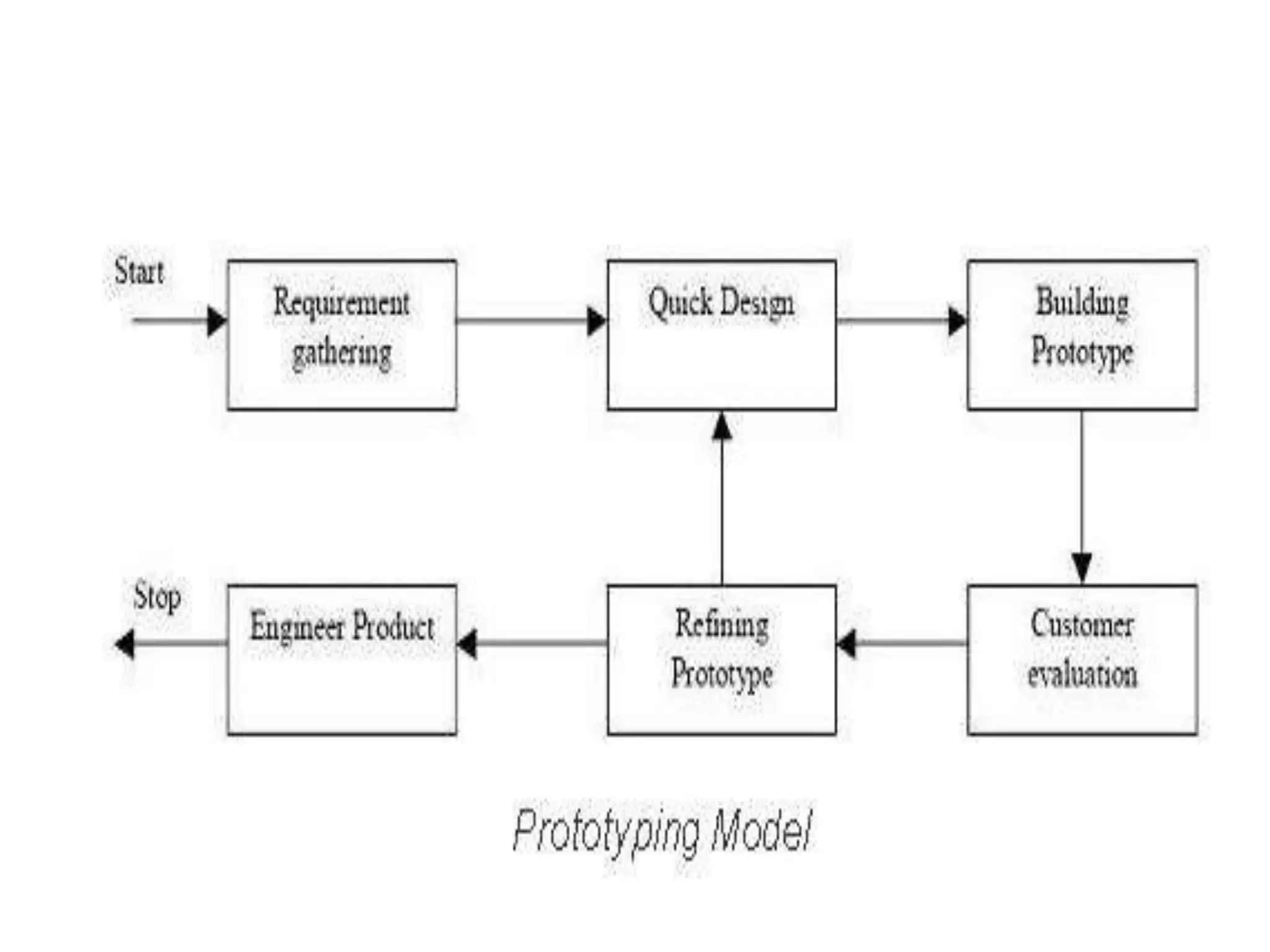
Prototype
Model
Prototype Model
• The basic idea here is that instead of freezing
the requirements before a design or coding
can proceed, a throwaway prototype is built
to understand the requirements.
• This prototype is developed based on the
currently known requirements. By using this
prototype, the client can get an “actual feel”
of the system, since the interactions with
prototype can enable the client to better
understand the requirements of the desired
system.
• Prototyping is an attractive idea for
complicated and large systems for which there
is no manual process or existing system to
help determining the requirements. The
prototype are usually not complete systems
and many of the details are not built in the
prototype. The goal is to provide a system
with overall functionality.
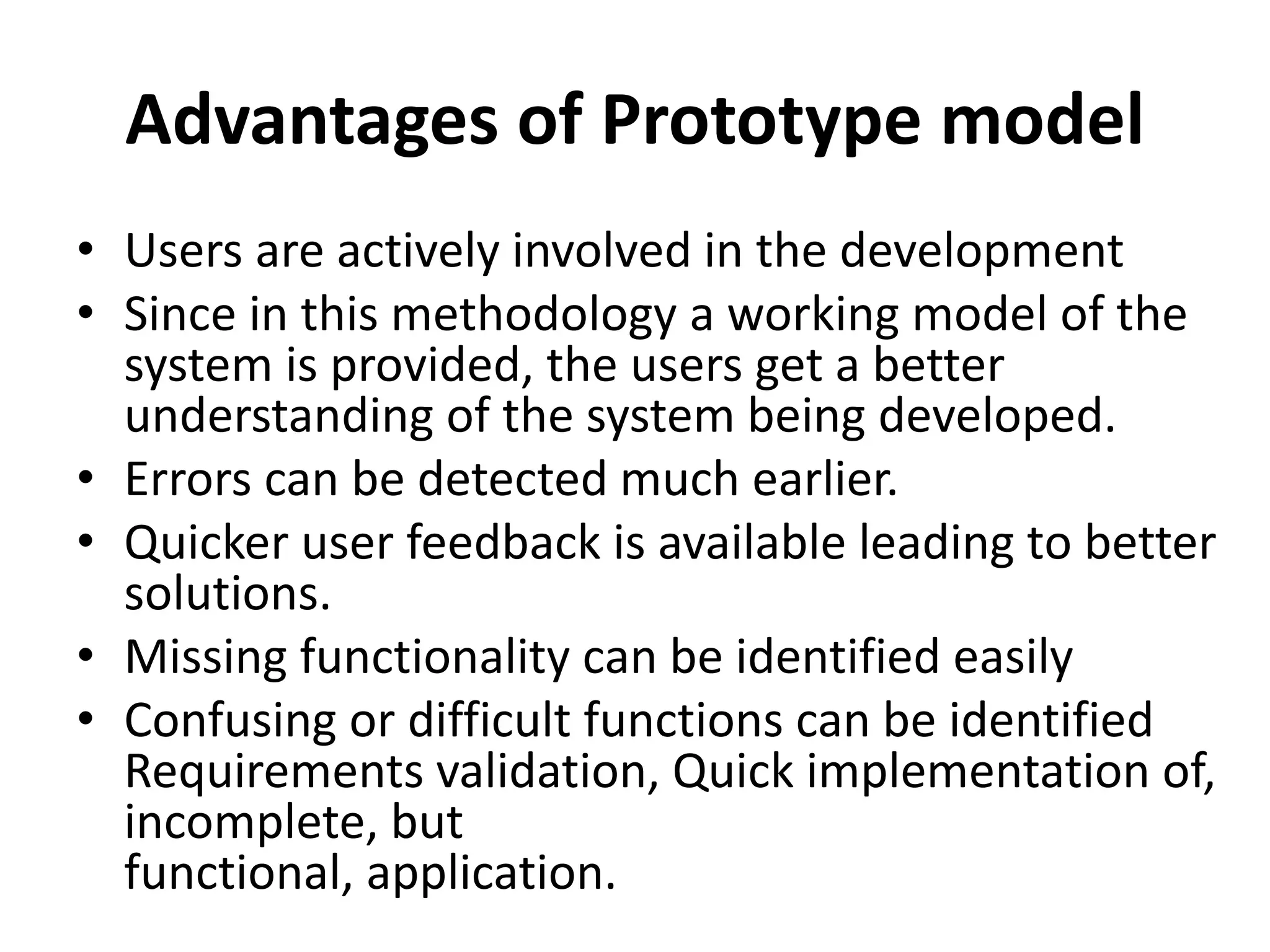
Advantages of Prototype model
• Users are actively involved in the development
• Since in this methodology a working model of the
system is provided, the users get a better
understanding of the system being developed.
• Errors can be detected much earlier.
• Quicker user feedback is available leading to better
solutions.
• Missing functionality can be identified easily
• Confusing or difficult functions can be identified
Requirements validation, Quick implementation of,
incomplete, but
functional, application.
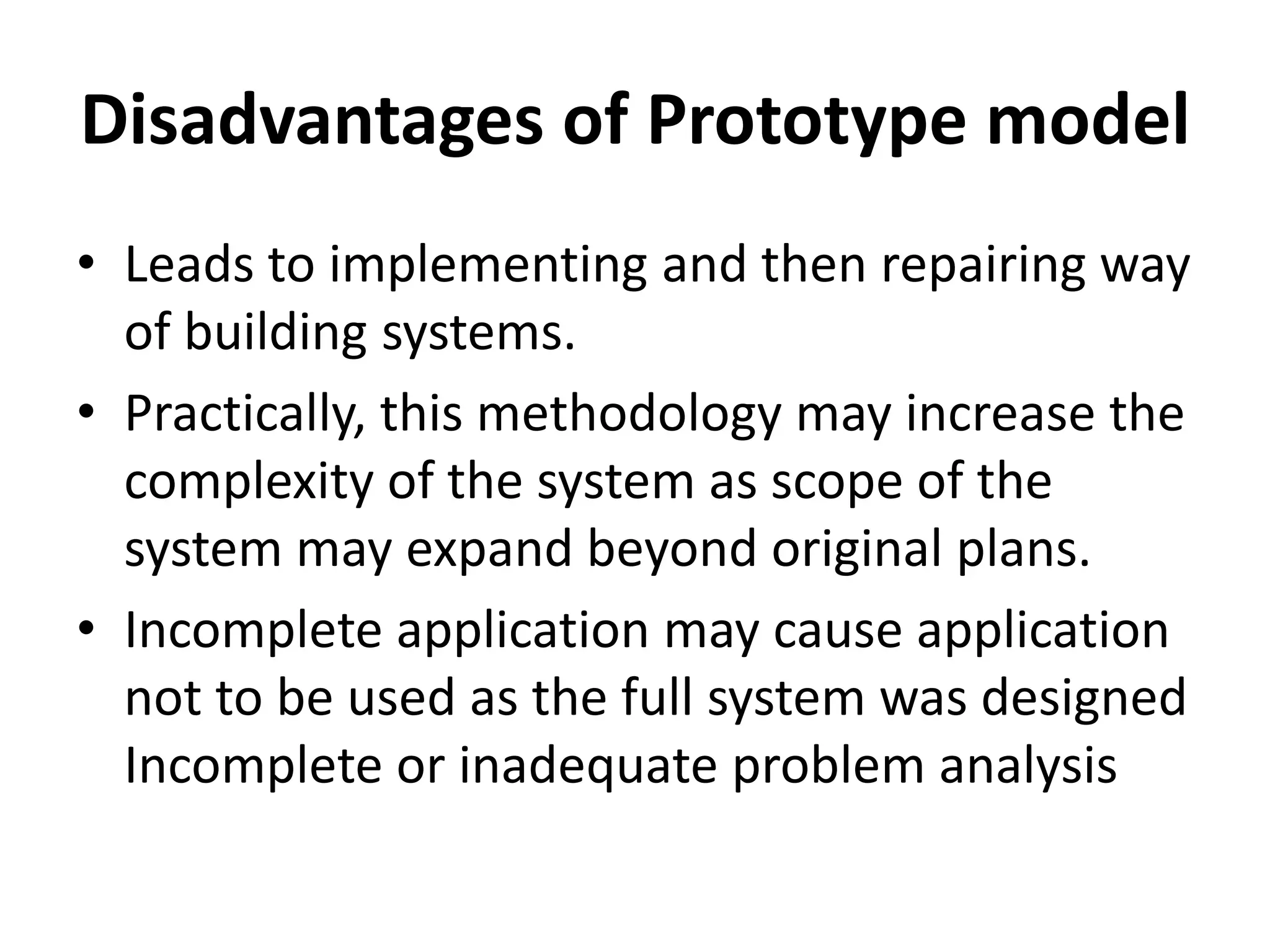
Disadvantages of Prototype model
• Leads to implementing and then repairing way
of building systems.
• Practically, this methodology may increase the
complexity of the system as scope of the
system may expand beyond original plans.
• Incomplete application may cause application
not to be used as the full system was designed
Incomplete or inadequate problem analysis
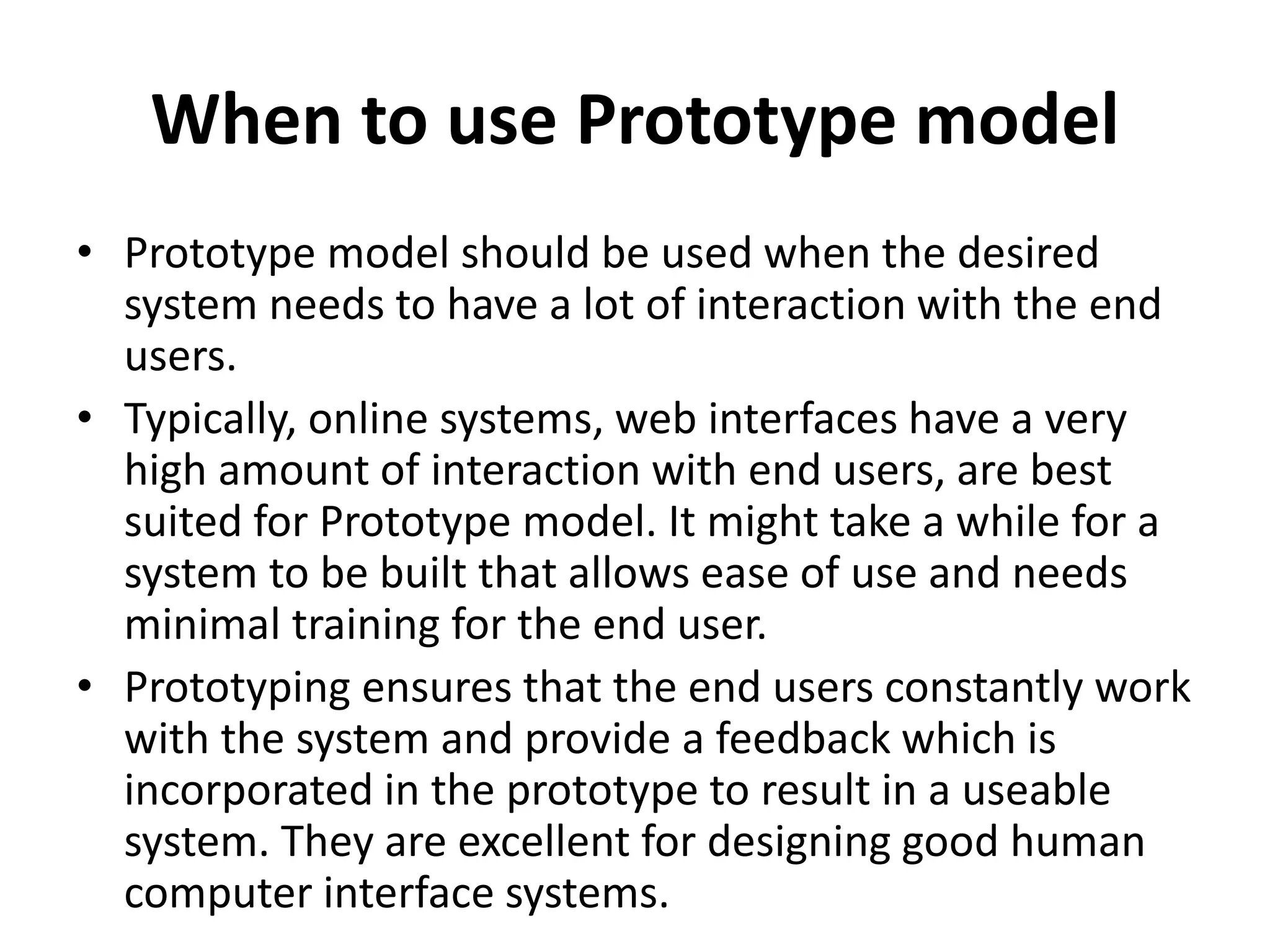
When to use Prototype model
• Prototype model should be used when the desired
system needs to have a lot of interaction with the end
users.
• Typically, online systems, web interfaces have a very
high amount of interaction with end users, are best
suited for Prototype model. It might take a while for a
system to be built that allows ease of use and needs
minimal training for the end user.
• Prototyping ensures that the end users constantly work
with the system and provide a feedback which is
incorporated in the prototype to result in a useable
system. They are excellent for designing good human
computer interface systems.
V Model
V Model
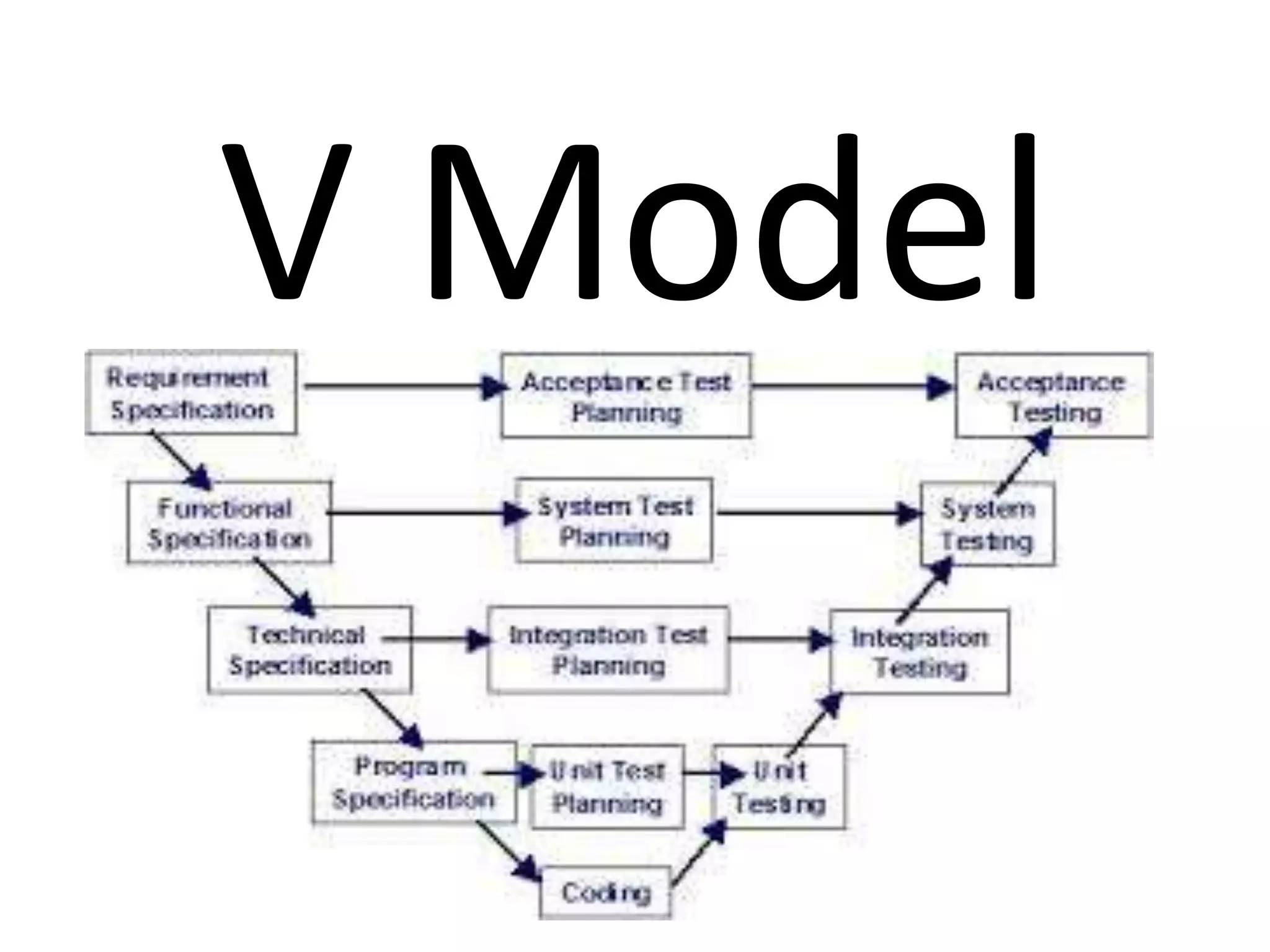
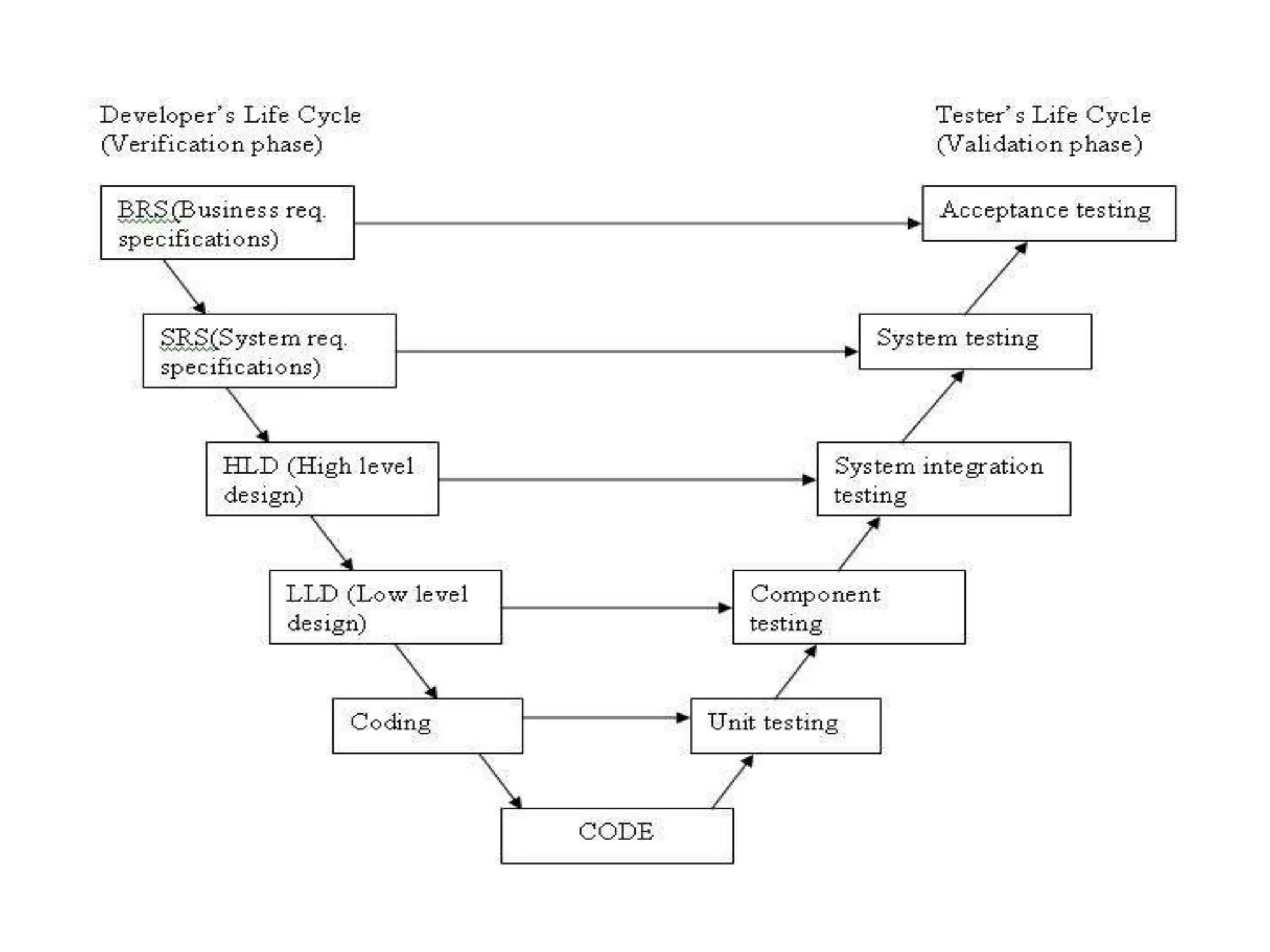
• ‘V-model’ is also used by many of the
companies in their product. ‘V-model’ is
nothing but ‘Verification’ and ‘Validation’
model. In ‘V-model’ the developer’s life cycle
and tester’s life cycle are mapped to each
other. In this model testing is done side by
side of the development.
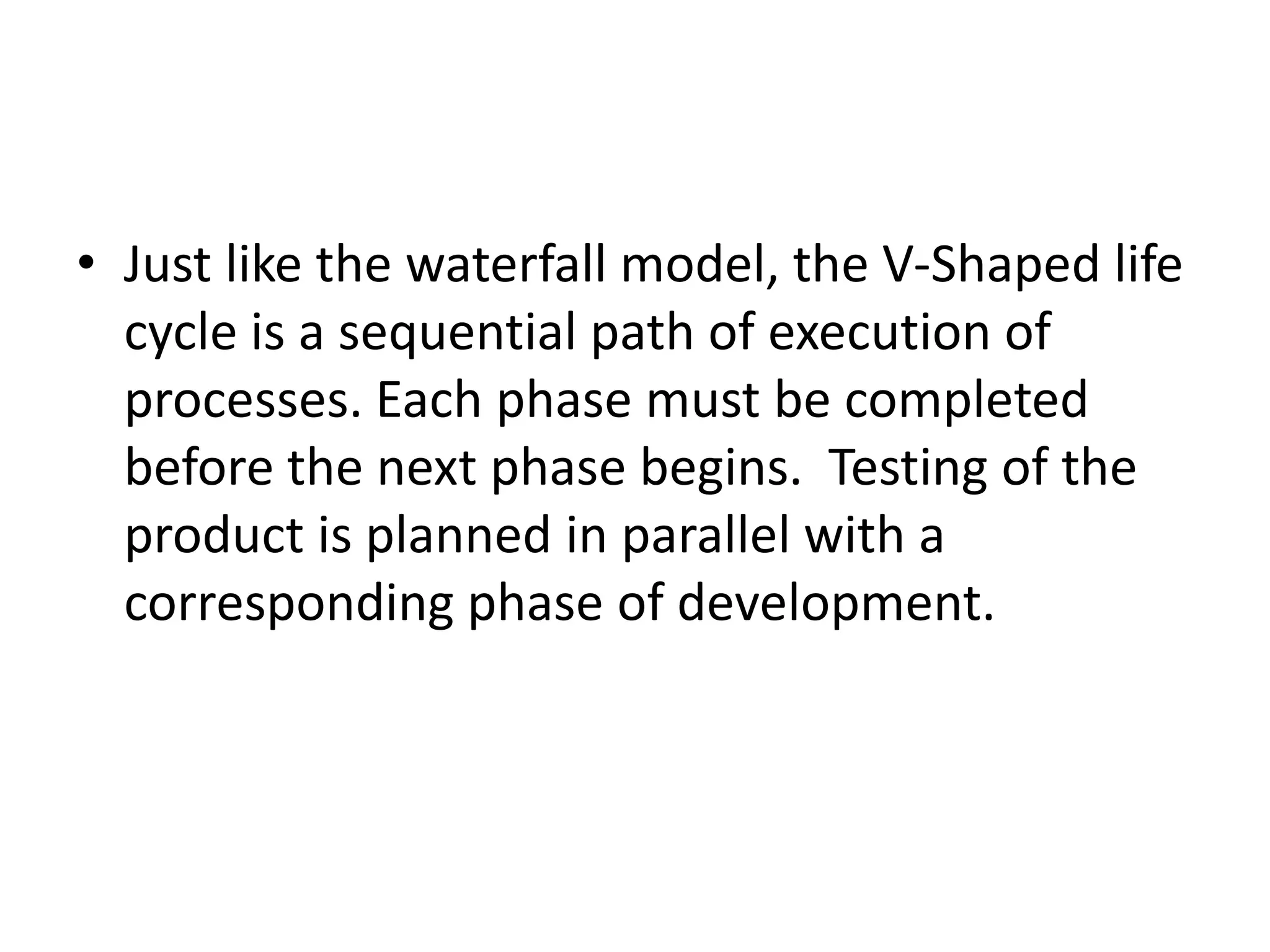
• Just like the waterfall model, the V-Shaped life
cycle is a sequential path of execution of
processes. Each phase must be completed
before the next phase begins. Testing of the
product is planned in parallel with a
corresponding phase of development.
V Model
REQUIREMENTS
ANALYSIS
SYSTEM
DESIGN
PROGRAM
DESIGN
CODING
UNIT & INTE-
GRATION TESTING
SYSTEM
TESTING
ACCEPTANCE
TESTING
OPERATION
& MAINTENANCE
Verify design
Validate requirements
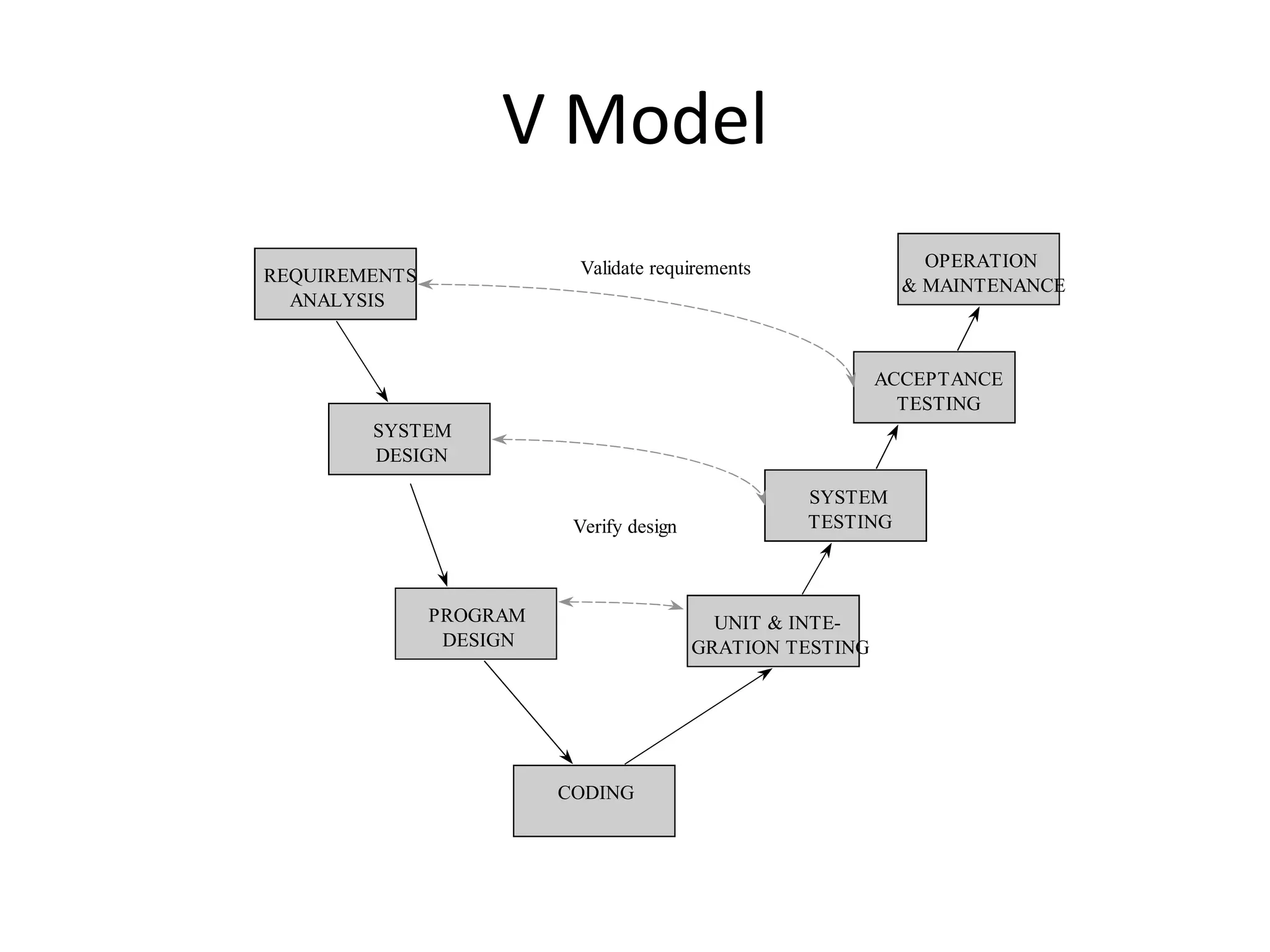
Various phases of the V-model are as
follows
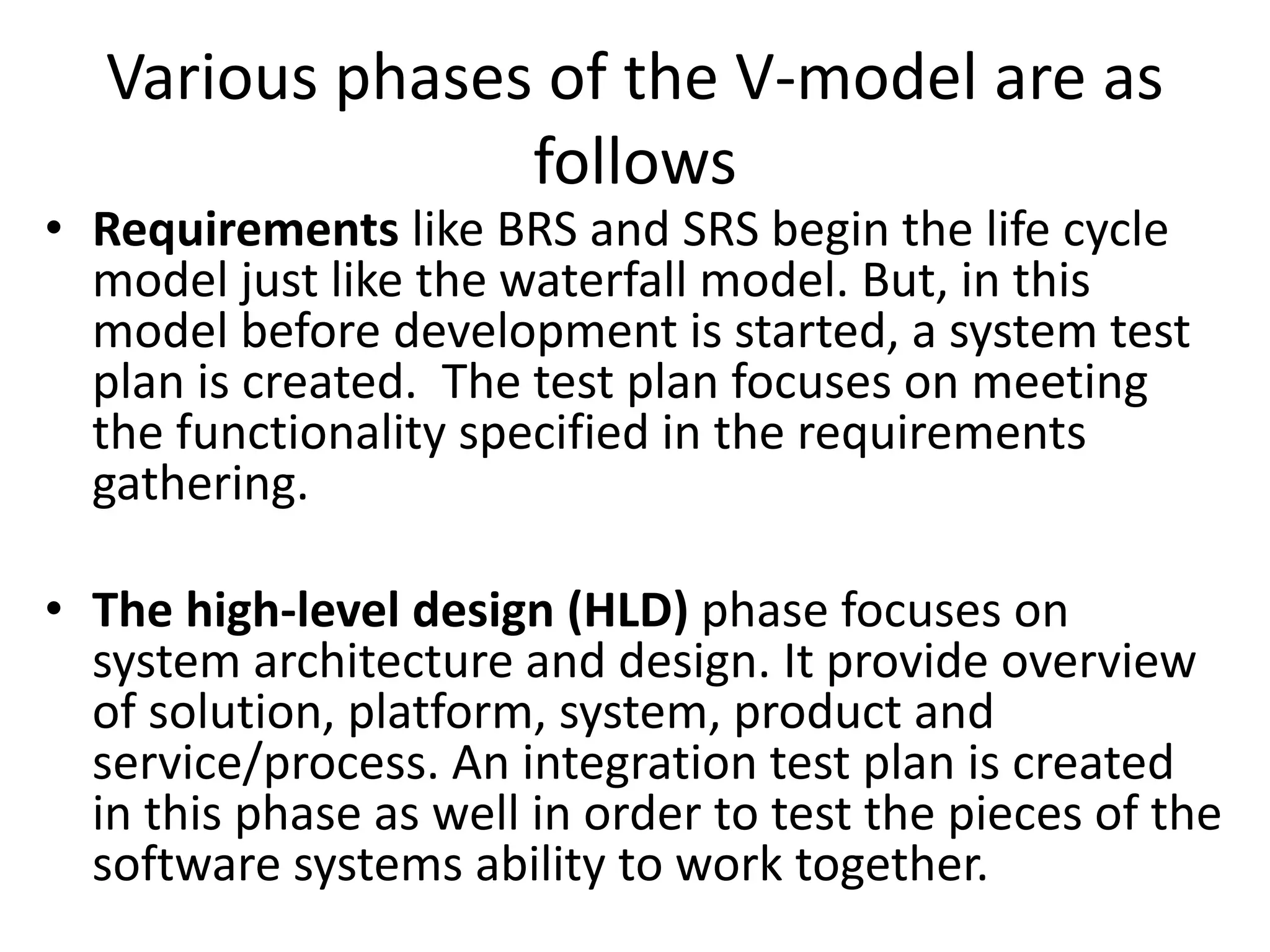
• Requirements like BRS and SRS begin the life cycle
model just like the waterfall model. But, in this
model before development is started, a system test
plan is created. The test plan focuses on meeting
the functionality specified in the requirements
gathering.
• The high-level design (HLD) phase focuses on
system architecture and design. It provide overview
of solution, platform, system, product and
service/process. An integration test plan is created
in this phase as well in order to test the pieces of the
software systems ability to work together.
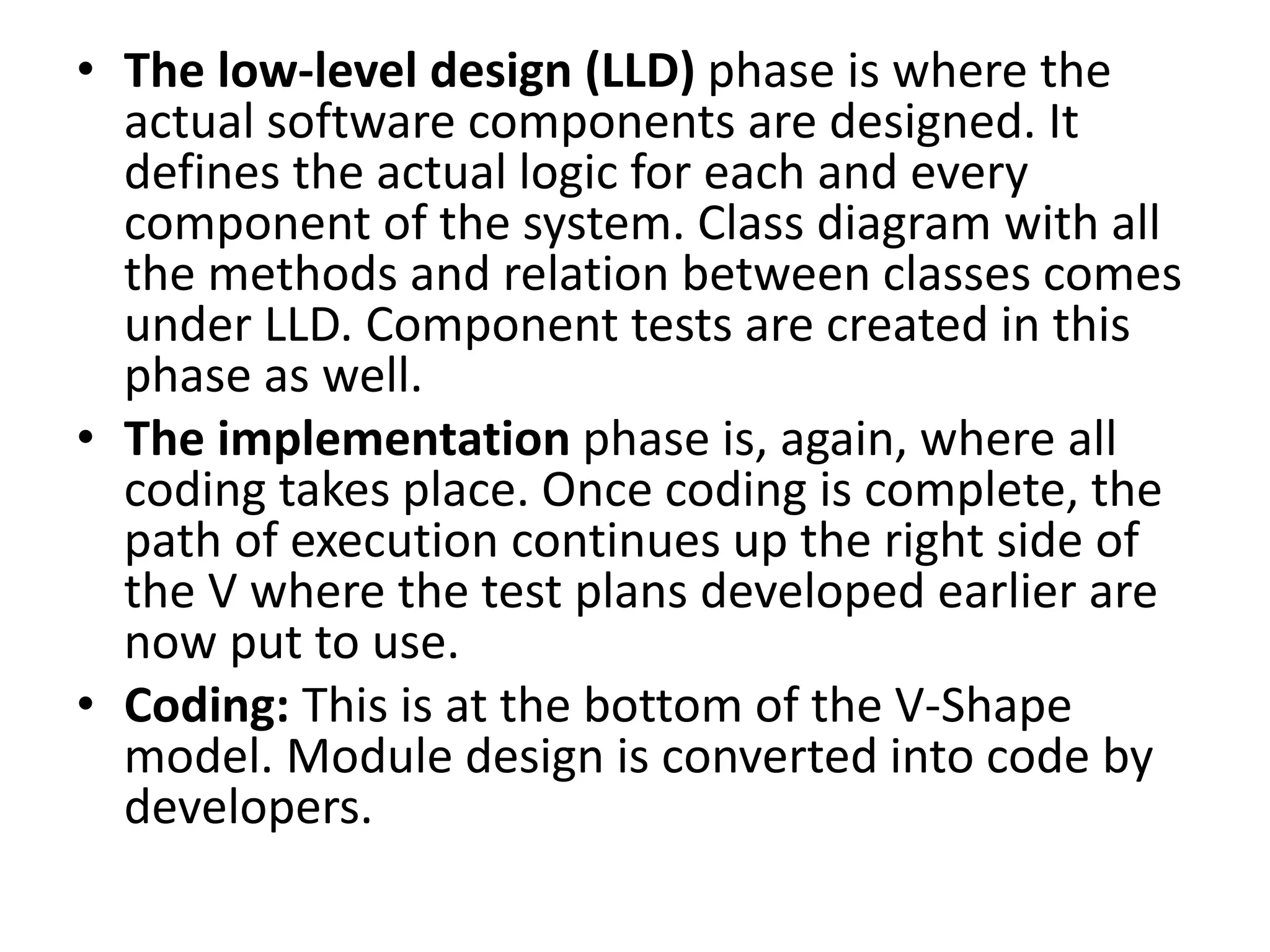
• The low-level design (LLD) phase is where the
actual software components are designed. It
defines the actual logic for each and every
component of the system. Class diagram with all
the methods and relation between classes comes
under LLD. Component tests are created in this
phase as well.
• The implementation phase is, again, where all
coding takes place. Once coding is complete, the
path of execution continues up the right side of
the V where the test plans developed earlier are
now put to use.
• Coding: This is at the bottom of the V-Shape
model. Module design is converted into code by
developers.
Advantages of V-model
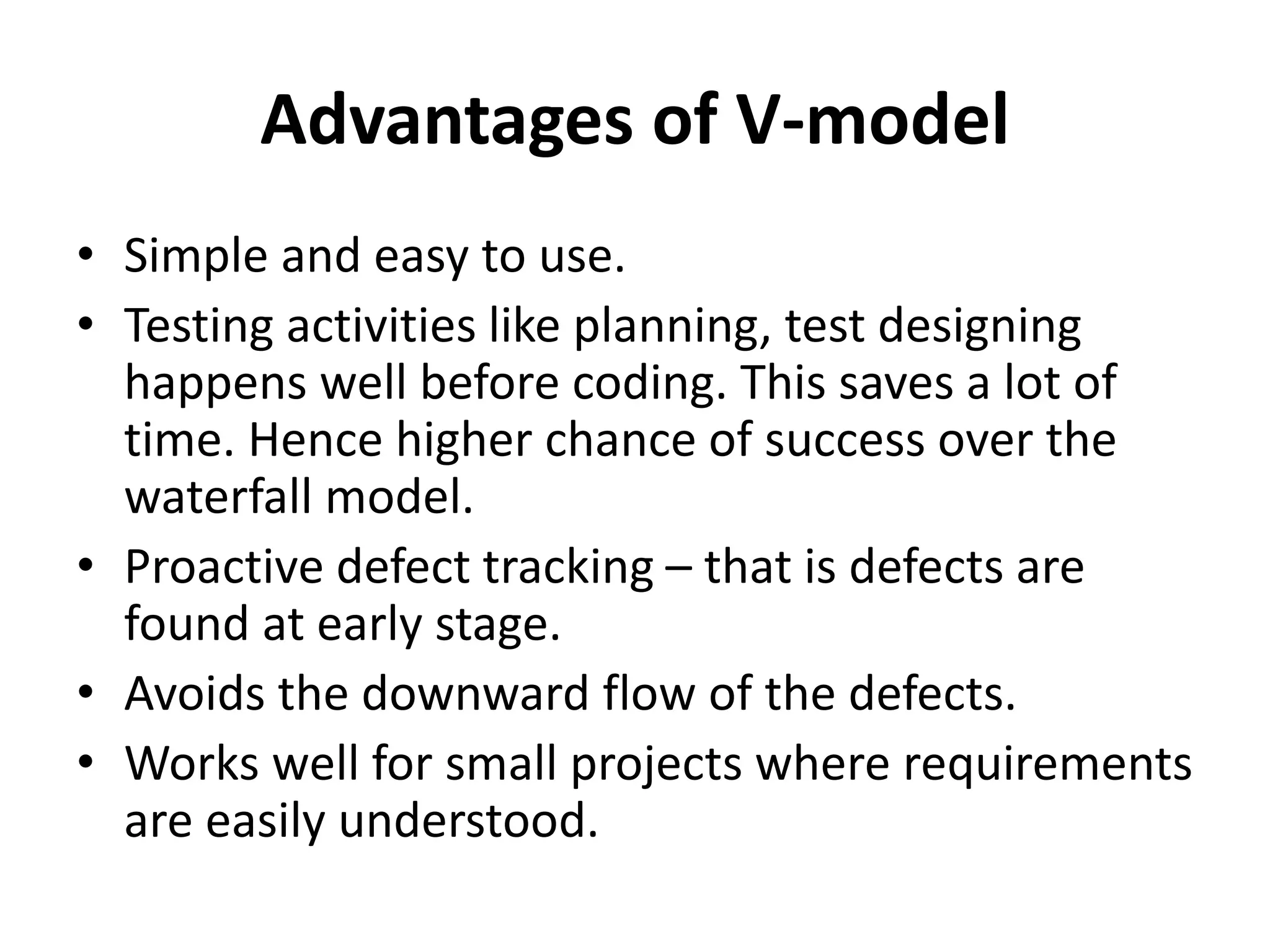
• Simple and easy to use.
• Testing activities like planning, test designing
happens well before coding. This saves a lot of
time. Hence higher chance of success over the
waterfall model.
• Proactive defect tracking – that is defects are
found at early stage.
• Avoids the downward flow of the defects.
• Works well for small projects where requirements
are easily understood.
Disadvantages of V-model
• Very rigid and least flexible.
• Software is developed during the
implementation phase, so no early prototypes
of the software are produced.
• If any changes happen in midway, then the
test documents along with requirement
documents has to be updated.
When to use the V-model
• The V-shaped model should be used for small to
medium sized projects where requirements are clearly
defined and fixed.
• The V-Shaped model should be chosen when ample
technical resources are available with needed technical
expertise.
HIGH CONFIDENCE OF CUSTOMER IS REQUIRED FOR
CHOOSING THE V-SHAPED MODEL APPROACH. SINCE,
NO PROTOTYPES ARE PRODUCED, THERE IS A VERY
HIGH RISK INVOLVED IN MEETING CUSTOMER
EXPECTATIONS.
Incremental
Model
Incremental Model
• DEVELOPING A SOFTWARE SYSTEM
INCREMENTALLY FOR TAKING ADVANTAGE OF
WHAT WAS BEING LEARNED DURING THE
DEVELOPMENT OF EARLIER, INCREMENTAL,
DELIVERABLE VERSIONS OF THE SYSTEM BY
DIVIDING PROJECT TO ITERATIONS OR
INCREMENTS
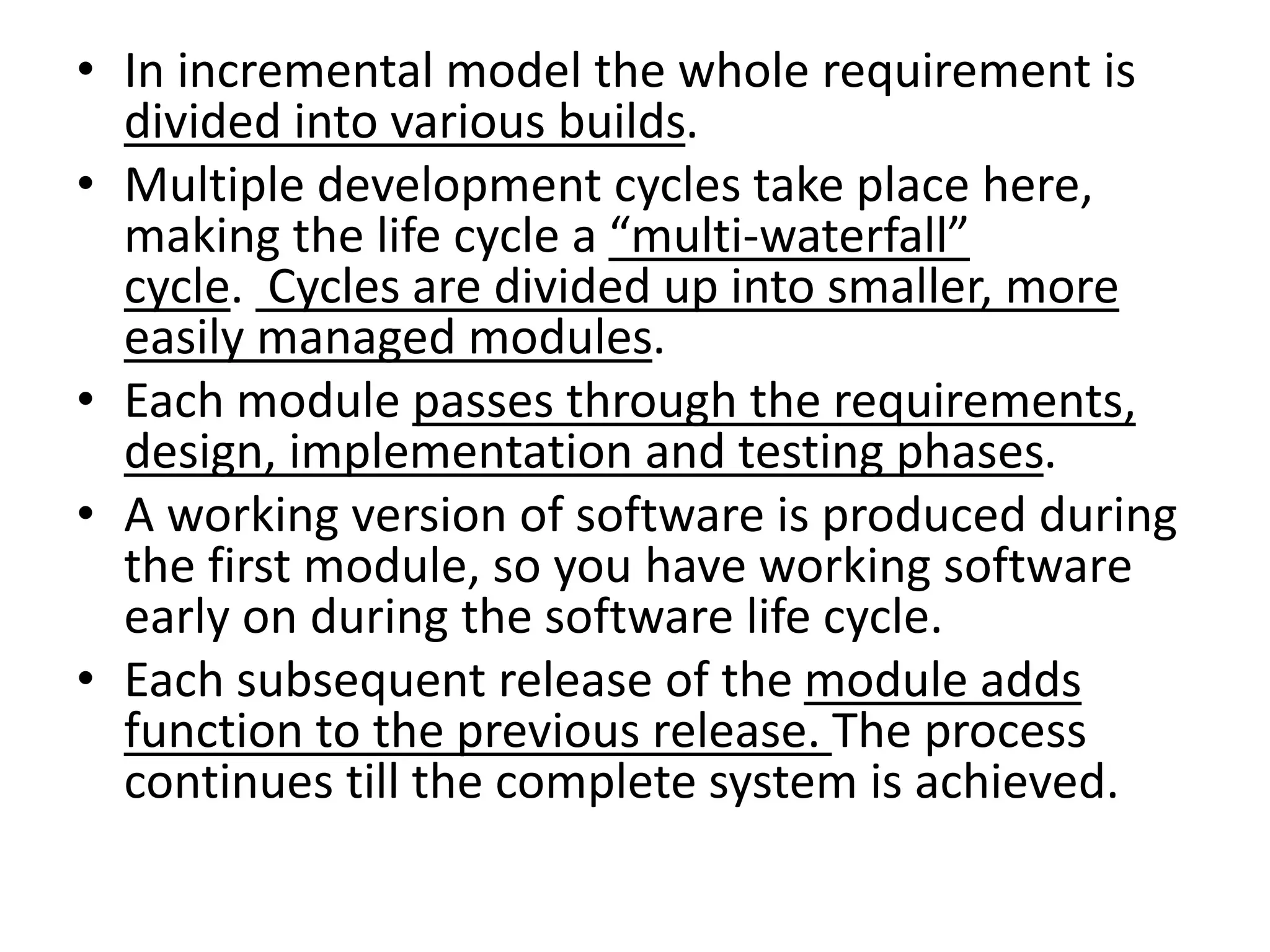
• In incremental model the whole requirement is
divided into various builds.
• Multiple development cycles take place here,
making the life cycle a “multi-waterfall”
cycle. Cycles are divided up into smaller, more
easily managed modules.
• Each module passes through the requirements,
design, implementation and testing phases.
• A working version of software is produced during
the first module, so you have working software
early on during the software life cycle.
• Each subsequent release of the module adds
function to the previous release. The process
continues till the complete system is achieved.
ITERATIVE AND INCREMENTAL
DEVELOPMENT
• is a cyclic software development model
developed in response to the weaknesses of
the water fall model.
• Approach attempts to combine the waterfall
sequence with some of the advantages of
prototyping.
• This approach favored by object oriented
practitioners.
INCREMENTAL MODEL LIFE CYCLE
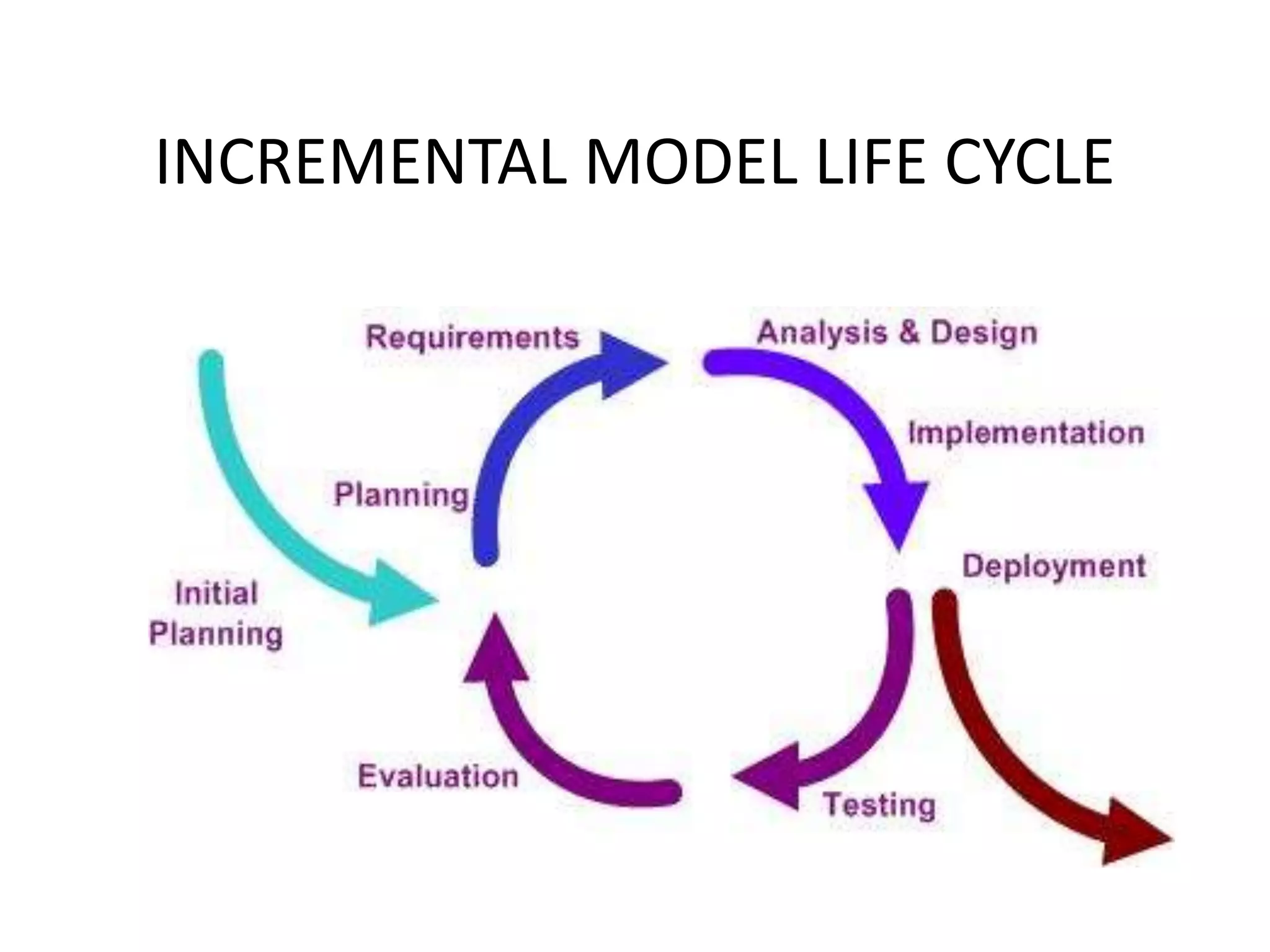
It basically:
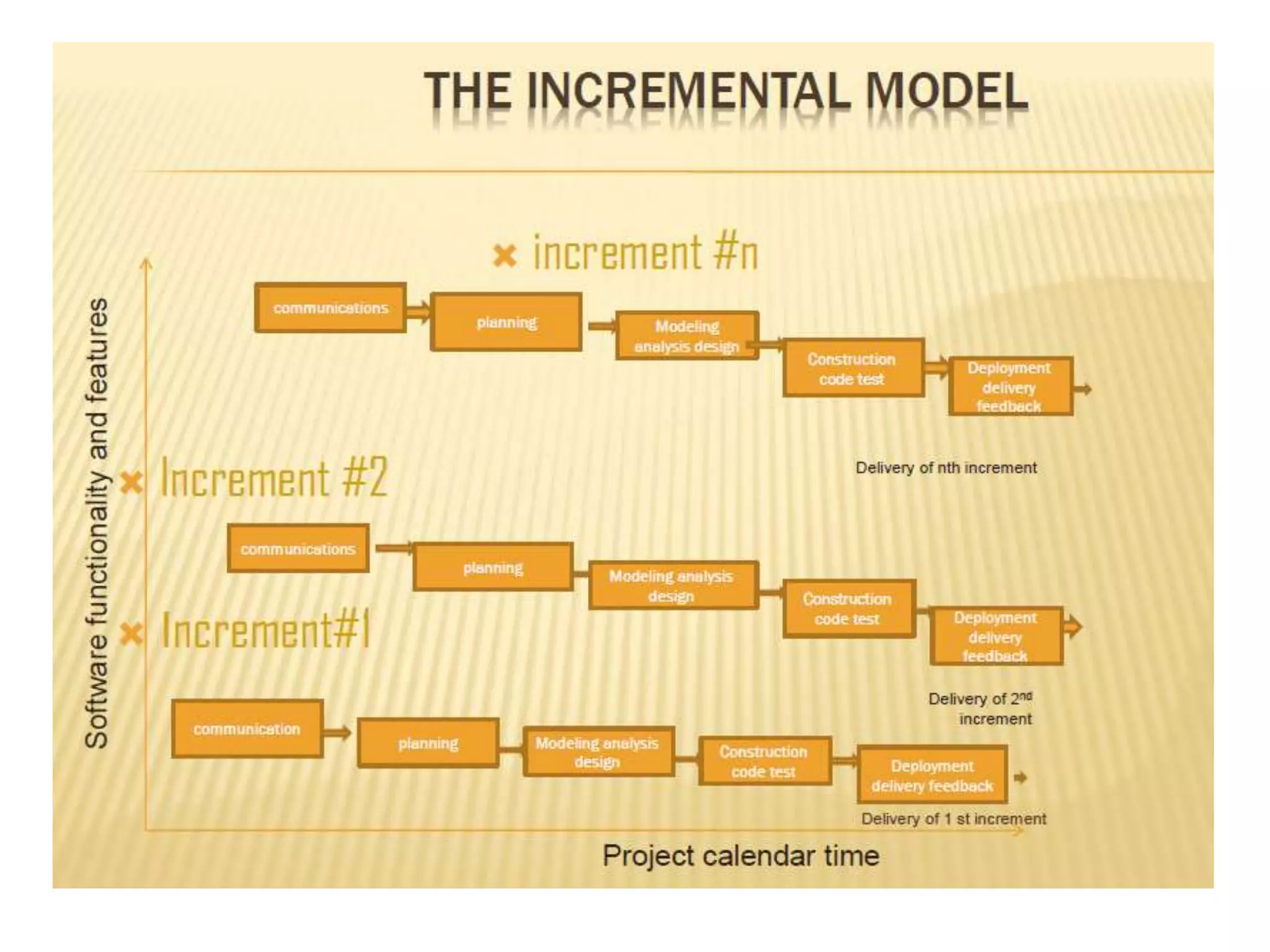
• divides the overall project into a number of increments.
• Then it applies the waterfall model to each increment.
• The system is put into production when the first increment
is delivered.
• As time passes additional increments are completed and
added to the working system
Notes:
• Phases on each increment are sequential.
• key process are to start with a simple implementation
of a subset of the software requirements and
iteratively enhance the evolving sequence of versions
until the full system is implemented.
• At each iteration, design modifications are made and
new functional capabilities are added.
DISADVANTAGES & ADVANTAGE
Advantages:
• Generates working software quickly and early during the software
life cycle.
• More flexible - less costly to change scope and requirements.
• Easier to test and debug during a smaller iteration.
• Easier to manage risk because risky pieces are identified and
handled during its iteration.
Disadvantages:
• Each phase of an iteration is rigid and do not overlap each other.
• Problems may arise pertaining to system architecture because not
all requirements are gathered up front for the entire software life
cycle.
When to use the Incremental model
• This model can be used when the requirements
of the complete system are clearly defined and
understood.
• Major requirements must be defined; however,
some details can evolve with time.
• There is a need to get a product to the market
early.
• A new technology is being used
• Resources with needed skill set are not available
• There are some high risk features and goals.
RAD
Model
Rapid Application Development Model
• It is a type of incremental model.
• In RAD model the components or functions
are developed in parallel as if they were mini
projects.
• The developments are time boxed, delivered
and then assembled into a working
prototype.
• This can quickly give the customer something
to see and use and to provide feedback
regarding the delivery and their requirements.
The phases in the rapid application
development (RAD) model are
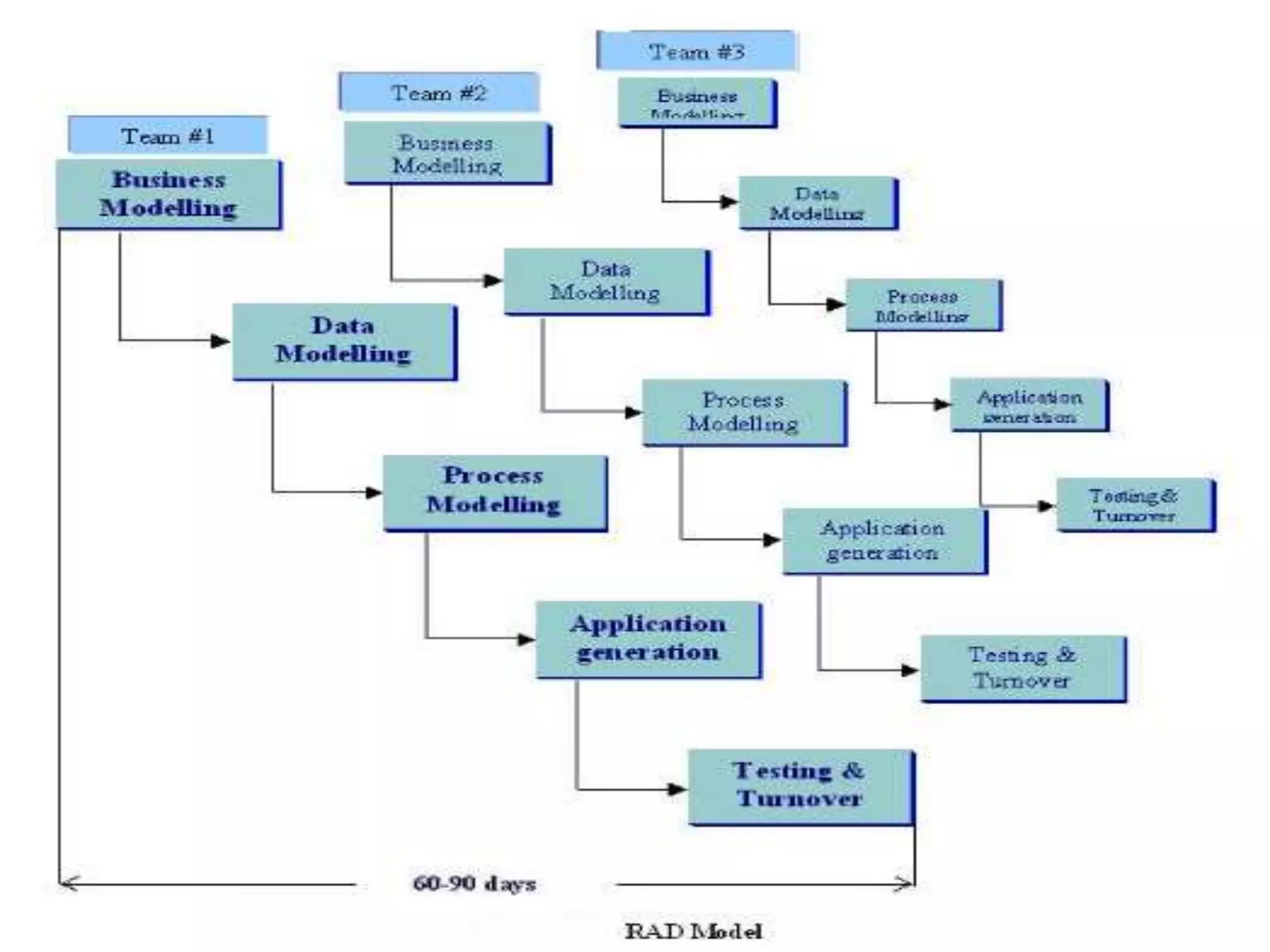
• Business modeling: The information flow is identified
between various business functions.
• Data modeling: Information gathered from business
modeling is used to define data objects that are needed for
the business.
• Process modeling: Data objects defined in data modeling
are converted to achieve the business information flow to
achieve some specific business objective. Description are
identified and created for CRUD of data objects.
• Application generation: Automated tools are used to
convert process models into code and the actual system.
• Testing and turnover: Test new components and all the
interfaces.
Advantages of the RAD model
• Reduced development time.
• Increases reusability of components
• Quick initial reviews occur
• Encourages customer feedback
Disadvantages of RAD model
• Depends on strong team and individual
performances for identifying business
requirements.
• Only system that can be modularized can be built
using RAD
• Requires highly skilled developers/designers.
• High dependency on modeling skills
• Inapplicable to cheaper projects as cost of
modeling and automated code generation is very
high.
When to use RAD model
• RAD should be used when there is a need to
create a system that can be modularized in 2-3
months of time.
• It should be used if there’s high availability of
designers for modeling and the budget is high
enough to afford their cost along with the cost of
automated code generating tools.
• RAD SDLC model should be chosen only if
resources with high business knowledge are
available and there is a need to produce the
system in a short span of time (2-3 months).
Agile Model
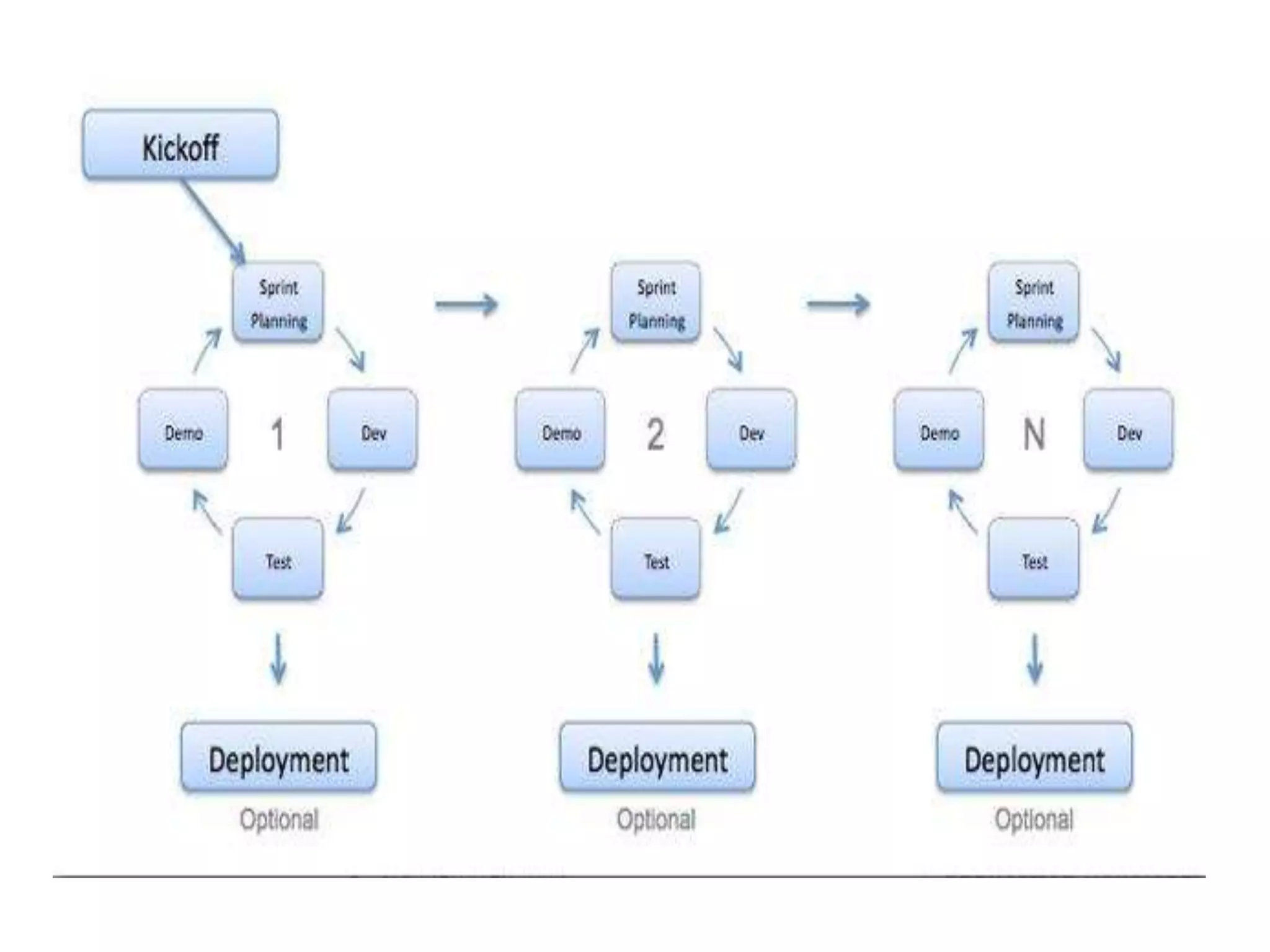
• Agile development model is also a type of
Incremental model.
• Software is developed in incremental, rapid
cycles. This results in small incremental releases
with each release building on previous
functionality.
• Each release is thoroughly tested to ensure
software quality is maintained. It is used for time
critical applications.
• Extreme Programming (XP) is currently one of the
most well known agile development life cycle
model.
Advantages of Agile model
• Customer satisfaction by rapid, continuous delivery of useful
software.
• People and interactions are emphasized rather than process and
tools. Customers, developers and testers constantly interact with
each other.
• Working software is delivered frequently (weeks rather than
months).
• Face-to-face conversation is the best form of communication.
• Close, daily cooperation between business people and developers.
• Continuous attention to technical excellence and good design.
• Regular adaptation to changing circumstances.
• Even late changes in requirements are welcomed
Disadvantages of Agile model
• In case of some software deliverables, especially the
large ones, it is difficult to assess the effort required at
the beginning of the software development life cycle.
• There is lack of emphasis on necessary designing and
documentation.
• The project can easily get taken off track if the
customer representative is not clear what final
outcome that they want.
• Only senior programmers are capable of taking the
kind of decisions required during the development
process. Hence it has no place for newbie
programmers, unless combined with experienced
resources
When to use Agile model
• When new changes are needed to be implemented. The freedom agile
gives to change is very important. New changes can be implemented at
very little cost because of the frequency of new increments that are
produced.
• To implement a new feature the developers need to lose only the work of
a few days, or even only hours, to roll back and implement it.
• Unlike the waterfall model in agile model very limited planning is required
to get started with the project. Agile assumes that the end users’ needs
are ever changing in a dynamic business and IT world. Changes can be
discussed and features can be newly effected or removed based on
feedback. This effectively gives the customer the finished system they
want or need.
• Both system developers and stakeholders alike, find they also get more
freedom of time and options than if the software was developed in a more
rigid sequential way. Having options gives them the ability to leave
important decisions until more or better data or even entire hosting
programs are available; meaning the project can continue to move
forward without fear of reaching a sudden standstill.
ThankYou&
KeepLearning!
?Follow us :
You can find me at
https://www.linkedin.com/in/drkamalgulati/
https://mybigdataanalytics.in/
https://www.facebook.com/DrKamalGulatiBig
DATA/

Models of SDLC (Software Development Life Cycle / Program Development Life Cycle)

  • 1.
    Software Engineering Dr. KamalGulati (Part 2) – Models of SDLC
  • 2.
    Contents 1. Software LifecycleModels / Software Development Models 2. Types of Software development models 3. Waterfall Model 4. Features of Waterfall Model 5. Phase of Waterfall Model 6. Prototype Model 7. Advantages of Prototype Model 8. Disadvantages of Prototype model 9. V Model 10. Advantages of V-model 11. Disadvantages of V-model 12. When to use the V-model 13. Incremental Model 14. ITERATIVE AND INCREMENTAL DEVELOPMENT 15. INCREMENTAL MODEL LIFE CYCLE 16. When to use the Incremental model 17. Rapid Application Development RAD Model 18. phases in the rapid application development (RAD) model 19. Advantages of the RAD model 20. Disadvantages of RAD model 21. When to use RAD model 22. Agile Model 23. Advantages of Agile model 24. Disadvantages of Agile model 25. When to use Agile model
  • 3.
    Software Lifecycle Models/ Software Development Models The development models are the various processes or methodologies that are being selected for the development of the project depending on the project’s aims and goals. There are many development life cycle models that have been developed in order to achieve different required objectives. The models specify the various stages of the process and the order in which they are carried out.
  • 4.
    • The selectionof model has very high impact on the testing that is carried out. It will define the what, where and when of our planned testing, influence regression testing and largely determines which test techniques to use.
  • 5.
    There are variousSoftware development models or methodologies. They are as follows:- 1. Waterfall Model 2. Prototype Model 3. V Model 4. Incremental model (Phased Development Model) 5. RAD model (Type of Incremental Model) 6. Agile model (Type of Incremental Model) 7. Iterative model 8. Prototyping Model 9. Spiral model (Similar to Incremental Model with more risk analysis)
  • 6.
  • 7.
    Software Development Lifecycle WaterfallModel Requirements Design Implementation Integration & Verification Validation Deployment & Maintenance Plan/Schedule Replan/Reschedule
  • 8.
    Features of WaterfallModel 1) A Water Fall Model is easy to flow. 2) It can be implemented for any size of project. 3) Every stage has to be done separately at the right time so you cannot jump stages. 4) Documentation is produced at every stage of a waterfall model allowing people to understand what has been done. 5) Testing is done at every stage.
  • 9.
    Phase of WaterfallModel Waterfall model has 5 different phases, Which are following. 1)Requirement gathering and Analysis. 2)Design. 3)Coding. 4)Testing. 5)Maintenance.
  • 10.
  • 11.
    1) Requirement gatheringand Analysis.  This is the first phase of waterfall model which includes a meeting with the customer to understand his requirements.  This is the most crucial phase as any misinterpretation at this stage may give rise to validation issues later.  The software definition must be detailed and accurate with no ambiguities.  It is very important to understand the customer requirements and expectations so that the end product meets his specifications.
  • 12.
     Requirement gatheringand Analysis phase the basic requirements of the system must be understood by software engineer, who is also called ANALYST.  All this requirements are then well documented and discussed further with the customer for reviewing.
  • 13.
    • 2)Design.  Thecustomer requirements are broken down into logical modules for the ease of implementation. Hardware and software requirements for every module are Identified and designed accordingly.  Also the inter relation between the various logical modules is established at this stage. Algorithms and diagrams defining the scope and objective of each logical model are developed.  In short, this phase lays a fundamental for actual programming and implementation
  • 14.
     It isa intermediate step between requirements analysis and coding. Design focuses on program attribute such as- 1) Data Structure. 2) Software Architecture. 3)Algorithm Details  The requirements are translated in some easy to represent form using which coding can be done effectively and efficiently.  The design needs to be documented for further use.
  • 15.
    3.) Coding  Codingis a step in which design is translated into machine- readable form.  If design is done in sufficient detail then coding can be done effectively. • Programs are created in this phase. •  In this phase all software divided into small module then after doing coding for that small module rather than do coding whole software.  According to design programmers do code and make class and structure of whole software.
  • 16.
    4.) Testing  Inthis stage, both individual components and the integrated whole are • methodically verified to ensure that they are error- free and fully meet the requirements • outlined in the first step.  In this phase testing whole software into two parts 1) HARDWARE & 2) SOFTWARE.  Type of testing is 2-types 1) Inside test. 2) Outside test.
  • 17.
    5)Maintenance.  This isthe final phase of the waterfall model, in which the completed software product is handed over to the client after alpha, beta testing.  After the software has been deployed on the client site, it is the duty of the software development team to undertake routine maintenance activities by visiting the client site.  If the customer suggests changes or enhancements the software process has to be followed all over again right from the first phase i.e requirement analysis.
  • 18.
    • The usuallythe longest stage of the software. In this phase the software is updated to: a) Meet the changing customer needs b) Adapted to accommodate changes in the external environment c) Correct errors and oversights previously undetected in the testing phases d) Enhancing the efficiency of the software Observe that feed back loops allow for corrections to be incorporated into the model.
  • 19.
     The waterfall model is easy to implementation.  For implementation of small systems water fall model is use full.  The project requires the fulfillment of one phase, before proceeding to the next.  It is easier to develop various software through this method in short span of time.  In this model phases are processed and completed one at a time. Phases do not overlap.
  • 20.
    Disadvantages of waterfallmodel • Once an application is in the testing stage, it is very difficult to go back and change something that was not well-thought out in the concept stage. • No working software is produced until late during the life cycle. • High amounts of risk and uncertainty. • Not a good model for complex and object-oriented projects. • Poor model for long and ongoing projects. • Not suitable for the projects where requirements are at a moderate to high risk of changing.
  • 21.
    When to usethe waterfall model • This model is used only when the requirements are very well known, clear and fixed. • Product definition is stable. • Technology is understood. • There are no ambiguous requirements • Ample resources with required expertise are available freely • The project is short.
  • 22.
  • 23.
    Prototype Model • Thebasic idea here is that instead of freezing the requirements before a design or coding can proceed, a throwaway prototype is built to understand the requirements. • This prototype is developed based on the currently known requirements. By using this prototype, the client can get an “actual feel” of the system, since the interactions with prototype can enable the client to better understand the requirements of the desired system.
  • 24.
    • Prototyping isan attractive idea for complicated and large systems for which there is no manual process or existing system to help determining the requirements. The prototype are usually not complete systems and many of the details are not built in the prototype. The goal is to provide a system with overall functionality.
  • 26.
    Advantages of Prototypemodel • Users are actively involved in the development • Since in this methodology a working model of the system is provided, the users get a better understanding of the system being developed. • Errors can be detected much earlier. • Quicker user feedback is available leading to better solutions. • Missing functionality can be identified easily • Confusing or difficult functions can be identified Requirements validation, Quick implementation of, incomplete, but functional, application.
  • 27.
    Disadvantages of Prototypemodel • Leads to implementing and then repairing way of building systems. • Practically, this methodology may increase the complexity of the system as scope of the system may expand beyond original plans. • Incomplete application may cause application not to be used as the full system was designed Incomplete or inadequate problem analysis
  • 28.
    When to usePrototype model • Prototype model should be used when the desired system needs to have a lot of interaction with the end users. • Typically, online systems, web interfaces have a very high amount of interaction with end users, are best suited for Prototype model. It might take a while for a system to be built that allows ease of use and needs minimal training for the end user. • Prototyping ensures that the end users constantly work with the system and provide a feedback which is incorporated in the prototype to result in a useable system. They are excellent for designing good human computer interface systems.
  • 29.
  • 30.
    V Model • ‘V-model’is also used by many of the companies in their product. ‘V-model’ is nothing but ‘Verification’ and ‘Validation’ model. In ‘V-model’ the developer’s life cycle and tester’s life cycle are mapped to each other. In this model testing is done side by side of the development.
  • 31.
    • Just likethe waterfall model, the V-Shaped life cycle is a sequential path of execution of processes. Each phase must be completed before the next phase begins. Testing of the product is planned in parallel with a corresponding phase of development.
  • 32.
    V Model REQUIREMENTS ANALYSIS SYSTEM DESIGN PROGRAM DESIGN CODING UNIT &INTE- GRATION TESTING SYSTEM TESTING ACCEPTANCE TESTING OPERATION & MAINTENANCE Verify design Validate requirements
  • 34.
    Various phases ofthe V-model are as follows • Requirements like BRS and SRS begin the life cycle model just like the waterfall model. But, in this model before development is started, a system test plan is created. The test plan focuses on meeting the functionality specified in the requirements gathering. • The high-level design (HLD) phase focuses on system architecture and design. It provide overview of solution, platform, system, product and service/process. An integration test plan is created in this phase as well in order to test the pieces of the software systems ability to work together.
  • 35.
    • The low-leveldesign (LLD) phase is where the actual software components are designed. It defines the actual logic for each and every component of the system. Class diagram with all the methods and relation between classes comes under LLD. Component tests are created in this phase as well. • The implementation phase is, again, where all coding takes place. Once coding is complete, the path of execution continues up the right side of the V where the test plans developed earlier are now put to use. • Coding: This is at the bottom of the V-Shape model. Module design is converted into code by developers.
  • 36.
    Advantages of V-model •Simple and easy to use. • Testing activities like planning, test designing happens well before coding. This saves a lot of time. Hence higher chance of success over the waterfall model. • Proactive defect tracking – that is defects are found at early stage. • Avoids the downward flow of the defects. • Works well for small projects where requirements are easily understood.
  • 37.
    Disadvantages of V-model •Very rigid and least flexible. • Software is developed during the implementation phase, so no early prototypes of the software are produced. • If any changes happen in midway, then the test documents along with requirement documents has to be updated.
  • 38.
    When to usethe V-model • The V-shaped model should be used for small to medium sized projects where requirements are clearly defined and fixed. • The V-Shaped model should be chosen when ample technical resources are available with needed technical expertise. HIGH CONFIDENCE OF CUSTOMER IS REQUIRED FOR CHOOSING THE V-SHAPED MODEL APPROACH. SINCE, NO PROTOTYPES ARE PRODUCED, THERE IS A VERY HIGH RISK INVOLVED IN MEETING CUSTOMER EXPECTATIONS.
  • 39.
  • 40.
    Incremental Model • DEVELOPINGA SOFTWARE SYSTEM INCREMENTALLY FOR TAKING ADVANTAGE OF WHAT WAS BEING LEARNED DURING THE DEVELOPMENT OF EARLIER, INCREMENTAL, DELIVERABLE VERSIONS OF THE SYSTEM BY DIVIDING PROJECT TO ITERATIONS OR INCREMENTS
  • 41.
    • In incrementalmodel the whole requirement is divided into various builds. • Multiple development cycles take place here, making the life cycle a “multi-waterfall” cycle. Cycles are divided up into smaller, more easily managed modules. • Each module passes through the requirements, design, implementation and testing phases. • A working version of software is produced during the first module, so you have working software early on during the software life cycle. • Each subsequent release of the module adds function to the previous release. The process continues till the complete system is achieved.
  • 43.
    ITERATIVE AND INCREMENTAL DEVELOPMENT •is a cyclic software development model developed in response to the weaknesses of the water fall model. • Approach attempts to combine the waterfall sequence with some of the advantages of prototyping. • This approach favored by object oriented practitioners.
  • 44.
  • 45.
    INCREMENTAL MODEL LIFECYCLE It basically: • divides the overall project into a number of increments. • Then it applies the waterfall model to each increment. • The system is put into production when the first increment is delivered. • As time passes additional increments are completed and added to the working system Notes: • Phases on each increment are sequential.
  • 46.
    • key processare to start with a simple implementation of a subset of the software requirements and iteratively enhance the evolving sequence of versions until the full system is implemented. • At each iteration, design modifications are made and new functional capabilities are added.
  • 47.
    DISADVANTAGES & ADVANTAGE Advantages: •Generates working software quickly and early during the software life cycle. • More flexible - less costly to change scope and requirements. • Easier to test and debug during a smaller iteration. • Easier to manage risk because risky pieces are identified and handled during its iteration. Disadvantages: • Each phase of an iteration is rigid and do not overlap each other. • Problems may arise pertaining to system architecture because not all requirements are gathered up front for the entire software life cycle.
  • 48.
    When to usethe Incremental model • This model can be used when the requirements of the complete system are clearly defined and understood. • Major requirements must be defined; however, some details can evolve with time. • There is a need to get a product to the market early. • A new technology is being used • Resources with needed skill set are not available • There are some high risk features and goals.
  • 49.
  • 50.
    Rapid Application DevelopmentModel • It is a type of incremental model. • In RAD model the components or functions are developed in parallel as if they were mini projects. • The developments are time boxed, delivered and then assembled into a working prototype. • This can quickly give the customer something to see and use and to provide feedback regarding the delivery and their requirements.
  • 52.
    The phases inthe rapid application development (RAD) model are • Business modeling: The information flow is identified between various business functions. • Data modeling: Information gathered from business modeling is used to define data objects that are needed for the business. • Process modeling: Data objects defined in data modeling are converted to achieve the business information flow to achieve some specific business objective. Description are identified and created for CRUD of data objects. • Application generation: Automated tools are used to convert process models into code and the actual system. • Testing and turnover: Test new components and all the interfaces.
  • 53.
    Advantages of theRAD model • Reduced development time. • Increases reusability of components • Quick initial reviews occur • Encourages customer feedback
  • 54.
    Disadvantages of RADmodel • Depends on strong team and individual performances for identifying business requirements. • Only system that can be modularized can be built using RAD • Requires highly skilled developers/designers. • High dependency on modeling skills • Inapplicable to cheaper projects as cost of modeling and automated code generation is very high.
  • 55.
    When to useRAD model • RAD should be used when there is a need to create a system that can be modularized in 2-3 months of time. • It should be used if there’s high availability of designers for modeling and the budget is high enough to afford their cost along with the cost of automated code generating tools. • RAD SDLC model should be chosen only if resources with high business knowledge are available and there is a need to produce the system in a short span of time (2-3 months).
  • 56.
  • 57.
    • Agile developmentmodel is also a type of Incremental model. • Software is developed in incremental, rapid cycles. This results in small incremental releases with each release building on previous functionality. • Each release is thoroughly tested to ensure software quality is maintained. It is used for time critical applications. • Extreme Programming (XP) is currently one of the most well known agile development life cycle model.
  • 59.
    Advantages of Agilemodel • Customer satisfaction by rapid, continuous delivery of useful software. • People and interactions are emphasized rather than process and tools. Customers, developers and testers constantly interact with each other. • Working software is delivered frequently (weeks rather than months). • Face-to-face conversation is the best form of communication. • Close, daily cooperation between business people and developers. • Continuous attention to technical excellence and good design. • Regular adaptation to changing circumstances. • Even late changes in requirements are welcomed
  • 60.
    Disadvantages of Agilemodel • In case of some software deliverables, especially the large ones, it is difficult to assess the effort required at the beginning of the software development life cycle. • There is lack of emphasis on necessary designing and documentation. • The project can easily get taken off track if the customer representative is not clear what final outcome that they want. • Only senior programmers are capable of taking the kind of decisions required during the development process. Hence it has no place for newbie programmers, unless combined with experienced resources
  • 61.
    When to useAgile model • When new changes are needed to be implemented. The freedom agile gives to change is very important. New changes can be implemented at very little cost because of the frequency of new increments that are produced. • To implement a new feature the developers need to lose only the work of a few days, or even only hours, to roll back and implement it. • Unlike the waterfall model in agile model very limited planning is required to get started with the project. Agile assumes that the end users’ needs are ever changing in a dynamic business and IT world. Changes can be discussed and features can be newly effected or removed based on feedback. This effectively gives the customer the finished system they want or need. • Both system developers and stakeholders alike, find they also get more freedom of time and options than if the software was developed in a more rigid sequential way. Having options gives them the ability to leave important decisions until more or better data or even entire hosting programs are available; meaning the project can continue to move forward without fear of reaching a sudden standstill.
  • 62.
    ThankYou& KeepLearning! ?Follow us : Youcan find me at https://www.linkedin.com/in/drkamalgulati/ https://mybigdataanalytics.in/ https://www.facebook.com/DrKamalGulatiBig DATA/