Ā 
ERP
ERP E  – Enterprise R   – Resource P  – Planning
ERP Enterprise Resource Planning, is a software driven business management system, which integrates all facets of the business, including Planning, Manufacturing, Sales and Marketing.  ERP as a business solution aims to help the management by setting better business practices and equipping them with the right information to take timely decisions.
ERP career exist distinctly in two areas: Implementation Development
ERP Software Packages SAP BAAN Logistics People Soft HRMS Oracle Applications Finance JD Edwards MFG Pro Ramco Marshal PP,PM,MM
SAP
SAP The name SAP being a German company, is an acronym for ā€œSysteme Anwendungen, Produkte in der Datenverarbeitungā€.   This is translated into English as:  Systems Applications, and Products in  Data Processing
SAP The third generation set of highly integrated software modules that perform common business functions based on multi-national leading practices. Takes care of any Enterprise however diverse it may be in operations, spread over the world geographically.
SAP was founded in 1972 by five people. Wellenreuther Hopp Hector Plattner  Tchira
FACTS ABOUT SAP Leading global provider of client/server business software solutions. Number 1 vendor of standard business application software, with a world-wide market share of 33%. 4 th  largest independent software supplier in the world. Available in 14 languages. 8 of the Top 10 US corporations use SAP. More than 7500 customers in over 90 countries have chosen SAP.
8 Reasons to use SAP Global Basis Faster Speed Flexibility for changes (Business & IT) Agility (quickness, alertness) Extended Supply Chain Management Reach New Opportunity Knowledge Sharing Creativity Focus
SAP R/2 R/2 is SAP AG mainframe solution and was first compact software package for the whole spectrum of business applications. SAP R/2 runs on mainframes, such as IBM, Siemens, Amdahl. The current version of R/2 is 6.1. This mainframe solution is not open, although with the help of ALE (Application Link Enabled) technology, R/2 can be linked to system and share online data. SAP AG is the company name AG stands for Aktiengesellschaft, which means in English ā€œIncorporationā€.
SAP R/3 SAP R/3 is SAP's integrated software solution for client/server and distributed open systems. SAP’s R/3 is the world’s most-used standard business software for client/server computing. R/3 meets the needs of a customer from the small companies to multi-billion dollar companies. The software is highly customizable using SAP’s proprietary programming language, ABAP/4.
R/2 Real Time Two Tier Architecture PRESENTATION LAYER APPLICATION LAYER DATABASE LAYER In R/2 we have got two layer concept: 1 st  Layer 2 nd   Layer
R/2 Real Time Two Tier Architecture Presentation Servers (Front Ends, Clients) Application Server / Database Server
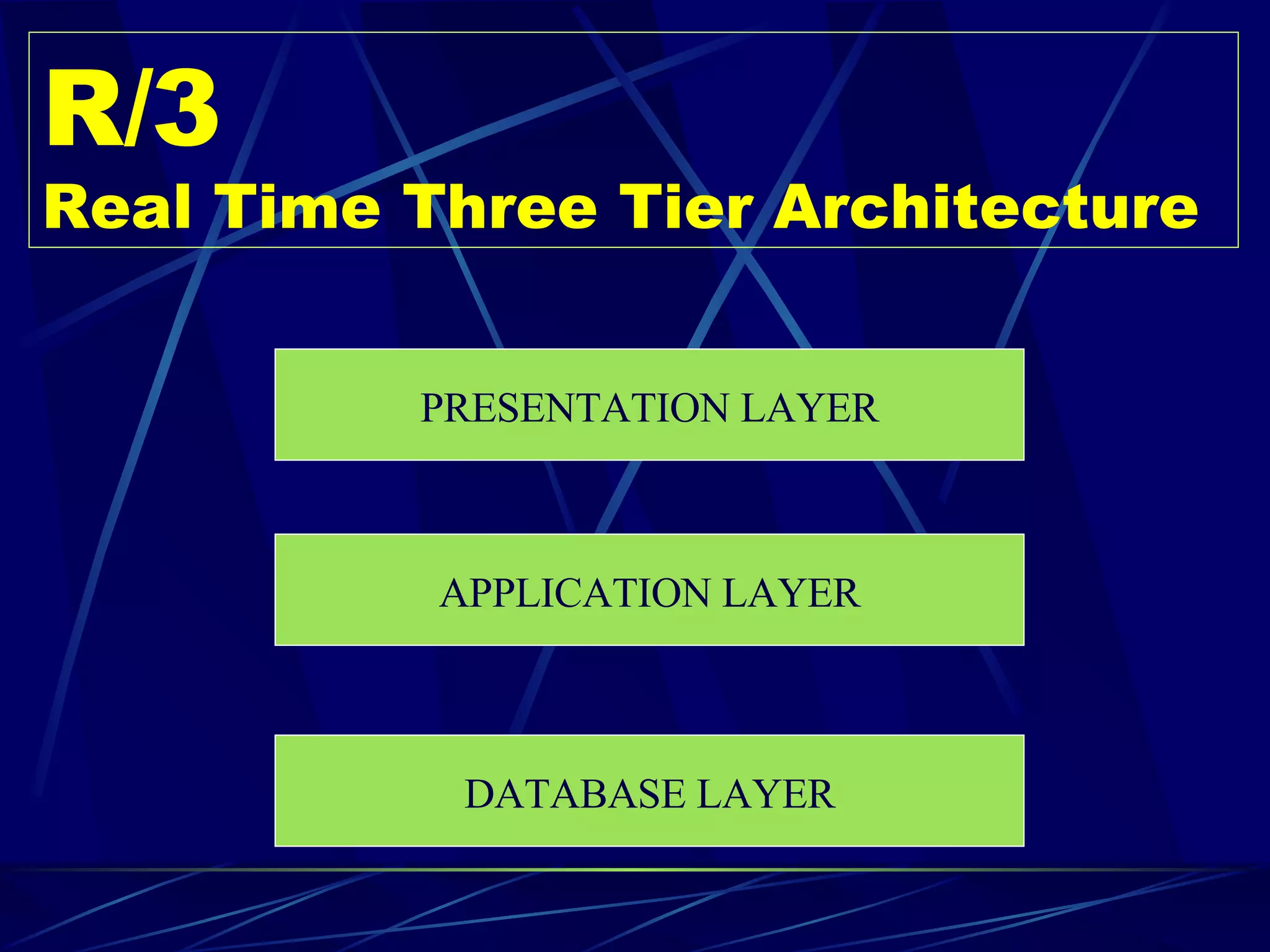
R/3 Real Time Three Tier Architecture PRESENTATION LAYER APPLICATION LAYER DATABASE LAYER
R/3 Real Time Three Tier Architecture Presentation Servers (Front Ends, Clients) Application Server Database Server
Request come from  Presentation Server To Database Server AS DISPATCHER D. Queue Buffer WP WP WP WP
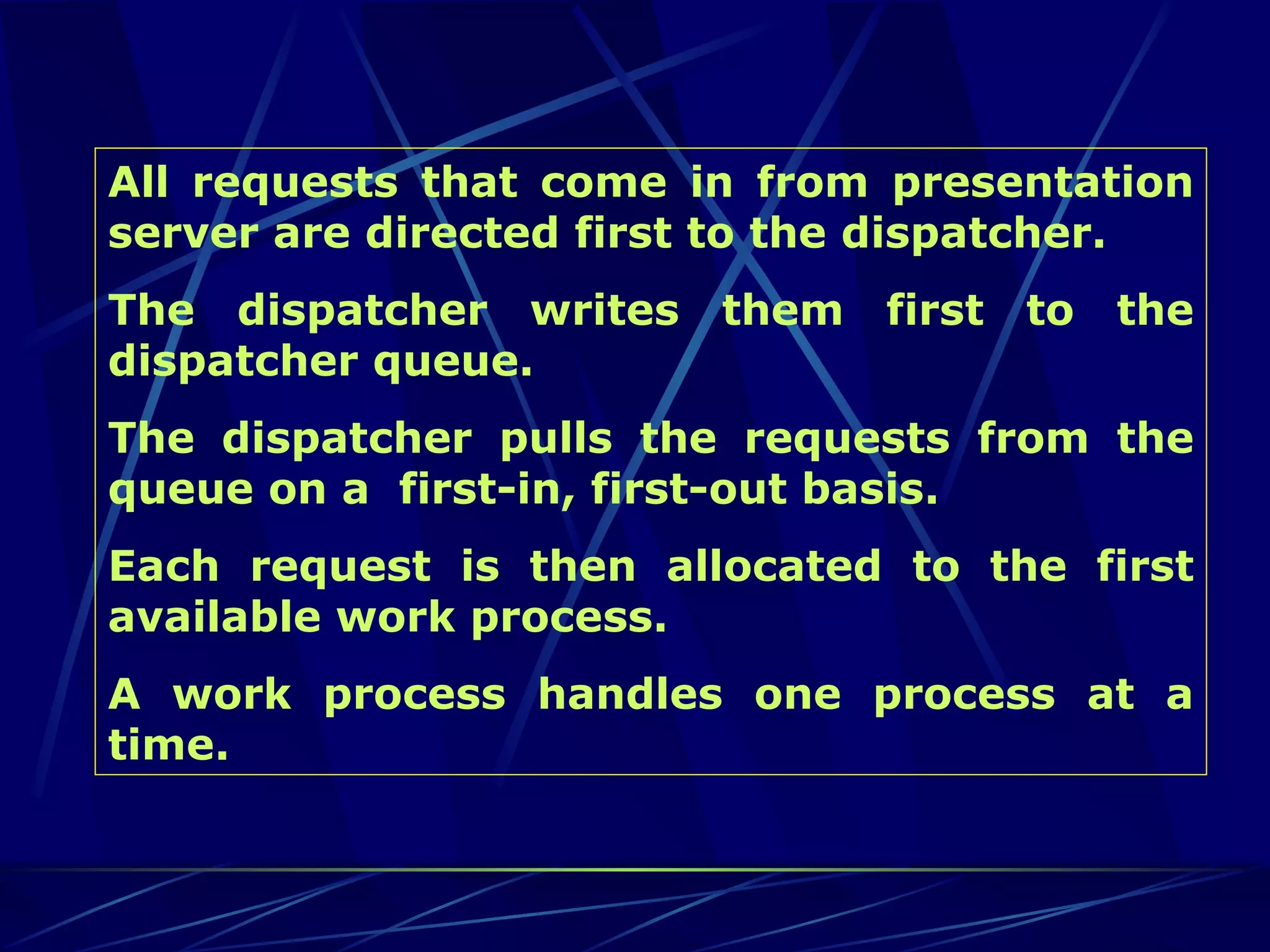
All requests that come in from presentation server are directed first to the dispatcher. The dispatcher writes them first to the dispatcher queue.  The dispatcher pulls the requests from the queue on a  first-in, first-out basis.  Each request is then allocated to the first available work process.  A work process handles one process at a time.
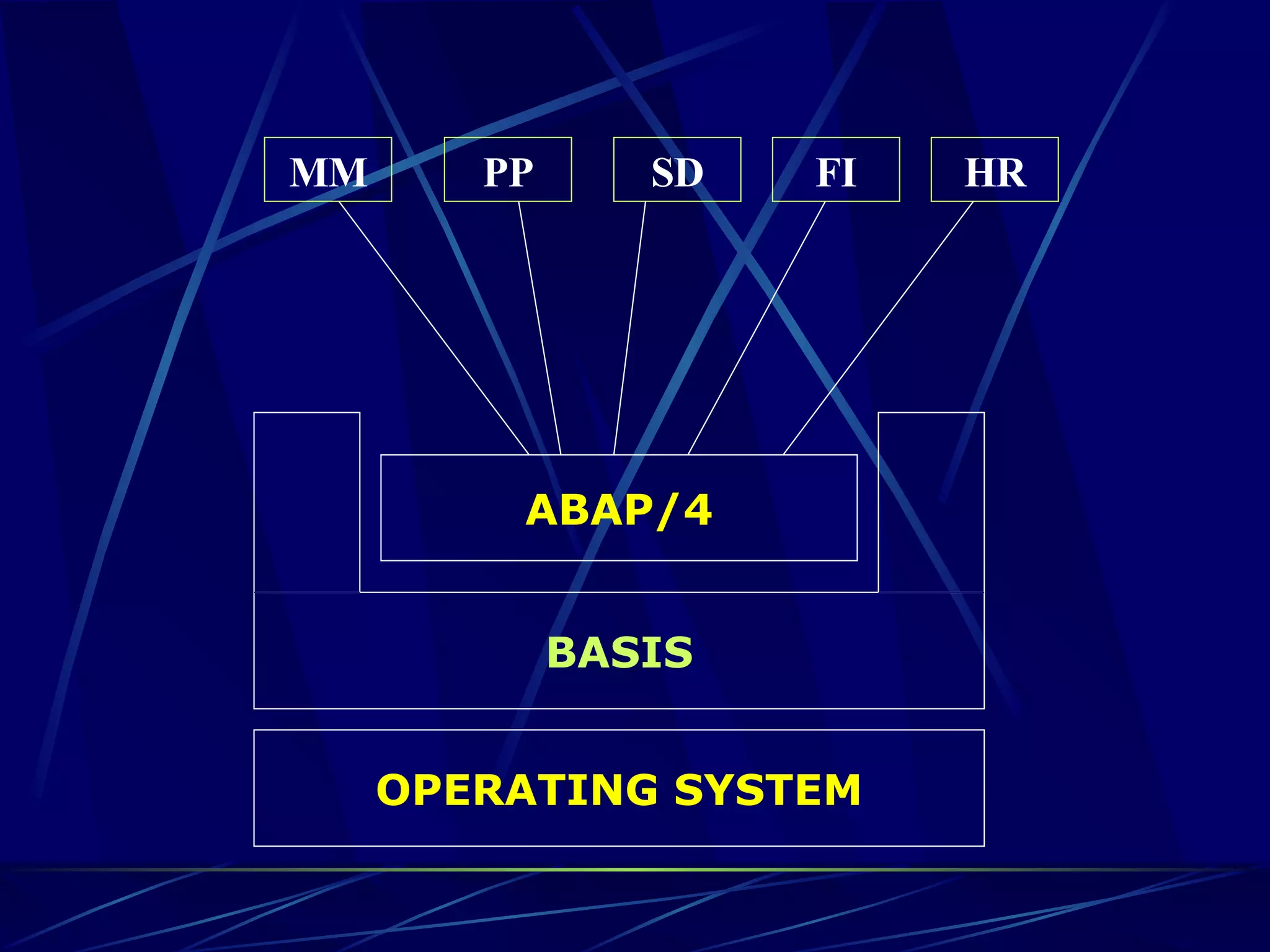
OPERATING SYSTEM BASIS ABAP/4 MM PP SD FI HR
ABAP/4 programs do not access operating system functions directly. Instead, they use Basis functions to perform file I/O. Basis is like an operating system for R/3. It sits between the ABAP/4 code and the computer's operating system. SAP likes to call it middleware because it sits in the middle. Basis provides runtime environment for ABAP/4 programs.
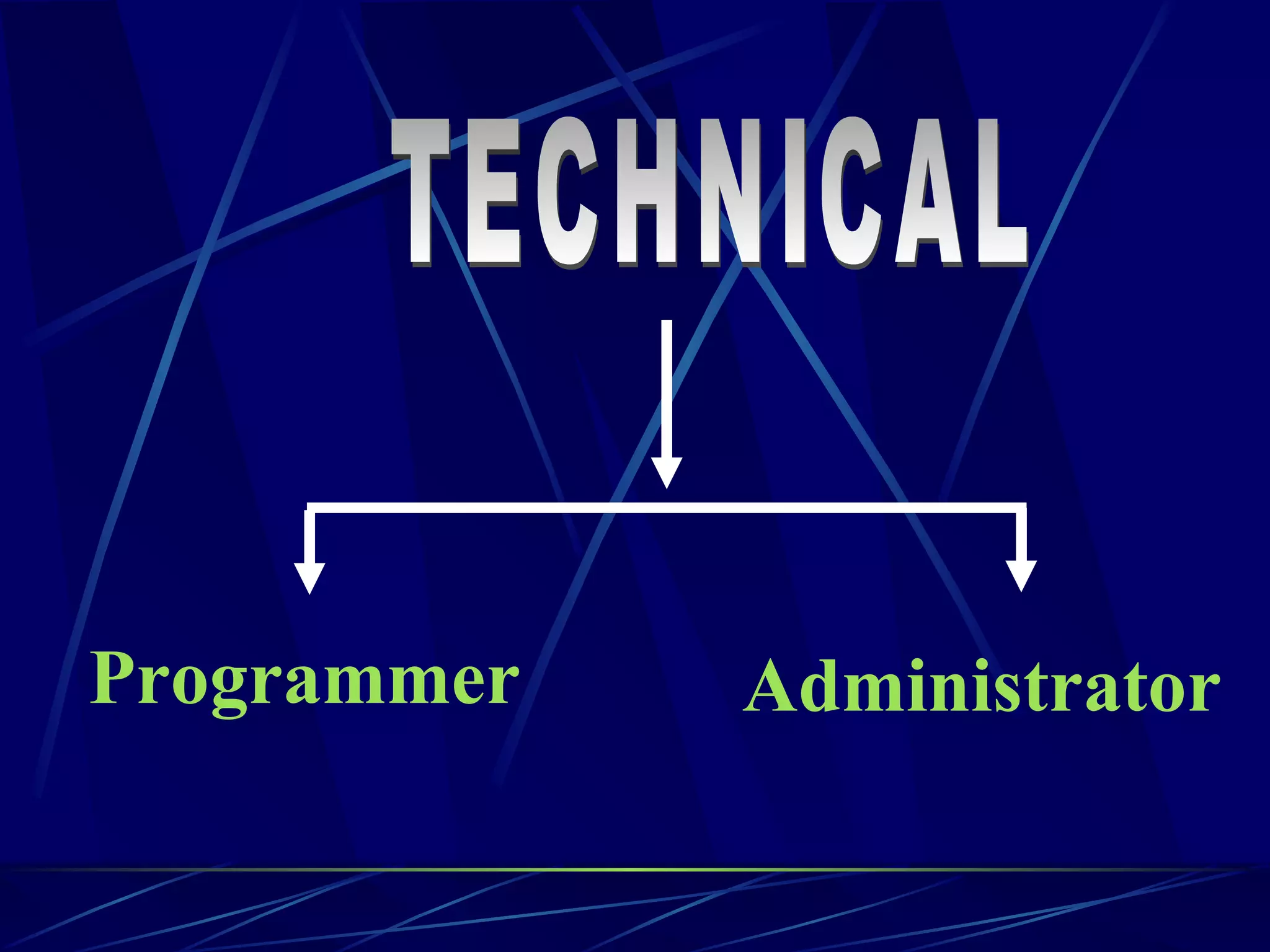
SAP R/3 TECHNICAL FUNCTIONAL
TECHNICAL Programmer Administrator
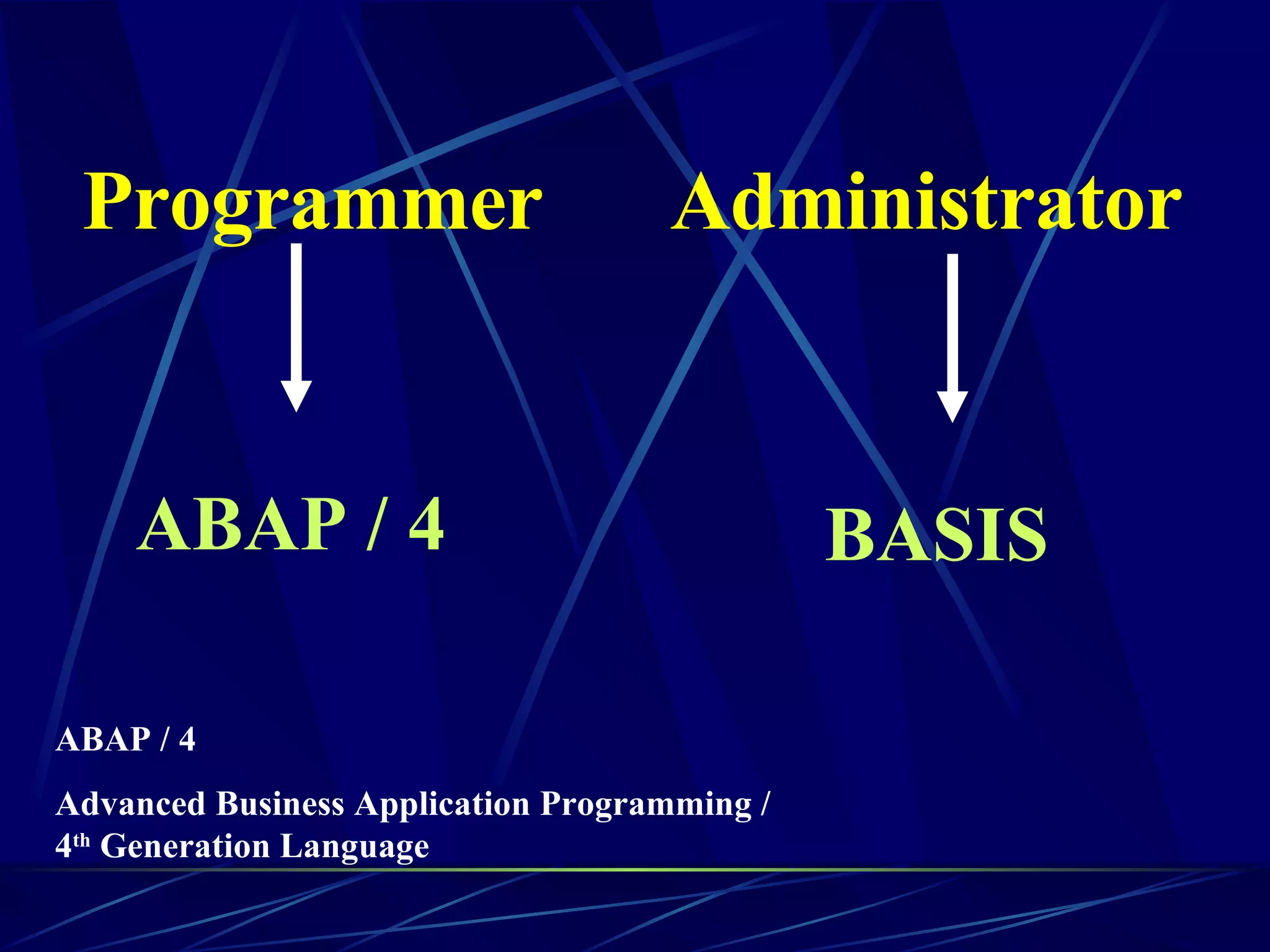
Programmer Administrator ABAP / 4 BASIS ABAP / 4  Advanced Business Application Programming / 4 th  Generation Language
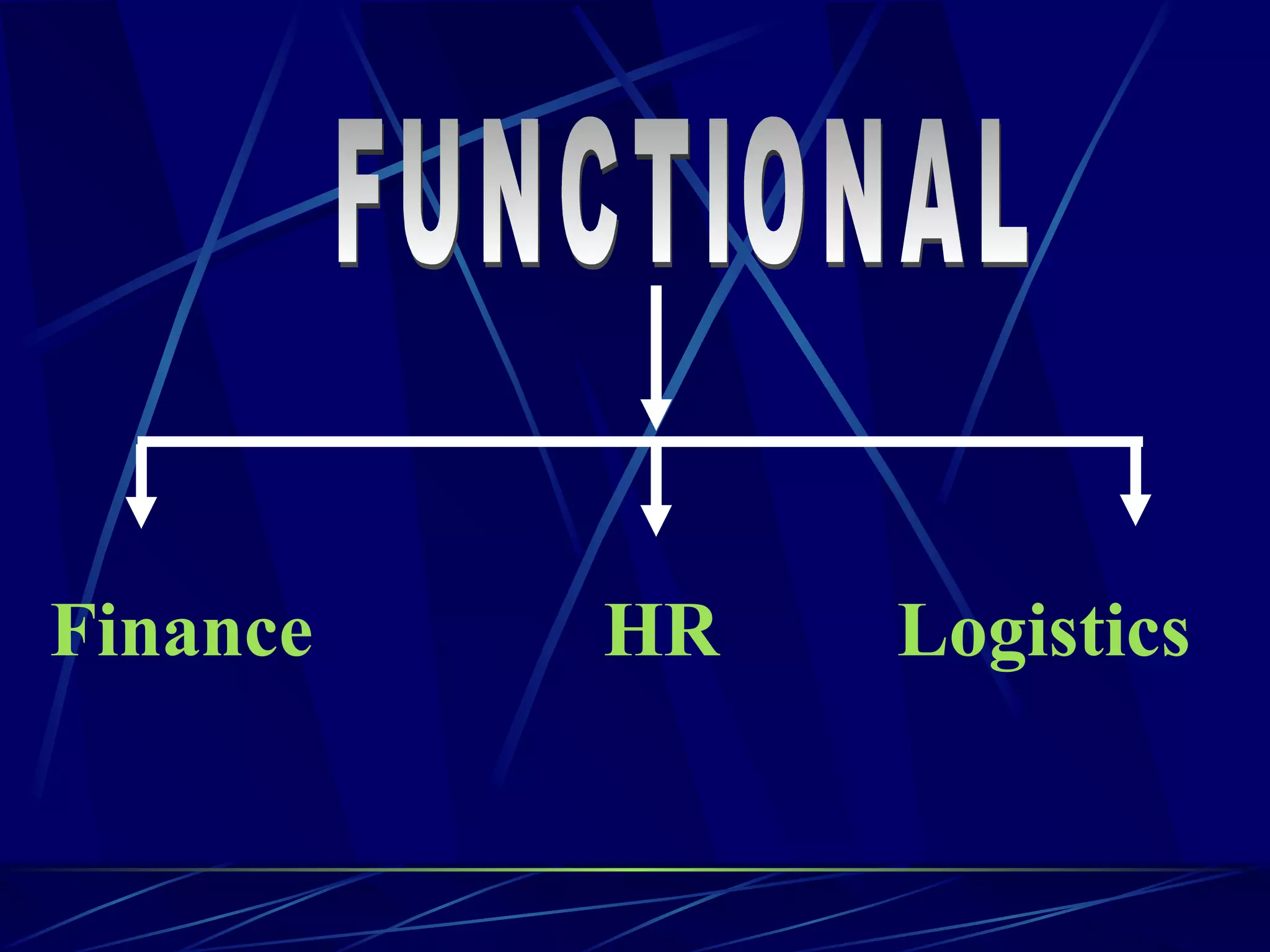
FUNCTIONAL Finance Logistics HR
Finance This functional area contains the necessary information on Profitability Analysis, General Ledger Accounts and Information on Reporting using the Executive Information System (EIS).
Finance Modules FI    - FINANCE CO   - CONTROLLING IM    - INVESTMENT MANAGEMENT TR  - TREASURY EC   - ENTERPRISE CONTROLLING REAL ESTATE MANAGEMENT
HUMAN RESOURCE HR module include support on Salary and Payroll administration as well as areas such as work schedule models. This core functional area is very country specific, due to country – related taxes, employee benefits, and employment laws.
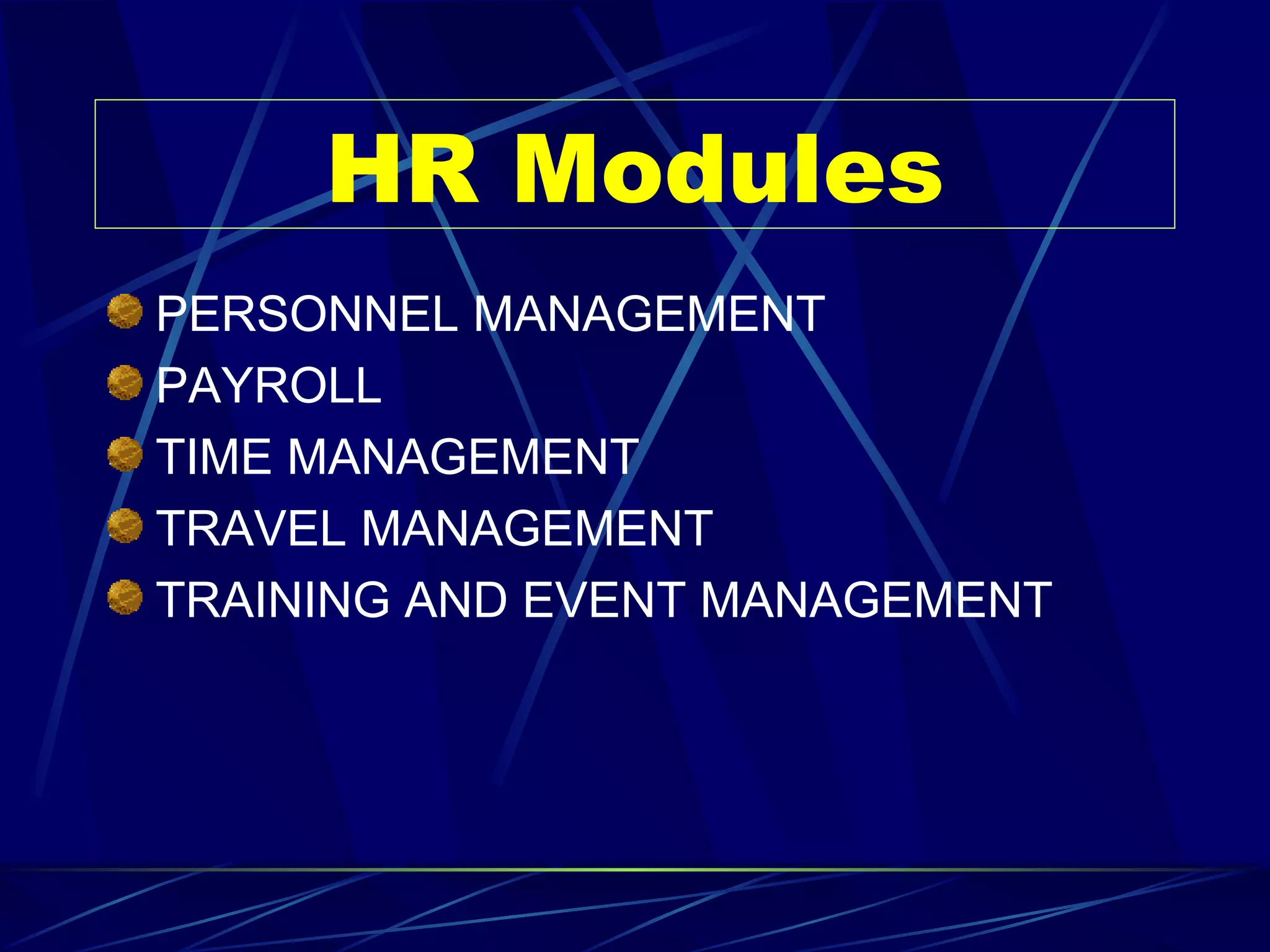
HR Modules PERSONNEL MANAGEMENT PAYROLL TIME MANAGEMENT TRAVEL MANAGEMENT TRAINING AND EVENT MANAGEMENT
LOGISTICS SD  -  SALES & DISTRIBUTION PP  -  PRODUCTION PLANNING MM  -  MATERIAL MANAGEMENT WM  - WAREHOUSE MANAGEMENT QM  - QUALITY MANAGEMENT Environment, Health and Safety Logistics is the largest of the three functional areas. It includes, among others, the following modules:-
FICO Organizational Structure Financial Accounting Global Settings (Fiscal Year, Posting Period, Document Types, Posting Keys) General Ledger Accounting Creation and Maintenance of House Bank Account Receivable Account Payable Asset Accounting Integration with SD and MM Controlling
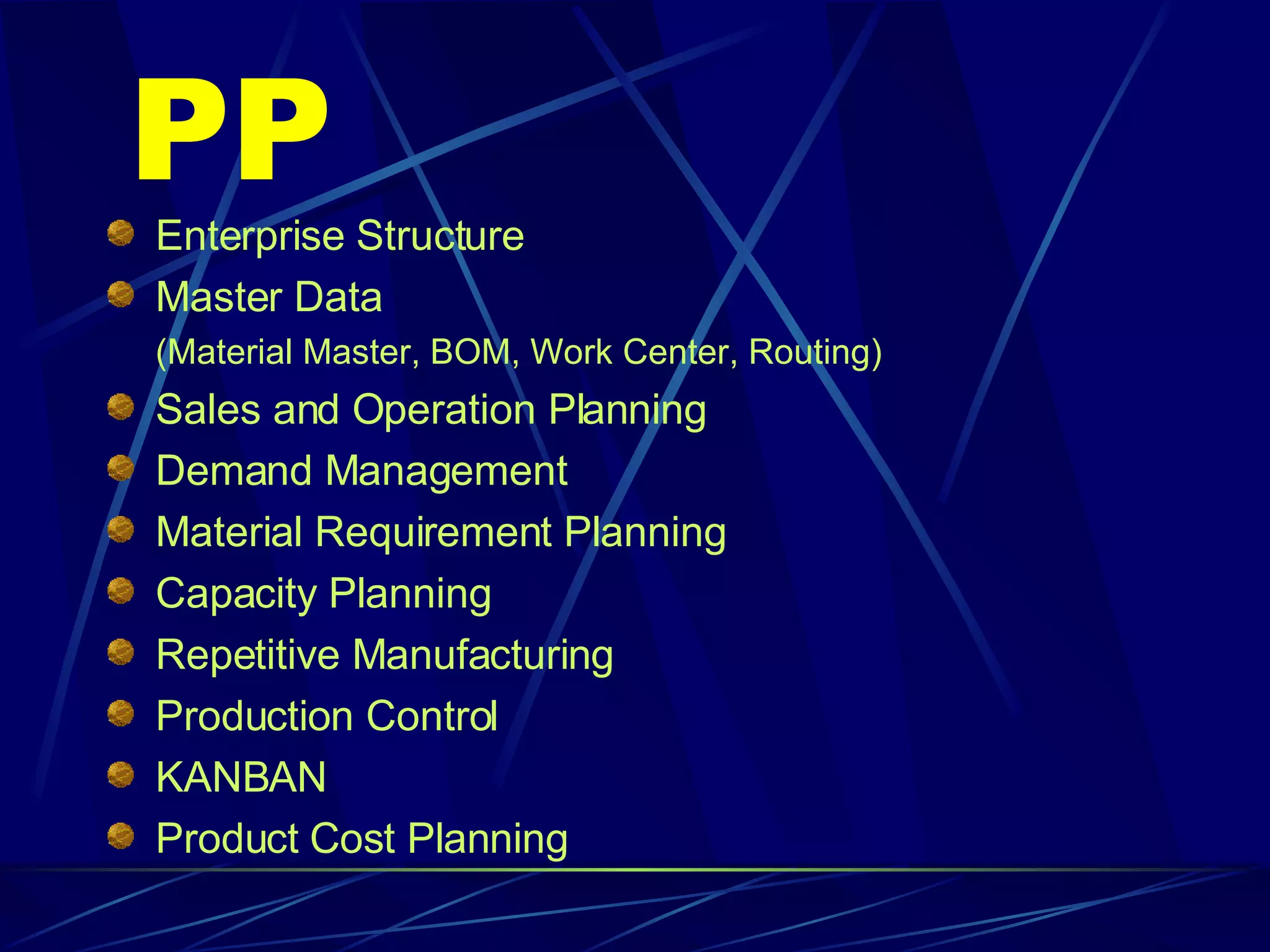
PP Enterprise Structure Master Data (Material Master, BOM, Work Center, Routing) Sales and Operation Planning Demand Management Material Requirement Planning Capacity Planning Repetitive Manufacturing Production Control KANBAN Product Cost Planning
SD Enterprise Structure Master Data  ( Creation of Customer and Material ) Pricing Order Management Special Functions (Free Goods, Listing/Exclusion, Item Proposal, Output Control) Delivery Billing Reporting Copy Control Credit Management
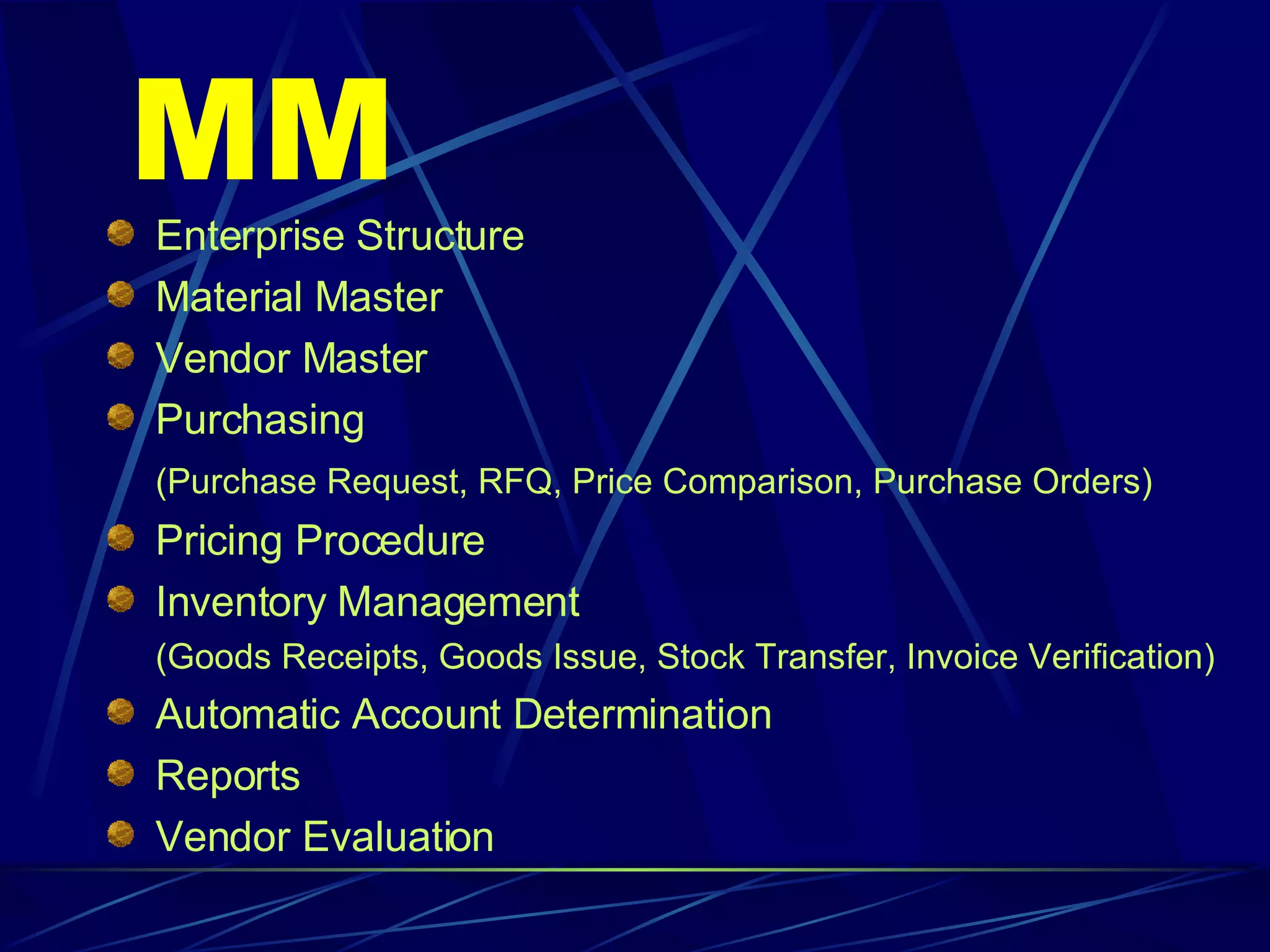
MM Enterprise Structure Material Master Vendor Master Purchasing (Purchase Request, RFQ, Price Comparison, Purchase Orders) Pricing Procedure Inventory Management (Goods Receipts, Goods Issue, Stock Transfer, Invoice Verification) Automatic Account Determination Reports Vendor Evaluation
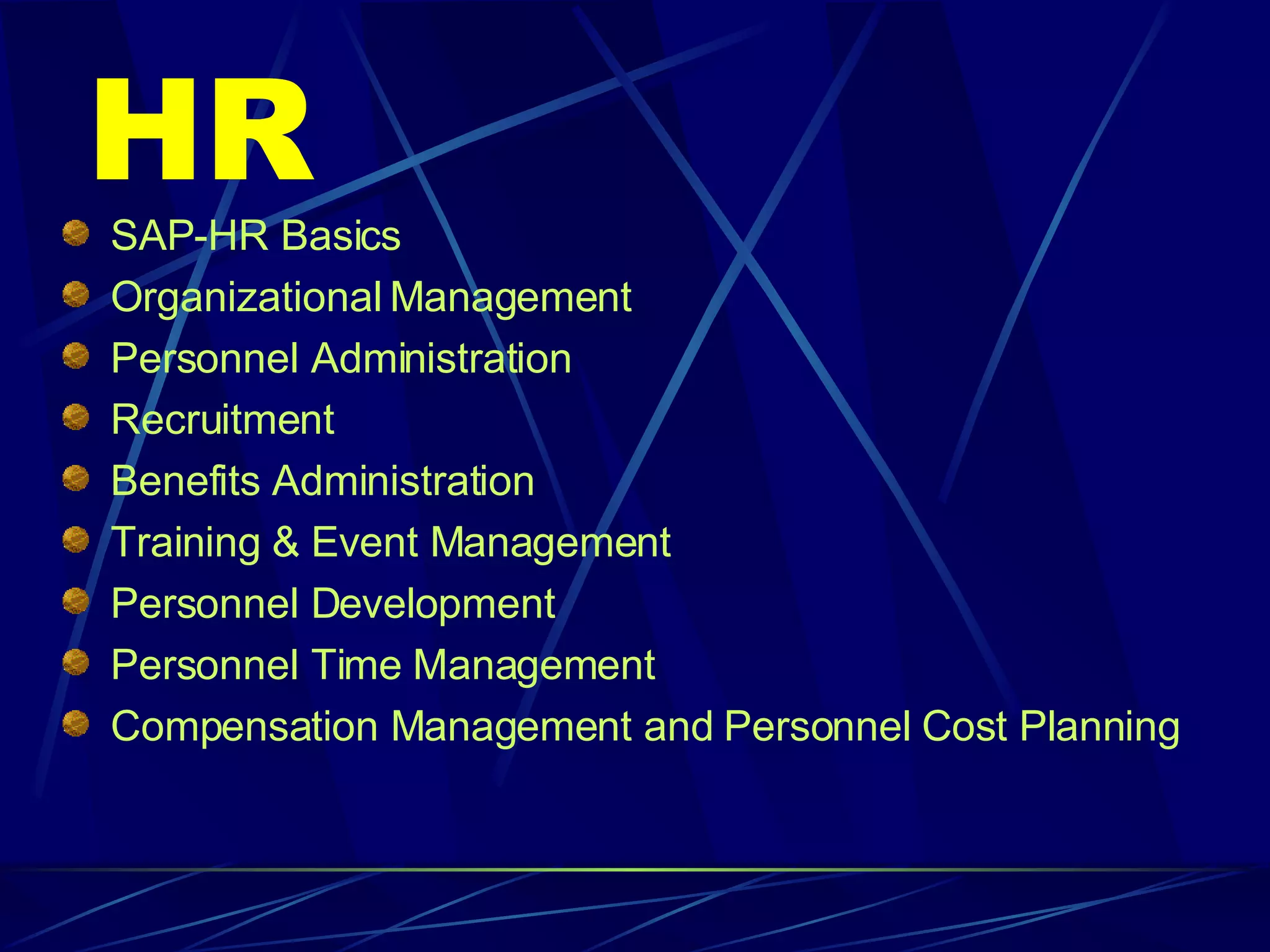
HR SAP-HR Basics Organizational Management Personnel Administration Recruitment Benefits Administration Training & Event Management Personnel Development Personnel Time Management Compensation Management and Personnel Cost Planning
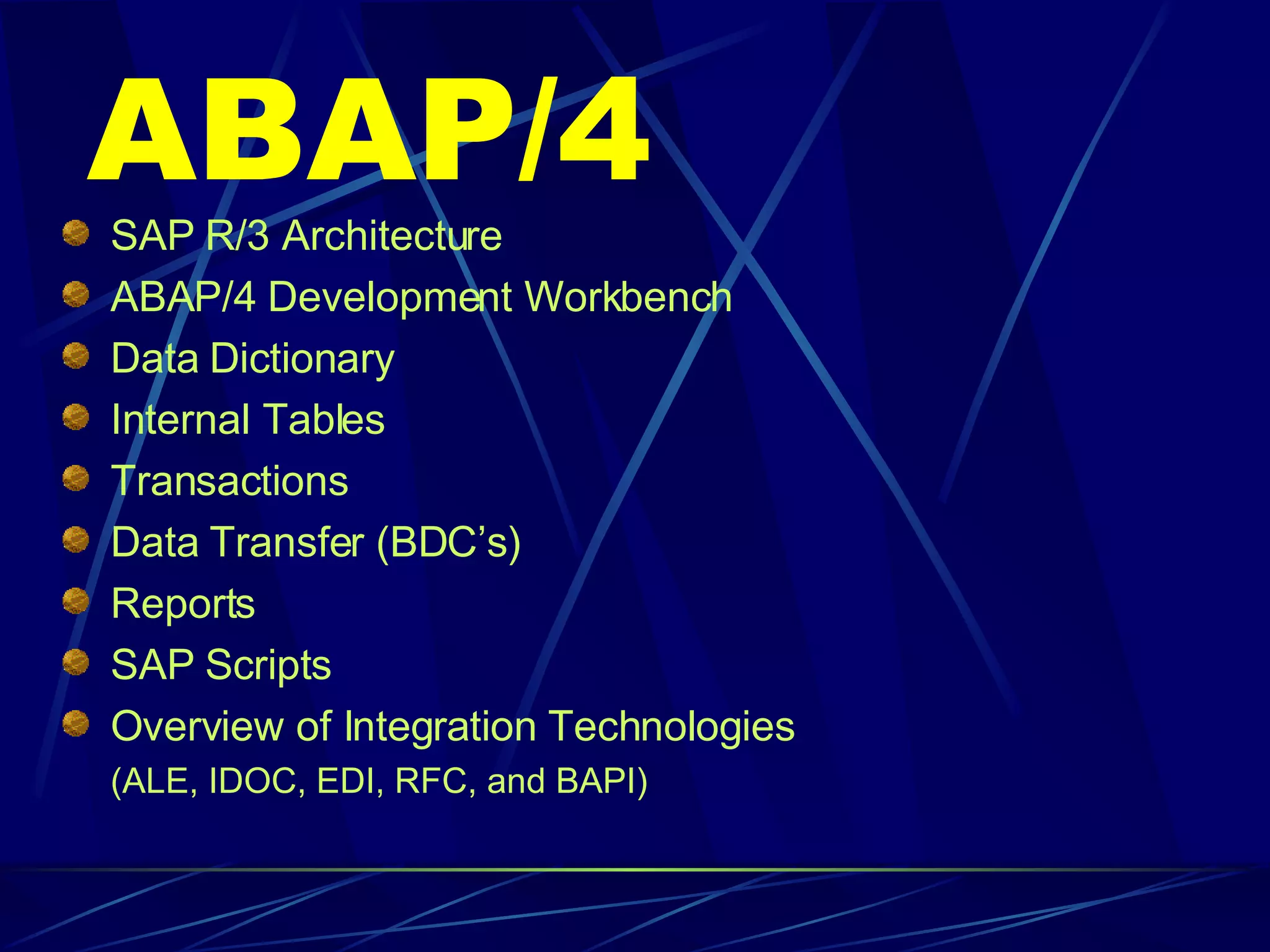
ABAP/4 SAP R/3 Architecture  ABAP/4 Development Workbench Data Dictionary Internal Tables Transactions Data Transfer (BDC’s) Reports SAP Scripts Overview of Integration Technologies (ALE, IDOC, EDI, RFC, and BAPI)
Staffing of SAP Projects Strategic Thinking --  SAP may be part of a larger change project. Process Design --  Expertise in the design, change and    documenting of business processes. Project Management --  Essential throughout the project lifecycle. Change Management --  Expertise is required in changing the organization. System Architect --  Overall responsibility for feasibility of the design    and integration issues. Application Experts --  People with skill in configuring specific modules. Business Analyst --  Involved in piloting and must be trained. Trainers --  Training must be given to the users and team    members new to SAP. SAP Developers --  People who can design and built bolt-on    functionality. Operational Staff --  Responsible for administration, performance and    transition.
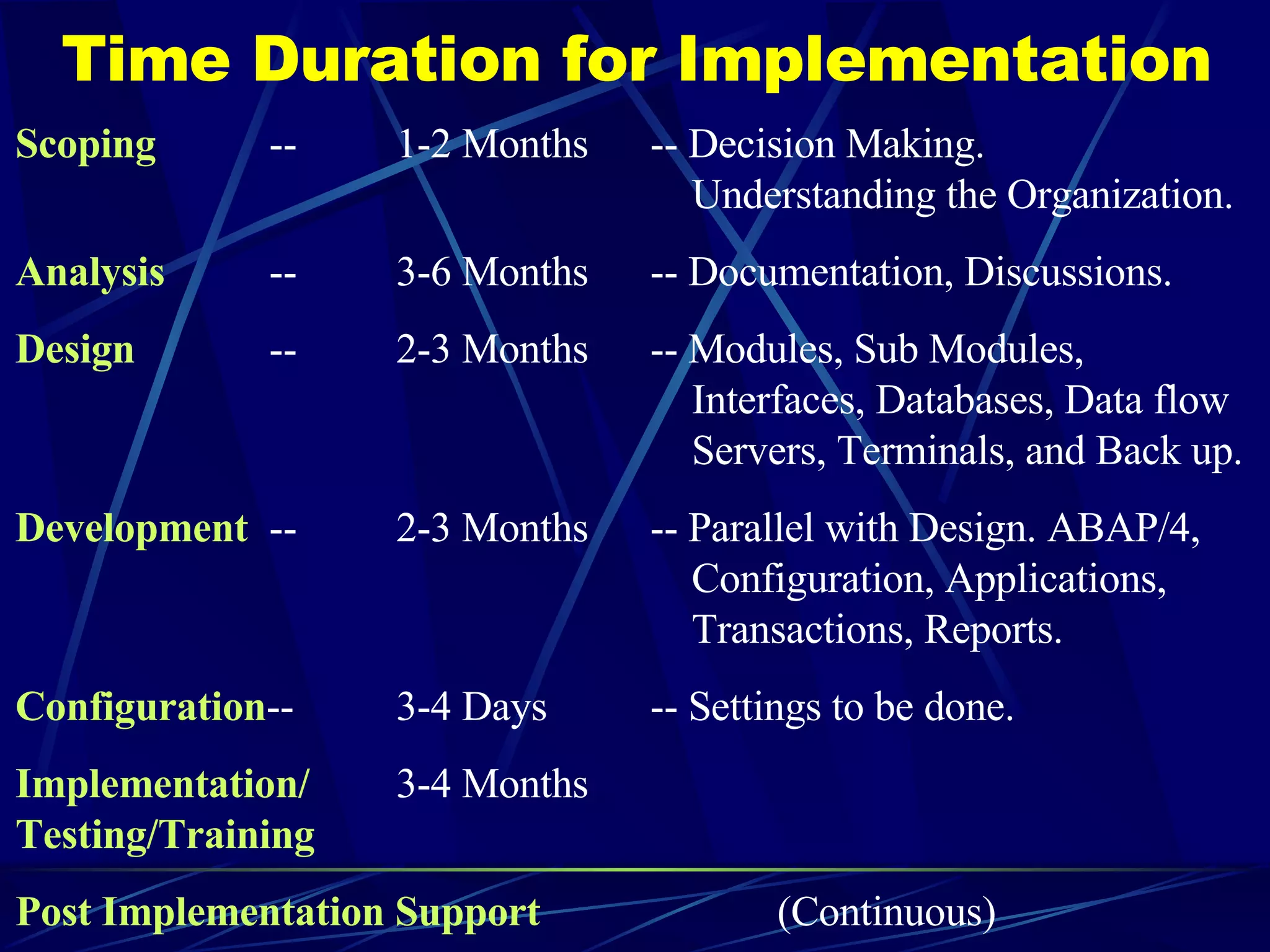
Time Duration for Implementation Scoping -- 1-2 Months -- Decision Making.    Understanding the Organization. Analysis -- 3-6 Months -- Documentation, Discussions. Design -- 2-3 Months -- Modules, Sub Modules,    Interfaces, Databases, Data flow    Servers, Terminals, and Back up. Development -- 2-3 Months -- Parallel with Design. ABAP/4,    Configuration, Applications,    Transactions, Reports. Configuration -- 3-4 Days -- Settings to be done. Implementation/ 3-4 Months Testing/Training Post Implementation Support  (Continuous)
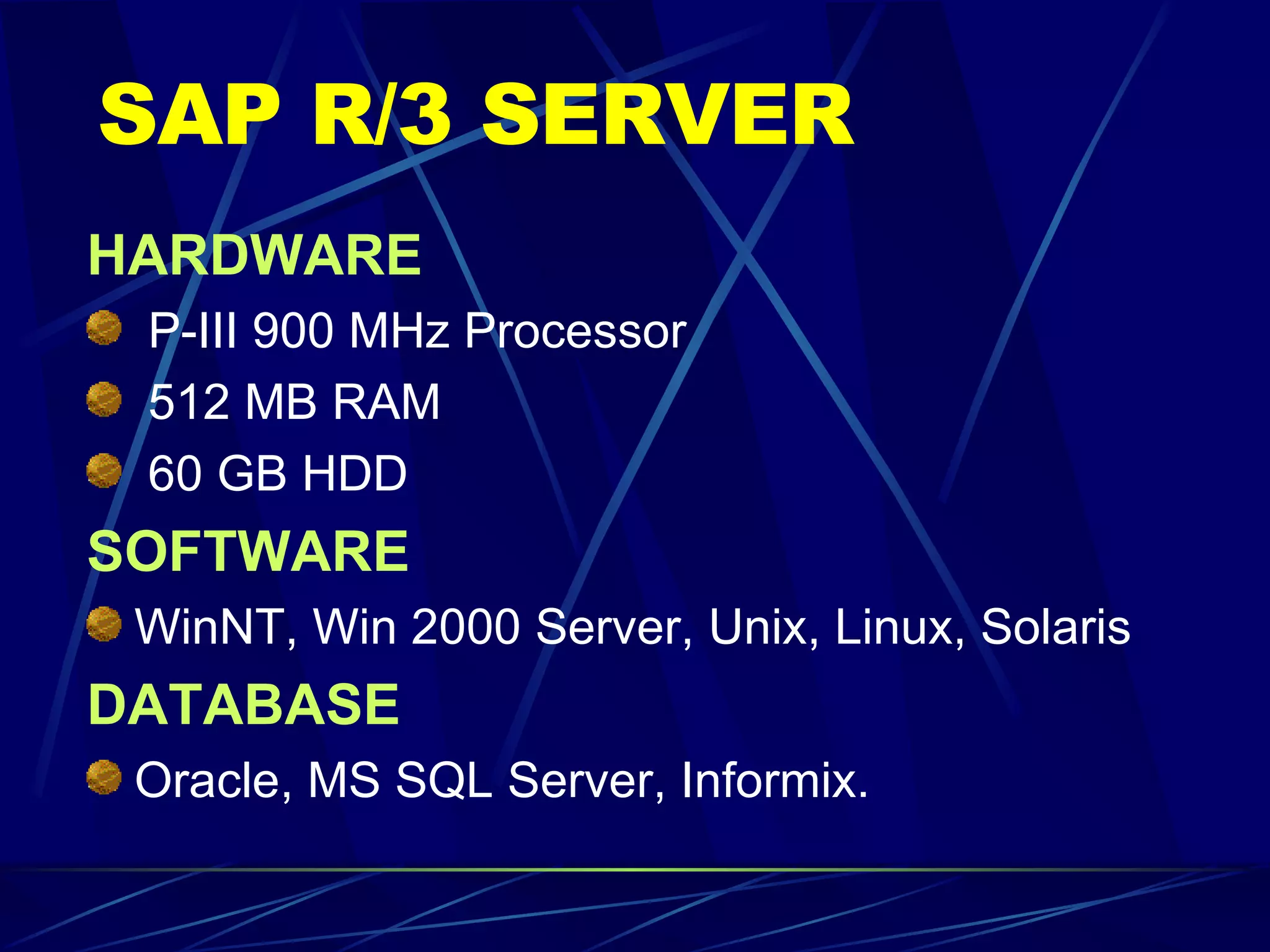
SAP R/3 SERVER   HARDWARE P-III 900 MHz Processor  512 MB RAM 60 GB HDD SOFTWARE WinNT, Win 2000 Server, Unix, Linux, Solaris DATABASE Oracle, MS SQL Server, Informix.
SAP R/3 CLIENT   HARDWARE Celeron 566 MHz Processor  128 MB RAM 10 GB HDD SOFTWARE Windows 98/NT/2000, Unix, Linux. Solaris

S A P Orientation

  • 1.
  • 2.
  • 3.
    ERP E – Enterprise R – Resource P – Planning
  • 4.
    ERP Enterprise ResourcePlanning, is a software driven business management system, which integrates all facets of the business, including Planning, Manufacturing, Sales and Marketing. ERP as a business solution aims to help the management by setting better business practices and equipping them with the right information to take timely decisions.
  • 5.
    ERP career existdistinctly in two areas: Implementation Development
  • 6.
    ERP Software PackagesSAP BAAN Logistics People Soft HRMS Oracle Applications Finance JD Edwards MFG Pro Ramco Marshal PP,PM,MM
  • 7.
  • 8.
    SAP The nameSAP being a German company, is an acronym for ā€œSysteme Anwendungen, Produkte in der Datenverarbeitungā€. This is translated into English as: Systems Applications, and Products in Data Processing
  • 9.
    SAP The thirdgeneration set of highly integrated software modules that perform common business functions based on multi-national leading practices. Takes care of any Enterprise however diverse it may be in operations, spread over the world geographically.
  • 10.
    SAP was foundedin 1972 by five people. Wellenreuther Hopp Hector Plattner Tchira
  • 11.
    FACTS ABOUT SAPLeading global provider of client/server business software solutions. Number 1 vendor of standard business application software, with a world-wide market share of 33%. 4 th largest independent software supplier in the world. Available in 14 languages. 8 of the Top 10 US corporations use SAP. More than 7500 customers in over 90 countries have chosen SAP.
  • 12.
    8 Reasons touse SAP Global Basis Faster Speed Flexibility for changes (Business & IT) Agility (quickness, alertness) Extended Supply Chain Management Reach New Opportunity Knowledge Sharing Creativity Focus
  • 13.
    SAP R/2 R/2is SAP AG mainframe solution and was first compact software package for the whole spectrum of business applications. SAP R/2 runs on mainframes, such as IBM, Siemens, Amdahl. The current version of R/2 is 6.1. This mainframe solution is not open, although with the help of ALE (Application Link Enabled) technology, R/2 can be linked to system and share online data. SAP AG is the company name AG stands for Aktiengesellschaft, which means in English ā€œIncorporationā€.
  • 14.
    SAP R/3 SAPR/3 is SAP's integrated software solution for client/server and distributed open systems. SAP’s R/3 is the world’s most-used standard business software for client/server computing. R/3 meets the needs of a customer from the small companies to multi-billion dollar companies. The software is highly customizable using SAP’s proprietary programming language, ABAP/4.
  • 15.
    R/2 Real TimeTwo Tier Architecture PRESENTATION LAYER APPLICATION LAYER DATABASE LAYER In R/2 we have got two layer concept: 1 st Layer 2 nd Layer
  • 16.
    R/2 Real TimeTwo Tier Architecture Presentation Servers (Front Ends, Clients) Application Server / Database Server
  • 17.
    R/3 Real TimeThree Tier Architecture PRESENTATION LAYER APPLICATION LAYER DATABASE LAYER
  • 18.
    R/3 Real TimeThree Tier Architecture Presentation Servers (Front Ends, Clients) Application Server Database Server
  • 19.
    Request come from Presentation Server To Database Server AS DISPATCHER D. Queue Buffer WP WP WP WP
  • 20.
    All requests thatcome in from presentation server are directed first to the dispatcher. The dispatcher writes them first to the dispatcher queue. The dispatcher pulls the requests from the queue on a first-in, first-out basis. Each request is then allocated to the first available work process. A work process handles one process at a time.
  • 21.
    OPERATING SYSTEM BASISABAP/4 MM PP SD FI HR
  • 22.
    ABAP/4 programs donot access operating system functions directly. Instead, they use Basis functions to perform file I/O. Basis is like an operating system for R/3. It sits between the ABAP/4 code and the computer's operating system. SAP likes to call it middleware because it sits in the middle. Basis provides runtime environment for ABAP/4 programs.
  • 23.
  • 24.
  • 25.
    Programmer Administrator ABAP/ 4 BASIS ABAP / 4 Advanced Business Application Programming / 4 th Generation Language
  • 26.
  • 27.
    Finance This functionalarea contains the necessary information on Profitability Analysis, General Ledger Accounts and Information on Reporting using the Executive Information System (EIS).
  • 28.
    Finance Modules FI - FINANCE CO - CONTROLLING IM - INVESTMENT MANAGEMENT TR - TREASURY EC - ENTERPRISE CONTROLLING REAL ESTATE MANAGEMENT
  • 29.
    HUMAN RESOURCE HRmodule include support on Salary and Payroll administration as well as areas such as work schedule models. This core functional area is very country specific, due to country – related taxes, employee benefits, and employment laws.
  • 30.
    HR Modules PERSONNELMANAGEMENT PAYROLL TIME MANAGEMENT TRAVEL MANAGEMENT TRAINING AND EVENT MANAGEMENT
  • 31.
    LOGISTICS SD - SALES & DISTRIBUTION PP - PRODUCTION PLANNING MM - MATERIAL MANAGEMENT WM - WAREHOUSE MANAGEMENT QM - QUALITY MANAGEMENT Environment, Health and Safety Logistics is the largest of the three functional areas. It includes, among others, the following modules:-
  • 32.
    FICO Organizational StructureFinancial Accounting Global Settings (Fiscal Year, Posting Period, Document Types, Posting Keys) General Ledger Accounting Creation and Maintenance of House Bank Account Receivable Account Payable Asset Accounting Integration with SD and MM Controlling
  • 33.
    PP Enterprise StructureMaster Data (Material Master, BOM, Work Center, Routing) Sales and Operation Planning Demand Management Material Requirement Planning Capacity Planning Repetitive Manufacturing Production Control KANBAN Product Cost Planning
  • 34.
    SD Enterprise StructureMaster Data ( Creation of Customer and Material ) Pricing Order Management Special Functions (Free Goods, Listing/Exclusion, Item Proposal, Output Control) Delivery Billing Reporting Copy Control Credit Management
  • 35.
    MM Enterprise StructureMaterial Master Vendor Master Purchasing (Purchase Request, RFQ, Price Comparison, Purchase Orders) Pricing Procedure Inventory Management (Goods Receipts, Goods Issue, Stock Transfer, Invoice Verification) Automatic Account Determination Reports Vendor Evaluation
  • 36.
    HR SAP-HR BasicsOrganizational Management Personnel Administration Recruitment Benefits Administration Training & Event Management Personnel Development Personnel Time Management Compensation Management and Personnel Cost Planning
  • 37.
    ABAP/4 SAP R/3Architecture ABAP/4 Development Workbench Data Dictionary Internal Tables Transactions Data Transfer (BDC’s) Reports SAP Scripts Overview of Integration Technologies (ALE, IDOC, EDI, RFC, and BAPI)
  • 38.
    Staffing of SAPProjects Strategic Thinking -- SAP may be part of a larger change project. Process Design -- Expertise in the design, change and documenting of business processes. Project Management -- Essential throughout the project lifecycle. Change Management -- Expertise is required in changing the organization. System Architect -- Overall responsibility for feasibility of the design and integration issues. Application Experts -- People with skill in configuring specific modules. Business Analyst -- Involved in piloting and must be trained. Trainers -- Training must be given to the users and team members new to SAP. SAP Developers -- People who can design and built bolt-on functionality. Operational Staff -- Responsible for administration, performance and transition.
  • 39.
    Time Duration forImplementation Scoping -- 1-2 Months -- Decision Making. Understanding the Organization. Analysis -- 3-6 Months -- Documentation, Discussions. Design -- 2-3 Months -- Modules, Sub Modules, Interfaces, Databases, Data flow Servers, Terminals, and Back up. Development -- 2-3 Months -- Parallel with Design. ABAP/4, Configuration, Applications, Transactions, Reports. Configuration -- 3-4 Days -- Settings to be done. Implementation/ 3-4 Months Testing/Training Post Implementation Support (Continuous)
  • 40.
    SAP R/3 SERVER HARDWARE P-III 900 MHz Processor 512 MB RAM 60 GB HDD SOFTWARE WinNT, Win 2000 Server, Unix, Linux, Solaris DATABASE Oracle, MS SQL Server, Informix.
  • 41.
    SAP R/3 CLIENT HARDWARE Celeron 566 MHz Processor 128 MB RAM 10 GB HDD SOFTWARE Windows 98/NT/2000, Unix, Linux. Solaris