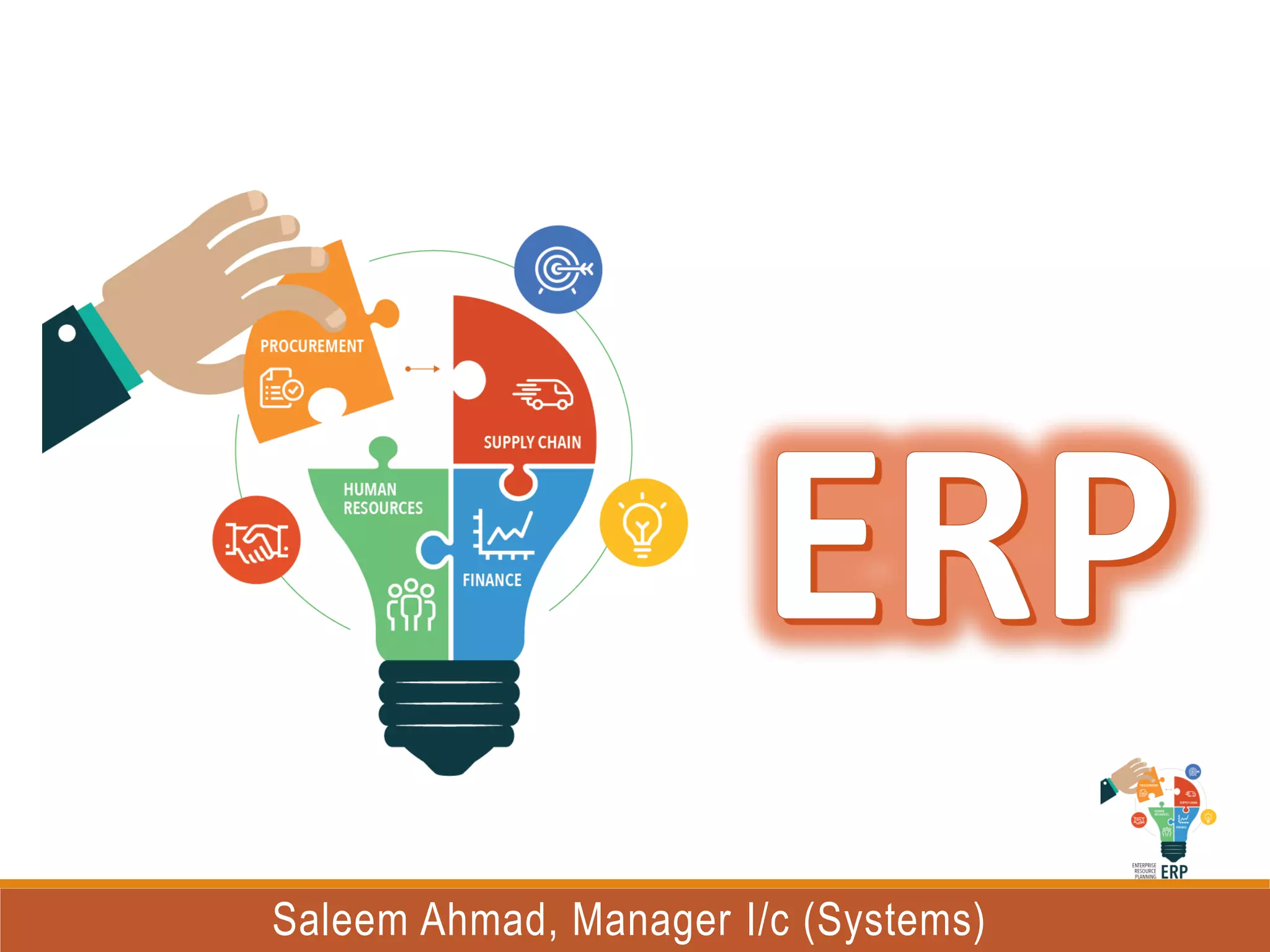
Saleem Ahmad, Manager I/c (Systems)
ERP – What it is?
Enterprise;
Enterprise has departments like Finance, HR, Production,
Sales, Material Management, Procurement etc.
Resource;
Enterprise needs to manage resources like HR, Finance,
Material, Equipment to do business
Planning;
Enterprise needs a tool to plan the function and
resources for optimal utilization
2
ERP – What it is?
ERP is a solution, which;
─ Facilitate company-wide integrated information
systems, covering all functional areas
─ Perform core corporate activities and increase
customer services augmenting Corporate Image
3
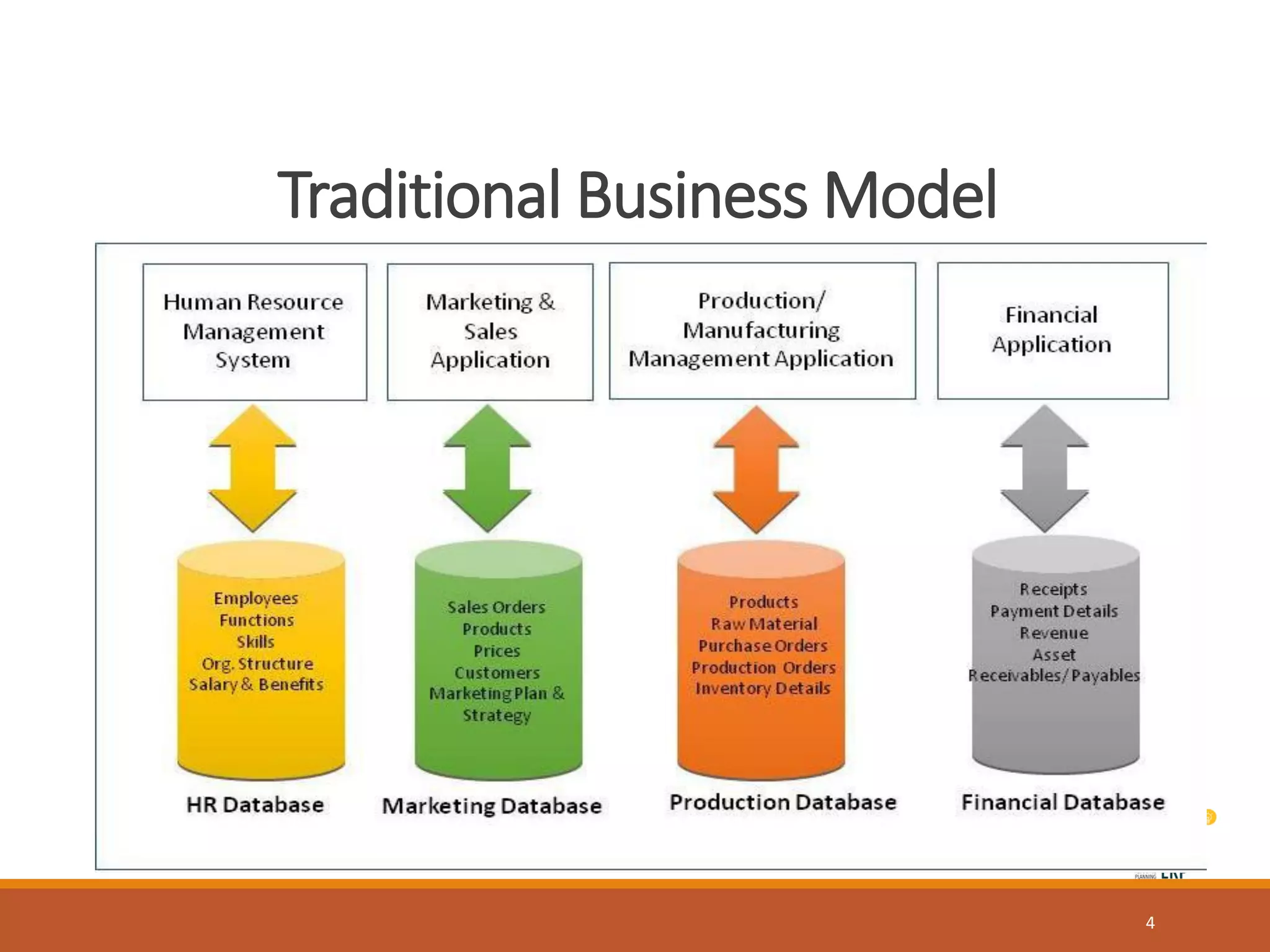
Traditional Business Model
4
Traditional Business Model
Islands of Information
─ Difficult to get timely & accurate information
─ Heterogeneous Hardware & Software platforms & practices
─ Poor connectivity between different organizational locations
─ Sticking with obsolete technology
─ Resist to change
─ Lack of proven man-power to develop integrated software
5
ERP – Definition
“Software solution that addresses the
Enterprise needs, taking a process view of
the overall organization to meet the goals,
by tightly integrating all functions and under
a common software platform”
6
7
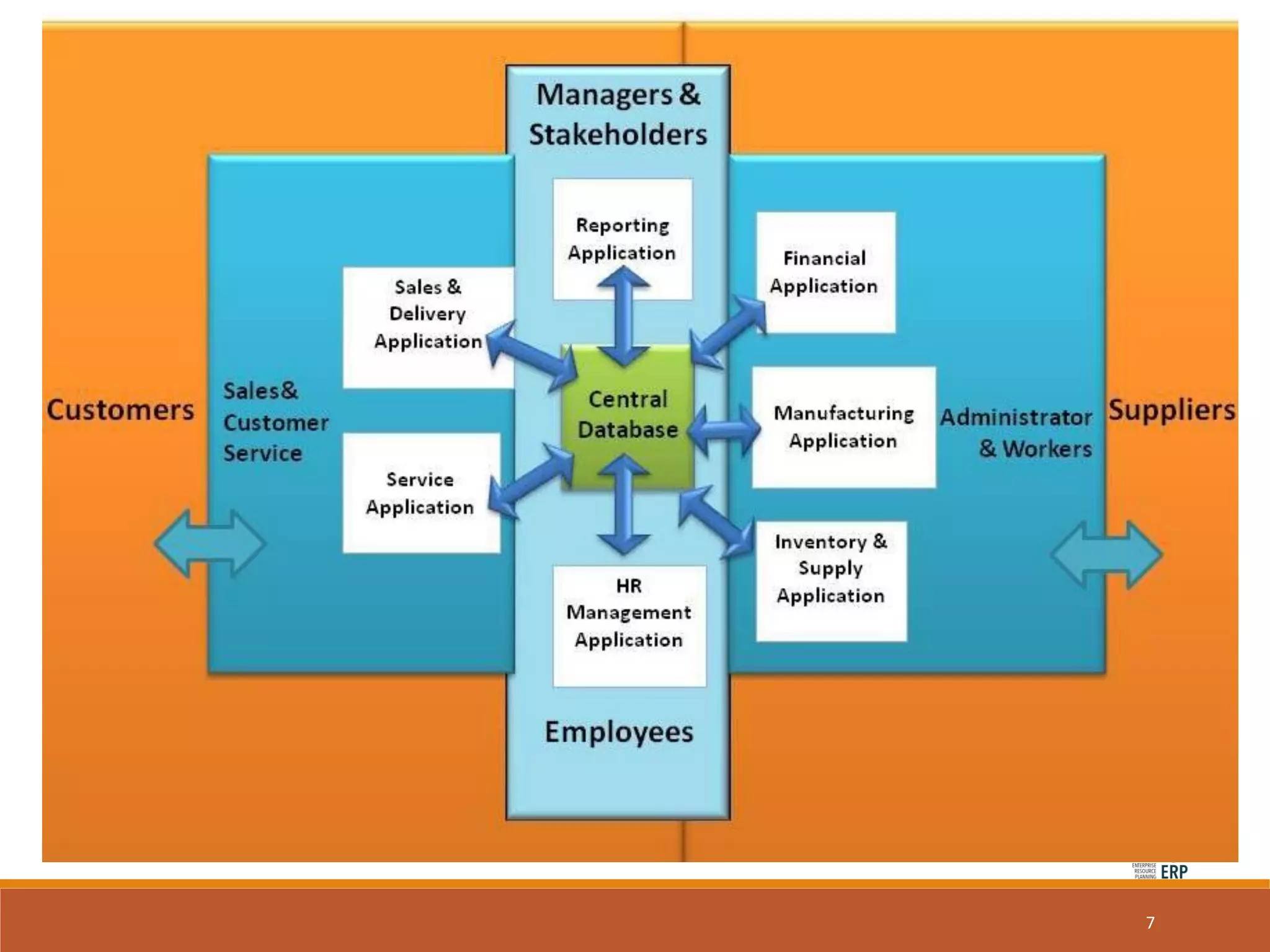
In order to optimize the company resources to generate best-possible business results all
the database should be centrali.e. an integrateddatabase for all the functions in an
organization.
Enterprise Resource Planning
The integrated system that manages all the
resources of the enterprise is called
Enterprise Resource Planning system and is
defined as comprehensive package that
supports and integrate all the processes of
organization
8
Why ERP?
─ For Management – to know what is happening in the
company
─ One solution for better Management
─ For cycle time reduction
─ To achieve cost control & low working capital
─ To marry latest technologies
─ To shun the geographical gaps
─ To satisfy the customers with high expectations
─ To be Competitive & for survival
9
10
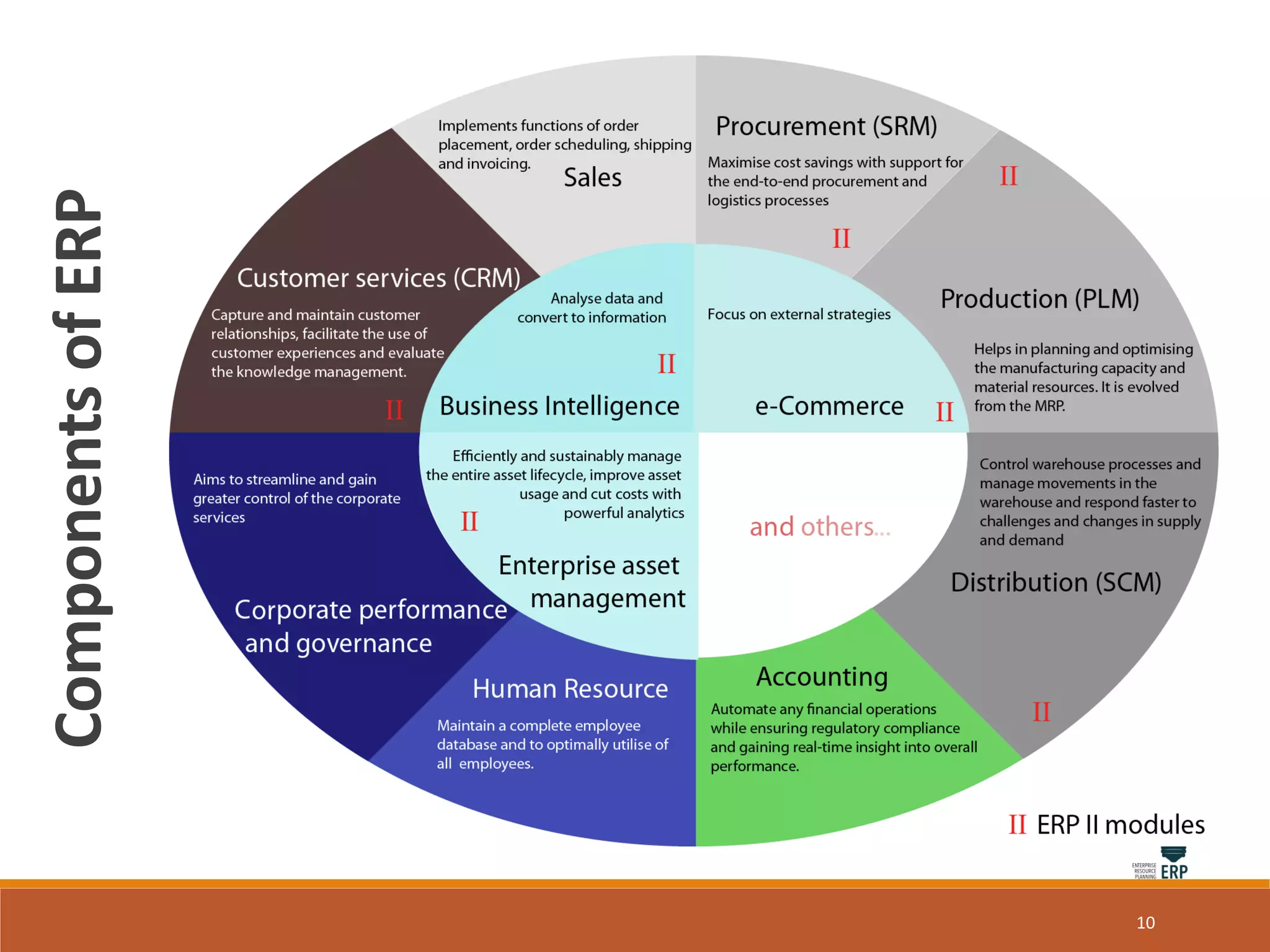
ComponentsofERP
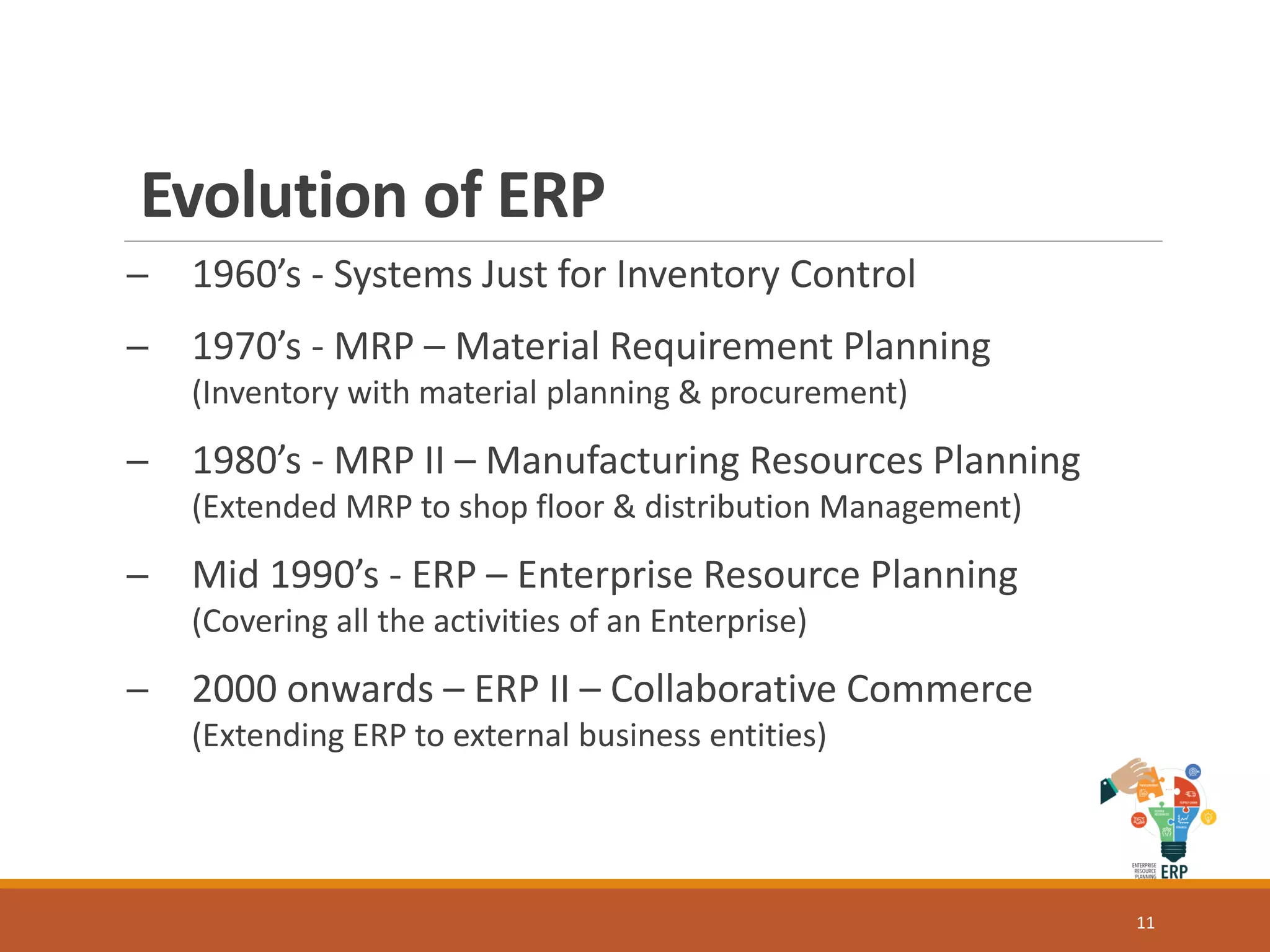
Evolution of ERP
─ 1960’s - Systems Just for Inventory Control
─ 1970’s - MRP – Material Requirement Planning
(Inventory with material planning & procurement)
─ 1980’s - MRP II – Manufacturing Resources Planning
(Extended MRP to shop floor & distribution Management)
─ Mid 1990’s - ERP – Enterprise Resource Planning
(Covering all the activities of an Enterprise)
─ 2000 onwards – ERP II – Collaborative Commerce
(Extending ERP to external business entities)
11
ERP Expectations
─ Integrating all the functions
─ Integrating the systems running in all the locations
─ Transparency of information using a single data source
across the organization
─ Software must be responsive
─ Modular
─ Flexible
─ Easy to add functionalities
─ Provide growth path
12
Problems Solved by ERP
─ Material Shortages
─ Productivity Enhancements
─ Customer Service
─ Cash Management
─ Inventory Problems
─ Quality Problems
13
How an ERP Works
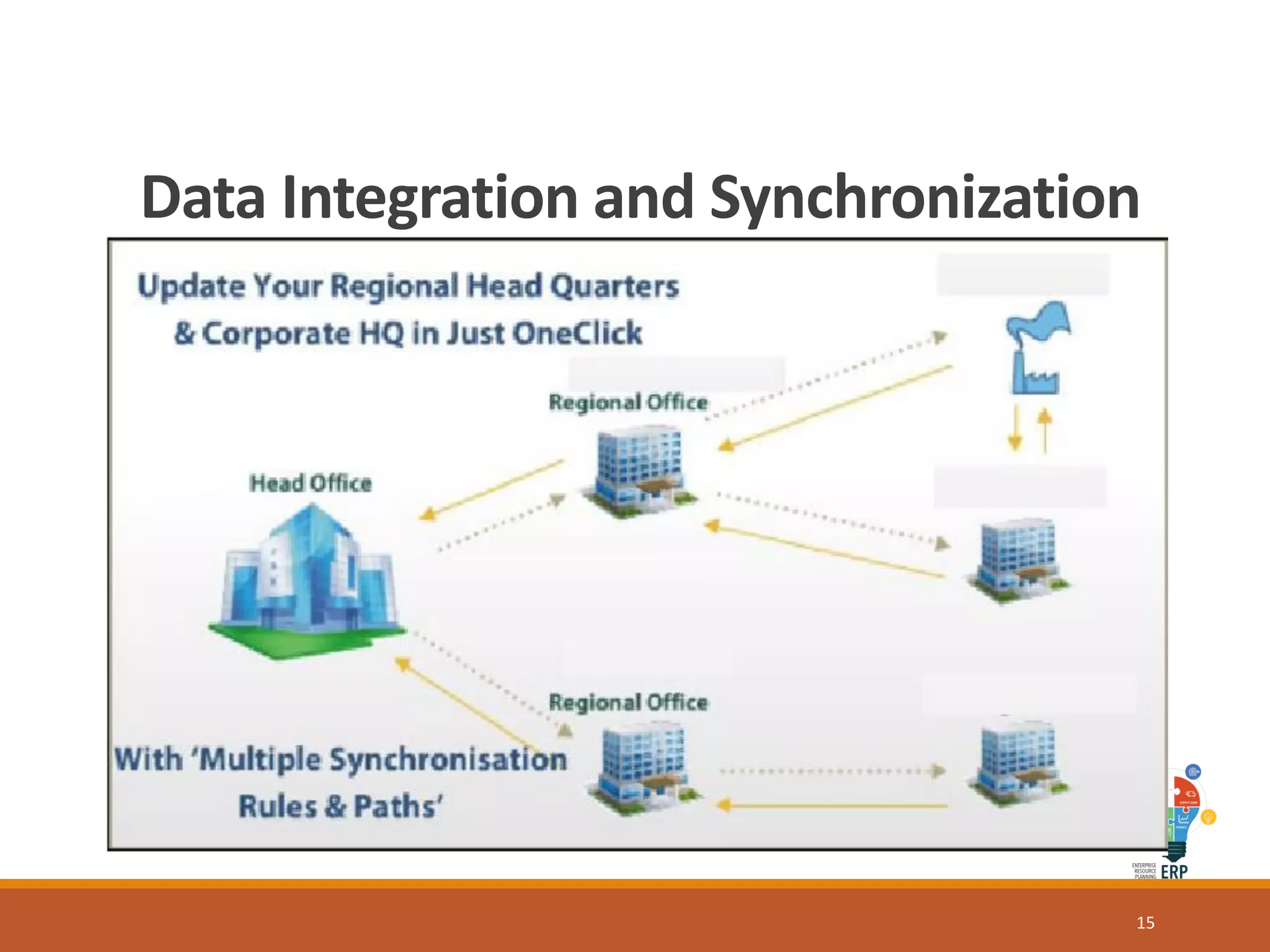
─ Data integration & synchronization
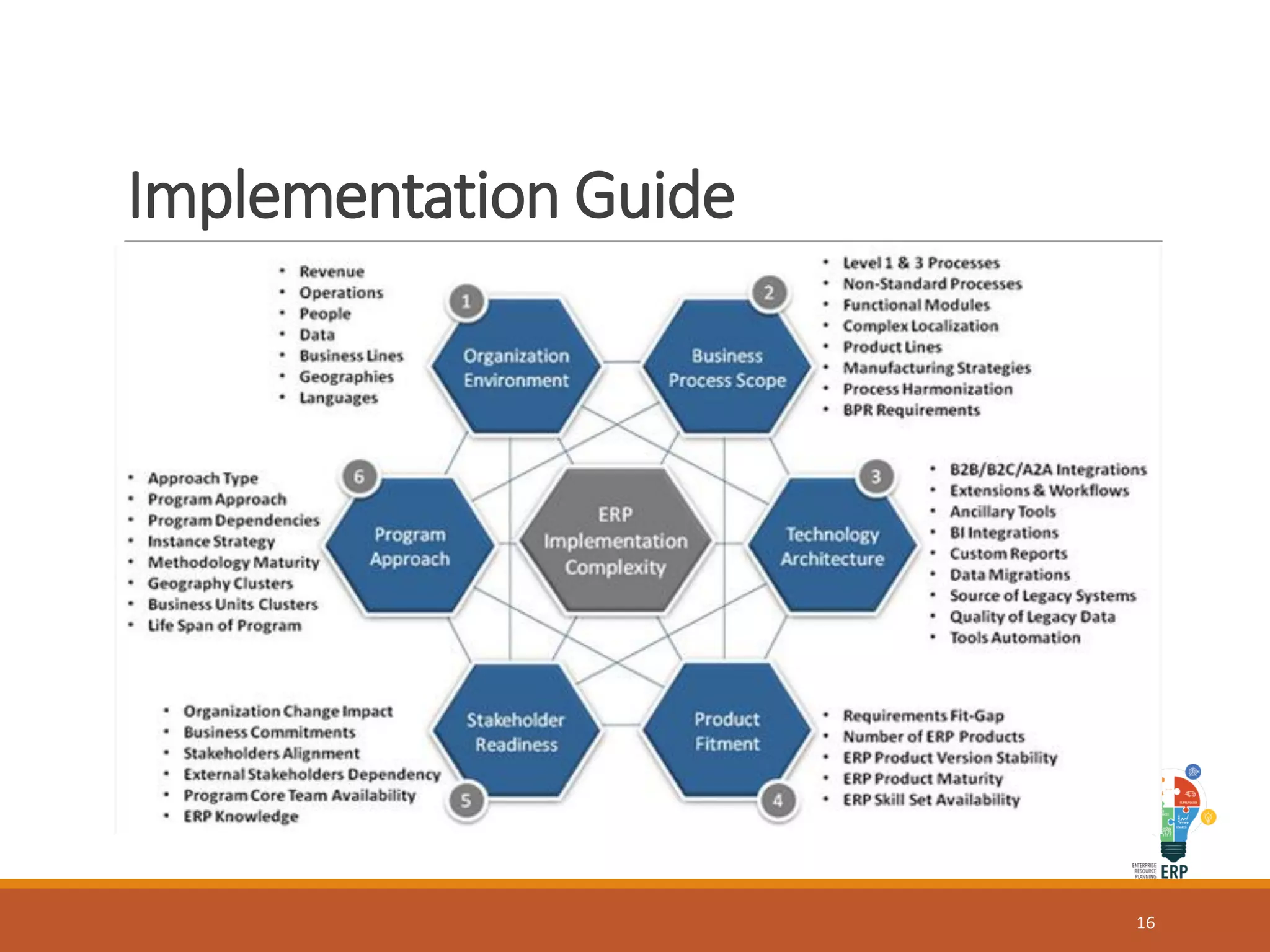
─ A complete implementation guide
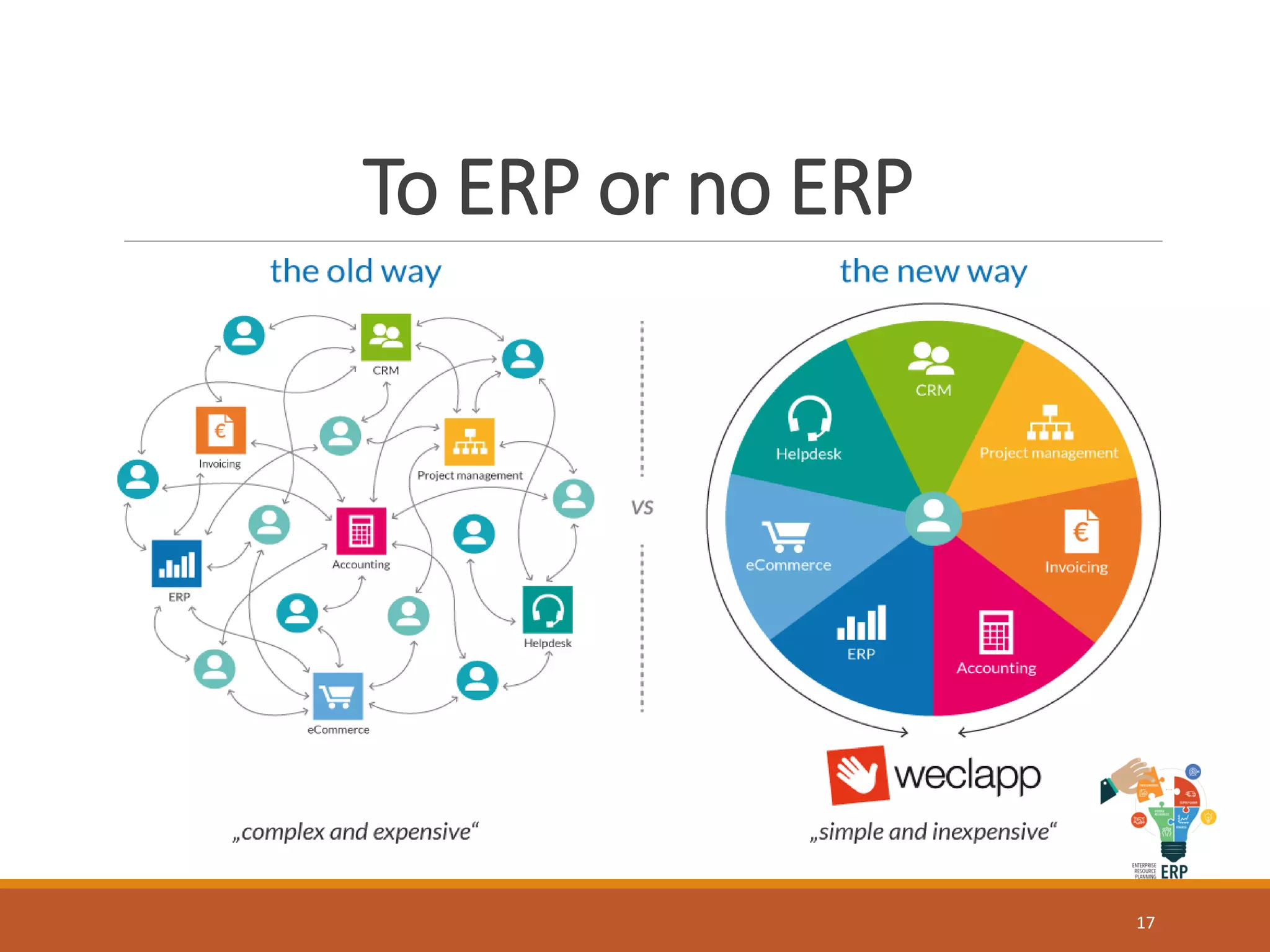
─ To ERP or no ERP
14
Data Integration and Synchronization
15
Implementation Guide
16
To ERP or no ERP
17
ERP Product Selection Phase
─ ERP Team formation for selection
─ Appointment of Consultants (if needed)
─ Scoping study
─ Product selection
─ Implementation partners selection
─ Hardware/Communication cost estimation
18
Product Selection - Parameters
─ Reputation of the ERP product
─ No of installations in the geographical vicinity
─ % of the overall functional availability
─ Customization possibilities
─ After sales support
─ Your investment plan & budget
─ Implementation partner’s track record
19
Preparation Phase
─ Framing ERP Implementation Strategies
─ Formation of Apex & Steering committees
─ Functional & IT team formation
─ Training on ERP functions & features
─ Scope finalization
─ Action plan to resolve the gap
20
Benefits of ERP
─ Centralized Database for all modules
─ Real time reports and data
─ Less human resources are required to maintain the
application
─ Improved performance
─ Reduced quality cost
─ Improve resources utilization
─ Improved information accuracy
─ Improved decision making capability
21
Pitfalls/Point of Concern
─ Costly comparing to custom-built options
─ Lot of hidden costs
─ Chances of cost & time overrun are high
─ Compulsion to pay for redundant modules/features
─ Vigorous involvement of all during implementation
─ Non-availability of special practices like Customer
Complaint, Logistics
─ Linking historical data – offline & painful
─ The requirement of Change Management is a must
─ Dependency on outsiders is high
─ IT department – Poor grip on the Implemented systems
22
Critical Success Factors for ERP
─ The firm & optimistic approach of the Management
─ The dedicated Team
─ Good Training
─ Strict adherence to the Project schedules
─ Right technical infra-structure
─ Change Management
23
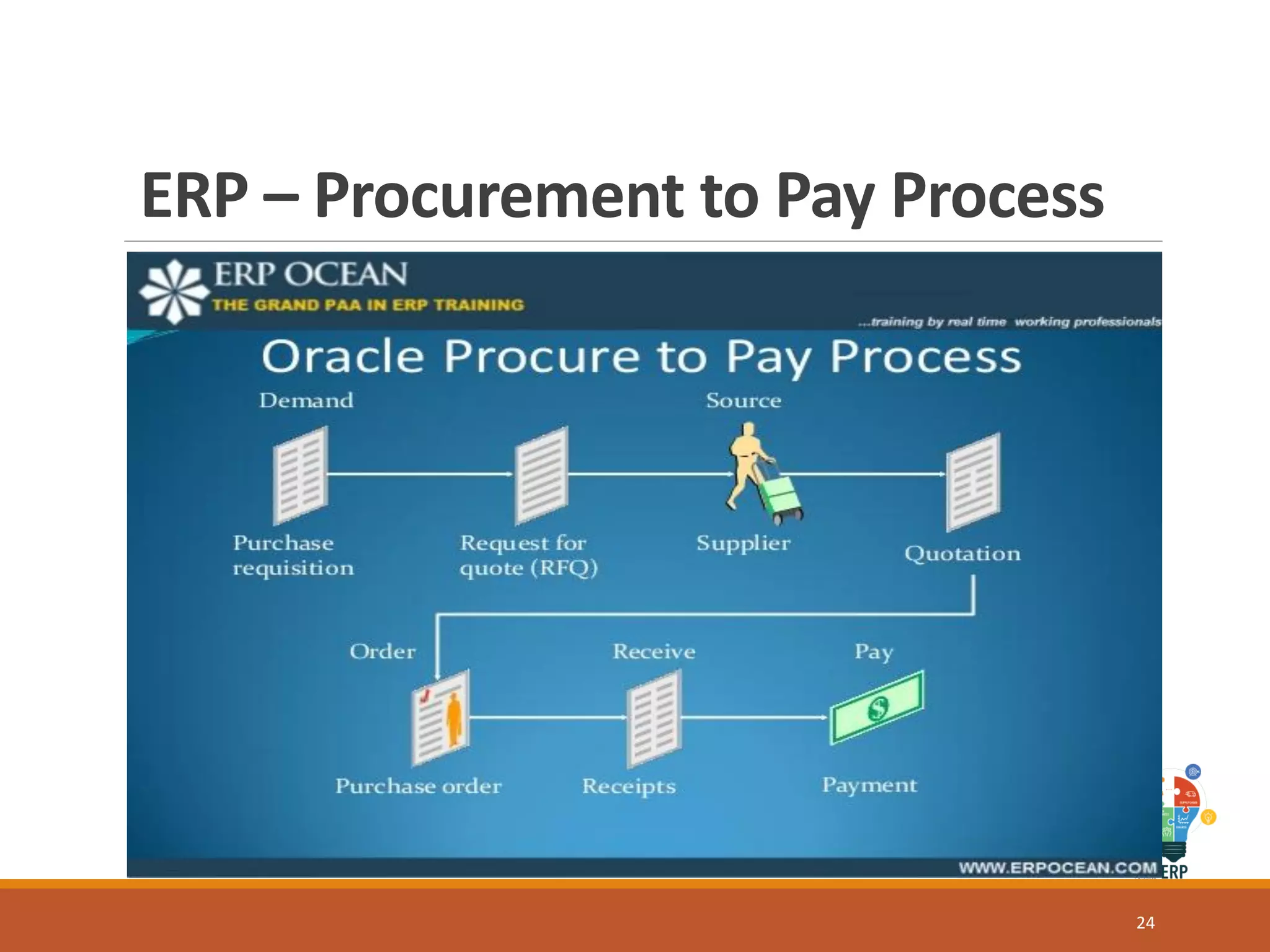
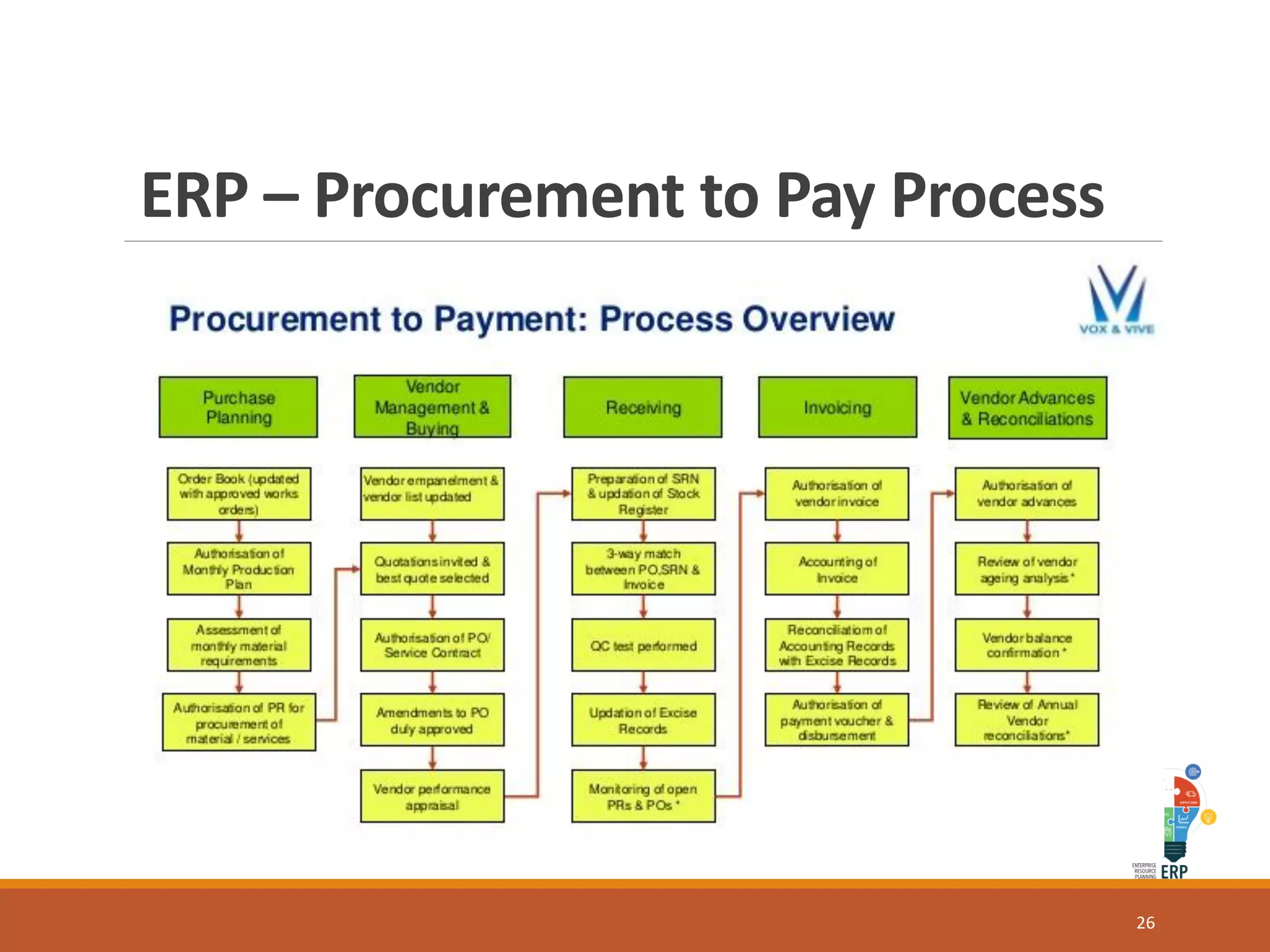
ERP – Procurement to Pay Process
24
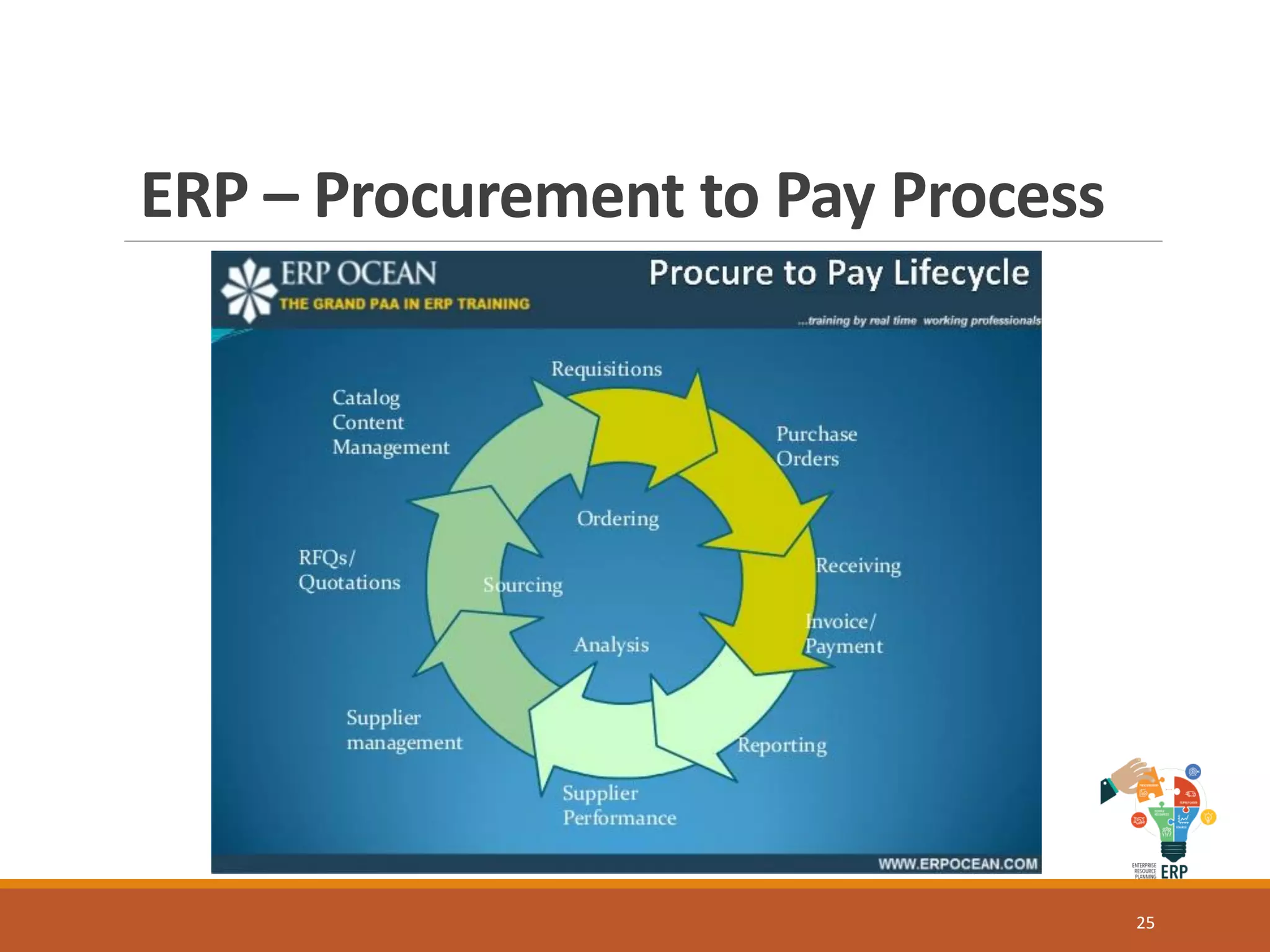
ERP – Procurement to Pay Process
25
ERP – Procurement to Pay Process
26
27
Conclusion
Conclusion
─ To become successive powerhouse of business,
organizations need an ERP.
─ If implemented rightfully, ERP acts as a bone of
organizational business processes.
─ Large organizations who have implemented ERP
and have a large amount of data set of different
departments of the organization are focusing on
implementing BI with ERP strategically.
28

Erp introduction

  • 1.
    Saleem Ahmad, ManagerI/c (Systems)
  • 2.
    ERP – Whatit is? Enterprise; Enterprise has departments like Finance, HR, Production, Sales, Material Management, Procurement etc. Resource; Enterprise needs to manage resources like HR, Finance, Material, Equipment to do business Planning; Enterprise needs a tool to plan the function and resources for optimal utilization 2
  • 3.
    ERP – Whatit is? ERP is a solution, which; ─ Facilitate company-wide integrated information systems, covering all functional areas ─ Perform core corporate activities and increase customer services augmenting Corporate Image 3
  • 4.
  • 5.
    Traditional Business Model Islandsof Information ─ Difficult to get timely & accurate information ─ Heterogeneous Hardware & Software platforms & practices ─ Poor connectivity between different organizational locations ─ Sticking with obsolete technology ─ Resist to change ─ Lack of proven man-power to develop integrated software 5
  • 6.
    ERP – Definition “Softwaresolution that addresses the Enterprise needs, taking a process view of the overall organization to meet the goals, by tightly integrating all functions and under a common software platform” 6
  • 7.
    7 In order tooptimize the company resources to generate best-possible business results all the database should be centrali.e. an integrateddatabase for all the functions in an organization.
  • 8.
    Enterprise Resource Planning Theintegrated system that manages all the resources of the enterprise is called Enterprise Resource Planning system and is defined as comprehensive package that supports and integrate all the processes of organization 8
  • 9.
    Why ERP? ─ ForManagement – to know what is happening in the company ─ One solution for better Management ─ For cycle time reduction ─ To achieve cost control & low working capital ─ To marry latest technologies ─ To shun the geographical gaps ─ To satisfy the customers with high expectations ─ To be Competitive & for survival 9
  • 10.
  • 11.
    Evolution of ERP ─1960’s - Systems Just for Inventory Control ─ 1970’s - MRP – Material Requirement Planning (Inventory with material planning & procurement) ─ 1980’s - MRP II – Manufacturing Resources Planning (Extended MRP to shop floor & distribution Management) ─ Mid 1990’s - ERP – Enterprise Resource Planning (Covering all the activities of an Enterprise) ─ 2000 onwards – ERP II – Collaborative Commerce (Extending ERP to external business entities) 11
  • 12.
    ERP Expectations ─ Integratingall the functions ─ Integrating the systems running in all the locations ─ Transparency of information using a single data source across the organization ─ Software must be responsive ─ Modular ─ Flexible ─ Easy to add functionalities ─ Provide growth path 12
  • 13.
    Problems Solved byERP ─ Material Shortages ─ Productivity Enhancements ─ Customer Service ─ Cash Management ─ Inventory Problems ─ Quality Problems 13
  • 14.
    How an ERPWorks ─ Data integration & synchronization ─ A complete implementation guide ─ To ERP or no ERP 14
  • 15.
    Data Integration andSynchronization 15
  • 16.
  • 17.
    To ERP orno ERP 17
  • 18.
    ERP Product SelectionPhase ─ ERP Team formation for selection ─ Appointment of Consultants (if needed) ─ Scoping study ─ Product selection ─ Implementation partners selection ─ Hardware/Communication cost estimation 18
  • 19.
    Product Selection -Parameters ─ Reputation of the ERP product ─ No of installations in the geographical vicinity ─ % of the overall functional availability ─ Customization possibilities ─ After sales support ─ Your investment plan & budget ─ Implementation partner’s track record 19
  • 20.
    Preparation Phase ─ FramingERP Implementation Strategies ─ Formation of Apex & Steering committees ─ Functional & IT team formation ─ Training on ERP functions & features ─ Scope finalization ─ Action plan to resolve the gap 20
  • 21.
    Benefits of ERP ─Centralized Database for all modules ─ Real time reports and data ─ Less human resources are required to maintain the application ─ Improved performance ─ Reduced quality cost ─ Improve resources utilization ─ Improved information accuracy ─ Improved decision making capability 21
  • 22.
    Pitfalls/Point of Concern ─Costly comparing to custom-built options ─ Lot of hidden costs ─ Chances of cost & time overrun are high ─ Compulsion to pay for redundant modules/features ─ Vigorous involvement of all during implementation ─ Non-availability of special practices like Customer Complaint, Logistics ─ Linking historical data – offline & painful ─ The requirement of Change Management is a must ─ Dependency on outsiders is high ─ IT department – Poor grip on the Implemented systems 22
  • 23.
    Critical Success Factorsfor ERP ─ The firm & optimistic approach of the Management ─ The dedicated Team ─ Good Training ─ Strict adherence to the Project schedules ─ Right technical infra-structure ─ Change Management 23
  • 24.
    ERP – Procurementto Pay Process 24
  • 25.
    ERP – Procurementto Pay Process 25
  • 26.
    ERP – Procurementto Pay Process 26
  • 27.
  • 28.
    Conclusion ─ To becomesuccessive powerhouse of business, organizations need an ERP. ─ If implemented rightfully, ERP acts as a bone of organizational business processes. ─ Large organizations who have implemented ERP and have a large amount of data set of different departments of the organization are focusing on implementing BI with ERP strategically. 28