ERP MODULES
Prepared by:
Mohammed S. Kazi
ENTERPRISE RESOURCE
PLANNING
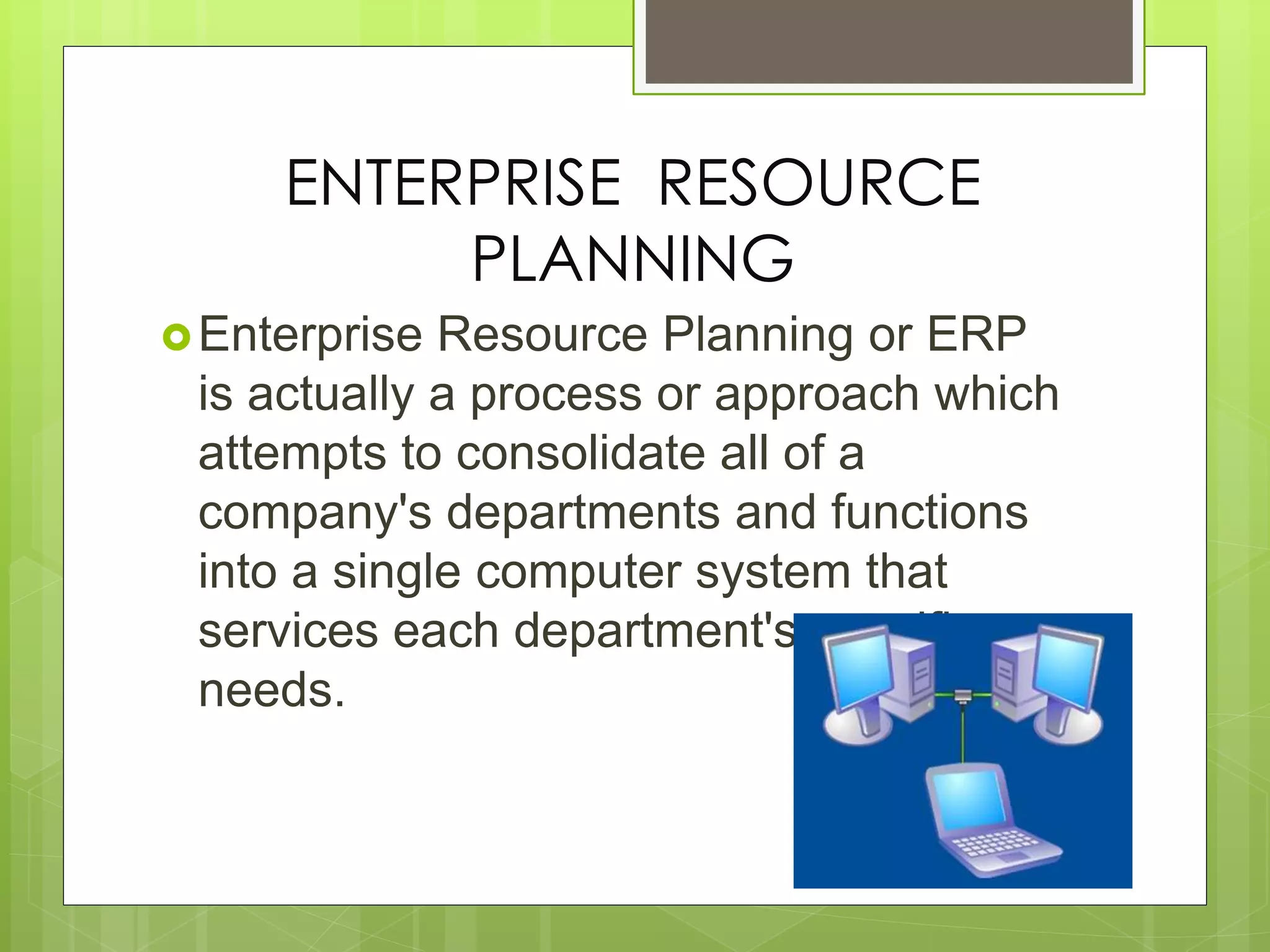
Enterprise Resource Planning or ERP
is actually a process or approach which
attempts to consolidate all of a
company's departments and functions
into a single computer system that
services each department's specific
needs.
MODULE STRUCTURE
ERP software is made up of many
software modules.
Each ERP software module
mimics a major functional area of
an organization.
VENDORSCUSTOMER
SALES
INVENTORY
PRODUCTION
PLANNING
SHOP
FLOOR
EXECUTION
FINANCE
HR
ERP FLOW
ERP
MODULES
PRODUCTION
PLANNING
MODULE
PURCHASING
MODULE
INVENTORY
CONTROL
SALES
MODULE
MARKETING
MODULE
HR
MODULE
FINANCIAL
MODULE
PRODUCTION PLANNING
MODULE
 In the process of evolution of manufacturing
requirements planning (MRP) II into ERP, while
vendors have developed more robust software
for production planning, consulting firms have
accumulated vast knowledge of implementing
production planning module.
 Production planning optimizes the utilization of
manufacturing capacity, parts, components
and material resources using historical
production data and sales forecasting.
PURCHASING MODULE
 Purchase module streamline procurement of
required raw materials. It automates the
processes of identifying potential suppliers,
negotiating price, awarding purchase order to
the supplier, and billing processes.
 Purchase module is tightly integrated with the
inventory control and production planning
modules. Purchasing module is often integrated
with supply chain management software.
INVENTORY CONTROL
 Inventory module facilitates processes of maintaining
the appropriate level of stock in a warehouse.
 The activities of inventory control involves in
identifying inventory requirements, setting targets,
providing replenishment techniques and options,
monitoring item usages, reconciling the inventory
balances, and reporting inventory status.
 Integration of inventory control module with sales,
purchase, finance modules allows ERP systems to
generate vigilant executive level reports.
SALES MODULE
 Revenues from sales are live blood for
commercial organizations.
 Sales module implements functions of
order placement, order scheduling,
shipping and invoicing.
 Sales module is closely integrated with
organizations' ecommerce websites.
Many ERP vendors offer online storefront
as part of the sales module.
FINANCIAL MODULE
 Both for-profit organizations and non-profit
organizations benefit from the
implementation of ERP financial module.
 The financial module is the core of many ERP
software systems. It can gather financial data
from various functional departments, and
generates valuable financial reports such as
balance sheet , general ledger, trail balance,
and quarterly financial statements.
HR MODULE
 HR (Human Resources) is another widely
implemented ERP module. HR module
streamlines the management of human
resources and human capitals.
 HR modules routinely maintain a
complete employee database including
contact information, salary details,
attendance, performance evaluation and
promotion of all employees.
 Advanced HR module is integrated with
knowledge management systems to optimally
utilize the expertise of all employees.
MARKETING MODULE
 ERP marketing module supports lead
generation, direct mailing campaign and
more.
ADVANTAGES OF ERP
 Complete visibility into all the important
processes, across various departments of an
organization.
 Automatic and coherent workflow from one
department/function to another, to ensure a
smooth transition and quicker completion of
processes.
 Since ERP is a modular software system, its
possible to implement either a few modules (or)
many modules based on the requirements of an
organization. If more modules implemented, the
integration between various departments may
be better.
ADVANTAGES OF ERP
 Improves information access and
management throughout the enterprise.
 Improved cost control.
DISADVANTAGES OF ERP
 The cost of ERP Software, planning,
customization, configuration, testing,
implementation, etc. is too high.
 Too little customization may not integrate the
ERP system with the business process & too
much customization may slow down the
project and make it difficult to upgrade.
 There maybe additional indirect costs due to
ERP implementation – like new IT infrastructure,
upgrading the WAN links, etc.
DISADVANTAGES OF ERP
 Choosing the right ERP package is not
easy. The selection process starts with an
identification of system scope, business
objectives and business processes.
SAP ERP MODULES
SAP has a number of application modules in
the package. Some of them are:
 Financials
 Controlling
 Investment management
 Treasury
 Integrated Enterprise management
 Sales and distribution
 Production planning and control.
THANK YOU!

Erp modules

  • 1.
  • 2.
    ENTERPRISE RESOURCE PLANNING Enterprise ResourcePlanning or ERP is actually a process or approach which attempts to consolidate all of a company's departments and functions into a single computer system that services each department's specific needs.
  • 3.
    MODULE STRUCTURE ERP softwareis made up of many software modules. Each ERP software module mimics a major functional area of an organization.
  • 4.
  • 5.
  • 6.
    PRODUCTION PLANNING MODULE  Inthe process of evolution of manufacturing requirements planning (MRP) II into ERP, while vendors have developed more robust software for production planning, consulting firms have accumulated vast knowledge of implementing production planning module.  Production planning optimizes the utilization of manufacturing capacity, parts, components and material resources using historical production data and sales forecasting.
  • 7.
    PURCHASING MODULE  Purchasemodule streamline procurement of required raw materials. It automates the processes of identifying potential suppliers, negotiating price, awarding purchase order to the supplier, and billing processes.  Purchase module is tightly integrated with the inventory control and production planning modules. Purchasing module is often integrated with supply chain management software.
  • 8.
    INVENTORY CONTROL  Inventorymodule facilitates processes of maintaining the appropriate level of stock in a warehouse.  The activities of inventory control involves in identifying inventory requirements, setting targets, providing replenishment techniques and options, monitoring item usages, reconciling the inventory balances, and reporting inventory status.  Integration of inventory control module with sales, purchase, finance modules allows ERP systems to generate vigilant executive level reports.
  • 9.
    SALES MODULE  Revenuesfrom sales are live blood for commercial organizations.  Sales module implements functions of order placement, order scheduling, shipping and invoicing.  Sales module is closely integrated with organizations' ecommerce websites. Many ERP vendors offer online storefront as part of the sales module.
  • 10.
    FINANCIAL MODULE  Bothfor-profit organizations and non-profit organizations benefit from the implementation of ERP financial module.  The financial module is the core of many ERP software systems. It can gather financial data from various functional departments, and generates valuable financial reports such as balance sheet , general ledger, trail balance, and quarterly financial statements.
  • 11.
    HR MODULE  HR(Human Resources) is another widely implemented ERP module. HR module streamlines the management of human resources and human capitals.  HR modules routinely maintain a complete employee database including contact information, salary details, attendance, performance evaluation and promotion of all employees.  Advanced HR module is integrated with knowledge management systems to optimally utilize the expertise of all employees.
  • 12.
    MARKETING MODULE  ERPmarketing module supports lead generation, direct mailing campaign and more.
  • 13.
    ADVANTAGES OF ERP Complete visibility into all the important processes, across various departments of an organization.  Automatic and coherent workflow from one department/function to another, to ensure a smooth transition and quicker completion of processes.  Since ERP is a modular software system, its possible to implement either a few modules (or) many modules based on the requirements of an organization. If more modules implemented, the integration between various departments may be better.
  • 14.
    ADVANTAGES OF ERP Improves information access and management throughout the enterprise.  Improved cost control.
  • 15.
    DISADVANTAGES OF ERP The cost of ERP Software, planning, customization, configuration, testing, implementation, etc. is too high.  Too little customization may not integrate the ERP system with the business process & too much customization may slow down the project and make it difficult to upgrade.  There maybe additional indirect costs due to ERP implementation – like new IT infrastructure, upgrading the WAN links, etc.
  • 16.
    DISADVANTAGES OF ERP Choosing the right ERP package is not easy. The selection process starts with an identification of system scope, business objectives and business processes.
  • 17.
    SAP ERP MODULES SAPhas a number of application modules in the package. Some of them are:  Financials  Controlling  Investment management  Treasury  Integrated Enterprise management  Sales and distribution  Production planning and control.
  • 18.