Abhijit Dave,
BIP,
Guided By: Mr. Milind
           Thosar.
   An integrated suite of information systems
    that form the backbone of the enterprise
    for running and managing its operations.
   ERP or enterprise resource planning software
    offers a broad suite of software functionalities
    designed to help you manage your accounting as
    well as your business's operational tasks. With an
    ERP system you are better able to centralize your
    data, provide uniform access to resources across
    your enterprise, and lower operating costs by
    preventing data re-entry.
   Enterprise resource planning (ERP) systems
    integrate internal and external management
    information across an entire
    organization, embracing
    finance/accounting, manufacturing, sales and
    service, customer relationship management, etc.
   ERP systems automate this activity with an
    integrated software application. Their purpose is
    to facilitate the flow of information between all
    business functions inside the boundaries of the
    organization and manage the connections to
    outside stockholders.
   ERP systems can run on a variety of computer
    hardware and network configurations, typically
    employing a database as a repository for
    information.
   ERP is a business process management solution that
    provides organizations with consolidated inventory,
    manufacturing, warehousing, financials, multi-site
    reporting and relationship and knowledge management
    capabilities.

   Employees, customers and partners are provided with
    access to information across the entire enterprise value
    chain.
   An integrated system that operates in real
    time (or next to real time), without relying on
    periodic updates.[citation needed]

   A common database, which supports all
    applications.

   A consistent look and feel throughout each
    module.
   Clients commonly realize the following benefits
    from ERP:
    Increased operational effectiveness &
    productivity
     Timely and targeted information feedback
    system for decision support
    Efficient inventory management
    Improved Planning
    Improved customer service
• Designed and Developed to follow cGAMP guidelines

• 21 CFR Part11 Compliant

• Electronic Batch Record Management (EBRM)

• Recipe Management

• Regulated FIFO concept of inventory control

• Multi-location warehouse Management System

• Seamless integration to Nova-LIMS
   Transactional database
   Management portal/dashboard
   Business intelligence system
   Customizable reporting
   External access via technology such as web
    services
   Search
   Document management
   Messaging/chat/wiki
   Workflow management
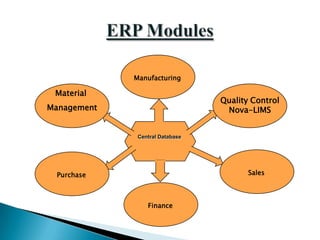
Manufacturing

 Material
                                 Quality Control
Management                        Nova-LIMS


              Central Database


 Purchase                               Sales


                 Finance
   Pharmaceutical-specific ERP (Enterprise Resource
    Planning) software system is the most effective way
    to identify and track every single raw material from
    receipt through processing, packaging and
    shipping, to the exact customer location.
   It has been proved beyond doubt that
    implementation of eresource ERP systems not only
    gives more transparency to your business process but
    also it allows your business to operate more
    efficiently, predictably and more profitably
    ERP helps you to oversee every area of your business
    without the necessity for separate software packages
    or expensive customization.
   Medical Representative Management
   Sales & Distribution Management
   Manufacture Resource Planning
   Batch Process Record
   Validation Protocol - SOP
   Total Quality Management
   Formulation Management
   Plant & Machine Maintenance
   Inventory & Material Management
   Purchase Management
   Accounts & Finance Management
   Excise Management
   The fundamental advantage of ERP is that integrating
    the all processes by which businesses operate saves
    time and expense. Decisions can be made more
    quickly and with fewer errors. Data becomes visible
    across the organization. Tasks that benefit from this
    integration include:[citation needed]
   Sales forecasting, which allows inventory optimization
   Chronological history of every transaction through
    relevant data compilation in every area of operation.
   Order tracking, from acceptance through fulfillment
   Revenue tracking, from invoice through cash receipt
   Matching purchase orders (what was
    ordered), inventory receipts (what arrived), and
    costing (what the vendor invoiced)
   ERP systems centralize business data, bringing the
    following benefits:
   They eliminate the need to synchronize changes
    between multiple systems—consolidation of
    finance, marketing and sales, human resource, and
    manufacturing applications
   They bring legitimacy and transparency in each bit of
    statistical data.
   They enable standard product naming/coding.
   They provide a comprehensive enterprise view (no
    "islands of information"). They make real–time
    information available to management anywhere, any
    time to make proper decisions.
   They protect sensitive data by consolidating multiple
    security systems into a single structure
   Allows easier global integration (barriers of
    currency exchange rates, language, and
    culture can be bridged automatically)
   Updates only need to be done once to be
    implemented company-wide
   Provides real-time information, reducing the
    possibility of reoccurring errors
   May create a more efficient work environment
    for employees
   Vendors have past knowledge and expertise
    on how to best build and implement a system
   Customization is problematic.
   Re–engineering business processes to fit the ERP
    system may damage competitiveness and/or
    divert focus from other critical activities
   ERP can cost more than less integrated and/or
    less comprehensive solutions.
   High switching costs associated with ERP can
    increase the ERP vendor's negotiating power
    which can result in higher
    support, maintenance, and upgrade expenses.
   Overcoming resistance to sharing sensitive
    information between departments can divert
    management attention.
   Integration of truly independent businesses can
    create unnecessary dependencies.
   Extensive training requirements take resources
    from daily operations.
   Due to ERP's architecture (OLTP, On-Line
    Transaction Processing) ERP systems are not well
    suited for production planning and supply chain
    management (SCM)
   Inflexibility - vendor packages may not fit a
    company's business model well and
    customization can be expensive
   Return on Investment may take too long to be
    profitable
   Implementations have a risk of project failure.
Thank you...
How do we
  begin?

ERP Software System

  • 1.
  • 2.
    An integrated suite of information systems that form the backbone of the enterprise for running and managing its operations.  ERP or enterprise resource planning software offers a broad suite of software functionalities designed to help you manage your accounting as well as your business's operational tasks. With an ERP system you are better able to centralize your data, provide uniform access to resources across your enterprise, and lower operating costs by preventing data re-entry.
  • 3.
    Enterprise resource planning (ERP) systems integrate internal and external management information across an entire organization, embracing finance/accounting, manufacturing, sales and service, customer relationship management, etc.  ERP systems automate this activity with an integrated software application. Their purpose is to facilitate the flow of information between all business functions inside the boundaries of the organization and manage the connections to outside stockholders.  ERP systems can run on a variety of computer hardware and network configurations, typically employing a database as a repository for information.
  • 4.
    ERP is a business process management solution that provides organizations with consolidated inventory, manufacturing, warehousing, financials, multi-site reporting and relationship and knowledge management capabilities.  Employees, customers and partners are provided with access to information across the entire enterprise value chain.
  • 5.
    An integrated system that operates in real time (or next to real time), without relying on periodic updates.[citation needed]  A common database, which supports all applications.  A consistent look and feel throughout each module.
  • 6.
    Clients commonly realize the following benefits from ERP: Increased operational effectiveness & productivity Timely and targeted information feedback system for decision support Efficient inventory management Improved Planning Improved customer service
  • 7.
    • Designed andDeveloped to follow cGAMP guidelines • 21 CFR Part11 Compliant • Electronic Batch Record Management (EBRM) • Recipe Management • Regulated FIFO concept of inventory control • Multi-location warehouse Management System • Seamless integration to Nova-LIMS
  • 8.
    Transactional database  Management portal/dashboard  Business intelligence system  Customizable reporting  External access via technology such as web services  Search  Document management  Messaging/chat/wiki  Workflow management
  • 9.
    Manufacturing Material Quality Control Management Nova-LIMS Central Database Purchase Sales Finance
  • 10.
    Pharmaceutical-specific ERP (Enterprise Resource Planning) software system is the most effective way to identify and track every single raw material from receipt through processing, packaging and shipping, to the exact customer location.  It has been proved beyond doubt that implementation of eresource ERP systems not only gives more transparency to your business process but also it allows your business to operate more efficiently, predictably and more profitably  ERP helps you to oversee every area of your business without the necessity for separate software packages or expensive customization.  Medical Representative Management  Sales & Distribution Management
  • 11.
    Manufacture Resource Planning  Batch Process Record  Validation Protocol - SOP  Total Quality Management  Formulation Management  Plant & Machine Maintenance  Inventory & Material Management  Purchase Management  Accounts & Finance Management  Excise Management
  • 12.
    The fundamental advantage of ERP is that integrating the all processes by which businesses operate saves time and expense. Decisions can be made more quickly and with fewer errors. Data becomes visible across the organization. Tasks that benefit from this integration include:[citation needed]  Sales forecasting, which allows inventory optimization  Chronological history of every transaction through relevant data compilation in every area of operation.  Order tracking, from acceptance through fulfillment  Revenue tracking, from invoice through cash receipt  Matching purchase orders (what was ordered), inventory receipts (what arrived), and costing (what the vendor invoiced)
  • 13.
    ERP systems centralize business data, bringing the following benefits:  They eliminate the need to synchronize changes between multiple systems—consolidation of finance, marketing and sales, human resource, and manufacturing applications  They bring legitimacy and transparency in each bit of statistical data.  They enable standard product naming/coding.  They provide a comprehensive enterprise view (no "islands of information"). They make real–time information available to management anywhere, any time to make proper decisions.  They protect sensitive data by consolidating multiple security systems into a single structure
  • 14.
    Allows easier global integration (barriers of currency exchange rates, language, and culture can be bridged automatically)  Updates only need to be done once to be implemented company-wide  Provides real-time information, reducing the possibility of reoccurring errors  May create a more efficient work environment for employees  Vendors have past knowledge and expertise on how to best build and implement a system
  • 15.
    Customization is problematic.  Re–engineering business processes to fit the ERP system may damage competitiveness and/or divert focus from other critical activities  ERP can cost more than less integrated and/or less comprehensive solutions.  High switching costs associated with ERP can increase the ERP vendor's negotiating power which can result in higher support, maintenance, and upgrade expenses.  Overcoming resistance to sharing sensitive information between departments can divert management attention.  Integration of truly independent businesses can create unnecessary dependencies.
  • 16.
    Extensive training requirements take resources from daily operations.  Due to ERP's architecture (OLTP, On-Line Transaction Processing) ERP systems are not well suited for production planning and supply chain management (SCM)  Inflexibility - vendor packages may not fit a company's business model well and customization can be expensive  Return on Investment may take too long to be profitable  Implementations have a risk of project failure.
  • 17.