This document discusses various digital encoding and modulation techniques used for transmitting digital and analog data over transmission channels. It describes:
- Digital signaling, where digital data is encoded into a digital signal using techniques like NRZ-L, NRZI, etc. to minimize bandwidth and errors.
- Analog signaling, where analog or digital data modulates an analog carrier signal using techniques like ASK, FSK, PSK to transmit over analog lines.
- Specific digital modulation techniques like BPSK, QPSK, MFSK that encode digital data onto signal properties like phase, frequency or amplitude to maximize bandwidth efficiency and minimize errors.
- How analog modulation techniques like AM, FM, PM encode analog data onto an
Overview of pass band transmission and key encoding/modulation techniques.
Comparison between digital and analog signaling, highlighting modulation methods and encoding examples.
Explanation of digital signals, data rates, and modulation rates including signal elements.
Factors impacting signal interpretation such as timing, signal levels, SNR, and bandwidth.
Introduction to various modulation techniques like ASK and their Susceptibility to noise.
Details on BFSK and MFSK, including their efficiency and use in various applications.
Descriptions of PSK, DPSK, and QPSK, emphasizing their phase shift representations.
Evaluates bandwidth efficiency and bit error rates of ASK, FSK, PSK, and QAM.Introduction to QAM, its variants, and applications in modern communication systems.
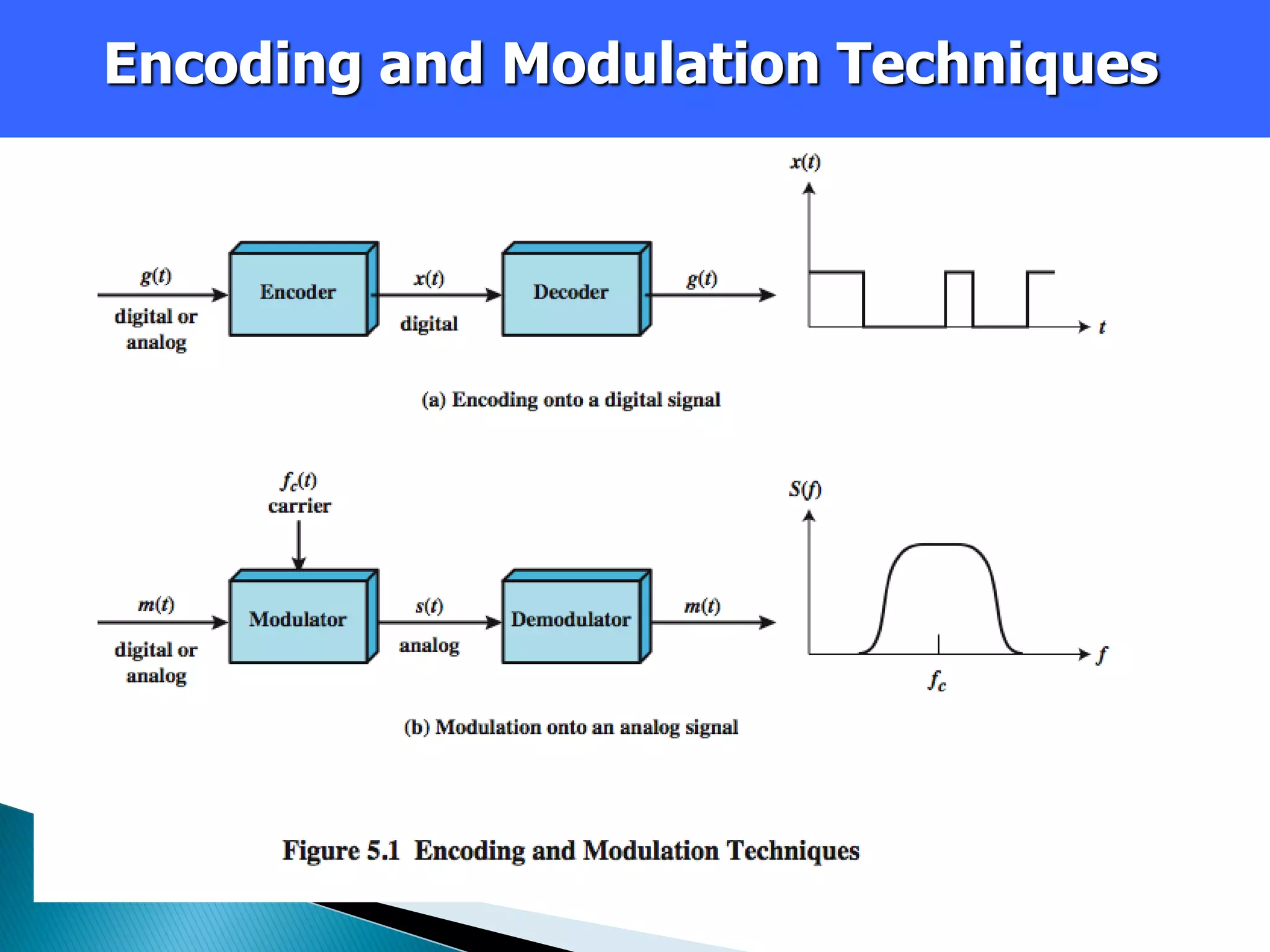
Digital Signaling VersusAnalog Signaling
• Digital signaling
• Digital or analog data is encoded into a digital signal
• Encoding may be chosen to conserve bandwidth or to minimize
error
• Analog Signaling
• Digital or analog data modulates analog carrier signal
• The frequency of the carrier fc is chosen to be compatible with
the transmission medium used
• Modulation: the amplitude, frequency or phase of the carrier
signal is varied in accordance with the modulating data signal
• by using different carrier frequencies, multiple data signals
(users) can share the same transmission medium
4.
Digital Signaling
• Digitaldata, digital signal
• Simplest encoding scheme: assign one voltage level to binary one
and another voltage level to binary zero
• More complex encoding schemes: are used to improve
performance (reduce transmission bandwidth and minimize
errors).
• Examples are NRZ-L, NRZI, Manchester, etc.
• Analog data, Digital signal
• Analog data, such as voice and video
• Often digitized to be able to use digital transmission facility
• Example: Pulse Code Modulation (PCM), which involves
sampling the analog data periodically and quantizing the samples
5.
5/45
Analog Signaling
• Digitaldata, Analog Signal
• A modem converts digital data to an analog signal so that it can
be transmitted over an analog line
• The digital data modulates the amplitude, frequency, or phase of a
carrier analog signal
• Examples: Amplitude Shift Keying (ASK), Frequency Shift
Keying (FSK), Phase Shift Keying (PSK)
• Analog data, Analog Signal
• Analog data, such as voice and video modulate the amplitude,
frequency, or phase of a carrier signal to produce an analog signal
in a different frequency band
• Examples: Amplitude Modulation (AM), Frequency Modulation
(FM), Phase Modulation (PM)
6.
6/5
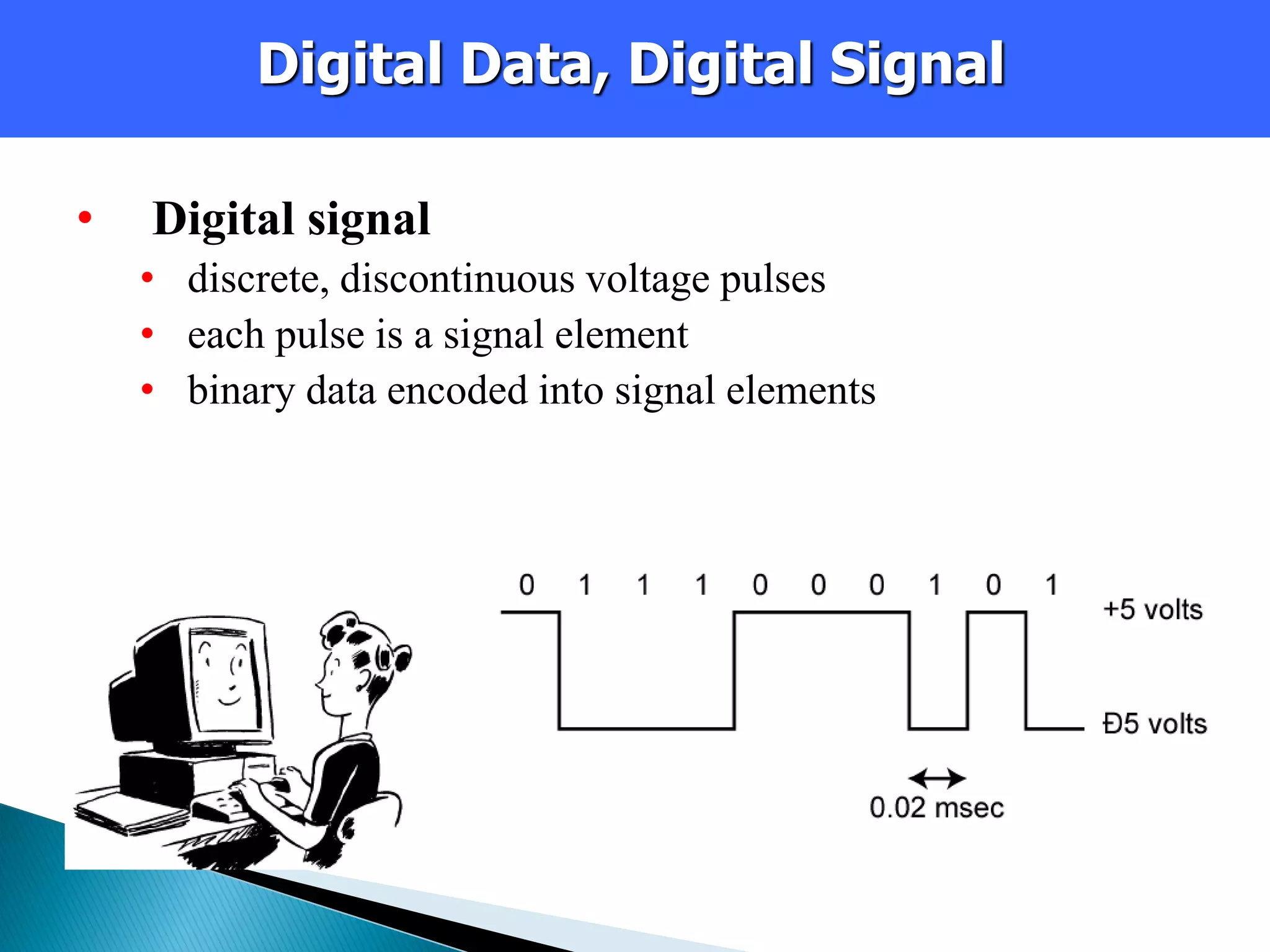
Digital Data, DigitalSignal
• Digital signal
• discrete, discontinuous voltage pulses
• each pulse is a signal element
• binary data encoded into signal elements
7.
Periodic signals
Dataelement: a single binary 1 or 0
Signal element: a voltage pulse of constant amplitude
Unipolar: All signal elements have the same sign
Polar: One logic state represented by positive voltage the other by negative
voltage
Data rate: Rate of data (R) transmission in bits per second
Duration or length of a bit: Time taken for transmitter to emit the bit
(Tb=1/R)
Modulation rate: Rate at which the signal level changes, measured in baud
= signal elements per second. Depends on type of digital encoding used.
8.
Interpreting Signals
• Needto know
• timing of bits: when they start and end
• signal levels: high or low
• factors affecting signal interpretation
• Data rate: increase data rate increases Bit Error Rate (BER)
• Signal to Noise Ratio (SNR): increase SNR decrease BER
• Bandwidth: increase bandwidth increase data rate
• encoding scheme: mapping from data bits to signal elements
9.
9/45
Comparison of EncodingSchemes
• Signal Spectrum
• Lack of high frequencies reduces required bandwidth,
• lack of dc component allows ac coupling via transformer, providing isolation,
• should concentrate power in the middle of the bandwidth
• Clocking
• synchronizing transmitter and receiver with a sync mechanism based on
suitable encoding
• Error Detection
• useful if can be built in to signal encoding
• signal interference and noise immunity
• cost and complexity: increases when increases data rate
29/45
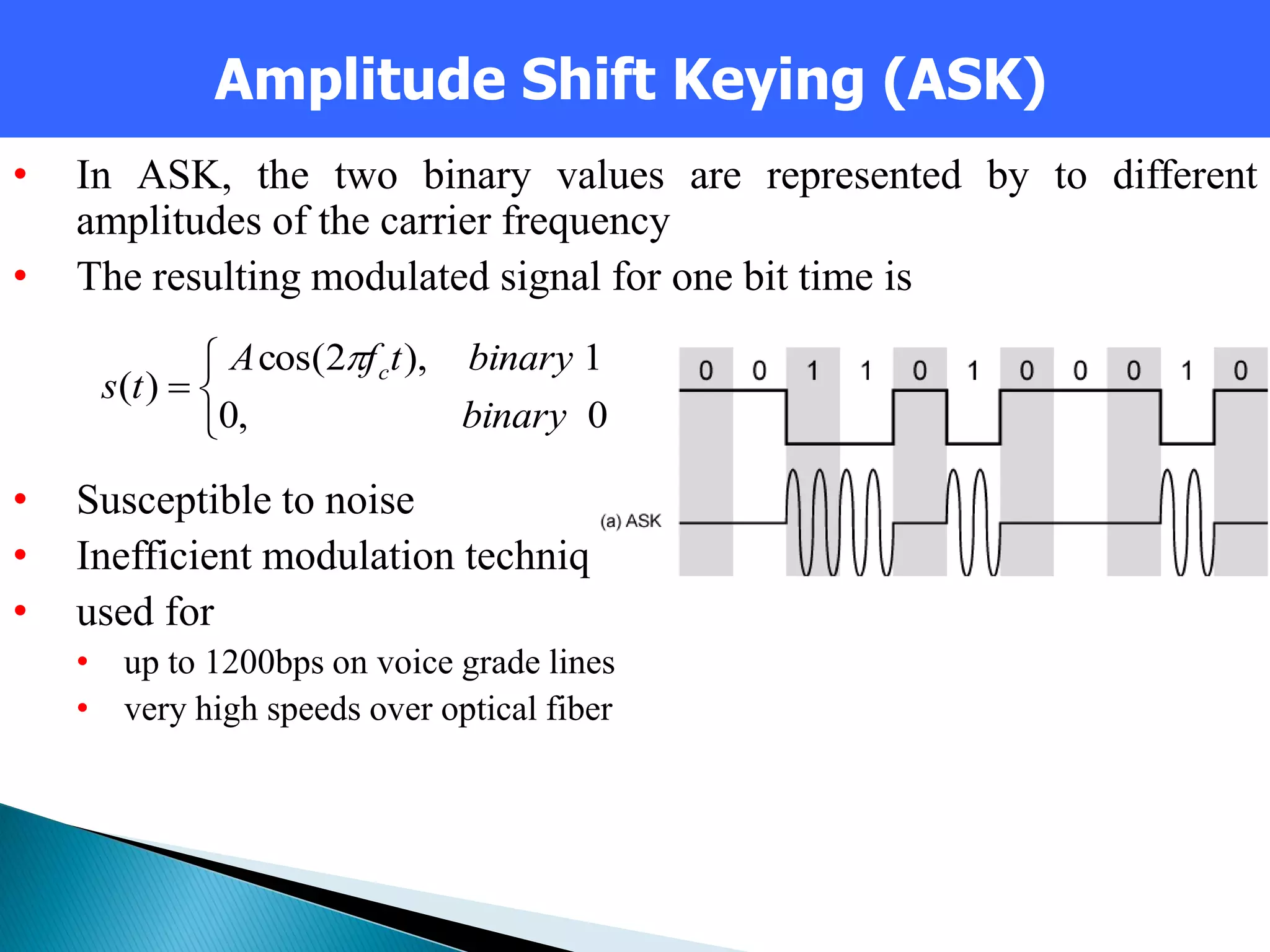
Amplitude Shift Keying(ASK)
• In ASK, the two binary values are represented by to different
amplitudes of the carrier frequency
• The resulting modulated signal for one bit time is
• Susceptible to noise
• Inefficient modulation technique
• used for
• up to 1200bps on voice grade lines
• very high speeds over optical fiber
0,0
1),2cos(
)(
binary
binarytfA
ts c
12.
30/45
Binary Frequency ShiftKeying (BFSK)
• The most common form of FSK is Binary FSK (BFSK)
• Two binary values represented by two different frequencies ( f1 and
f2 )
• less susceptible to noise than ASK
• used for
• up to 1200bps on voice grade lines
• high frequency radio (3 to 30MHz)
• even higher frequency on LANs using coaxial cable
0),2cos(
1),2cos(
)(
2
1
binarytfA
binarytfA
ts
0 0 1 1 0 1 0 0 0 1 0
f2 f2 f1 f1 f2 f1 f2 f2 f2 f1 f2
13.
31/45
Full-Duplex BFSK Transmissionon
a Voice-Grade line
• Voice grade lines will pass voice frequencies in the range 300 to
3400Hz
• Full duplex means that signals are transmitted in both directions at
the same time
f1 f 3 f4f2
14.
32/45
Multiple FSK (MFSK)
•More than two frequencies (M frequencies) are used
• More bandwidth efficient compared to BFSK
• More susceptible to noise compared to BFSK
• MFSK signal:
elementsignalperbitsofnumberL
elementssignaldifferentofnumberM
frequencydifferencethef
frequencycarrierthef
fMiff
where
MitfAts
L
d
c
dci
ii
2
)12(
1),2cos()(
15.
33/45
Multiple FSK (MFSK)
MFSK signal:
Period of signal element
Minimum frequency separation
MFSK signal bandwidth:
elementsignalperbitsofnumberL
elementssignaldifferentofnumberM
fMiff
where
MitfAts
L
dci
ii
2
)12(
1),2cos()(
ddd MffMW 2)2(
periodbitTperiodelementsignalTLTT bsbs ::,
)(2/12)/(12/1 ratebitLfTfLTfT dbdbds
16.
34/45
Example
With fc=250KHz,fd=25KHz, and M=8 (L=3 bits), we have the following
frequency assignment for each of the 8 possible 3-bit data combinations:
This scheme can support a data rate of:
KHzMfWbandwidth
KHzf
KHzf
KHzf
KHzf
KHzf
KHzf
KHzf
KHzf
ds 4002
425111
375110
325101
275100
225011
175010
125001
75000
8
7
6
5
4
3
2
1
KbpsHzbitsLfT db 150)25)(3(22/1
dci fMiff )12(
17.
35/45
Example
• The followingfigure shows an example of MFSK with M=4. An
input bit stream of 20 bits is encoded 2bits at a time, with each of the
possible 2-bit combinations transmitted as a different frequency.
dc
dc
dc
dc
dci
fffi
fffi
fffi
fffi
fMiff
3411
310
201
3100
)12(
4
3
2
1
18.
36/45
Phase Shift Keying(PSK)
• Phase of carrier signal is shifted to represent data
• Binary PSK (BPSK): two phases represent two binary digits
0 0 1 1 0 1 0 0 0 1 0
π π 0 0 π 0 π π π 0 π
1)(),2cos()(
0),2cos(
1),2cos(
0),2cos(
1),2cos(
)(
tdtftAd
binarytfA
binarytfA
binarytfA
binarytfA
ts
c
c
c
c
c
19.
37/45
Differential PSK (DPSK)
•In DPSK, the phase shift is with reference to the previous bit
transmitted rather than to some constant reference signal
• Binary 0:signal burst with the same phase as the previous one
• Binary 1:signal burst of opposite phase to the preceding one
20.
38/45
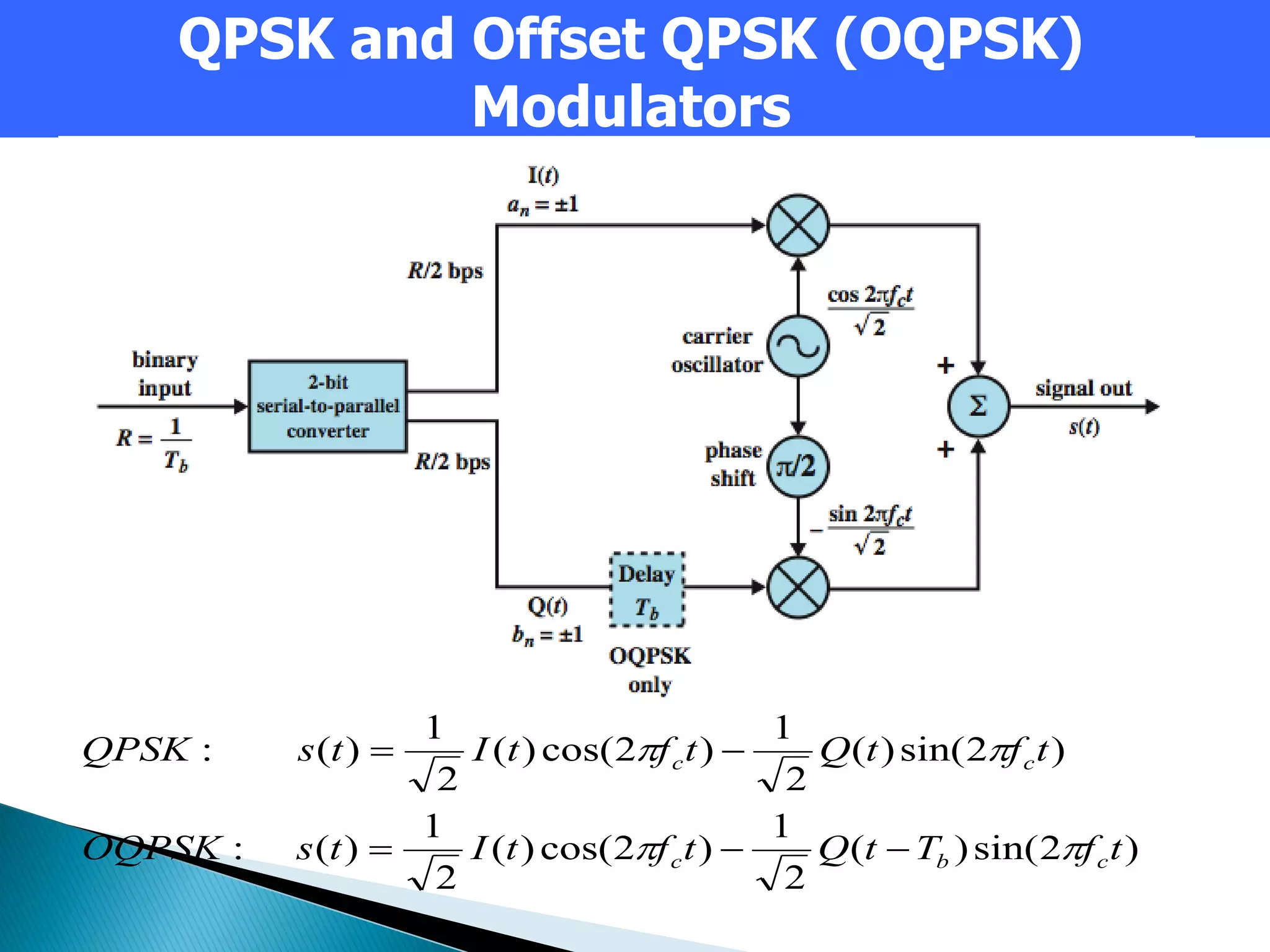
Four-level PSK: QuadraturePSK (QPSK)
10)
4
2cos(
00)
4
3
2cos(
01)
4
3
2cos(
11)
4
2cos(
)(
tfA
tfA
tfA
tfA
ts
c
c
c
c
• More efficient use of bandwidth if each signal element
represents more than one bit
• eg. shifts of /2 (90o)
• each signal element represents two bits
• split input data stream in two & modulate onto the phase of the
carrier
• can use 8 phase angles & more than one amplitude
• 9600bps modem uses 12 phase angles, four of which have two
amplitudes: this gives a total of 16 different signal elements
41/45
Performance of ASK,FSK, MFSK, PSK and
MPSK
• Bandwidth Efficiency
• ASK/PSK:
• MPSK:
• MFSK:
10,
1
1
r
rB
R
bandwidthontransmissi
ratedata
T
elementssignaldifferentofnumberM
r
M
B
R
T
:,
1
log2
Mr
M
B
R
T )1(
log2
• Bit Error Rate (BER)
• bit error rate of PSK and QPSK are about 3dB superior to
ASK and FSK (see Fig. 5.4)
• for MFSK & MPSK have tradeoff between bandwidth
efficiency and error performance
24.
42/45
Performance of MFSKand MPSK
• MFSK: increasing M decreases BER and decreases bandwidth Efficiency
• MPSK: Increasing M increases BER and increases bandwidth efficiency
25.
43/45
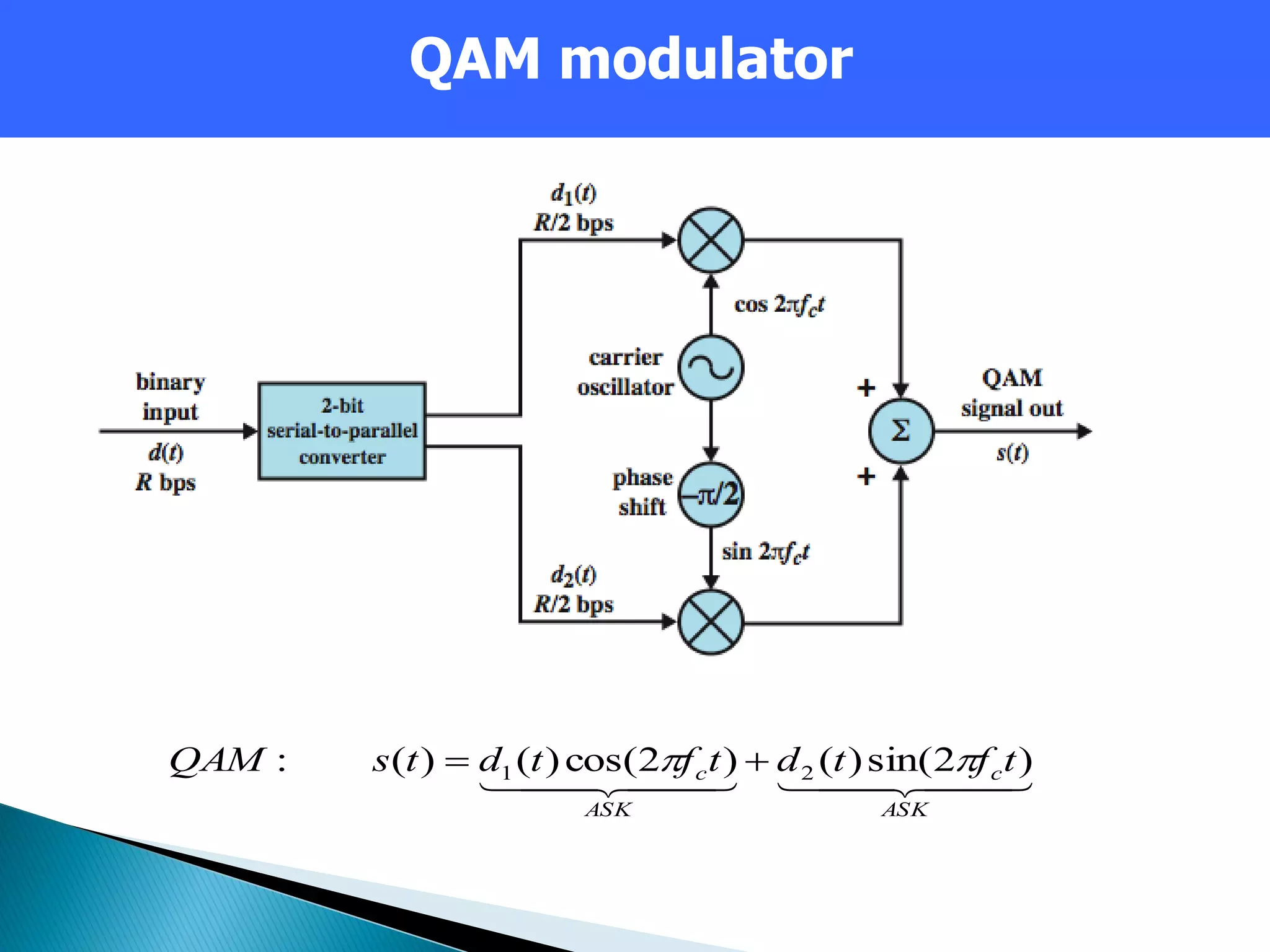
Quadrature Amplitude Modulation(QAM)
• QAM used on asymmetric digital subscriber line
(ADSL) and some wireless standards
• combination of ASK and PSK
• logical extension of QPSK
• send two different signals simultaneously on same
carrier frequency
• use two copies of carrier, one shifted by 90°
• each carrier is ASK modulated
45/45
QAM Variants
• Twolevel ASK (two different amplitude levels)
• each of two streams in one of two states
• four state system
• essentially QPSK
• Four level ASK (four different amplitude levels)
• combined stream in one of 16 states
• Have 64 and 256 state systems
• Improved data rate for given bandwidth
• but increased potential error rate