Lecture Overview
Theobjectives of today’s lecture are
Explain the course mechanics
Provide an overview of the course
Describe the major components of the
course
3.
Required Course Materials
Textbook:
B.P. Lathi, Modern Digital and Analog
Communication Systems, 4th Ed.
References:
Slides will be posted online on Google
classroom
Live Zoom sessions
Some videos
4.
Course Components
Thecourse has two main components:
Lectures – These are meant to introduce the key
concepts in the course and provide you with
fundamental understanding. This is the primary
source of information in the class. I will provide
you with lecture notes on the website typically
the weekend before class. Attending the lectures
is absolutely crucial to successfully completing
this course!
Exams – These are meant to show me how well
you have grasped the material .
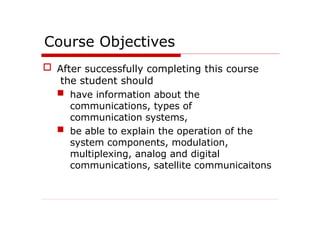
Course Objectives
Aftersuccessfully completing this course
the student should
have information about the
communications, types of
communication systems,
be able to explain the operation of the
system components, modulation,
multiplexing, analog and digital
communications, satellite communicaitons
7.
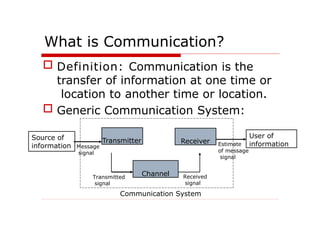
What is Communication?
Definition: Communication is the
transfer of information at one time or
location to another time or location.
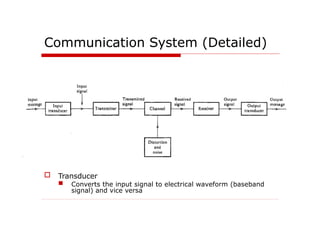
Generic Communication System:
Channel
Receiver
Transmitter
Received
signal
Transmitted
signal
Communication System
Estimate
of message
signal
User of
information
Source of
information Message
signal
8.
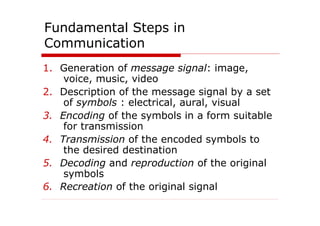
Fundamental Steps in
Communication
1.Generation of message signal: image,
voice, music, video
2. Description of the message signal by a set
of symbols : electrical, aural, visual
3. Encoding of the symbols in a form suitable
for transmission
4. Transmission of the encoded symbols to
the desired destination
5. Decoding and reproduction of the original
symbols
6. Recreation of the original signal
9.
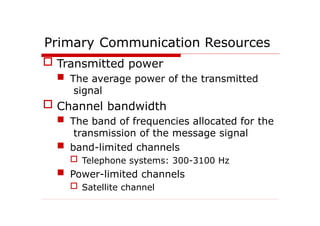
Primary Communication Resources
Transmitted power
The average power of the transmitted
signal
Channel bandwidth
The band of frequencies allocated for the
transmission of the message signal
band-limited channels
Telephone systems: 300-3100 Hz
Power-limited channels
Satellite channel
10.
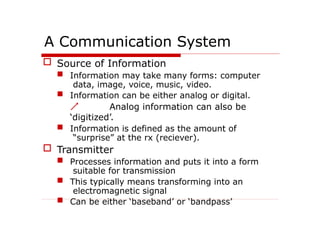
A Communication System
Source of Information
Information may take many forms: computer
data, image, voice, music, video.
Information can be either analog or digital.
Analog information can also be
‘digitized’.
Information is defined as the amount of
“surprise” at the rx (reciever).
Transmitter
Processes information and puts it into a form
suitable for transmission
This typically means transforming into an
electromagnetic signal
Can be either ‘baseband’ or ‘bandpass’
11.
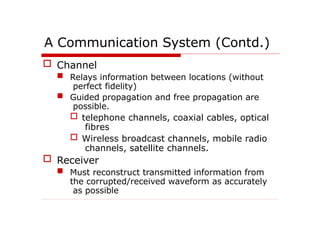
A Communication System(Contd.)
Channel
Relays information between locations (without
perfect fidelity)
Guided propagation and free propagation are
possible.
telephone channels, coaxial cables, optical
fibres
Wireless broadcast channels, mobile radio
channels, satellite channels.
Receiver
Must reconstruct transmitted information from
the corrupted/received waveform as accurately
as possible
A Communication System(Contd.)
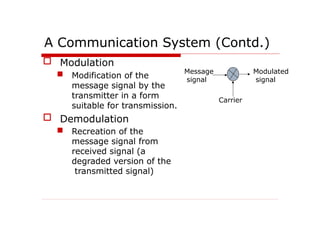
Modulation
Modification of the
message signal by the
transmitter in a form
suitable for transmission.
Demodulation
Recreation of the
message signal from
received signal (a
degraded version of the
transmitted signal)
Modulated
signal
Message
signal
Carrier
15.
Modulation
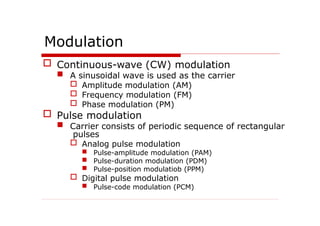
Continuous-wave (CW)modulation
A sinusoidal wave is used as the carrier
Amplitude modulation (AM)
Frequency modulation (FM)
Phase modulation (PM)
Pulse modulation
Carrier consists of periodic sequence of rectangular
pulses
Analog pulse modulation
Pulse-amplitude modulation (PAM)
Pulse-duration modulation (PDM)
Pulse-position modulatiob (PPM)
Digital pulse modulation
Pulse-code modulation (PCM)
16.
Modulation
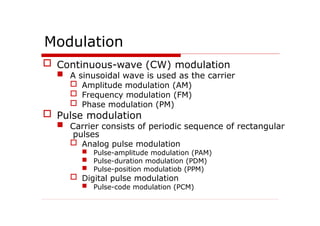
Continuous-wave (CW)modulation
A sinusoidal wave is used as the carrier
Amplitude modulation (AM)
Frequency modulation (FM)
Phase modulation (PM)
Pulse modulation
Carrier consists of periodic sequence of rectangular
pulses
Analog pulse modulation
Pulse-amplitude modulation (PAM)
Pulse-duration modulation (PDM)
Pulse-position modulatiob (PPM)
Digital pulse modulation
Pulse-code modulation (PCM)
17.
Bandpass vs. Baseband
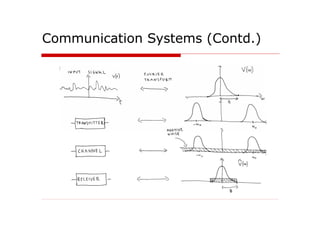
The information signal or message signal m(t) is a
baseband signal, that is it contains energy about D.C.
(f = 0)
The transmitted signal may be at baseband or may be
a bandpass signal, that is it contains energy about f
= fc where fc >> 0.
Wireless signals are (almost) always bandpass due to
physical antenna limitations whereas wireline signals
could be either bandpass or baseband .
Each wireless application is assigned a specific
frequency band in which it can radiate energy. This is
one reason why Fourier Transforms (spectral
information) are so important in communications.
18.
Examples of CommunicationSystems
Broadcast Radio
Music and voice are transmitted from a broadcast station to
large number of receivers (i.e., radios) over the air
Broadcast Television
Images are transmitted from a broadcast station to a large
number of receivers (i.e., TVs) over the air
Telephone system
Voice (digital data also possible) transmitted from one point to
another point (i.e., one phone to another) through wires
(both copper and optical fiber)
Cellular telephone
Voice (digital data also possible) transmitted from one point to
another point through both wires and over the air
Internet (computer networks)
Digital data transmitted from one point to another point
through wires
Satellite communication systems
Digital data or voice transmitted from one point to another
point using satellite as an intermediate transmitter/receiver
19.
What Makes aGood
Communication System
Good Received Signal Fidelity
Analog System: high Signal-to-Noise Ratio
(SNR)
Digital System: low Bit Error Rate (BER)
Low Transmit Signal Power
A large amount of information is
transmitted
Signal occupies a small
bandwidth
System has a low cost
(complexity?)
Complex digital operations have steadily
grown cheaper
Communications engineers must trade off
all of these
20.
Examples of Tradeoffsin
Communications
Designs
Satellite and Deep Space Communications
Power is expensive to generate in space and
transmission distances are enormous – Must be
very energy efficient
Microwave Relay Towers
Power is cheap, but available bandwidth is
restricted by regulation - Must be very
bandwidth efficient
Cellular Phones
Power is costly (impacts battery life and size)
but bandwidth is also limited - Must be both
bandwidth and power efficient
21.
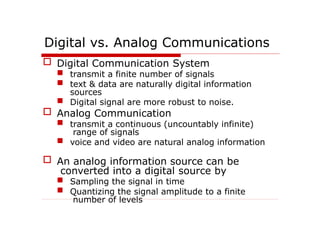
Digital vs. AnalogCommunications
Digital Communication System
transmit a finite number of signals
text & data are naturally digital information
sources
Digital signal are more robust to noise.
Analog Communication
transmit a continuous (uncountably infinite)
range of signals
voice and video are natural analog information
An analog information source can be
converted into a digital source by
Sampling the signal in time
Quantizing the signal amplitude to a finite
number of levels
22.
Analog to DigitalConversion (A/D)
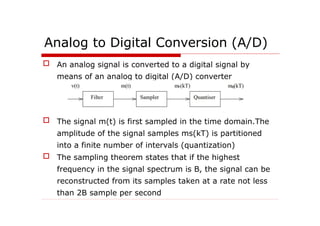
An analog signal is converted to a digital signal by
means of an analog to digital (A/D) converter
The signal m(t) is first sampled in the time domain.The
amplitude of the signal samples ms(kT) is partitioned
into a finite number of intervals (quantization)
The sampling theorem states that if the highest
frequency in the signal spectrum is B, the signal can be
reconstructed from its samples taken at a rate not less
than 2B sample per second
23.
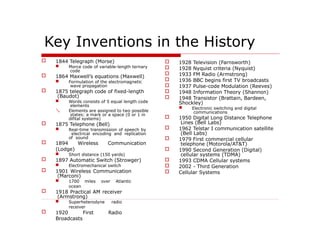
Key Inventions inthe History
1844 Telegraph (Morse)
Morce code of variable-length ternary
code
1864 Maxwell’s equations (Maxwell)
Formulation of the electromagnetic
wave propagation
1875 telegraph code of fixed-length
(Baudot)
Words consists of 5 equal length code
elements
Elements are assigned to two possible
states: a mark or a space (0 or 1 in
difital systems)
1875 Telephone (Bell)
Real-time transmission of speech by
electrical encoding and replication
of sound
1894 Wireless Communication
(Lodge)
Short distance (150 yards)
1897 Automatic Switch (Strowger)
Electromechanical switch
1901 Wireless Communication
(Marconi)
1700 miles over Atlantic
ocean
1918 Practical AM receiver
(Armstrong)
Superheterodyne radio
receiver
1920 First Radio
Broadcasts
1928 Television (Farnsworth)
1928 Nyquist criteria (Nyquist)
1933 FM Radio (Armstrong)
1936 BBC begins first TV broadcasts
1937 Pulse-code Modulation (Reeves)
1948 Information Theory (Shannon)
1948 Transistor (Brattain, Bardeen,
Shockley)
Electronic switching and digital
communications
1950 Digital Long Distance Telephone
Lines (Bell Labs)
1962 Telstar I communication satellite
(Bell Labs)
1979 First commercial cellular
telephone (Motorola/AT&T)
1990 Second Generation (Digital)
cellular systems (TDMA)
1993 CDMA Cellular systems
2002 - Third Generation
Cellular Systems
Overview
The Objectives ofToday’s Lecture
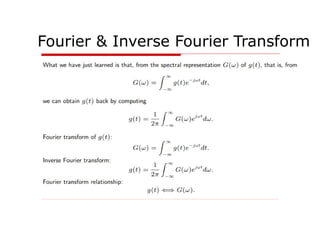
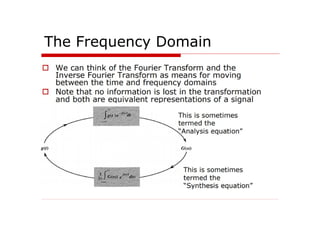
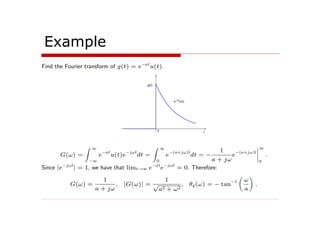
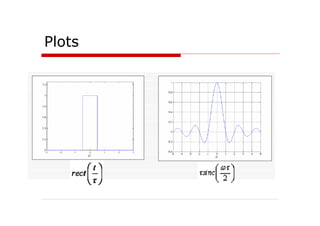
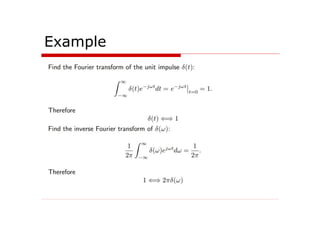
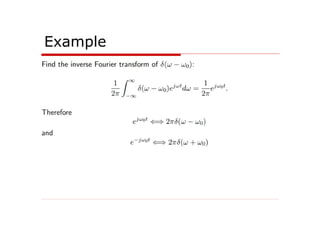
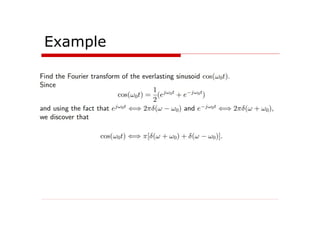
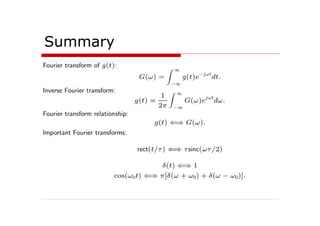
• To introduce Fourier integral, Fourier transformation
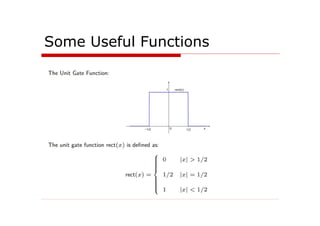
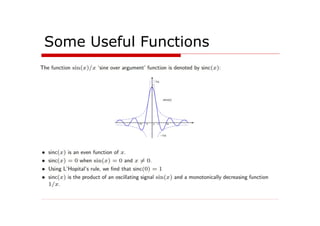
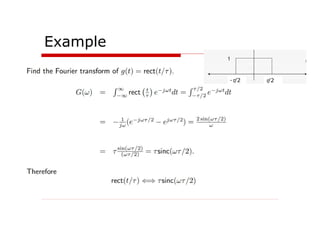
• To present transforms of some useful functions
• To discuss some properties of the Fourier transform