Digital communication Digital communication Digital communication Digital communication Digital communication Digital communication Digital communication
Similar to Digital communication Digital communication Digital communication Digital communication Digital communication Digital communication Digital communication
Digital communication Digital communication Digital communication Digital communication Digital communication Digital communication Digital communication
Introduction
Signal Types
CommunicationsTypes
Advantages and Disadvantages
Block Diagram of Digital communication Systems
Source Coding
Presentation Outline
Introduction to Digital
Communications
3
4.
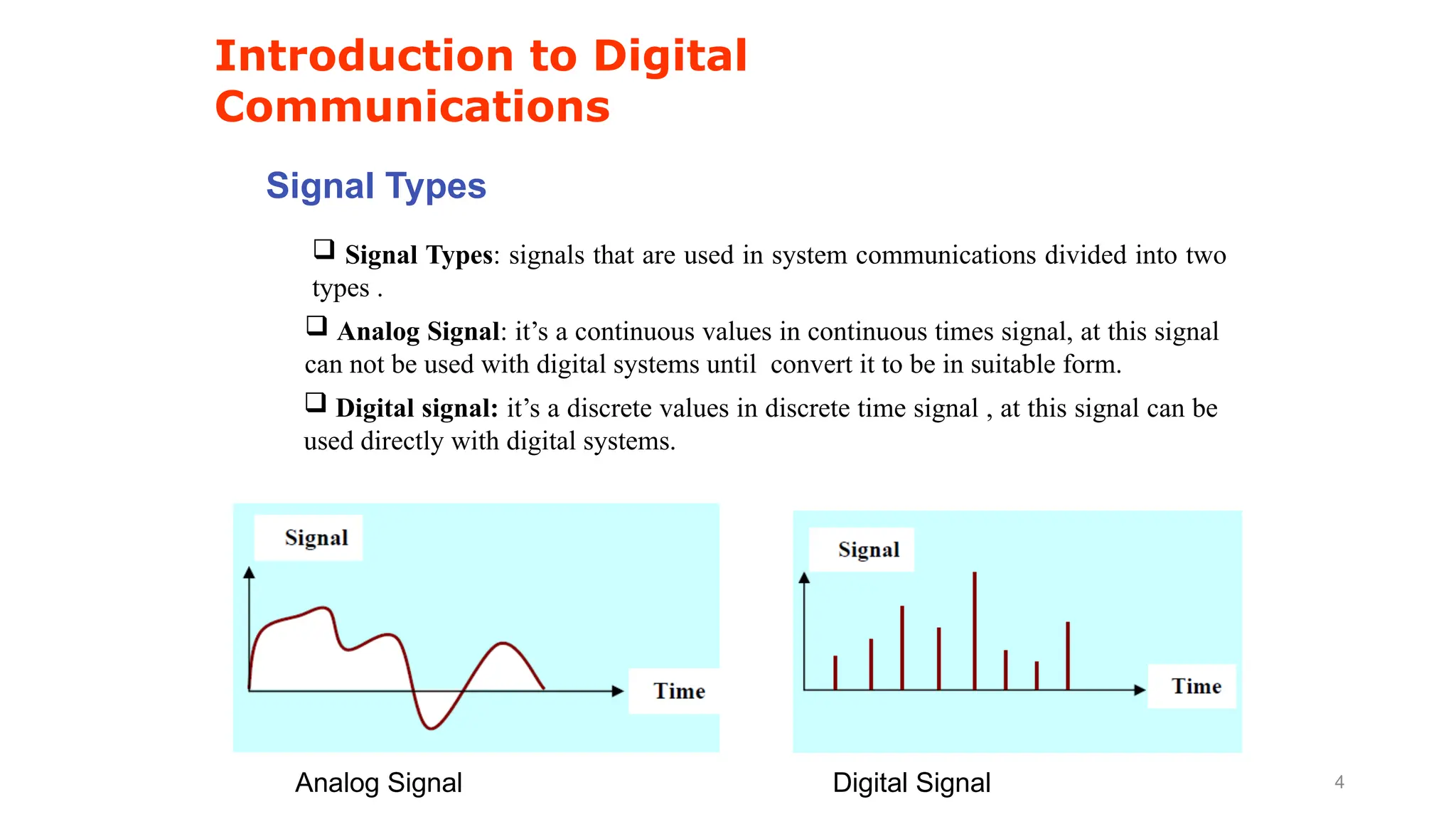
Signal Types
AnalogSignal: it’s a continuous values in continuous times signal, at this signal
can not be used with digital systems until convert it to be in suitable form.
Analog Signal Digital Signal
Introduction to Digital
Communications
Digital signal: it’s a discrete values in discrete time signal , at this signal can be
used directly with digital systems.
4
Signal Types: signals that are used in system communications divided into two
types .
5.
Types of Analogand digital signal
Introduction to Digital
Communications
5
Analog and digital signal can be founded in varies forms according to
it’s value of the amplitude and it’s time period :
1- according to it’s values:
- deterministic signals : signals with deterministic amplitude values.
- random signals: signals with random values.
2- according it’s period time :
- periodic signals: are repeated in equivalent times (same forms).
- aperiodic (non periodic signals) signals: are repeated with different
forms.
6.
2-Digital Communications Systems
1-Analog Communication Systems
Communications Systems Types
Introduction to Digital
Communications
Respect to the type of signals the communication
systems can be divided into two types:
6
7.
Introduction to Digital
Communications
Advantagesand Disadvantages of Digital
Communications
1. Simplicity of regeneration of signals that are effected by the noises and
attenuation through the communication channels.
2. Easily of realizing an advanced processing of signals (encoding with it’s
types, security, compression, and so on).
3. The hardware components that are used in digital communications are more
simple, confidante, and flexible than that used in analog communication.
4. Simplicity in using the multiple systems (TDM, CDMA(Code Division Multiple
Access)) with the comparison of the multiple systems that are used in analog
communications such as FDM.
5. Low of the affection with the noises because the receiver device is only
treatment with two values 0 or 1.
6. Ability in sending and receiving different types of information at the same
Advantages
7
8.
Introduction to Digital
Communications
Advantagesand Disadvantages of Digital
1. High quality when receiving the information
2. More suitable and easily in using with computers and compression systems.
3. Low cost of resources
Advantages
8
9.
Introduction to Digital
Communications
Advantagesand Disadvantages of Digital
1. It’s necessary to be a synchronization between transmitter and receiver.
2. it’s necessary to convert the analog signals to digital signals .
3. it’s not suitable to use with the analog devices.
Disadvantages of digital communication systems
9
10.
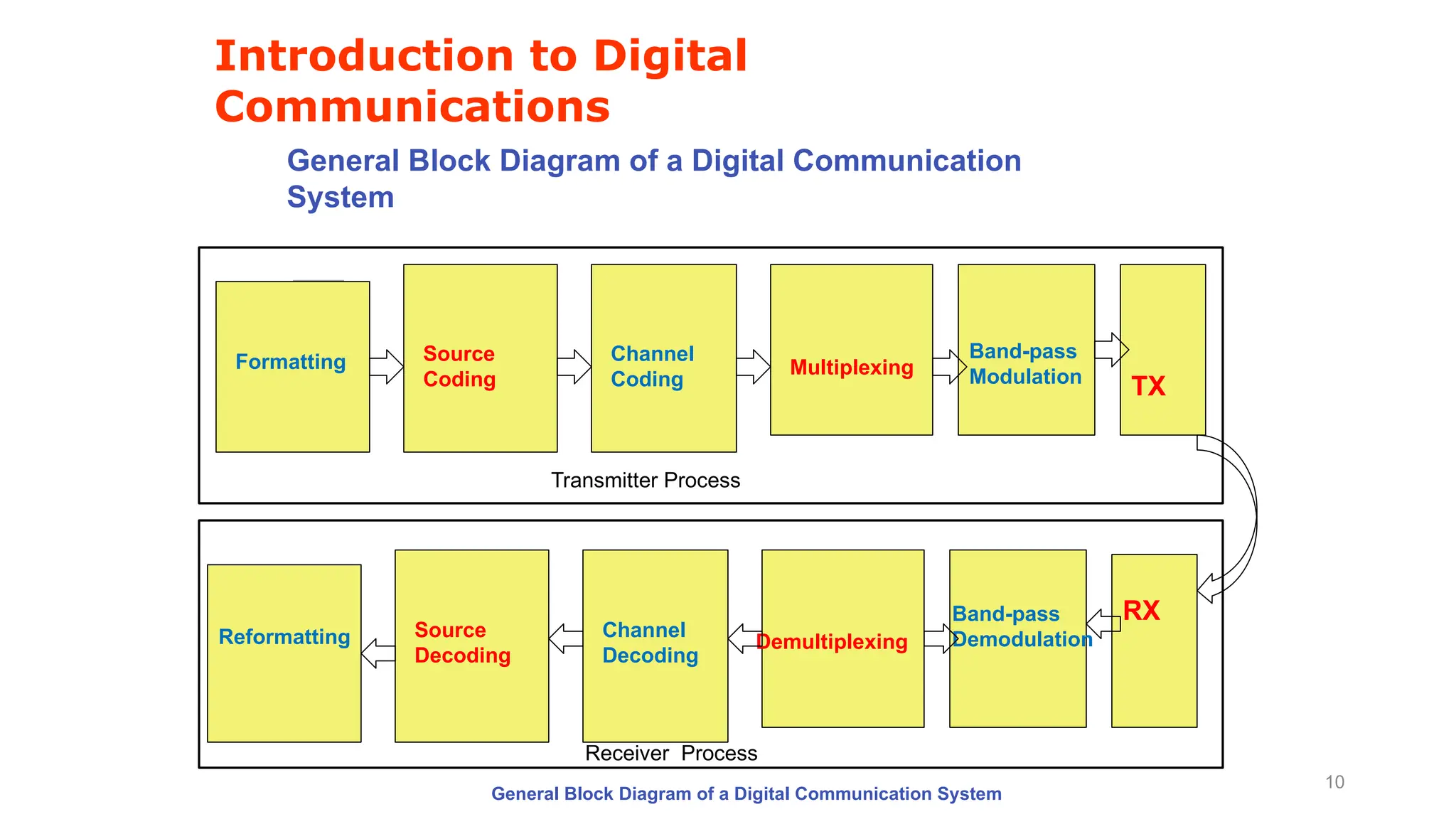
General Block Diagramof a Digital Communication
System
Introduction to Digital
Communications
TX
Formatting Source
Coding
Channel
Coding
Multiplexing
Band-pass
Modulation
RX
Reformatting Source
Decoding
Channel
Decoding
Demultiplexing
Band-pass
Demodulation
Transmitter Process
Receiver Process
General Block Diagram of a Digital Communication System
10
11.
Introduction to Digital
Communications
GeneralBlock Diagram of a Digital Communication
System
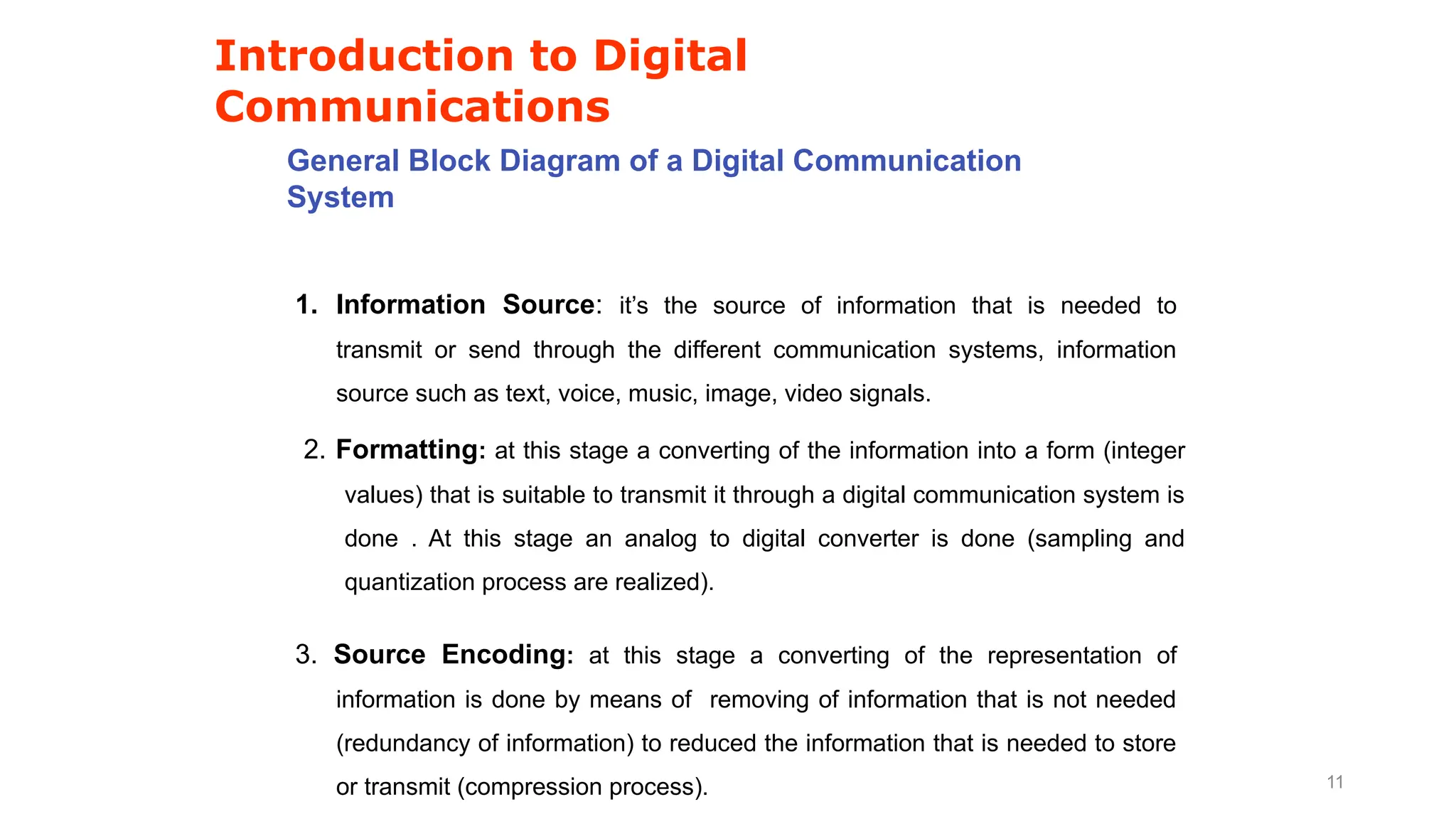
1. Information Source: it’s the source of information that is needed to
transmit or send through the different communication systems, information
source such as text, voice, music, image, video signals.
2. Formatting: at this stage a converting of the information into a form (integer
values) that is suitable to transmit it through a digital communication system is
done . At this stage an analog to digital converter is done (sampling and
quantization process are realized).
3. Source Encoding: at this stage a converting of the representation of
information is done by means of removing of information that is not needed
(redundancy of information) to reduced the information that is needed to store
or transmit (compression process). 11
12.
Introduction to Digital
Communications
GeneralBlock Diagram of a Digital Communication
System
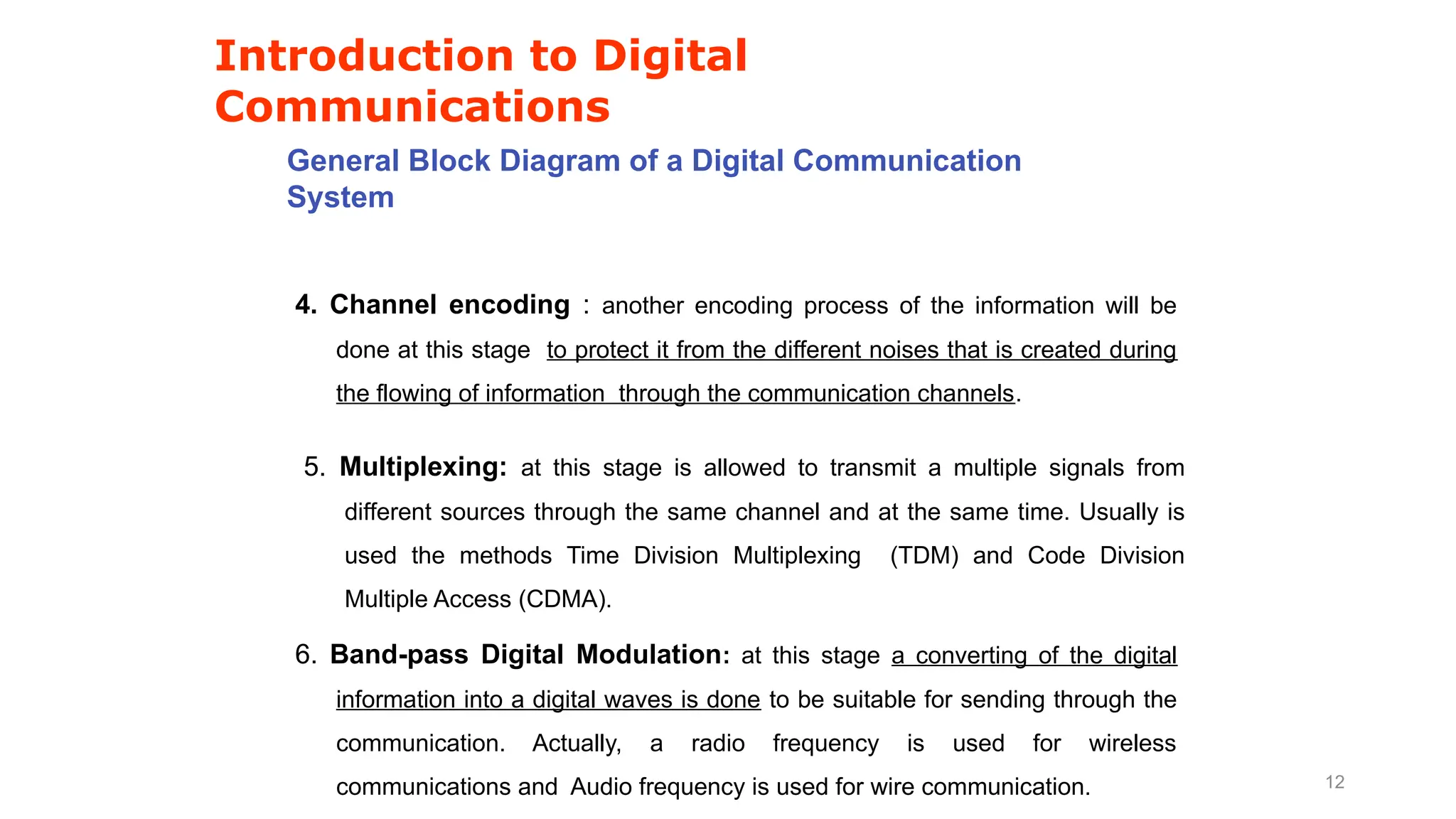
4. Channel encoding : another encoding process of the information will be
done at this stage to protect it from the different noises that is created during
the flowing of information through the communication channels.
5. Multiplexing: at this stage is allowed to transmit a multiple signals from
different sources through the same channel and at the same time. Usually is
used the methods Time Division Multiplexing (TDM) and Code Division
Multiple Access (CDMA).
6. Band-pass Digital Modulation: at this stage a converting of the digital
information into a digital waves is done to be suitable for sending through the
communication. Actually, a radio frequency is used for wireless
communications and Audio frequency is used for wire communication. 12
13.
Introduction to Digital
Communications
GeneralBlock Diagram of a Digital Communication
System
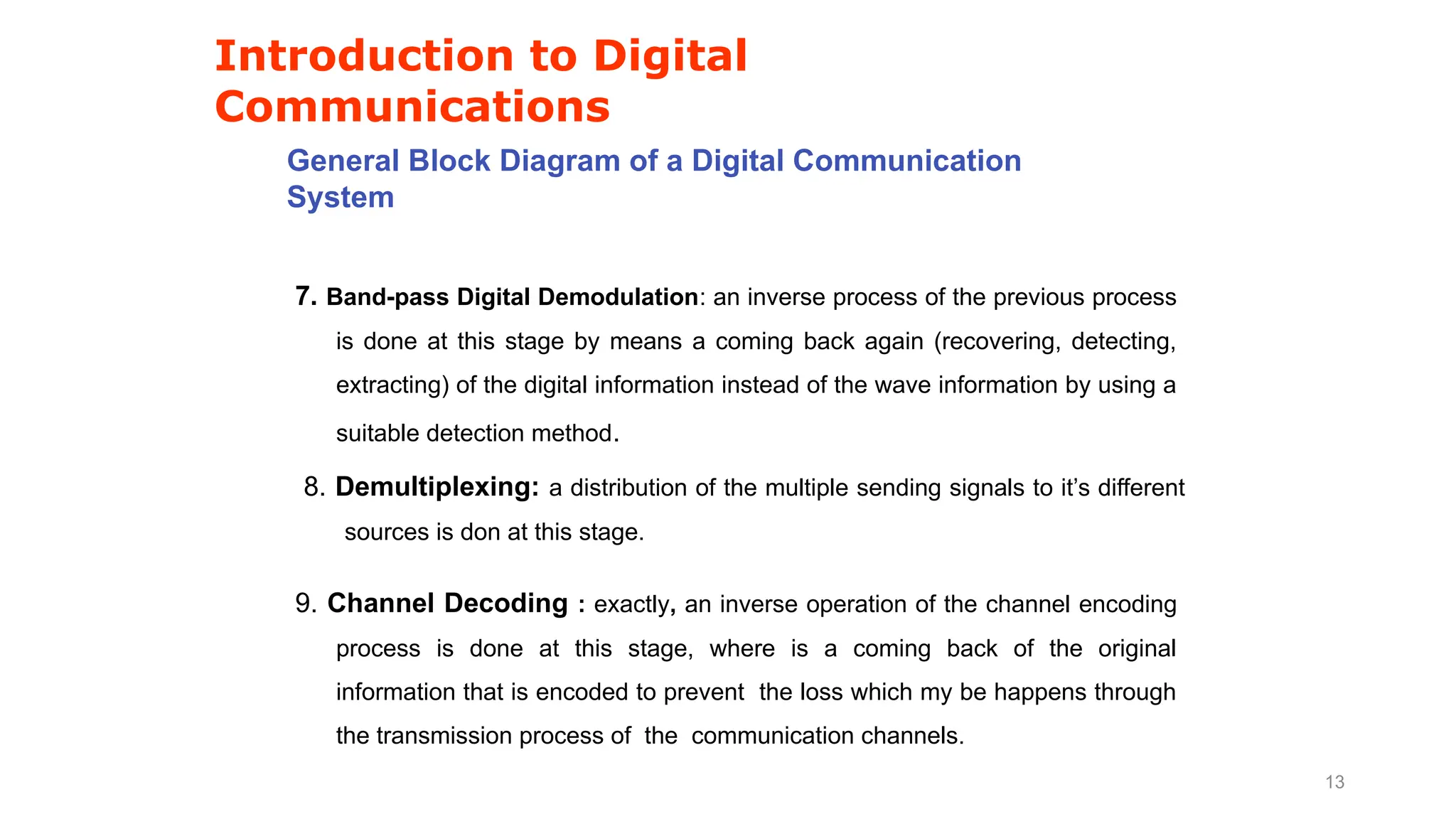
7. Band-pass Digital Demodulation: an inverse process of the previous process
is done at this stage by means a coming back again (recovering, detecting,
extracting) of the digital information instead of the wave information by using a
suitable detection method.
8. Demultiplexing: a distribution of the multiple sending signals to it’s different
sources is don at this stage.
9. Channel Decoding : exactly, an inverse operation of the channel encoding
process is done at this stage, where is a coming back of the original
information that is encoded to prevent the loss which my be happens through
the transmission process of the communication channels.
13
14.
Introduction to Digital
Communications
GeneralBlock Diagram of a Digital Communication
System
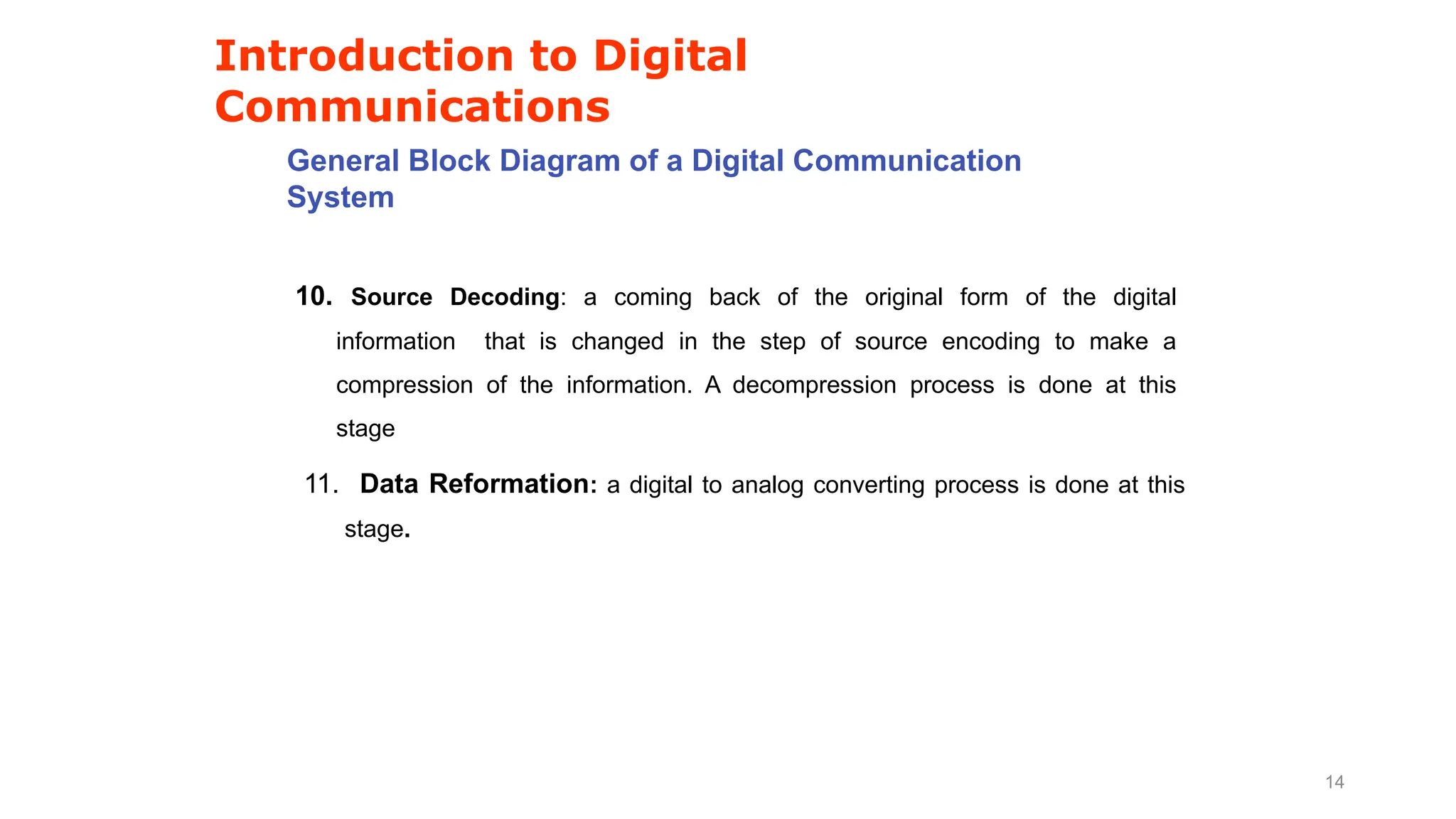
10. Source Decoding: a coming back of the original form of the digital
information that is changed in the step of source encoding to make a
compression of the information. A decompression process is done at this
stage
11. Data Reformation: a digital to analog converting process is done at this
stage.
14
Editor's Notes
#1 Titulo de mi tesis es “Diseño de Circuitos para Tratamiento de Imágenes Aplicando Técnicas Basadas en Soft Computing”.
Title of my thesis is " Design of Circuits for Image Processing Appling techniques based on Soft Computing“.
Memory for the degree of Doctor
PhD program "Microelectronics"
Dept. of Electronics and Electromagnetism. Universidad de Sevilla
#3 El contenido de esta presentación trata los cuatro aspectos que hemos considerado en el campo del procesado de imágenes:
- la compresión de imágenes
- el control del contraste
- la segmentación
y la detección de bordes
Por último se presentaran las conclusiones y líneas de futuro.
The contents of this presentation discusses the four aspects that we considered in the field of image processing:
Image compression
- The contrast control
- Segmentation
and edge detection
Finally, we will present the conclusions and future lines.
In this presentation we will discusse four topics we are considrede in the field of image processing:
#4 Respecto a la velocidad de procesado la tabla muestra los tiempos necesarios para cada circuito para procesar una imagen de 64x64 pixeles.
Respecting to the processing speed the table shows the times required for each circuit for processing an image of 64x64 pixels
#5 Respecto a la velocidad de procesado la tabla muestra los tiempos necesarios para cada circuito para procesar una imagen de 64x64 pixeles.
Respecting to the processing speed the table shows the times required for each circuit for processing an image of 64x64 pixels
#10 Los objetivos que hemos planteado en este tema son:
en primer lugar, desarrollar algoritmos de compresión de imágenes con pérdidas y sin pérdidas
y en segundo lugar, realizar la implementación hardware de los algoritmos propuestos con requerimientos de bajo coste, alta velocidad de procesado y una adecuada relación entre calidad y razón de compresión.
//////////////////////////////////////////
In this topic we are interested to relize tow main objectives