20EC014 – ANALOG COMMUNICATION
Dr.S.Mary Praveena
Associate Professor
ECE Department
Sri Ramakrishna Institute of Technology
Coimbatore
INTRODUCTION TO ANALOG
COMMUNICATION SYSTEM
INTRODUCTION TO COMMUNICATION SYSTEMS
What is Communication ?
Communication is the process of conveying information
from one point to another
What is the purpose of Communication system?



The purpose of communication systems is to communicate
information bearing signals from a source located at one point in
space to a user destination located at another point.
The three most common sources of information are:
speech (or
sound), video and data.
Regardless of the source, the information that is transmitted and
received in a communication system consists of a signal, encoding
the information in some appropriate fashion
MODEL OF COMMUNICATION SYSTEMS
.
INTRODUCTION TO COMMUNICATION
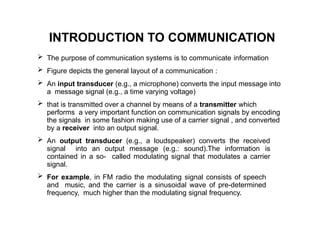
 The purpose of communication systems is to communicate information
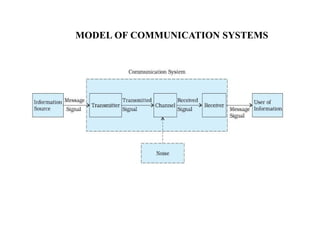
 Figure depicts the general layout of a communication :
 An input transducer (e.g., a microphone) converts the input message into
a message signal (e.g., a time varying voltage)
 that is transmitted over a channel by means of a transmitter which
performs a very important function on communication signals by encoding
the signals in some fashion making use of a carrier signal , and converted
by a receiver into an output signal.
 An output transducer (e.g., a loudspeaker) converts the received
signal into an output message (e.g.: sound).The information is
contained in a so- called modulating signal that modulates a carrier
signal.
 For example, in FM radio the modulating signal consists of speech
and music, and the carrier is a sinusoidal wave of pre-determined
frequency, much higher than the modulating signal frequency.
INFORMATION THEORY
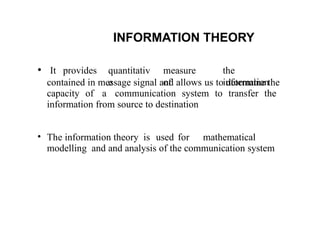
• It provides quantitativ
e
measure
of
the
information
contained in message signal and allows us to determine the
capacity of a communication system to transfer the
information from source to destination
• The information theory is used for mathematical
modelling and and analysis of the communication system
TYPES OF COMMUNICATION SYSTEM
HYBRID
COMM
ANALO
G
COMM
DIGITAL
COMM
COMM
SYSTEM
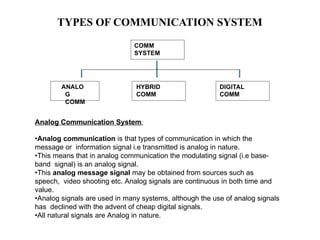
Analog Communication System:
•Analog communication is that types of communication in which the
message or information signal i.e transmitted is analog in nature.
•This means that in analog communication the modulating signal (i.e base-
band signal) is an analog signal.
•This analog message signal may be obtained from sources such as
speech, video shooting etc. Analog signals are continuous in both time and
value.
•Analog signals are used in many systems, although the use of analog signals
has declined with the advent of cheap digital signals.
•All natural signals are Analog in nature.
FREQUENCY RANGE
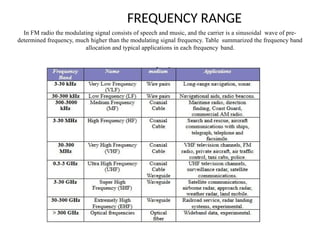
In FM radio the modulating signal consists of speech and music, and the carrier is a sinusoidal wave of pre-
determined frequency, much higher than the modulating signal frequency. Table summarized the frequency band
allocation and typical applications in each frequency band.
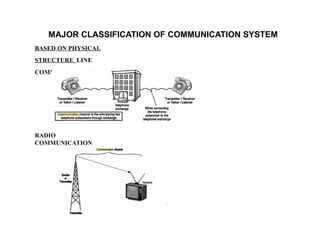
MAJOR CLASSIFICATION OF COMMUNICATION SYSTEM
BASED ON PHYSICAL
STRUCTURE LINE
COMMUNICATION
RADIO
COMMUNICATION
MAJOR CLASSIFICATION OF COMMUNICATION SYSTEM
BASED ON THE SIGNAL SPECIFICATIONS
• Nature of the baseband or information signal.
• Nature of the transmitted signal.
BASED ON THE NATURE OF THE BASEBAND SIGNAL
• Analog communication systems
• Digital communication systems
BASED ON THE NATURE OF TRANSMITTED SIGNAL:
The baseband signal can either be transmitted as it is without modulation, or through
a carrier signal with modulation. The two systems can then be categorized as:
• Baseband communication system
• Carrier communication system
Therefore, the four types of communication system categorized based on
signal specification are:
• Analog communication systems
• Digital communication systems
• Baseband communication systems
• Carrier communication
systems
MODULATION
MODULATION
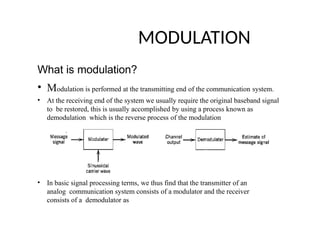
What is modulation?
• Modulation is performed at the transmitting end of the communication system.
• At the receiving end of the system we usually require the original baseband signal
to be restored, this is usually accomplished by using a process known as
demodulation which is the reverse process of the modulation
• In basic signal processing terms, we thus find that the transmitter of an
analog communication system consists of a modulator and the receiver
consists of a demodulator as
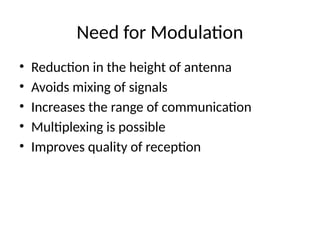
Need for Modulation
• Reduction in the height of antenna
• Avoids mixing of signals
• Increases the range of communication
• Multiplexing is possible
• Improves quality of reception
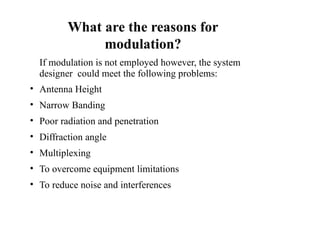
If modulation is not employed however, the system
designer could meet the following problems:
• Antenna Height
• Narrow Banding
• Poor radiation and penetration
• Diffraction angle
• Multiplexing
• To overcome equipment limitations
• To reduce noise and interferences
What are the reasons for
modulation?
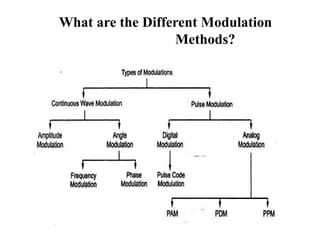
What are the Different Modulation
Methods?

Introduction to Analog Communication systemtx

  • 1.
    20EC014 – ANALOGCOMMUNICATION Dr.S.Mary Praveena Associate Professor ECE Department Sri Ramakrishna Institute of Technology Coimbatore
  • 2.
  • 3.
    INTRODUCTION TO COMMUNICATIONSYSTEMS What is Communication ? Communication is the process of conveying information from one point to another What is the purpose of Communication system?    The purpose of communication systems is to communicate information bearing signals from a source located at one point in space to a user destination located at another point. The three most common sources of information are: speech (or sound), video and data. Regardless of the source, the information that is transmitted and received in a communication system consists of a signal, encoding the information in some appropriate fashion
  • 4.
  • 5.
    INTRODUCTION TO COMMUNICATION The purpose of communication systems is to communicate information  Figure depicts the general layout of a communication :  An input transducer (e.g., a microphone) converts the input message into a message signal (e.g., a time varying voltage)  that is transmitted over a channel by means of a transmitter which performs a very important function on communication signals by encoding the signals in some fashion making use of a carrier signal , and converted by a receiver into an output signal.  An output transducer (e.g., a loudspeaker) converts the received signal into an output message (e.g.: sound).The information is contained in a so- called modulating signal that modulates a carrier signal.  For example, in FM radio the modulating signal consists of speech and music, and the carrier is a sinusoidal wave of pre-determined frequency, much higher than the modulating signal frequency.
  • 6.
    INFORMATION THEORY • Itprovides quantitativ e measure of the information contained in message signal and allows us to determine the capacity of a communication system to transfer the information from source to destination • The information theory is used for mathematical modelling and and analysis of the communication system
  • 7.
    TYPES OF COMMUNICATIONSYSTEM HYBRID COMM ANALO G COMM DIGITAL COMM COMM SYSTEM Analog Communication System: •Analog communication is that types of communication in which the message or information signal i.e transmitted is analog in nature. •This means that in analog communication the modulating signal (i.e base- band signal) is an analog signal. •This analog message signal may be obtained from sources such as speech, video shooting etc. Analog signals are continuous in both time and value. •Analog signals are used in many systems, although the use of analog signals has declined with the advent of cheap digital signals. •All natural signals are Analog in nature.
  • 8.
    FREQUENCY RANGE In FMradio the modulating signal consists of speech and music, and the carrier is a sinusoidal wave of pre- determined frequency, much higher than the modulating signal frequency. Table summarized the frequency band allocation and typical applications in each frequency band.
  • 9.
    MAJOR CLASSIFICATION OFCOMMUNICATION SYSTEM BASED ON PHYSICAL STRUCTURE LINE COMMUNICATION RADIO COMMUNICATION
  • 10.
    MAJOR CLASSIFICATION OFCOMMUNICATION SYSTEM BASED ON THE SIGNAL SPECIFICATIONS • Nature of the baseband or information signal. • Nature of the transmitted signal. BASED ON THE NATURE OF THE BASEBAND SIGNAL • Analog communication systems • Digital communication systems BASED ON THE NATURE OF TRANSMITTED SIGNAL: The baseband signal can either be transmitted as it is without modulation, or through a carrier signal with modulation. The two systems can then be categorized as: • Baseband communication system • Carrier communication system Therefore, the four types of communication system categorized based on signal specification are: • Analog communication systems • Digital communication systems • Baseband communication systems • Carrier communication systems
  • 11.
  • 12.
    MODULATION What is modulation? •Modulation is performed at the transmitting end of the communication system. • At the receiving end of the system we usually require the original baseband signal to be restored, this is usually accomplished by using a process known as demodulation which is the reverse process of the modulation • In basic signal processing terms, we thus find that the transmitter of an analog communication system consists of a modulator and the receiver consists of a demodulator as
  • 13.
    Need for Modulation •Reduction in the height of antenna • Avoids mixing of signals • Increases the range of communication • Multiplexing is possible • Improves quality of reception
  • 14.
    If modulation isnot employed however, the system designer could meet the following problems: • Antenna Height • Narrow Banding • Poor radiation and penetration • Diffraction angle • Multiplexing • To overcome equipment limitations • To reduce noise and interferences What are the reasons for modulation?
  • 15.
    What are theDifferent Modulation Methods?