
S.S.A.S.I.T, SURAT GTU
INTRODUCTION
• Building construction is an ancient human activity. It began
with the purely functional need for a controlled environment to
moderate the effects of climate. Constructed shelters were
one means by which human beings were able to adapt
themselves to a wide variety of climates and become a global
species.
2
The history of civil construction was began from the period
of Primitive human.
From the protection against cold,
rain, heat, etc they made “cave” as
their shelter.
But that was not enough, cave
didn’t remained safe for long, so
huts from the straws and
leaves…..evolution goes on…!
But for better comfort, civil
construction got evolved and still
evolving…
Today, we have every comfort and facility, but we have to face
the future upcoming challenges as the shortage of land, etc
3
CLASSIFICATION OF
BUILDINGS
❖ Building are Classified as follows :
i. Based on
Occupancy
ii. Based on
Structure
4
BASED
ON
OCCUPANCY
Residential
Buildings
Educational
Buildings
Institutional
Buildings
Assembly
Buildings
Business
Buildings
Mercantile
Buildings
Industrial
Buildings
Storage
Buildings
Hazardous
Buildings
5
6
7
8
Load Bearing
Structure
Framed Structure
Composite
Structure
BASED ON STRUCTURE
9
LOAD BEARING STRUCTURE
 It is a structure comprising
of Slabs, Beams and Load
Bearing walls.
 Such type of structures are
most suited where Hard
Strata of soil is available at
shallow depth.
10
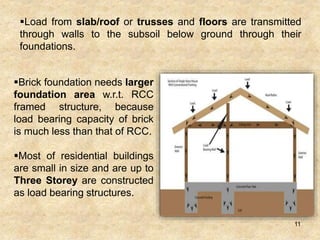
Brick foundation needs larger
foundation area w.r.t. RCC
framed structure, because
load bearing capacity of brick
is much less than that of RCC.
Most of residential buildings
are small in size and are up to
Three Storey are constructed
as load bearing structures.
Load from slab/roof or trusses and floors are transmitted
through walls to the subsoil below ground through their
foundations.
11
12
FRAMED STRUCTURE
• It is a structure
comprising of Slabs
resting on beams and
Beams are supported
by a network of
Columns.
• The frame structure can
be of Concrete , Steel
or of Wood.
13
 Loads from the slabs are transferred to the beams and beams rest
over columns and whole load of the structure is transferred to the
subsoil below the ground through columns and their footings.
 Here, walls just act like partitions
and none of them bears load.
 R.C.C is the most suitable material
to withstand external loads like
compressive ,tensile ,torsion and
shear along with moment, so all
framed structures are constructed
with R.C.C .
 Generally all multi stored buildings
or high-rise buildings are
constructed as framed structure.
14
15
16
COMPOSITE STRUCTURE
• The structure constructed with
combination of both load
bearing as well as framed
structure is called composite
structure.
• In this type of structure external
walls are treated as load bearing
walls and all intermediate
supports are in the form of
R.C.C. columns.
17
• Here the load of slabs is transmitted to the
subsoil below the ground by load bearing walls
and columns through foundations.
• Composite structures are preferred for buildings
having large spans such as workshops , halls ,
large factories shed , go downs etc.
• They been very remarkable for Huge or Tall
buildings around the world.
18
LOAD
Dead Load
Live Load Snow Load
Rain Load
Wind Load Earthquake Load
Anything which exerts pressure or thrust on a structure is
termed as Load. 19
• It is permanent ,
immovable and
nontransferable load of
structure.
Dead Load
•Walls , floors , roofs,
partitions , ceilings , water
tanks and weights of all
other permanent
constructions or structures
and fixtures are included
in dead load.
20
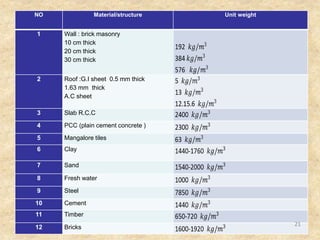
NO Material/structure Unit weight
1 Wall : brick masonry
10 cm thick
20 cm thick
30 cm thick
2 Roof :G.I sheet 0.5 mm thick
1.63 mm thick
A.C sheet
3 Slab R.C.C
4 PCC (plain cement concrete )
5 Mangalore tiles
6 Clay
7 Sand
8 Fresh water
9 Steel
10 Cement
11 Timber
12 Bricks
21
Live Load
• It is movable, temporary and transferable
load on the floor and hence it is variable.
• Weight of everything
superimposed on, or
temporarily attached to, a
structure (people, machinery
and equipment, furniture,
appliances, etc.) but Not that
of the material utilized in its
construction or of anything
permanently attached to it.
22
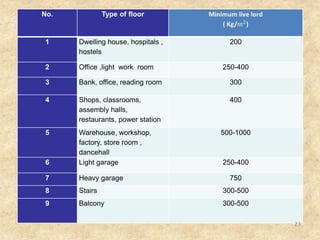
No. Type of floor
1 Dwelling house, hospitals ,
hostels
200
2 Office ,light work room 250-400
3 Bank, office, reading room 300
4 Shops, classrooms,
assembly halls,
restaurants, power station
400
5 Warehouse, workshop,
factory, store room ,
dancehall
500-1000
6 Light garage 250-400
7 Heavy garage 750
8 Stairs 300-500
9 Balcony 300-500
23
Number of floors carried by
member (column,
foundation, wall etc.)
Total L.L on all floors above the member
1 100%
2 90%
3 80%
4 70%
5 60%
6 or more 50%
For multi-storeyed buildings, live loads are considered in
designing columns, walls, and foundations depend upon number
of floors.
24
25
Snow Load
•Snow loads are prevalent in northern and/or mountainous
regions all over the world.
•It actually acts on Roof. It depends
upon the Shape of the roof & it’s
Capacity to retain the snow.
•Load of Snow maybe taken as 2.5
kg/m^2 per Centimetre depth of
Snow.
•It can be neglected if slopes greater
than 50 ° angle.
26
•It actually acts on Roofs whose positioning, shape and
drainage system are such that they accumulate rain water.
Rain Load
•Thus, due to accumulation of rain
water, load due to it is called Rain
Load.
•The Rain loads and Live loads
for the Roofs shall be considered
separately.
27
Earthquake Load
•The random Earthquake causes shaking of the ground,
which causes the whole structure to vibrate. It can be
resolved in any three mutually perpendicular directions.
•The prominent direction of
Ground vibrations is usually in
Horizontal directions.
•Although, it may get damaged
but would not collapse until
earthquake is of beyond the
limit.
28
Building Construction
29
30
31
32
33
34
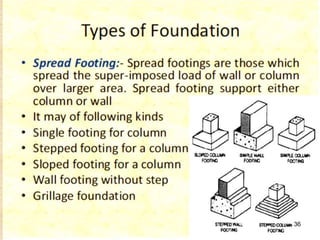
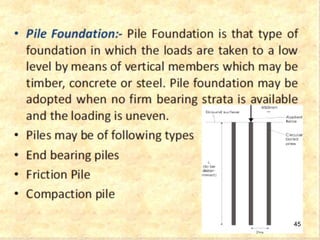
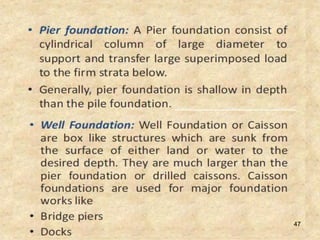
Types of Foundation
Shallow Deep
Pile Pier Well or Caissons
Spread footing Strap footing Combined footing Mat footing
For walls for columns Rectangular Trapezoidal
Simple Stepped Grillage Single Stepped Sloped
35
36
37
38
39
40
41
42
43
44
45
46
47
48
49
50
51
52
Types of Doors
53
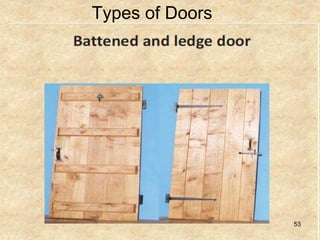
Types of Doors
54
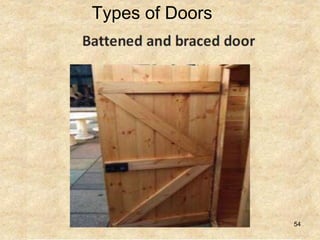
Types of Doors
55
Types of Doors
56
57
58
Types of Windows
59
Types of Windows
60
Types of Windows
61
Types of Windows
62
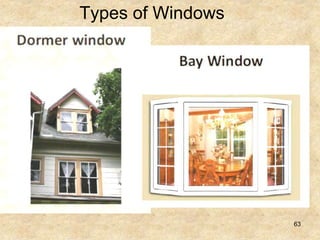
Types of Windows
63
64
65
Stair Components
66
67
68
69
70

Chapter 7 building construction

  • 1.
  • 2.
    INTRODUCTION • Building constructionis an ancient human activity. It began with the purely functional need for a controlled environment to moderate the effects of climate. Constructed shelters were one means by which human beings were able to adapt themselves to a wide variety of climates and become a global species. 2
  • 3.
    The history ofcivil construction was began from the period of Primitive human. From the protection against cold, rain, heat, etc they made “cave” as their shelter. But that was not enough, cave didn’t remained safe for long, so huts from the straws and leaves…..evolution goes on…! But for better comfort, civil construction got evolved and still evolving… Today, we have every comfort and facility, but we have to face the future upcoming challenges as the shortage of land, etc 3
  • 4.
    CLASSIFICATION OF BUILDINGS ❖ Buildingare Classified as follows : i. Based on Occupancy ii. Based on Structure 4
  • 5.
  • 6.
  • 7.
  • 8.
  • 9.
  • 10.
    LOAD BEARING STRUCTURE It is a structure comprising of Slabs, Beams and Load Bearing walls.  Such type of structures are most suited where Hard Strata of soil is available at shallow depth. 10
  • 11.
    Brick foundation needslarger foundation area w.r.t. RCC framed structure, because load bearing capacity of brick is much less than that of RCC. Most of residential buildings are small in size and are up to Three Storey are constructed as load bearing structures. Load from slab/roof or trusses and floors are transmitted through walls to the subsoil below ground through their foundations. 11
  • 12.
  • 13.
    FRAMED STRUCTURE • Itis a structure comprising of Slabs resting on beams and Beams are supported by a network of Columns. • The frame structure can be of Concrete , Steel or of Wood. 13
  • 14.
     Loads fromthe slabs are transferred to the beams and beams rest over columns and whole load of the structure is transferred to the subsoil below the ground through columns and their footings.  Here, walls just act like partitions and none of them bears load.  R.C.C is the most suitable material to withstand external loads like compressive ,tensile ,torsion and shear along with moment, so all framed structures are constructed with R.C.C .  Generally all multi stored buildings or high-rise buildings are constructed as framed structure. 14
  • 15.
  • 16.
  • 17.
    COMPOSITE STRUCTURE • Thestructure constructed with combination of both load bearing as well as framed structure is called composite structure. • In this type of structure external walls are treated as load bearing walls and all intermediate supports are in the form of R.C.C. columns. 17
  • 18.
    • Here theload of slabs is transmitted to the subsoil below the ground by load bearing walls and columns through foundations. • Composite structures are preferred for buildings having large spans such as workshops , halls , large factories shed , go downs etc. • They been very remarkable for Huge or Tall buildings around the world. 18
  • 19.
    LOAD Dead Load Live LoadSnow Load Rain Load Wind Load Earthquake Load Anything which exerts pressure or thrust on a structure is termed as Load. 19
  • 20.
    • It ispermanent , immovable and nontransferable load of structure. Dead Load •Walls , floors , roofs, partitions , ceilings , water tanks and weights of all other permanent constructions or structures and fixtures are included in dead load. 20
  • 21.
    NO Material/structure Unitweight 1 Wall : brick masonry 10 cm thick 20 cm thick 30 cm thick 2 Roof :G.I sheet 0.5 mm thick 1.63 mm thick A.C sheet 3 Slab R.C.C 4 PCC (plain cement concrete ) 5 Mangalore tiles 6 Clay 7 Sand 8 Fresh water 9 Steel 10 Cement 11 Timber 12 Bricks 21
  • 22.
    Live Load • Itis movable, temporary and transferable load on the floor and hence it is variable. • Weight of everything superimposed on, or temporarily attached to, a structure (people, machinery and equipment, furniture, appliances, etc.) but Not that of the material utilized in its construction or of anything permanently attached to it. 22
  • 23.
    No. Type offloor 1 Dwelling house, hospitals , hostels 200 2 Office ,light work room 250-400 3 Bank, office, reading room 300 4 Shops, classrooms, assembly halls, restaurants, power station 400 5 Warehouse, workshop, factory, store room , dancehall 500-1000 6 Light garage 250-400 7 Heavy garage 750 8 Stairs 300-500 9 Balcony 300-500 23
  • 24.
    Number of floorscarried by member (column, foundation, wall etc.) Total L.L on all floors above the member 1 100% 2 90% 3 80% 4 70% 5 60% 6 or more 50% For multi-storeyed buildings, live loads are considered in designing columns, walls, and foundations depend upon number of floors. 24
  • 25.
  • 26.
    Snow Load •Snow loadsare prevalent in northern and/or mountainous regions all over the world. •It actually acts on Roof. It depends upon the Shape of the roof & it’s Capacity to retain the snow. •Load of Snow maybe taken as 2.5 kg/m^2 per Centimetre depth of Snow. •It can be neglected if slopes greater than 50 ° angle. 26
  • 27.
    •It actually actson Roofs whose positioning, shape and drainage system are such that they accumulate rain water. Rain Load •Thus, due to accumulation of rain water, load due to it is called Rain Load. •The Rain loads and Live loads for the Roofs shall be considered separately. 27
  • 28.
    Earthquake Load •The randomEarthquake causes shaking of the ground, which causes the whole structure to vibrate. It can be resolved in any three mutually perpendicular directions. •The prominent direction of Ground vibrations is usually in Horizontal directions. •Although, it may get damaged but would not collapse until earthquake is of beyond the limit. 28
  • 29.
  • 30.
  • 31.
  • 32.
  • 33.
  • 34.
  • 35.
    Types of Foundation ShallowDeep Pile Pier Well or Caissons Spread footing Strap footing Combined footing Mat footing For walls for columns Rectangular Trapezoidal Simple Stepped Grillage Single Stepped Sloped 35
  • 36.
  • 37.
  • 38.
  • 39.
  • 40.
  • 41.
  • 42.
  • 43.
  • 44.
  • 45.
  • 46.
  • 47.
  • 48.
  • 49.
  • 50.
  • 51.
  • 52.
  • 53.
  • 54.
  • 55.
  • 56.
  • 57.
  • 58.
  • 59.
  • 60.
  • 61.
  • 62.
  • 63.
  • 64.
  • 65.
  • 66.
  • 67.
  • 68.
  • 69.
  • 70.