Cement & Concrete Blocks
Cement and Concrete blocks are also used
as alternative materials for masonry
construction.
Cement Blocks vs Concrete
Blocks
 Cement block is cheaper than concrete block
 Cement block has less dead weight than concrete block
 Cement block low in strength than concrete block
 Concrete block has glossy finish than cement block
 Concrete block has high impermeability.
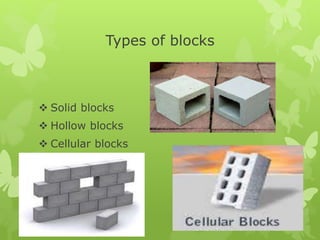
Types of blocks
 Solid blocks
 Hollow blocks
 Cellular blocks
Dimensions of blocks
 Length- 390,440,490 or 590mm
 Width- 40, 65, 90, 140, 190, 240 or 290mm
 Height- 190 or 90mm
Advantages on using
Cement/Concrete Blocks
 Less mortar
 Less dead weight
 Less time required
 Less cost
 Thermal acoustic
 No real need for plastering
 Environment friendly
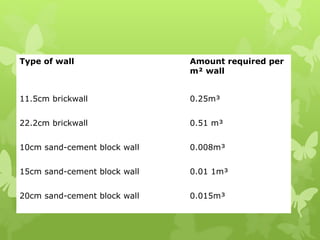
Type of wall Amount required per
m² wall
11.5cm brickwall 0.25m³
22.2cm brickwall 0.51 m³
10cm sand-cement block wall 0.008m³
15cm sand-cement block wall 0.01 1m³
20cm sand-cement block wall 0.015m³
Disadvantages on using Cement/
Concrete Blocks
 Cracks will be wider and larger
 Shrinkage due to the movement of moisture
Storage of Blocks
 Protects from rain
 Pile it in stacks at appropriate height.
Testing of Blocks
 Appearance
 Dimensions
 Block density
 Compressive strength
 Water absorption
Determination of Block Density
 Three blocks shall be dried to constant mass in a
suitable oven heated to approximately 1000C.
 After cooling the blocks to room temperature, the
dimensions of each block shall be measured in
centimetres to the nearest millimetre and the overall
volume computed in cubic centimetres.
 The blocks shall then be weighted in kilograms to the
nearest 10 gm.
 Density in kg/m3 = Mass of block in kg/Mass of block in
cm2 * 106
Construction Strength And
Concrete Block
 Concrete block homes better withstand hurricane,
tornado and earthquake when steel reinforcements and
poured concrete are added in the central hollow space of
the block walls.
Aluminium
 Aluminium is a material widely used for the partitions in
the office environment.
Advantages of Aluminium
 Aesthetic appearance
 Light weight
 Re usable
 Durable for long period
 It takes small area (thickness)
Form of Aluminium
 It is available in different types and shapes
Aluminium Extrusions
 Specially designed for architectural purpose
 Made with reinforcement to increase the stiffness
Uses of Aluminium
 Doors & windows
 Frame work for canopy and skylight
 Supporting system for suspended ceiling
 Cladding
 Curtain wall
Storage of Aluminium
 Must be wrapped in a sealant tape
 Must be avoid dropping
 Avoid placing any heavy materials on top
 Avoid the surface being rubbed against a hard material
Finishing on Aluminium
 Factory finish
 Spray painting
 Powder coating
Other uses of Aluminium
 Handles, locks and hinges are made of aluminium alloya
or stainless steel.
Questions and
clarifications
Thank you

Cement & concrete blocks

  • 1.
    Cement & ConcreteBlocks Cement and Concrete blocks are also used as alternative materials for masonry construction.
  • 2.
    Cement Blocks vsConcrete Blocks  Cement block is cheaper than concrete block  Cement block has less dead weight than concrete block  Cement block low in strength than concrete block  Concrete block has glossy finish than cement block  Concrete block has high impermeability.
  • 4.
    Types of blocks Solid blocks  Hollow blocks  Cellular blocks
  • 5.
    Dimensions of blocks Length- 390,440,490 or 590mm  Width- 40, 65, 90, 140, 190, 240 or 290mm  Height- 190 or 90mm
  • 6.
    Advantages on using Cement/ConcreteBlocks  Less mortar  Less dead weight  Less time required  Less cost  Thermal acoustic  No real need for plastering  Environment friendly
  • 7.
    Type of wallAmount required per m² wall 11.5cm brickwall 0.25m³ 22.2cm brickwall 0.51 m³ 10cm sand-cement block wall 0.008m³ 15cm sand-cement block wall 0.01 1m³ 20cm sand-cement block wall 0.015m³
  • 8.
    Disadvantages on usingCement/ Concrete Blocks  Cracks will be wider and larger  Shrinkage due to the movement of moisture
  • 9.
    Storage of Blocks Protects from rain  Pile it in stacks at appropriate height.
  • 10.
    Testing of Blocks Appearance  Dimensions  Block density  Compressive strength  Water absorption
  • 11.
    Determination of BlockDensity  Three blocks shall be dried to constant mass in a suitable oven heated to approximately 1000C.  After cooling the blocks to room temperature, the dimensions of each block shall be measured in centimetres to the nearest millimetre and the overall volume computed in cubic centimetres.  The blocks shall then be weighted in kilograms to the nearest 10 gm.  Density in kg/m3 = Mass of block in kg/Mass of block in cm2 * 106
  • 12.
    Construction Strength And ConcreteBlock  Concrete block homes better withstand hurricane, tornado and earthquake when steel reinforcements and poured concrete are added in the central hollow space of the block walls.
  • 13.
    Aluminium  Aluminium isa material widely used for the partitions in the office environment.
  • 14.
    Advantages of Aluminium Aesthetic appearance  Light weight  Re usable  Durable for long period  It takes small area (thickness)
  • 15.
    Form of Aluminium It is available in different types and shapes
  • 16.
    Aluminium Extrusions  Speciallydesigned for architectural purpose  Made with reinforcement to increase the stiffness
  • 17.
    Uses of Aluminium Doors & windows  Frame work for canopy and skylight  Supporting system for suspended ceiling  Cladding  Curtain wall
  • 19.
    Storage of Aluminium Must be wrapped in a sealant tape  Must be avoid dropping  Avoid placing any heavy materials on top  Avoid the surface being rubbed against a hard material
  • 20.
    Finishing on Aluminium Factory finish  Spray painting  Powder coating
  • 21.
    Other uses ofAluminium  Handles, locks and hinges are made of aluminium alloya or stainless steel.
  • 22.
  • 23.