1 | P a g e
Salahaddin University -Erbil
College of Engineering
Civil Engineering Department
CONCRETE BLOCK
Prepared by
Zainab Dler
Ruya Omer
Supervisor
Ali Rizgar
2 | P a g e
ABSTRACT
The purpose of choosing this subject which is about concrete block
because it is an important material in construction. We mentioned all
important information’s about concrete blocks, and we compared with
another building material which is brick. So, I hope you get any
information about concrete block or if you have any question about
concrete block you can ask me1
.
1
Alirizgar234@gmail.com
3 | P a g e
Table of Content
• Introduction……………………………………………………………................4
• Types of concrete block ……..…………………………………………………4
1. Hollow concrete block
2. Aerated autoclaved concrete block
3. Solid concrete block
4. Lintel block
5. Paving concrete block
• Advantages of concrete block …………………………………….…...……. 6
• Disadvantages of concrete block ………………………………..………......7
• The manufacturing process .……………………………………….………….7
• Required tests …………………………………………………………………...8
• Physical properties of concrete block ………………………………………9
• Mechanical properties of concrete block .………………….…………….…9
• References
4 | P a g e
Introduction
A concrete block is primarily used as a building material in the construction
of walls and fence. It is sometimes called a concrete masonry unit (CMU). A
concrete block is one of several precast concrete products used in
construction. The term precast refers to the fact that the blocks are formed
and hardened before their use. Most concrete blocks have one or more
hollow cavities, and their sides may be cast smooth or with a design.
Concrete mortar is used to bind shaped stones together in the construction
of buildings. The early blocks were usually cast by hand, and the average
output was about 10 blocks per person per hour. Today, concrete block
manufacturing is a highly automated process that can produce up to 2,000
blocks per hour. The Engineering properties of the concrete block is
regularity of dimensions and shape, high structural capacity, controlling the
strength by changing the mixing ratios.
Types of concrete block
1. Hollow concrete blocks
They are manufactured from lightweight aggregates. They are light blocks
and easy to handle. And there are eight types of hollow concrete blocks.
They are used in all types of masonry constructions. For instead: for below
and above grade in exterior load bearing walls, interior load bearing walls,
and partitions and panel walks..etc.
5 | P a g e
2. Aerated Autoclaved Concrete Block (AAC)
Aerated Autoclaved concrete blocks are lighter and bigger than bricks.
Mostly made with same ingredients as of bricks but in a different way. It is
made of Portland cement, fine aggregates, water, and an expansion agent.
Using AAC blocks reduces the load on the foundation and other structural
components in a structure because of its lower self-weight. It has a good fire
resistance because of its homogeneous structure.
3. Solid concrete blocks
Solid concrete blocks are manufactured to be strong, heavy, with a great
dense aggregate. These solid concrete blocks are strong enough which can
be used for large masonry units that are load-bearing in nature. They are
similar to bricks but they are heavier and can exposure to more forces.
4. Lintel blocks
Lintel blocks are U shaped horizontal masonry units. They are used to form
lintel beam, which support the wall portion between two vertical supports.
They also can be used as bond beams.
5. Paving Concrete Blocks
PCB is available in a variety of colors, shapes and textures. They are made
of high strength concrete, and are durable. They can resist many chemicals.
One of its advantages over solid paving is that it can be easily reinstated
following work on underground services.
6 | P a g e
Advantages of concrete blocks
✓ Using concrete block in construction significantly reduces cost in various
ways. To produce brick hectors of land, tons of wood and coal are wasted.
If we practice using concrete block, we can save these natural resources
to build our home, offices, roads and any other construction. Each block
can save approximately 25% than using brick.
✓ Made from waste: They do not harm or deplete nature for being made.
They are made from Fly Ash, which is nothing but a residue of thermal
power plants.
✓ Strength: Concrete blocks have enough resistance for earthquakes which
are happening quite frequently these days, hurricanes and tornadoes.
✓ Soundproofing: For those residing in industrial areas or areas that are
near busy roads, some sort of soundproofing can be a bliss. Block walls
have high density they offer a good soundproofing. Their efficient acoustic
insulation is a big help if your home is constantly surrounded by noise that
could keep you from getting a sound sleep.
✓ The construction of concrete block masonry is easier and faster that
requires less labor cost than brick masonry.
✓ There is saving in construction of mortar because the numbers of joints
are reduced.
✓ The blocks can be prepared in such a manner that the vertical joints can
be staggered automatically and thus the skilled supervision is reduced.
✓ Speed of construction2
: A concrete block building can often be completed
in less time than a brick structure. Because they are bigger in size.
2
Design of concrete structures book……………. chapter 18, page 613.
7 | P a g e
Disadvantages of concrete block
❖ style and design: the natural color of concrete block is grey in color so
sometimes it can be a problem with aesthetic.
❖ they have less resistance as compared to bricks, so they can be burnt
easily.
❖ Weak insulation.
❖ Durability: bricks can last for a longer time than concrete blocks (hollow)
that means some types of concrete blocks are less durable.
Manufacturing of Concrete Blocks
The materials required for the production of the concrete blocks are
(aggregates, cement, and water). The degree of quality of the concrete
blocks depends on the materials that are used for manufacturing concrete
blocks. The strength, texture and economy of the concrete block depend
upon the careful grading of the aggregate.
The processes involved in the manufacturing of the concrete blocks are as
follows:
1. Selection and proportion of ingredients: The main criteria for the
selection of the ingredients are the desired strength of the block. The
greater the proportion of coarse aggregate, the greater will be the strength
of the quality of cement used.
2. Mixing of ingredients: The blending of aggregate, cement and water
should be done very carefully. The mixing should preferably take place in
a mechanical mixer. For hand mixing, extreme care should be taken to
see that the cement and aggregates are first mixed thoroughly in dry state
and the water is then added gradually.
3. Placing and vibration: The mixed concrete material is fed into the mould
box up to the top level and it is ensured that the box is evenly filled. The
vibration of concrete is done till it has uniformly settled in the mould box.
8 | P a g e
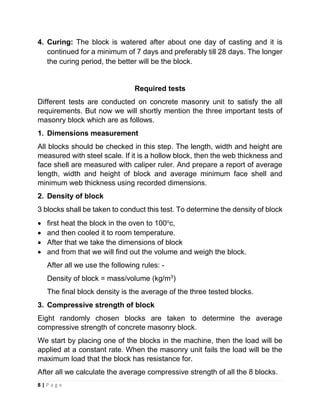
4. Curing: The block is watered after about one day of casting and it is
continued for a minimum of 7 days and preferably till 28 days. The longer
the curing period, the better will be the block.
Required tests
Different tests are conducted on concrete masonry unit to satisfy the all
requirements. But now we will shortly mention the three important tests of
masonry block which are as follows.
1. Dimensions measurement
All blocks should be checked in this step. The length, width and height are
measured with steel scale. If it is a hollow block, then the web thickness and
face shell are measured with caliper ruler. And prepare a report of average
length, width and height of block and average minimum face shell and
minimum web thickness using recorded dimensions.
2. Density of block
3 blocks shall be taken to conduct this test. To determine the density of block
• first heat the block in the oven to 100o
c,
• and then cooled it to room temperature.
• After that we take the dimensions of block
• and from that we will find out the volume and weigh the block.
After all we use the following rules: -
Density of block = mass/volume (kg/m3
)
The final block density is the average of the three tested blocks.
3. Compressive strength of block
Eight randomly chosen blocks are taken to determine the average
compressive strength of concrete masonry block.
We start by placing one of the blocks in the machine, then the load will be
applied at a constant rate. When the masonry unit fails the load will be the
maximum load that the block has resistance for.
After all we calculate the average compressive strength of all the 8 blocks.
9 | P a g e
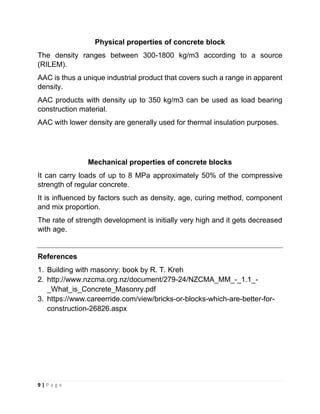
Physical properties of concrete block
The density ranges between 300-1800 kg/m3 according to a source
(RILEM).
AAC is thus a unique industrial product that covers such a range in apparent
density.
AAC products with density up to 350 kg/m3 can be used as load bearing
construction material.
AAC with lower density are generally used for thermal insulation purposes.
Mechanical properties of concrete blocks
It can carry loads of up to 8 MPa approximately 50% of the compressive
strength of regular concrete.
It is influenced by factors such as density, age, curing method, component
and mix proportion.
The rate of strength development is initially very high and it gets decreased
with age.
References
1. Building with masonry: book by R. T. Kreh
2. http://www.nzcma.org.nz/document/279-24/NZCMA_MM_-_1.1_-
_What_is_Concrete_Masonry.pdf
3. https://www.careerride.com/view/bricks-or-blocks-which-are-better-for-
construction-26826.aspx

concrete block properties & types

  • 1.
    1 | Pa g e Salahaddin University -Erbil College of Engineering Civil Engineering Department CONCRETE BLOCK Prepared by Zainab Dler Ruya Omer Supervisor Ali Rizgar
  • 2.
    2 | Pa g e ABSTRACT The purpose of choosing this subject which is about concrete block because it is an important material in construction. We mentioned all important information’s about concrete blocks, and we compared with another building material which is brick. So, I hope you get any information about concrete block or if you have any question about concrete block you can ask me1 . 1 Alirizgar234@gmail.com
  • 3.
    3 | Pa g e Table of Content • Introduction……………………………………………………………................4 • Types of concrete block ……..…………………………………………………4 1. Hollow concrete block 2. Aerated autoclaved concrete block 3. Solid concrete block 4. Lintel block 5. Paving concrete block • Advantages of concrete block …………………………………….…...……. 6 • Disadvantages of concrete block ………………………………..………......7 • The manufacturing process .……………………………………….………….7 • Required tests …………………………………………………………………...8 • Physical properties of concrete block ………………………………………9 • Mechanical properties of concrete block .………………….…………….…9 • References
  • 4.
    4 | Pa g e Introduction A concrete block is primarily used as a building material in the construction of walls and fence. It is sometimes called a concrete masonry unit (CMU). A concrete block is one of several precast concrete products used in construction. The term precast refers to the fact that the blocks are formed and hardened before their use. Most concrete blocks have one or more hollow cavities, and their sides may be cast smooth or with a design. Concrete mortar is used to bind shaped stones together in the construction of buildings. The early blocks were usually cast by hand, and the average output was about 10 blocks per person per hour. Today, concrete block manufacturing is a highly automated process that can produce up to 2,000 blocks per hour. The Engineering properties of the concrete block is regularity of dimensions and shape, high structural capacity, controlling the strength by changing the mixing ratios. Types of concrete block 1. Hollow concrete blocks They are manufactured from lightweight aggregates. They are light blocks and easy to handle. And there are eight types of hollow concrete blocks. They are used in all types of masonry constructions. For instead: for below and above grade in exterior load bearing walls, interior load bearing walls, and partitions and panel walks..etc.
  • 5.
    5 | Pa g e 2. Aerated Autoclaved Concrete Block (AAC) Aerated Autoclaved concrete blocks are lighter and bigger than bricks. Mostly made with same ingredients as of bricks but in a different way. It is made of Portland cement, fine aggregates, water, and an expansion agent. Using AAC blocks reduces the load on the foundation and other structural components in a structure because of its lower self-weight. It has a good fire resistance because of its homogeneous structure. 3. Solid concrete blocks Solid concrete blocks are manufactured to be strong, heavy, with a great dense aggregate. These solid concrete blocks are strong enough which can be used for large masonry units that are load-bearing in nature. They are similar to bricks but they are heavier and can exposure to more forces. 4. Lintel blocks Lintel blocks are U shaped horizontal masonry units. They are used to form lintel beam, which support the wall portion between two vertical supports. They also can be used as bond beams. 5. Paving Concrete Blocks PCB is available in a variety of colors, shapes and textures. They are made of high strength concrete, and are durable. They can resist many chemicals. One of its advantages over solid paving is that it can be easily reinstated following work on underground services.
  • 6.
    6 | Pa g e Advantages of concrete blocks ✓ Using concrete block in construction significantly reduces cost in various ways. To produce brick hectors of land, tons of wood and coal are wasted. If we practice using concrete block, we can save these natural resources to build our home, offices, roads and any other construction. Each block can save approximately 25% than using brick. ✓ Made from waste: They do not harm or deplete nature for being made. They are made from Fly Ash, which is nothing but a residue of thermal power plants. ✓ Strength: Concrete blocks have enough resistance for earthquakes which are happening quite frequently these days, hurricanes and tornadoes. ✓ Soundproofing: For those residing in industrial areas or areas that are near busy roads, some sort of soundproofing can be a bliss. Block walls have high density they offer a good soundproofing. Their efficient acoustic insulation is a big help if your home is constantly surrounded by noise that could keep you from getting a sound sleep. ✓ The construction of concrete block masonry is easier and faster that requires less labor cost than brick masonry. ✓ There is saving in construction of mortar because the numbers of joints are reduced. ✓ The blocks can be prepared in such a manner that the vertical joints can be staggered automatically and thus the skilled supervision is reduced. ✓ Speed of construction2 : A concrete block building can often be completed in less time than a brick structure. Because they are bigger in size. 2 Design of concrete structures book……………. chapter 18, page 613.
  • 7.
    7 | Pa g e Disadvantages of concrete block ❖ style and design: the natural color of concrete block is grey in color so sometimes it can be a problem with aesthetic. ❖ they have less resistance as compared to bricks, so they can be burnt easily. ❖ Weak insulation. ❖ Durability: bricks can last for a longer time than concrete blocks (hollow) that means some types of concrete blocks are less durable. Manufacturing of Concrete Blocks The materials required for the production of the concrete blocks are (aggregates, cement, and water). The degree of quality of the concrete blocks depends on the materials that are used for manufacturing concrete blocks. The strength, texture and economy of the concrete block depend upon the careful grading of the aggregate. The processes involved in the manufacturing of the concrete blocks are as follows: 1. Selection and proportion of ingredients: The main criteria for the selection of the ingredients are the desired strength of the block. The greater the proportion of coarse aggregate, the greater will be the strength of the quality of cement used. 2. Mixing of ingredients: The blending of aggregate, cement and water should be done very carefully. The mixing should preferably take place in a mechanical mixer. For hand mixing, extreme care should be taken to see that the cement and aggregates are first mixed thoroughly in dry state and the water is then added gradually. 3. Placing and vibration: The mixed concrete material is fed into the mould box up to the top level and it is ensured that the box is evenly filled. The vibration of concrete is done till it has uniformly settled in the mould box.
  • 8.
    8 | Pa g e 4. Curing: The block is watered after about one day of casting and it is continued for a minimum of 7 days and preferably till 28 days. The longer the curing period, the better will be the block. Required tests Different tests are conducted on concrete masonry unit to satisfy the all requirements. But now we will shortly mention the three important tests of masonry block which are as follows. 1. Dimensions measurement All blocks should be checked in this step. The length, width and height are measured with steel scale. If it is a hollow block, then the web thickness and face shell are measured with caliper ruler. And prepare a report of average length, width and height of block and average minimum face shell and minimum web thickness using recorded dimensions. 2. Density of block 3 blocks shall be taken to conduct this test. To determine the density of block • first heat the block in the oven to 100o c, • and then cooled it to room temperature. • After that we take the dimensions of block • and from that we will find out the volume and weigh the block. After all we use the following rules: - Density of block = mass/volume (kg/m3 ) The final block density is the average of the three tested blocks. 3. Compressive strength of block Eight randomly chosen blocks are taken to determine the average compressive strength of concrete masonry block. We start by placing one of the blocks in the machine, then the load will be applied at a constant rate. When the masonry unit fails the load will be the maximum load that the block has resistance for. After all we calculate the average compressive strength of all the 8 blocks.
  • 9.
    9 | Pa g e Physical properties of concrete block The density ranges between 300-1800 kg/m3 according to a source (RILEM). AAC is thus a unique industrial product that covers such a range in apparent density. AAC products with density up to 350 kg/m3 can be used as load bearing construction material. AAC with lower density are generally used for thermal insulation purposes. Mechanical properties of concrete blocks It can carry loads of up to 8 MPa approximately 50% of the compressive strength of regular concrete. It is influenced by factors such as density, age, curing method, component and mix proportion. The rate of strength development is initially very high and it gets decreased with age. References 1. Building with masonry: book by R. T. Kreh 2. http://www.nzcma.org.nz/document/279-24/NZCMA_MM_-_1.1_- _What_is_Concrete_Masonry.pdf 3. https://www.careerride.com/view/bricks-or-blocks-which-are-better-for- construction-26826.aspx