ActiveLearning:What, Why and How
ESED 8200: Teaching Undergraduate Engineering
Summer 2015
ESED8200-Summer2015
Active Learning
• By the end of this presentation, you will be able to:
• Summarize what active learning is
• Summarize the potential benefits of using active learning
techniques in your class
• Practice an activity for your class that engages students in paired
problem solving
ESED8200-Summer2015
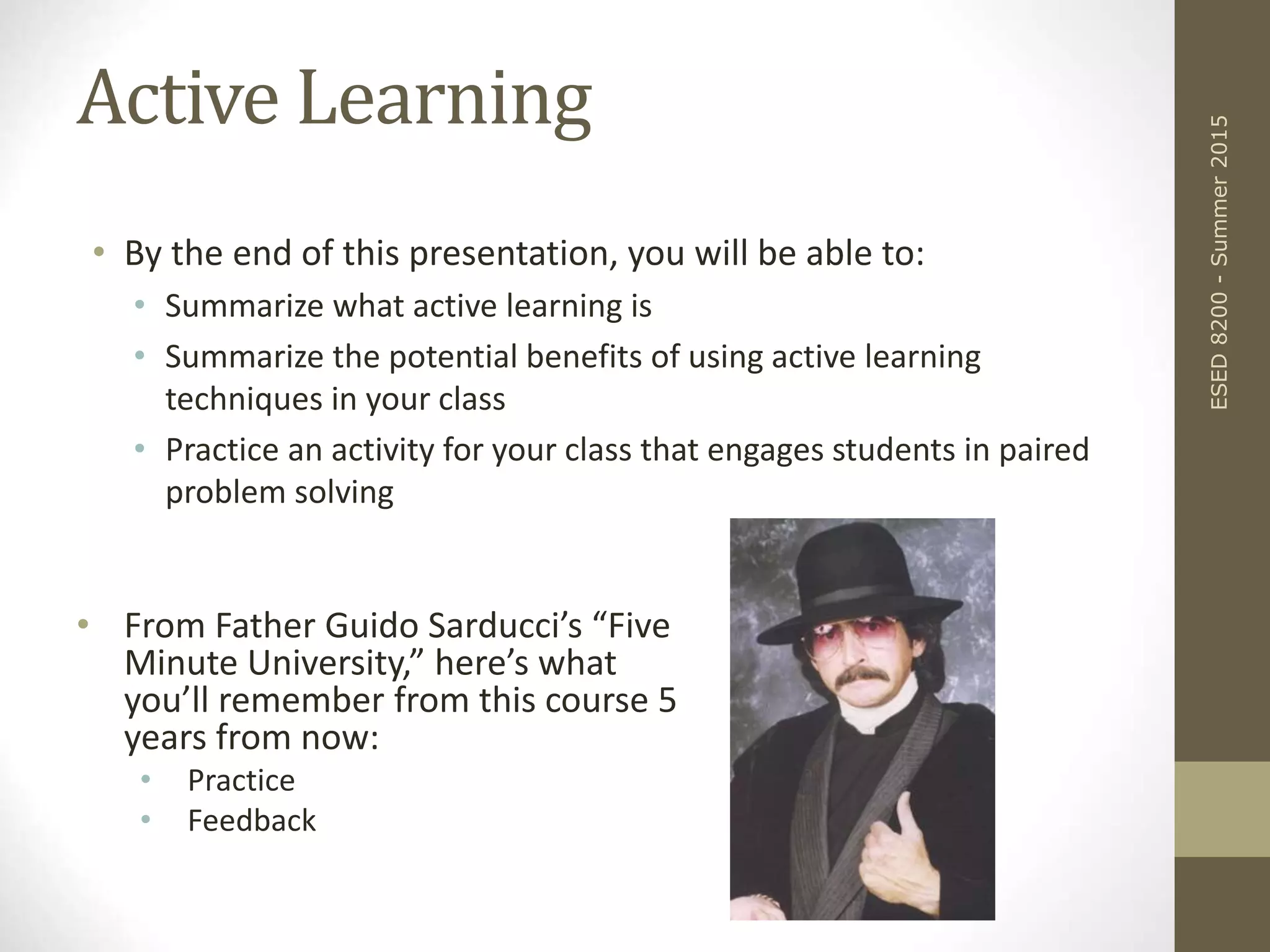
• From Father Guido Sarducci’s “Five
Minute University,” here’s what
you’ll remember from this course 5
years from now:
• Practice
• Feedback
What is Active Learning?
• Students are responsible for learning by engaging in activities
that promote analysis, synthesis, and evaluation of class
content.
• Examples of activities in class:
• Collaborative learning (peer instruction, paired problem solving)
• Problem formulation and prediction
• Trouble-shooting
• Brainstorming
• Concept mapping
• More advanced active learning techniques:
• Role-playing, simulations and games
• Case studies
• Challenge-based learning or problem-based learning
ESED8200-Summer2015
Why Active Learning?
• Think: List as many benefits to active learning as you can
• Pair: Turn to your neighbor and compare your lists. Come up
with one list of the best ideas from both of you.
• Share: Read your list out loud to the class when your “pair” is
called on.
• This approach is called “Think-Pair-Share” and is one of the
simplest ways to actively engage students during class.
ESED8200-Summer2015
Why Active Learning?
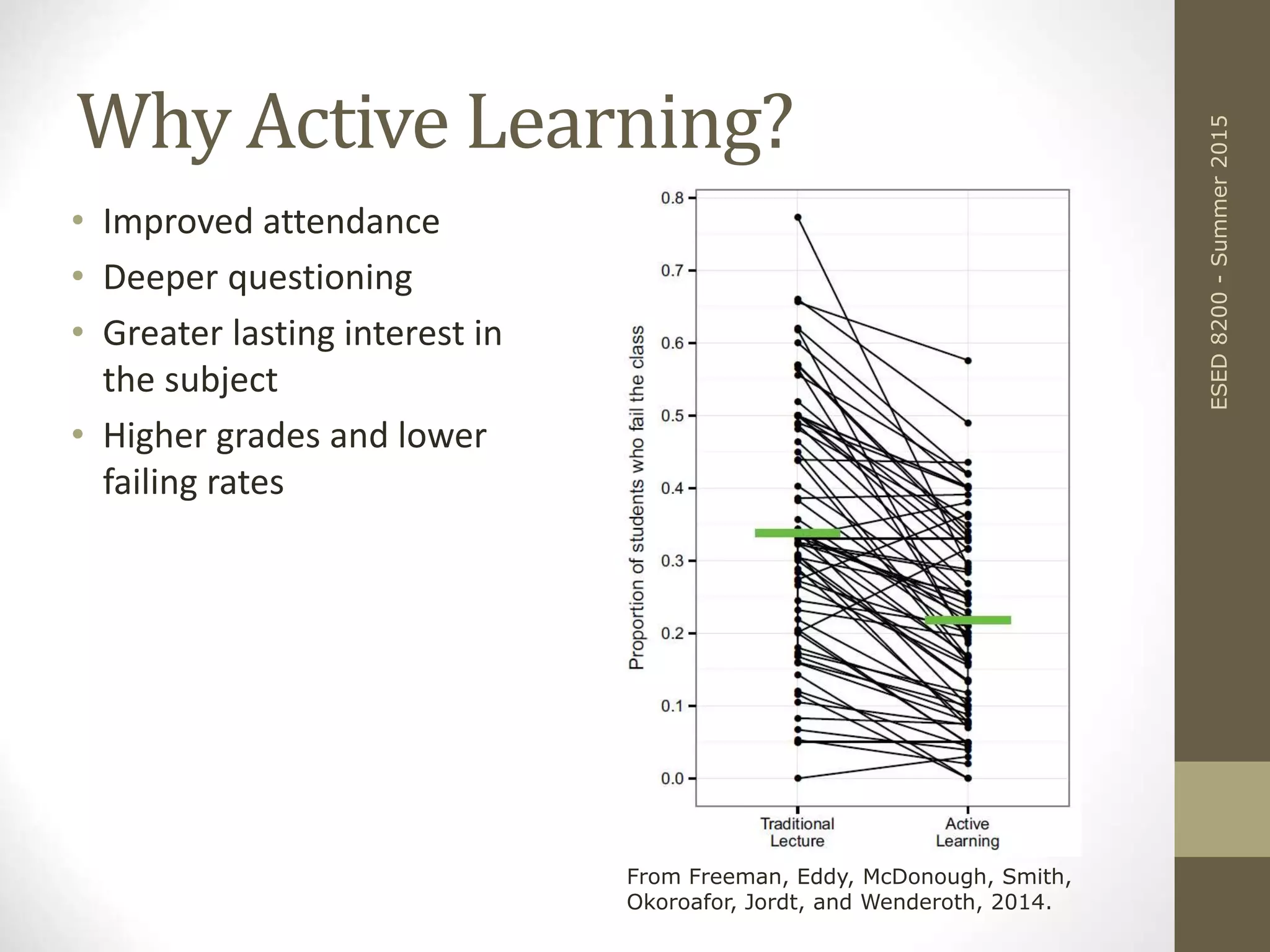
• Improved attendance
• Deeper questioning
• Greater lasting interest in
the subject
• Higher grades and lower
failing rates
ESED8200-Summer2015
From Freeman, Eddy, McDonough, Smith,
Okoroafor, Jordt, and Wenderoth, 2014.
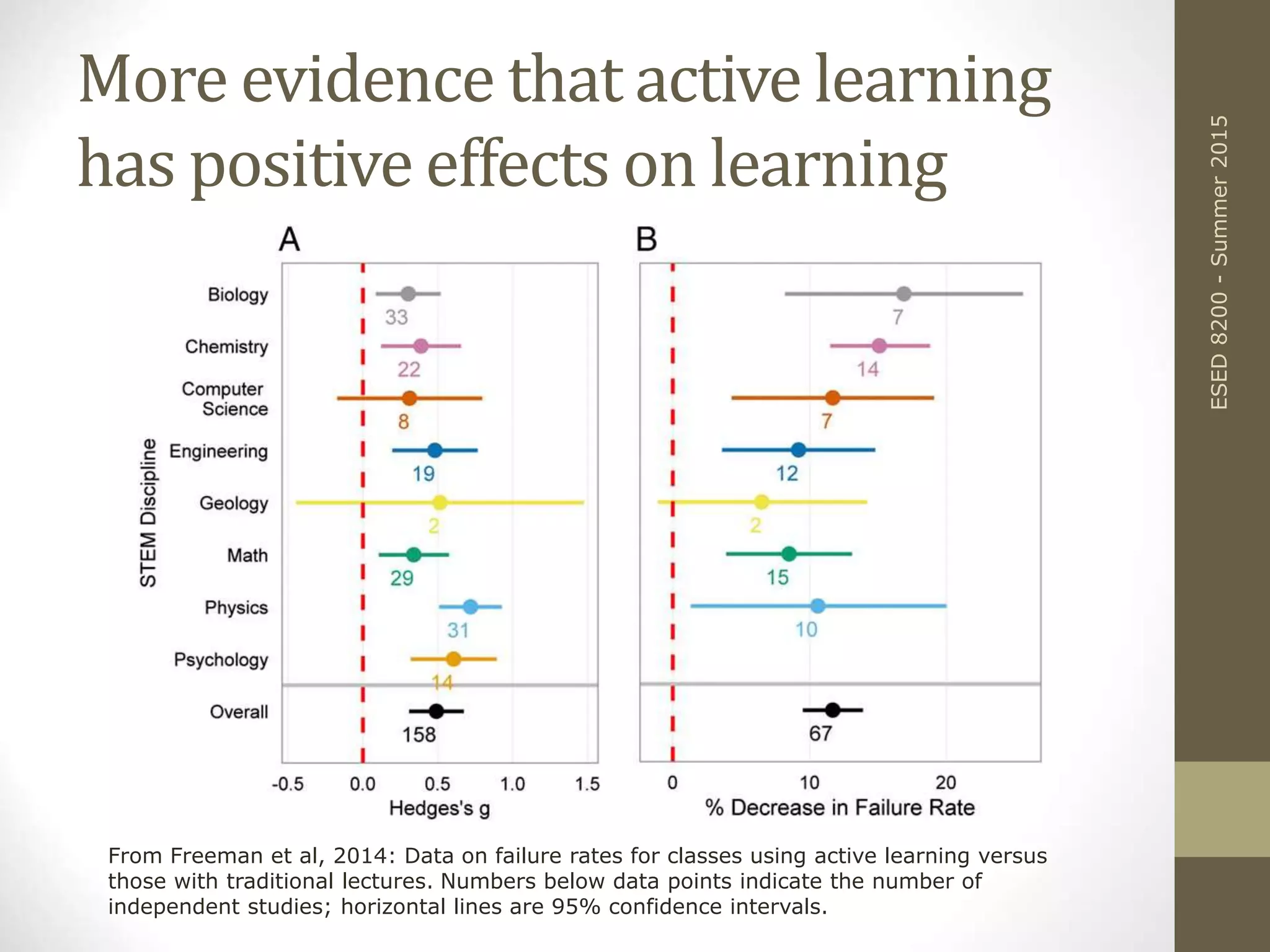
More evidence that active learning
has positive effects on learning
ESED8200-Summer2015
From Freeman et al, 2014: Data on failure rates for classes using active learning versus
those with traditional lectures. Numbers below data points indicate the number of
independent studies; horizontal lines are 95% confidence intervals.
How do you fit it in?
• Can you afford NOT to?
• Our job is not to COVER material, but to UNCOVER it
• Time managements tips
• Use handouts
• Printed material will save time for students to take notes
• Leave holes and gaps in the handouts
• Axes without graphs
• Questions without answers
• Blanks within statements
• Don’t spend class time on material for definitions and
prerequisite material
• Identify resources for students to look up what they need to fill in
holes in their background knowledge
ESED8200-Summer2015
How do you get started?
• Start simple!
• Assign one to two tasks during a 50-minute class period to
break up lecture
• Students work in groups of 3 - 5
• Allow about 5 minutes per activity
ESED8200-Summer2015
How do you get started?
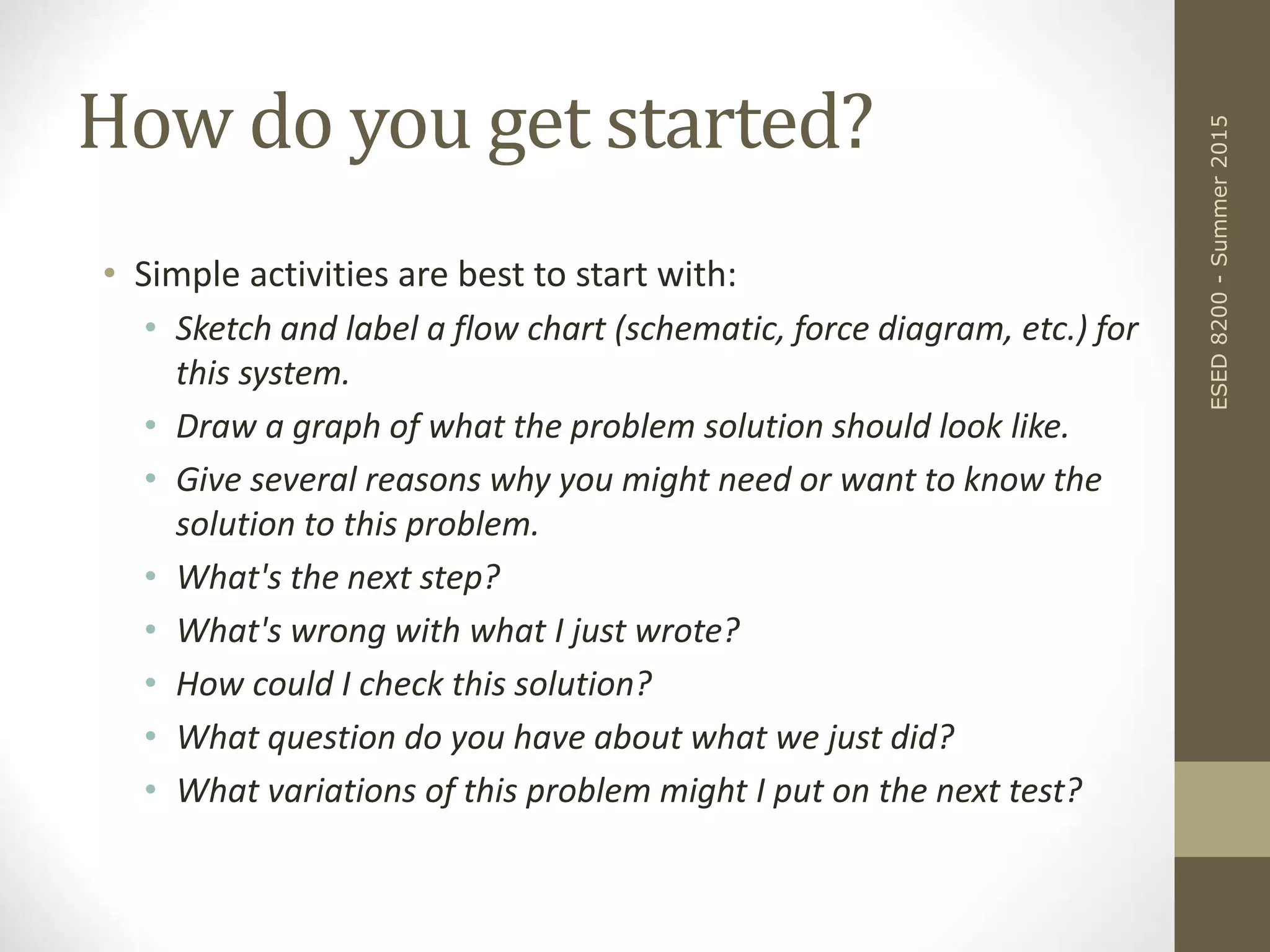
• Simple activities are best to start with:
• Sketch and label a flow chart (schematic, force diagram, etc.) for
this system.
• Draw a graph of what the problem solution should look like.
• Give several reasons why you might need or want to know the
solution to this problem.
• What's the next step?
• What's wrong with what I just wrote?
• How could I check this solution?
• What question do you have about what we just did?
• What variations of this problem might I put on the next test?
ESED8200-Summer2015
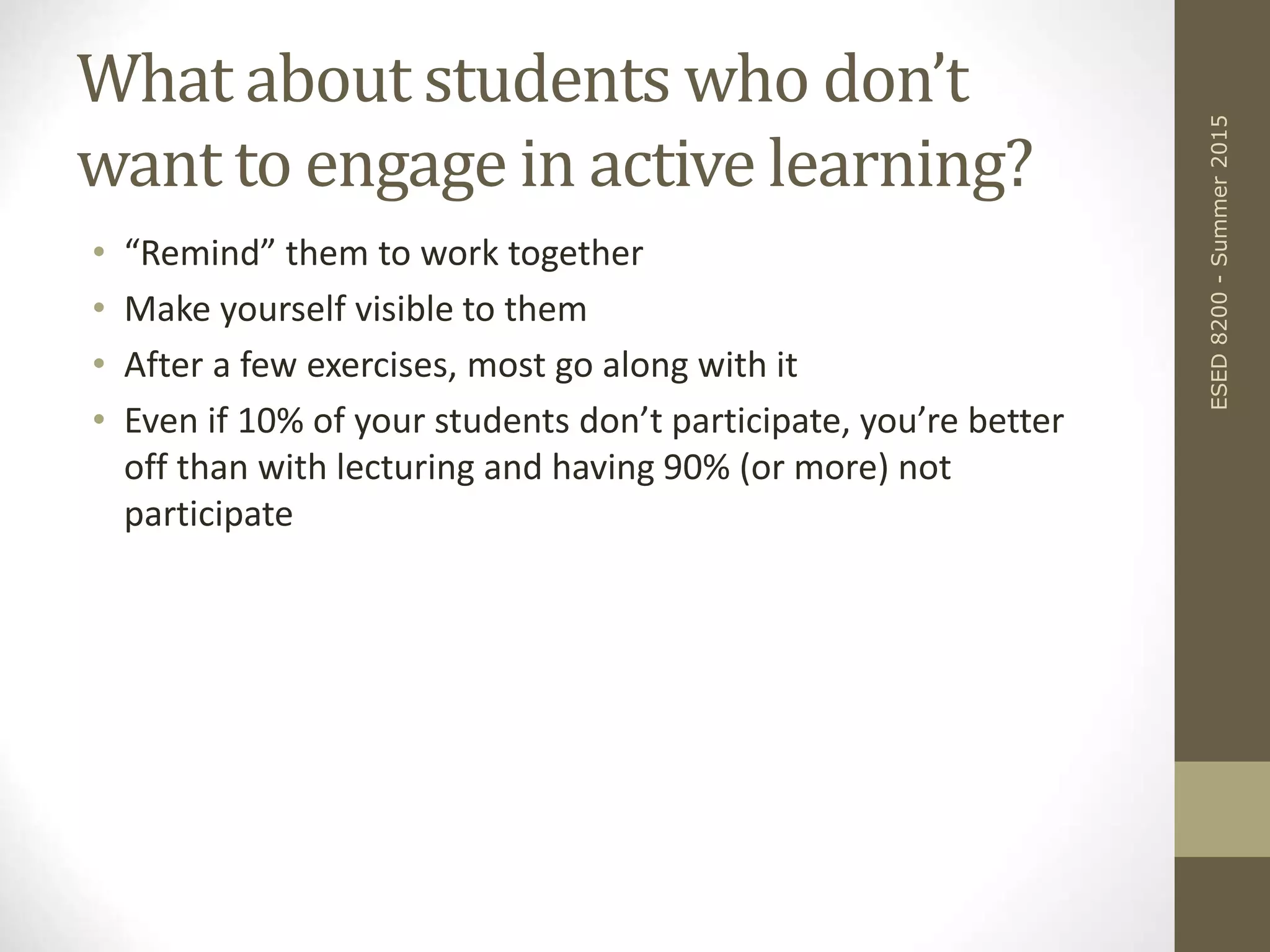
What about students who don’t
want to engage in active learning?
• “Remind” them to work together
• Make yourself visible to them
• After a few exercises, most go along with it
• Even if 10% of your students don’t participate, you’re better
off than with lecturing and having 90% (or more) not
participate
ESED8200-Summer2015
Further reading on active learning:
• Freeman, S; Eddy, S; McDonough, M; Smith, M; Okoroafor, N; Jordt, H; and
Wenderoth, M. 2014. Active learning increases student performance in science,
engineering and mathematics. Proceedings of the National Academy of Science,
doi:10.1073/pnas.1319030111 http://www.pnas.org/content/early/2014/05/08/1319030111.short?rss=1&ssource=mfr
• Reaching Students: What Research Says About Effective Instruction in Undergraduate
Science and Engineering. 2015. Washington, DC: National Academies Press. PDF
available for download: http://www.nap.edu/catalog/18687/reaching-students-what-research-says-about-effective-instruction-in-undergraduate
• National Effective Teaching Institute Workshop Handout, available upon request at
http://www4.ncsu.edu/unity/lockers/users/f/felder/public/NETI.html
• Johnson, D. W., Johnson, R. T., and Smith, K. A. 1998. Active learning: Cooperation in
the college classroom (2nd ed.) Edina, MN: Interaction Book Co.
• King, A. 1993. From sage on the stage to guide on the side. College Teaching, 41(1),
30-35.
• Angelo, T. A. and Cross, K. P. 1993. Classroom Assessment Techniques: A handbook for
college teaching (2nd ed.), San Francisco: Jossey-Bass.
• More tips and resources on active learning are available on the Clemson University
College of Engineering and Science Graduate TA Training website:
http://www.clemson.edu/ces/research/graduate-studies/current-students/gta-training/index.html
ESED8200-Summer2015
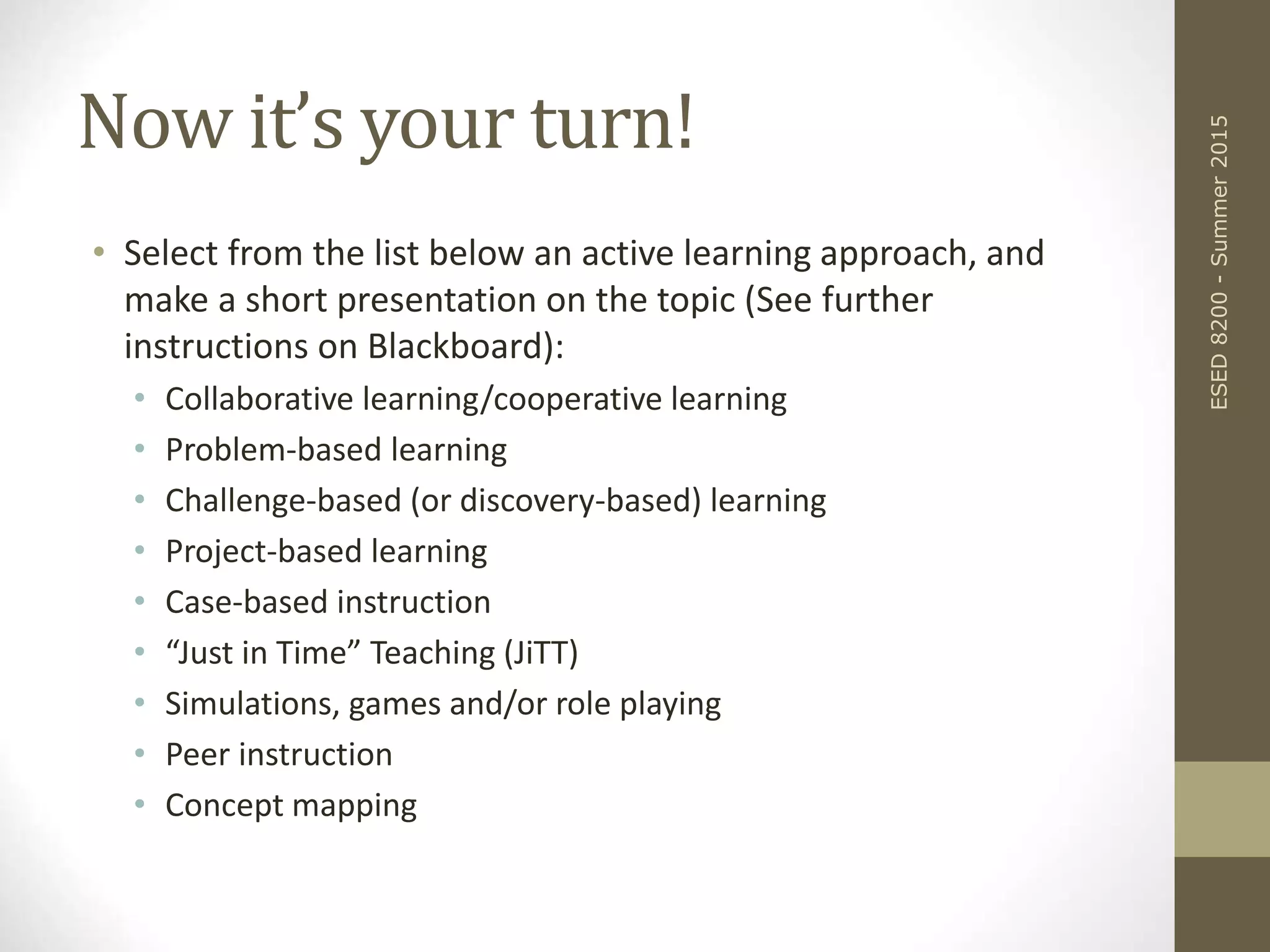
Now it’s your turn!
• Select from the list below an active learning approach, and
make a short presentation on the topic (See further
instructions on Blackboard):
• Collaborative learning/cooperative learning
• Problem-based learning
• Challenge-based (or discovery-based) learning
• Project-based learning
• Case-based instruction
• “Just in Time” Teaching (JiTT)
• Simulations, games and/or role playing
• Peer instruction
• Concept mapping
ESED8200-Summer2015

Introduction to Active Learning

  • 1.
    ActiveLearning:What, Why andHow ESED 8200: Teaching Undergraduate Engineering Summer 2015 ESED8200-Summer2015
  • 2.
    Active Learning • Bythe end of this presentation, you will be able to: • Summarize what active learning is • Summarize the potential benefits of using active learning techniques in your class • Practice an activity for your class that engages students in paired problem solving ESED8200-Summer2015 • From Father Guido Sarducci’s “Five Minute University,” here’s what you’ll remember from this course 5 years from now: • Practice • Feedback
  • 3.
    What is ActiveLearning? • Students are responsible for learning by engaging in activities that promote analysis, synthesis, and evaluation of class content. • Examples of activities in class: • Collaborative learning (peer instruction, paired problem solving) • Problem formulation and prediction • Trouble-shooting • Brainstorming • Concept mapping • More advanced active learning techniques: • Role-playing, simulations and games • Case studies • Challenge-based learning or problem-based learning ESED8200-Summer2015
  • 4.
    Why Active Learning? •Think: List as many benefits to active learning as you can • Pair: Turn to your neighbor and compare your lists. Come up with one list of the best ideas from both of you. • Share: Read your list out loud to the class when your “pair” is called on. • This approach is called “Think-Pair-Share” and is one of the simplest ways to actively engage students during class. ESED8200-Summer2015
  • 5.
    Why Active Learning? •Improved attendance • Deeper questioning • Greater lasting interest in the subject • Higher grades and lower failing rates ESED8200-Summer2015 From Freeman, Eddy, McDonough, Smith, Okoroafor, Jordt, and Wenderoth, 2014.
  • 6.
    More evidence thatactive learning has positive effects on learning ESED8200-Summer2015 From Freeman et al, 2014: Data on failure rates for classes using active learning versus those with traditional lectures. Numbers below data points indicate the number of independent studies; horizontal lines are 95% confidence intervals.
  • 7.
    How do youfit it in? • Can you afford NOT to? • Our job is not to COVER material, but to UNCOVER it • Time managements tips • Use handouts • Printed material will save time for students to take notes • Leave holes and gaps in the handouts • Axes without graphs • Questions without answers • Blanks within statements • Don’t spend class time on material for definitions and prerequisite material • Identify resources for students to look up what they need to fill in holes in their background knowledge ESED8200-Summer2015
  • 8.
    How do youget started? • Start simple! • Assign one to two tasks during a 50-minute class period to break up lecture • Students work in groups of 3 - 5 • Allow about 5 minutes per activity ESED8200-Summer2015
  • 9.
    How do youget started? • Simple activities are best to start with: • Sketch and label a flow chart (schematic, force diagram, etc.) for this system. • Draw a graph of what the problem solution should look like. • Give several reasons why you might need or want to know the solution to this problem. • What's the next step? • What's wrong with what I just wrote? • How could I check this solution? • What question do you have about what we just did? • What variations of this problem might I put on the next test? ESED8200-Summer2015
  • 10.
    What about studentswho don’t want to engage in active learning? • “Remind” them to work together • Make yourself visible to them • After a few exercises, most go along with it • Even if 10% of your students don’t participate, you’re better off than with lecturing and having 90% (or more) not participate ESED8200-Summer2015
  • 11.
    Further reading onactive learning: • Freeman, S; Eddy, S; McDonough, M; Smith, M; Okoroafor, N; Jordt, H; and Wenderoth, M. 2014. Active learning increases student performance in science, engineering and mathematics. Proceedings of the National Academy of Science, doi:10.1073/pnas.1319030111 http://www.pnas.org/content/early/2014/05/08/1319030111.short?rss=1&ssource=mfr • Reaching Students: What Research Says About Effective Instruction in Undergraduate Science and Engineering. 2015. Washington, DC: National Academies Press. PDF available for download: http://www.nap.edu/catalog/18687/reaching-students-what-research-says-about-effective-instruction-in-undergraduate • National Effective Teaching Institute Workshop Handout, available upon request at http://www4.ncsu.edu/unity/lockers/users/f/felder/public/NETI.html • Johnson, D. W., Johnson, R. T., and Smith, K. A. 1998. Active learning: Cooperation in the college classroom (2nd ed.) Edina, MN: Interaction Book Co. • King, A. 1993. From sage on the stage to guide on the side. College Teaching, 41(1), 30-35. • Angelo, T. A. and Cross, K. P. 1993. Classroom Assessment Techniques: A handbook for college teaching (2nd ed.), San Francisco: Jossey-Bass. • More tips and resources on active learning are available on the Clemson University College of Engineering and Science Graduate TA Training website: http://www.clemson.edu/ces/research/graduate-studies/current-students/gta-training/index.html ESED8200-Summer2015
  • 12.
    Now it’s yourturn! • Select from the list below an active learning approach, and make a short presentation on the topic (See further instructions on Blackboard): • Collaborative learning/cooperative learning • Problem-based learning • Challenge-based (or discovery-based) learning • Project-based learning • Case-based instruction • “Just in Time” Teaching (JiTT) • Simulations, games and/or role playing • Peer instruction • Concept mapping ESED8200-Summer2015

Editor's Notes

  • #6 Fig. S1. from Freeman et al.: Changes in failure rate. Data points on failure rates under traditional lecturing and active learning from the same study—and thus from the same course and comparable student populations—are connected by a line. The overall means for each treatment are indicated by the green bars.