
Basics of
Amin Neghavati
neghavati@gmail.com
in language teaching
Aims
• The concept of reflection
• Kolb’s learning cycle
• Reflective teaching
• Means of collecting classroom data
• Teaching diaries
• Recording lessons
• Peer observation
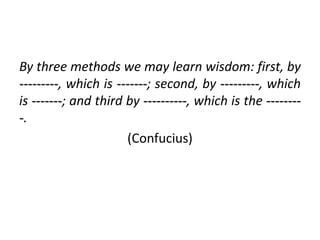
By three methods we may learn wisdom: first, by
---------, which is -------; second, by ---------, which
is -------; and third by ----------, which is the --------
-.
(Confucius)
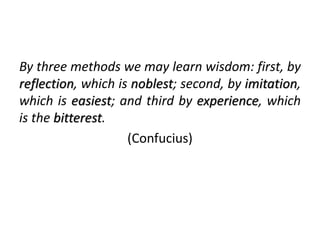
By three methods we may learn wisdom: first, by
reflection, which is noblest; second, by imitation,
which is easiest; and third by experience, which
is the bitterest.
(Confucius)
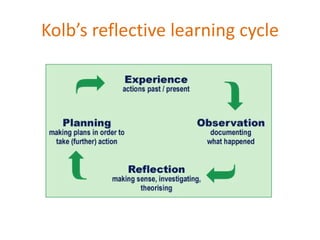
Kolb’s reflective learning cycle
Reflective teaching
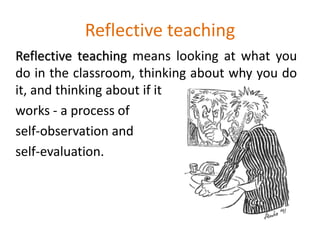
Reflective teaching means looking at what you
do in the classroom, thinking about why you do
it, and thinking about if it
works - a process of
self-observation and
self-evaluation.
Reflective teaching
Reflection can occur at any time. It may be
whilst you follow the materials in this course or
it may happen as you prepare or deliver your
own lessons.
A good time for reflection is after a lesson and it
is good practice to record your thoughts.
Reflective teaching- how to start
Asking ‘what and why’ questions
Means of gathering classroom data
• Maintaining a teaching diary
• Recording a lesson
• Receiving feedback from students
• Inviting a colleague to observe you/ Peer
Observation
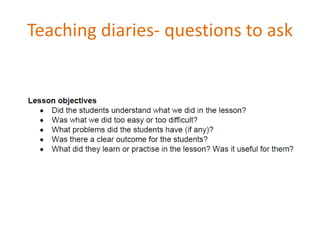
Teaching diaries
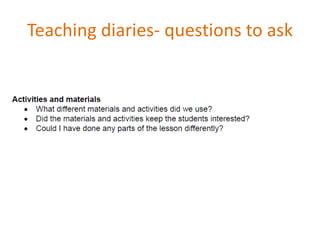
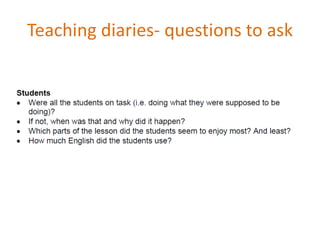
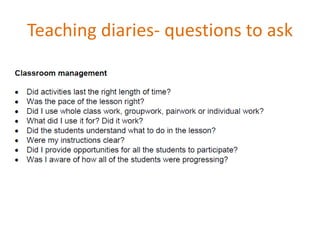
Teaching diaries- questions to ask
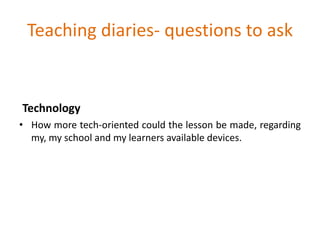
Technology
• How more tech-oriented could the lesson be made, regarding
my, my school and my learners available devices.
Teaching diaries- questions to ask
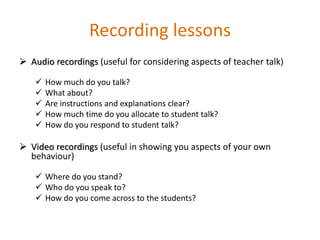
Recording lessons
 Audio recordings (useful for considering aspects of teacher talk)
 How much do you talk?
 What about?
 Are instructions and explanations clear?
 How much time do you allocate to student talk?
 How do you respond to student talk?
 Video recordings (useful in showing you aspects of your own
behaviour)
 Where do you stand?
 Who do you speak to?
 How do you come across to the students?
Peer observation
To both observe and be observed
The pre-observation session
The observation
The post-observation session
Reflection is cyclical.
Change is the only constant.
(Heraclitus, Greek Philosopher)
Aims
• The concept of reflection
• Kolb’s learning cycle
• Reflective teaching
• Means of collecting classroom data
• Teaching diaries
• Recording lessons
• Peer observation
References
• http://www.teachingenglish.org.uk/article/reflective-teaching-exploring-
our-own-classroom-practice
• http://www.onestopenglish.com/support/methodology/professional-
development/professional-development-reflective-
teaching/146478.article
• Pak J. (1985), ‘Find Out How You Teach’, Adelaide
• Richards J.C. (1990), ‘The Language Teaching Matrix’, Cambridge University
Press

Basics of Reflective Teaching