Classroom Assessment Techniques


                              Dr. Steve Sorden
                       Director, CTLE-Prescott
                     Faculty Brownbag Session
                           September 25, 2012
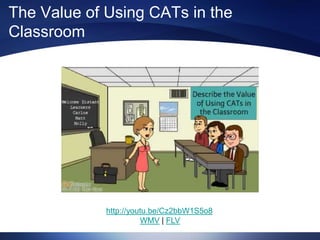
The Value of Using CATs in the
Classroom


             http://youtu.be/Cz2bbW1S5o8
                       WMV | FLV
Agenda

• Examples of Classroom Assessment Techniques
• Invited Speakers
  –   Brian Davis
  –   Julio Benavides
  –   Angela Beck
  –   Quentin Bailey
• Discussion
The Classic on CATs

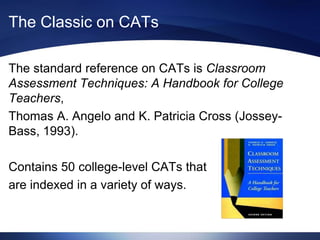
The standard reference on CATs is Classroom
Assessment Techniques: A Handbook for College
Teachers,
Thomas A. Angelo and K. Patricia Cross (Jossey-
Bass, 1993).

Contains 50 college-level CATs that
are indexed in a variety of ways.
Classroom Assessment Techniques

 Classroom Assessment Techniques (CATs) are generally
 simple, non-graded, anonymous, in-class activities
 designed to give you and your students useful feedback on
 how well students are learning or are prepared to learn the
 class material.

 Most are designed to be quick and easy to use and each
 CAT provides different kinds of information.
Levels of Assessment

• Summative Assessment
  – Course Level
  – Program Level


• Formative Assessment
  – Classroom assessment is both a teaching approach and a
    set of techniques.
  – The more you know about what and how students are
    learning, the better you can plan learning activities to
    structure your teaching.
Why should I use CATs?

CATs can be used to improve the teaching and learning that
occurs in a class. More frequent use of CATs can…

   – Provide just-in-time feedback about the teaching-learning process
   – Provide information about student learning with less work than
     traditional assignments (tests, papers, etc.)
   – Encourage the view that teaching is an ongoing process of inquiry,
     experimentation, and reflection
   – Help students become better monitors of their own learning
   – Help students feel less anonymous, even in large courses
   – Provide concrete evidence that the instructor cares about learning
Why CATs Are Important

ASU Physics Professor David Hestenes had taught the
fundamental concept of force to thousands of undergraduates.

The students could recite Newton’s Third Law and apply it to
solving problems, but when posed a real-world event like a
collision between a heavy truck and a light car, many firmly
declared that the heavy truck exerts a larger force.

This, despite being taught repeatedly during the semester that
an object’s weight is irrelevant to the force exerted.
Eric Mazur at Harvard

Mazur did a classroom assessment with his own
physics students at Harvard. The first question one of
his students asked:

“How should I answer these questions—according to
what you taught me, or how I usually think about these
things.”
How Should I use CATs

1. Decide what you want to assess about your students’
   learning from a CAT.
2. Choose a CAT that provides this feedback, is consistent with
   your teaching style, and can be implemented easily in your
   class.
3. Explain the purpose of the activity to students, and then
   conduct it.
4. After class, review the results, determine what they tell you
   about your students’ learning, and decide what changes to
   make, if any.
5. Let your students know what you learned from the CAT and
   how you will use this information.
Examples of CATs

• The Muddiest Point     • Keystroke Reports
• The Minute Paper       • Defining Features
• Background Knowledge     Matrix
  Probe                  • Online CATs
• Self-Confidence        • Classroom Response
  Surveys                  Systems
• Empty Outlines
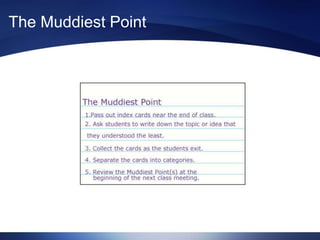
The Muddiest Point
The Minute Paper

Tests how students are learning, or not.

The instructor ends class by asking students to write a
brief response to the following question on a half sheet
of paper:

   What is the most important thing I learned today
        and what did I understand the least?
Online Version of the Minute Paper

1. What is the one thing that helped you most in this
   week's activities?
2. What is the one thing in this course that is least
   helpful to your learning?

                                   Useful as a quick
                                   ungraded assessment
                                   for the teacher, a
                                   reflective opportunity
                                   for the student, and a
                                   chance for mentoring
                                   and dialog with other
                                   students.
Two Minute Paper
The Background Knowledge Probe

The Background
Knowledge Probe is
a short, simple
questionnaire given
to students at the
start of a course, or
before the
introduction of a new
unit, lesson or topic.
It is designed to
uncover students’
pre-conceptions.
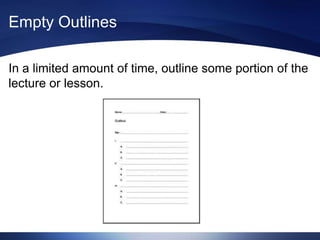
Empty Outlines

In a limited amount of time, outline some portion of the
lecture or lesson.
Keystroke reports for technology


With a partner, record the steps need to perform a task
using a specific tool
What’s the Principle?

Useful in courses requiring problem-solving. After
students figure out what type of problem they are
dealing with, they often must decide what principle(s)
to apply in order to solve the problem.

This CAT provides students with a few problems and
asks them to state the principle that best applies to
each problem.
Defining Features Matrix

Best used in courses that require student to distinguish
between closely related or seeming similar items or
concepts.


• Psychology – Freudian and behaviorist views
• Political Science – Federalism in U.S., Germany &
  Canada
• Biology – Neanderthals and Homo sapiens
Defining Features Matrix

Features                                           Institutional   Classroom
                                                   Assessment      Assessment

Teacher-designed and directed                            -              +

Large sample sizes required                              +              -

Sophisticated statistical data analysis required         +              -

Standardized and validated instruments preferred         +              -

Focused o classroom teaching and learning                -              +

Replicable and comparable                                +              -

Useful to students and teachers                          -              +

Useful to administrators                                 +              -

Aims to improve quality of education                     +              +
Double-Entry Journals

• Provides detailed feedback on how students read,
  analyze, and respond to assigned texts, problems,
  and formulas.
Online CATs

•   Email
•   Surveys in Blackboard
•   Surveys in Google Docs
•   Journals in Blackboard
Classroom Response Systems (Clickers)

• Poll Anywhere (mobile phones, twitter, texting and
  the web)
• Top Hat Monocle - http://www.tophatmonocle.com
• Socrative (apps for iOS & Android)
• i>clickers
Resources

Field Tested Learning Assessment Guide:
CATs for Science, Math, Engineering, and Technology
Instructors
http://www.flaguide.org/cat/cat.php

Classroom Assessment Techniques. Vanderbilt University.
http://cft.vanderbilt.edu/teaching-guides/assessment/cats

Classroom Assessment Techniques: A Handbook for College
Teachers. Angelo & Cross, 1993.
Classroom Assessment Techniques


                              Dr. Steve Sorden
                       Director, CTLE-Prescott
                     Faculty Brownbag Session
                           September 25, 2012

Classroom Assessment Techniques

  • 1.
    Classroom Assessment Techniques Dr. Steve Sorden Director, CTLE-Prescott Faculty Brownbag Session September 25, 2012
  • 2.
    The Value ofUsing CATs in the Classroom http://youtu.be/Cz2bbW1S5o8 WMV | FLV
  • 3.
    Agenda • Examples ofClassroom Assessment Techniques • Invited Speakers – Brian Davis – Julio Benavides – Angela Beck – Quentin Bailey • Discussion
  • 4.
    The Classic onCATs The standard reference on CATs is Classroom Assessment Techniques: A Handbook for College Teachers, Thomas A. Angelo and K. Patricia Cross (Jossey- Bass, 1993). Contains 50 college-level CATs that are indexed in a variety of ways.
  • 5.
    Classroom Assessment Techniques Classroom Assessment Techniques (CATs) are generally simple, non-graded, anonymous, in-class activities designed to give you and your students useful feedback on how well students are learning or are prepared to learn the class material. Most are designed to be quick and easy to use and each CAT provides different kinds of information.
  • 6.
    Levels of Assessment •Summative Assessment – Course Level – Program Level • Formative Assessment – Classroom assessment is both a teaching approach and a set of techniques. – The more you know about what and how students are learning, the better you can plan learning activities to structure your teaching.
  • 7.
    Why should Iuse CATs? CATs can be used to improve the teaching and learning that occurs in a class. More frequent use of CATs can… – Provide just-in-time feedback about the teaching-learning process – Provide information about student learning with less work than traditional assignments (tests, papers, etc.) – Encourage the view that teaching is an ongoing process of inquiry, experimentation, and reflection – Help students become better monitors of their own learning – Help students feel less anonymous, even in large courses – Provide concrete evidence that the instructor cares about learning
  • 8.
    Why CATs AreImportant ASU Physics Professor David Hestenes had taught the fundamental concept of force to thousands of undergraduates. The students could recite Newton’s Third Law and apply it to solving problems, but when posed a real-world event like a collision between a heavy truck and a light car, many firmly declared that the heavy truck exerts a larger force. This, despite being taught repeatedly during the semester that an object’s weight is irrelevant to the force exerted.
  • 9.
    Eric Mazur atHarvard Mazur did a classroom assessment with his own physics students at Harvard. The first question one of his students asked: “How should I answer these questions—according to what you taught me, or how I usually think about these things.”
  • 10.
    How Should Iuse CATs 1. Decide what you want to assess about your students’ learning from a CAT. 2. Choose a CAT that provides this feedback, is consistent with your teaching style, and can be implemented easily in your class. 3. Explain the purpose of the activity to students, and then conduct it. 4. After class, review the results, determine what they tell you about your students’ learning, and decide what changes to make, if any. 5. Let your students know what you learned from the CAT and how you will use this information.
  • 11.
    Examples of CATs •The Muddiest Point • Keystroke Reports • The Minute Paper • Defining Features • Background Knowledge Matrix Probe • Online CATs • Self-Confidence • Classroom Response Surveys Systems • Empty Outlines
  • 12.
  • 13.
    The Minute Paper Testshow students are learning, or not. The instructor ends class by asking students to write a brief response to the following question on a half sheet of paper: What is the most important thing I learned today and what did I understand the least?
  • 14.
    Online Version ofthe Minute Paper 1. What is the one thing that helped you most in this week's activities? 2. What is the one thing in this course that is least helpful to your learning? Useful as a quick ungraded assessment for the teacher, a reflective opportunity for the student, and a chance for mentoring and dialog with other students.
  • 15.
  • 16.
    The Background KnowledgeProbe The Background Knowledge Probe is a short, simple questionnaire given to students at the start of a course, or before the introduction of a new unit, lesson or topic. It is designed to uncover students’ pre-conceptions.
  • 17.
    Empty Outlines In alimited amount of time, outline some portion of the lecture or lesson.
  • 18.
    Keystroke reports fortechnology With a partner, record the steps need to perform a task using a specific tool
  • 19.
    What’s the Principle? Usefulin courses requiring problem-solving. After students figure out what type of problem they are dealing with, they often must decide what principle(s) to apply in order to solve the problem. This CAT provides students with a few problems and asks them to state the principle that best applies to each problem.
  • 20.
    Defining Features Matrix Bestused in courses that require student to distinguish between closely related or seeming similar items or concepts. • Psychology – Freudian and behaviorist views • Political Science – Federalism in U.S., Germany & Canada • Biology – Neanderthals and Homo sapiens
  • 21.
    Defining Features Matrix Features Institutional Classroom Assessment Assessment Teacher-designed and directed - + Large sample sizes required + - Sophisticated statistical data analysis required + - Standardized and validated instruments preferred + - Focused o classroom teaching and learning - + Replicable and comparable + - Useful to students and teachers - + Useful to administrators + - Aims to improve quality of education + +
  • 22.
    Double-Entry Journals • Providesdetailed feedback on how students read, analyze, and respond to assigned texts, problems, and formulas.
  • 23.
    Online CATs • Email • Surveys in Blackboard • Surveys in Google Docs • Journals in Blackboard
  • 24.
    Classroom Response Systems(Clickers) • Poll Anywhere (mobile phones, twitter, texting and the web) • Top Hat Monocle - http://www.tophatmonocle.com • Socrative (apps for iOS & Android) • i>clickers
  • 25.
    Resources Field Tested LearningAssessment Guide: CATs for Science, Math, Engineering, and Technology Instructors http://www.flaguide.org/cat/cat.php Classroom Assessment Techniques. Vanderbilt University. http://cft.vanderbilt.edu/teaching-guides/assessment/cats Classroom Assessment Techniques: A Handbook for College Teachers. Angelo & Cross, 1993.
  • 26.
    Classroom Assessment Techniques Dr. Steve Sorden Director, CTLE-Prescott Faculty Brownbag Session September 25, 2012

Editor's Notes

  • #13 One of the simplest CATs to help assess where students are having difficulties. The technique consists of asking students to jot down a quick response to one question: “What was the muddiest point in [the lecture, discussion, homework assignment, film, etc.]?” The term “muddiest” means “most unclear” or “most confusing.”
  • #21 Prepare a handout with a matrix of three columns and several rows.  At the top of the first two columns, list two distinct concepts that have potentially confusing similarities (e.g. hurricanes vs. tornados, Picasso vs. Matisse).  In the third column, list the important characteristics of both concepts in no particular order.  Give your students the handout and have them use the matrix to identify which characteristics belong to each of the two concepts.  Collect their responses, and you’ll quickly find out which characteristics are giving your students the most trouble.