Beam Deflection
BIOE 3200 - Fall 2015Watching stuff break
Learning Objectives
 Define beam deflection (δ) and identify
the factors that affect it
 Determine deflection and slope in
beams in bending using double
integration method
BIOE 3200 - Fall 2015
Deflection in beams
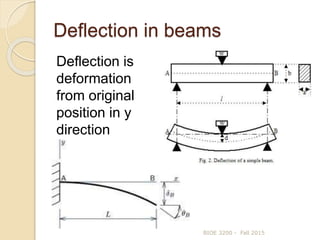
Deflection is
deformation
from original
position in y
direction
BIOE 3200 - Fall 2015
Recall relationships between shear
force, bending moment and normal
stresses
BIOE 3200 - Fall 2015
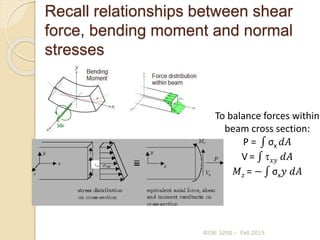
To balance forces within
beam cross section:
P = σx 𝑑𝐴
V =  𝑥𝑦 𝑑𝐴
𝑀 𝑧 = − σx 𝑦 𝑑𝐴
 𝑥𝑦
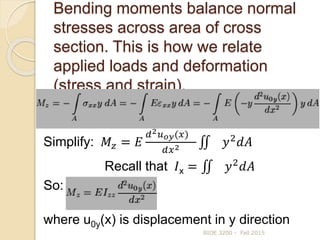
Bending moments balance normal
stresses across area of cross
section. This is how we relate
applied loads and deformation
(stress and strain).
BIOE 3200 - Fall 2015
Simplify: 𝑀𝑧 = 𝐸
𝑑2 𝑢 𝑜𝑦(𝑥)
𝑑𝑥2 𝑦2
𝑑𝐴
Recall that 𝐼x = 𝑦2
𝑑𝐴
So:
where u0y(x) is displacement in y direction
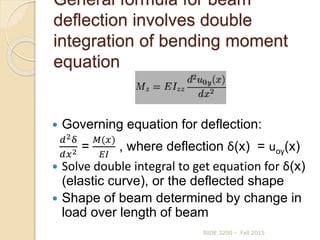
General formula for beam
deflection involves double
integration of bending moment
equation
 Governing equation for deflection:
𝑑2δ
𝑑𝑥2 =
𝑀(𝑥)
𝐸𝐼
, where deflection δ(x) = uoy(x)
 Solve double integral to get equation for δ(x)
(elastic curve), or the deflected shape
 Shape of beam determined by change in
load over length of beam
BIOE 3200 - Fall 2015
How to calculate beam deflection
using double integration method
BIOE 3200 - Fall 2015
δ(x)
EI = Flexural Rigidity
 Governing equation:
𝑑2δ
𝑑𝑥2 =
𝑀
𝐸𝐼
𝐸𝐼
𝑑δ
𝑑𝑥
= 0
𝑥
𝑀 𝑥 𝑑𝑥 + 𝐶1 Note:
𝑑δ
𝑑𝑥
= tan θ ≈ θ(x)
 𝐸𝐼θ(x) = 0
𝑥
𝑀 𝑥 𝑑𝑥 + 𝐶1
𝐸𝐼δ = 0
𝑥
[ 0
𝑥
𝑀 𝑥 𝑑𝑥 + 𝐶1 ] dx + 𝐶2
𝐸𝐼δ = 0
𝑥
𝑑𝑥 0
𝑥
𝑀 𝑥 𝑑𝑥 + 𝐶1x + 𝐶2 - general formula for
beam deflection
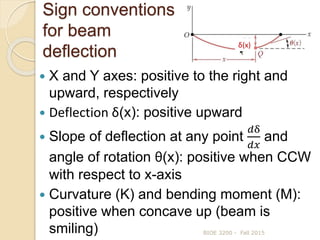
Sign conventions
for beam
deflection
 X and Y axes: positive to the right and
upward, respectively
 Deflection δ(x): positive upward
 Slope of deflection at any point
𝑑δ
𝑑𝑥
and
angle of rotation θ(x): positive when CCW
with respect to x-axis
 Curvature (K) and bending moment (M):
positive when concave up (beam is
smiling) BIOE 3200 - Fall 2015
δ(x)
What affects deflection?
 Bending moment
◦ Magnitude and type of loading
◦ Span (length) of beam
◦ Beam type (simply supported, cantilever)
 Material properties of beam (E)
 Shape of beam (Moment of Intertia I)
BIOE 3200 - Fall 2015
How to complete double
integration
𝐸𝐼δ = 0
𝑥
𝑑𝑥 0
𝑥
𝑀 𝑥 𝑑𝑥 + 𝐶1x + 𝐶2
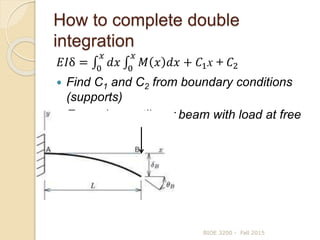
 Find C1 and C2 from boundary conditions
(supports)
 Example: cantilever beam with load at free
end
BIOE 3200 - Fall 2015
Using boundary conditions to
calculate deflections in beams
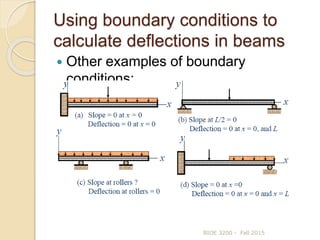
 Other examples of boundary
conditions:
BIOE 3200 - Fall 2015
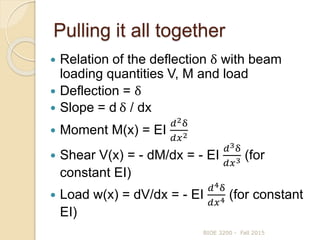
Pulling it all together
 Relation of the deflection δ with beam
loading quantities V, M and load
 Deflection = δ
 Slope = d δ / dx
 Moment M(x) = EI
𝑑2δ
𝑑𝑥2
 Shear V(x) = - dM/dx = - EI
𝑑3δ
𝑑𝑥3 (for
constant EI)
 Load w(x) = dV/dx = - EI
𝑑4δ
𝑑𝑥4 (for constant
EI)
BIOE 3200 - Fall 2015
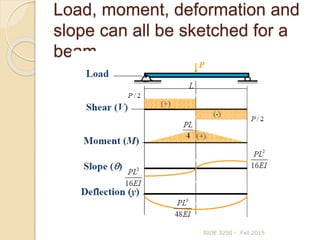
Load, moment, deformation and
slope can all be sketched for a
beam
BIOE 3200 - Fall 2015
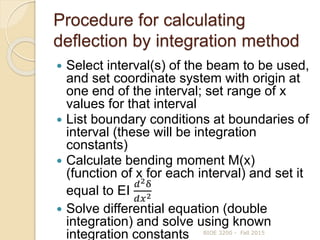
Procedure for calculating
deflection by integration method
 Select interval(s) of the beam to be used,
and set coordinate system with origin at
one end of the interval; set range of x
values for that interval
 List boundary conditions at boundaries of
interval (these will be integration
constants)
 Calculate bending moment M(x)
(function of x for each interval) and set it
equal to EI
𝑑2δ
𝑑𝑥2
 Solve differential equation (double
integration) and solve using known
integration constants BIOE 3200 - Fall 2015
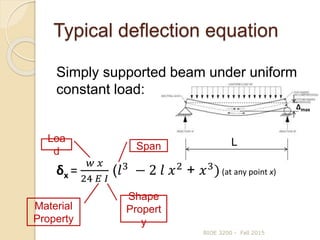
Typical deflection equation
Simply supported beam under uniform
constant load:
δx =
𝑤 𝑥
24 𝐸 𝐼
(𝑙3
− 2 𝑙 𝑥2
+ 𝑥3
)(at any point x)
BIOE 3200 - Fall 2015
Loa
d
Material
Property
Shape
Propert
y
L
Δmax
Span
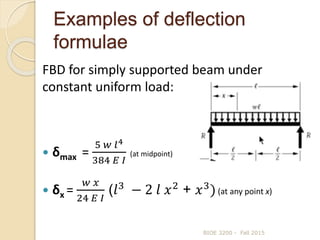
Examples of deflection
formulae
FBD for simply supported beam under
constant uniform load:
 δmax =
5 𝑤 𝑙4
384 𝐸 𝐼
(at midpoint)
 δx =
𝑤 𝑥
24 𝐸 𝐼
(𝑙3
− 2 𝑙 𝑥2
+ 𝑥3
)(at any point x)
BIOE 3200 - Fall 2015
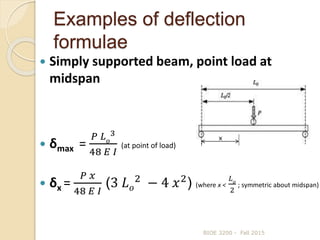
Examples of deflection
formulae
 Simply supported beam, point load at
midspan
 δmax =
𝑃 𝐿 𝑜
3
48 𝐸 𝐼
(at point of load)
 δx =
𝑃 𝑥
48 𝐸 𝐼
(3 𝐿 𝑜
2
− 4 𝑥2
) (where x <
𝐿 𝑜
2
; symmetric about midspan)
BIOE 3200 - Fall 2015
x
Examples of deflection
formulae
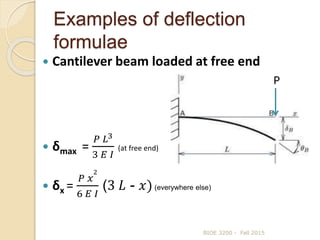
 Cantilever beam loaded at free end
 δmax =
𝑃 𝐿3
3 𝐸 𝐼
(at free end)
 δx =
𝑃 𝑥
2
6 𝐸 𝐼
(3 𝐿 - 𝑥)(everywhere else)
BIOE 3200 - Fall 2015
P

8 beam deflection

  • 1.
    Beam Deflection BIOE 3200- Fall 2015Watching stuff break
  • 2.
    Learning Objectives  Definebeam deflection (δ) and identify the factors that affect it  Determine deflection and slope in beams in bending using double integration method BIOE 3200 - Fall 2015
  • 3.
    Deflection in beams Deflectionis deformation from original position in y direction BIOE 3200 - Fall 2015
  • 4.
    Recall relationships betweenshear force, bending moment and normal stresses BIOE 3200 - Fall 2015 To balance forces within beam cross section: P = σx 𝑑𝐴 V =  𝑥𝑦 𝑑𝐴 𝑀 𝑧 = − σx 𝑦 𝑑𝐴  𝑥𝑦
  • 5.
    Bending moments balancenormal stresses across area of cross section. This is how we relate applied loads and deformation (stress and strain). BIOE 3200 - Fall 2015 Simplify: 𝑀𝑧 = 𝐸 𝑑2 𝑢 𝑜𝑦(𝑥) 𝑑𝑥2 𝑦2 𝑑𝐴 Recall that 𝐼x = 𝑦2 𝑑𝐴 So: where u0y(x) is displacement in y direction
  • 6.
    General formula forbeam deflection involves double integration of bending moment equation  Governing equation for deflection: 𝑑2δ 𝑑𝑥2 = 𝑀(𝑥) 𝐸𝐼 , where deflection δ(x) = uoy(x)  Solve double integral to get equation for δ(x) (elastic curve), or the deflected shape  Shape of beam determined by change in load over length of beam BIOE 3200 - Fall 2015
  • 7.
    How to calculatebeam deflection using double integration method BIOE 3200 - Fall 2015 δ(x) EI = Flexural Rigidity  Governing equation: 𝑑2δ 𝑑𝑥2 = 𝑀 𝐸𝐼 𝐸𝐼 𝑑δ 𝑑𝑥 = 0 𝑥 𝑀 𝑥 𝑑𝑥 + 𝐶1 Note: 𝑑δ 𝑑𝑥 = tan θ ≈ θ(x)  𝐸𝐼θ(x) = 0 𝑥 𝑀 𝑥 𝑑𝑥 + 𝐶1 𝐸𝐼δ = 0 𝑥 [ 0 𝑥 𝑀 𝑥 𝑑𝑥 + 𝐶1 ] dx + 𝐶2 𝐸𝐼δ = 0 𝑥 𝑑𝑥 0 𝑥 𝑀 𝑥 𝑑𝑥 + 𝐶1x + 𝐶2 - general formula for beam deflection
  • 8.
    Sign conventions for beam deflection X and Y axes: positive to the right and upward, respectively  Deflection δ(x): positive upward  Slope of deflection at any point 𝑑δ 𝑑𝑥 and angle of rotation θ(x): positive when CCW with respect to x-axis  Curvature (K) and bending moment (M): positive when concave up (beam is smiling) BIOE 3200 - Fall 2015 δ(x)
  • 9.
    What affects deflection? Bending moment ◦ Magnitude and type of loading ◦ Span (length) of beam ◦ Beam type (simply supported, cantilever)  Material properties of beam (E)  Shape of beam (Moment of Intertia I) BIOE 3200 - Fall 2015
  • 10.
    How to completedouble integration 𝐸𝐼δ = 0 𝑥 𝑑𝑥 0 𝑥 𝑀 𝑥 𝑑𝑥 + 𝐶1x + 𝐶2  Find C1 and C2 from boundary conditions (supports)  Example: cantilever beam with load at free end BIOE 3200 - Fall 2015
  • 11.
    Using boundary conditionsto calculate deflections in beams  Other examples of boundary conditions: BIOE 3200 - Fall 2015
  • 12.
    Pulling it alltogether  Relation of the deflection δ with beam loading quantities V, M and load  Deflection = δ  Slope = d δ / dx  Moment M(x) = EI 𝑑2δ 𝑑𝑥2  Shear V(x) = - dM/dx = - EI 𝑑3δ 𝑑𝑥3 (for constant EI)  Load w(x) = dV/dx = - EI 𝑑4δ 𝑑𝑥4 (for constant EI) BIOE 3200 - Fall 2015
  • 13.
    Load, moment, deformationand slope can all be sketched for a beam BIOE 3200 - Fall 2015
  • 14.
    Procedure for calculating deflectionby integration method  Select interval(s) of the beam to be used, and set coordinate system with origin at one end of the interval; set range of x values for that interval  List boundary conditions at boundaries of interval (these will be integration constants)  Calculate bending moment M(x) (function of x for each interval) and set it equal to EI 𝑑2δ 𝑑𝑥2  Solve differential equation (double integration) and solve using known integration constants BIOE 3200 - Fall 2015
  • 15.
    Typical deflection equation Simplysupported beam under uniform constant load: δx = 𝑤 𝑥 24 𝐸 𝐼 (𝑙3 − 2 𝑙 𝑥2 + 𝑥3 )(at any point x) BIOE 3200 - Fall 2015 Loa d Material Property Shape Propert y L Δmax Span
  • 16.
    Examples of deflection formulae FBDfor simply supported beam under constant uniform load:  δmax = 5 𝑤 𝑙4 384 𝐸 𝐼 (at midpoint)  δx = 𝑤 𝑥 24 𝐸 𝐼 (𝑙3 − 2 𝑙 𝑥2 + 𝑥3 )(at any point x) BIOE 3200 - Fall 2015
  • 17.
    Examples of deflection formulae Simply supported beam, point load at midspan  δmax = 𝑃 𝐿 𝑜 3 48 𝐸 𝐼 (at point of load)  δx = 𝑃 𝑥 48 𝐸 𝐼 (3 𝐿 𝑜 2 − 4 𝑥2 ) (where x < 𝐿 𝑜 2 ; symmetric about midspan) BIOE 3200 - Fall 2015 x
  • 18.
    Examples of deflection formulae Cantilever beam loaded at free end  δmax = 𝑃 𝐿3 3 𝐸 𝐼 (at free end)  δx = 𝑃 𝑥 2 6 𝐸 𝐼 (3 𝐿 - 𝑥)(everywhere else) BIOE 3200 - Fall 2015 P

Editor's Notes

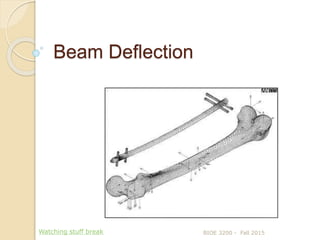
  • #2 Long bone curvature results in bending when compressive loads applied; convex surface under tension, convex surface under compression.
  • #4 Unloaded beam: neutral axis is level Applied load: neutral axis bends and takes on curved shape Distance d (also delta; maximum deflection is delta max) is distance between unloaded and loaded neutral axis (NA). Delta max occurs at mid-span of simply supported beam, or at free end of cantilever beam
  • #5 The axial stress σx produces a moment about the z-axis that must be equivalent to the moment resultant Mz. In other words, σx balances moment Mz, and Mz balances σx
  • #6 Recall that stress = strain x Young’s modulus (𝜖E) Note that we must integrate Mz over the cross-section A,  which lies in the y-z plane. Assume that Young's modulus E is a constant over the cross-section, and thus E may be taken outside the integral. Since uoy(x) is not a function of y or z, it may also be taken outside the integral. Replacing strain and E for stress, moment equation includes E and second derivative of displacement term u(x). This is also called delta (δ) Iz = Second moment of area Note EI = flexural rigidity; material and shape property of beam, assumed to be constant throughout beam (unless otherwise noted)
  • #7 The equation for beam deflection is an ordinary second order differential equation. It defines the transverse displacement in terms of the bending moment. We know that bending moment Mz is a function of position x along the beam, and we have already learned how to determine the equation for Mz. So deflection can be determined by double integrating the equation for M. Note: EI = flexural rigidity
  • #8 Integrate 2nd order differential equation twice to get expression for δ(x) θ(x) – approximate slope at location Q along the beam for small deflections, because d𝛅 dx = tan θ ≈ θ(x) for small deflections Beam deflection defined between two points; red curve represents the deflected shape of the beam. Can express elastic curve as a function of x – get equation of line, can get deflection at any point on the beam. Governing equation: M = complete equation for moment distribution along a beam; Differential equation can be integrated in each particular case to find the deflection delta, provided by bending moment M and flexural rigidity EI are known.
  • #9 Beam between two points; red curve represented the deflected shape of the beam. Can express elastic curve as a function of x – get equation of line, can get deflection at any point on the beam. Governing equation: M = complete equation for moment distribution along a beam; Differential equation can be integrated in each particular case to find the deflection delta, provided by bending moment M and flexural rigidity EI are known. EI = flexural rigidity
  • #10 Higher magnitude, more deflection; Uniform load produces less deflection than single point (same equivalent resultant) Same load on a longer beam will be greater than on a shorter beam Stiffer beam (higher E) will deflect less Shape of beam – mainly cross section (rectangular, circular, I-shape)
  • #11 At points A and B for simply supported beam, deflection = 0 For cantilever, slope and deflection at A = 0 Use these boundary conditions to calculate C1 and C2 (2 constants, 2 boundary conditions) (1) the x and y axes are positive to the right and upward, respectively; (2) The deflection ν is positive upward; (3) The slope dν dx and angle of rotation θ are positive when counterclockwise with respect to the positive x axis; (4) The curvature k is positive when the beam is bent concave upward; and (5) the bending moment M is positive when it produces compression in the upper part of the beam.
  • #12 For more complex loading scenarios where equation for moment cannot be defined for entire x, cut beam into sections where M can be represented by one function – concentrated loads, discontinuity in distributed loads
  • #14 Sign convention: (1) the x and y axes are positive to the right and upward, respectively; (2) The deflection ν is positive upward; (3) The slope dν dx and angle of rotation θ are positive when counterclockwise with respect to the positive x axis; (4) The curvature k is positive when the beam is bent concave upward; and (5) the bending moment M is positive when it produces compression in the upper part of the beam.
  • #16 Example (W is a distributed load): At any distance x from left to right (except midspan) Delta max is at mid-span
  • #17 Delta max is at mid-span
  • #18 Delta x left or right of midspan, deflection will be less than delta max (deflection at midspan)
  • #19 All these equations have the same elements: load, geometry, material properties and shape properties