Cooperative Learning How working together gives  you skills for life! By Lori Brouillette Adams Middle School 6 th  Grade Language Arts Instructor Click on the arrows to guide you through the slide show.
Standards The State of Nebraska thinks cooperative learning is a life-skill that you should have mastery of before you graduate.  It’s that important!   LA 6.3.3 Reciprocal Communication: Students will develop, apply, and adapt reciprocal communication skills.
6.3.3 Breakdown LA 6.3.3.a Demonstrate sensitivity to the use of words in general as well as to a particular audience (e.g., stereotypes, connotations, subtleties of language)  LA 6.3.3.b Apply conversation strategies (e.g., listen while others are talking, gain the floor, eye contact, tone, stay on topic, non-verbal cues)  LA 6.3.3.c Interact and collaborate with others in learning situations by contributing questions, information, opinions, and ideas using a variety of media and formats
What Is Cooperative Learning? Cooperative learning   is where teams of students, with various abilities and skills, work together on different activities to learn about a subject.  Groups will stay together for weeks, months or years. Groups should be 2-5 people in size.
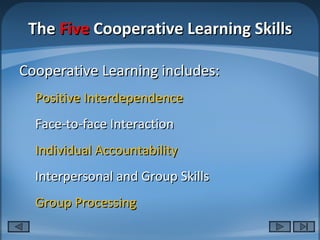
The  Five  Cooperative Learning Skills Cooperative Learning includes: Positive Interdependence Face-to-face Interaction Individual Accountability Interpersonal and Group Skills Group Processing
Positive Interdependence Positive interdependence   means you need each other to complete your task. How do you get it? Establish mutual goals Come up with rewards to everyone Share materials and information Assign roles
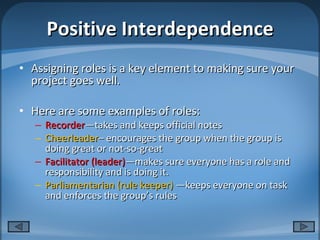
Positive Interdependence Assigning roles is a key element to making sure your project goes well. Here are some examples of roles: Recorder —takes and keeps official notes Cheerleader – encourages the group when the group is doing great or not-so-great Facilitator (leader) —makes sure everyone has a role and responsibility and is doing it.  Parliamentarian (rule keeper)  —keeps everyone on task and enforces the group’s rules
Positive Interdependence With your table group, think of at least three (3) other roles cooperative learning groups might have. We will be assigning these group roles this week.
Face-to-Face Interaction You get to talk in class! But only about your project by… Summarizing the lesson or assignment Helping each other out by explaining assignments or further discussing them with your group Sit facing each other Not in rows or lines Look at the speaker (eye-contact) Think about what they are saying
Individual Accountability Everyone  must learn the information,  so  everyone  can contribute to the project. Group grade and individual grade. Group is graded on project. Individuals are graded on how well they perform their role, responsibilities and know the information. Everyone has a job to do.
Responsibilities & Individual Accountability Make a “T-chart” of group project responsibilities that you have enjoyed in the past and some that you have not liked.  Write at least three in each column. When everyone is finished, share your answers with each other.
Interpersonal & Group Skills Brainstorm a list of reasons why working in groups is tough. Focus on what people do to make it hard to get the job done. Example: Insults like, “Don’t be stupid, that’s not how you do it!”
Interpersonal & Group Skills Now… as a group, come up with solutions to those negative problems. Focus on how your group will work through problems Example: “One of our group rules is no “put downs,” let’s hear your idea.”
Interpersonal & Group Skills Wouldn’t it be easier to  prevent  or avoid conflicts before they start? Respect each other’s opinion Celebrate and use your differences to your advantage Use active listening
Interpersonal & Group Skills Active listening  is a structured form of listening and responding that focuses the attention on the speaker.  Listener gives the speaker his or her  full attention . Listener  repeats   the speaker’s words. Speaker will  clarify  if the listener doesn’t understand their point of view.
Interpersonal & Group Skills Click on the video to learn how active listening can help you manage conflicts.
Active Listening Quiz Paying attention Showing interest Eye contact Walk away from the speaker Don’t interrupt or change the subject Ask questions Repeat what the speaker said in your own words Listen for feelings Click on the bulleted words that are  not  an example of active listening?
Active Listening Quiz Correct! You did a great job listening to the video. Use those listening skills to avoid conflict when working with others!
Active Listening Quiz Sorry, that’s wrong. The correct answer was: “ An active listener does not walk away  from the speaker.”  Talk to your group about why you thought your answer was correct or replay the video.  Replay video
Interpersonal & Group Skills Remember… in order to effectively learn, cooperative groups must use these skills: Communication Decision-making Active Listening Conflict-management Leadership That might mean… letting someone else be the leader.
Group Process Groups need time to think and reflect. What procedures are working well– what needs to change What has the group learned? What has the group accomplished? What would the group/group members do differently next time? How would the group grade itself? Each other?
Cooperative Learning Works! Research suggests that students who work in  cooperative groups have higher achievement and learning  than… When they work alone Work competitively Or individually … regardless  of their differences in ability, ethnic background, handicapped or not!
Cooperative Learning Quiz Cooperative learning groups need which of the following skills to successfully work? Click on your answer. A– Positive interdependence B– Face-to-face interaction C– Individual accountability D– Interpersonal and group skills E– Group processing  F— All of the above
Cooperative Learning Quiz You’re Right! Your skills are going to be a great asset to your cooperative learning group!
Cooperative Learning Quiz That’s  one  of the ways to make a cooperative learning group experience great, but you’re forgetting the rest.  Click here   to review the list and don’t forget to practice  all  of the skills listed!
Internet Resources www.unitedsteaming.com http://edtech.kennesaw.edu/intech/cooperativelearning.htm www.colorado.edu/conflict/peace/treatment/activel.htm

Cooperative Learning Powerpoint

  • 1.
    Cooperative Learning Howworking together gives you skills for life! By Lori Brouillette Adams Middle School 6 th Grade Language Arts Instructor Click on the arrows to guide you through the slide show.
  • 2.
    Standards The Stateof Nebraska thinks cooperative learning is a life-skill that you should have mastery of before you graduate. It’s that important! LA 6.3.3 Reciprocal Communication: Students will develop, apply, and adapt reciprocal communication skills.
  • 3.
    6.3.3 Breakdown LA6.3.3.a Demonstrate sensitivity to the use of words in general as well as to a particular audience (e.g., stereotypes, connotations, subtleties of language) LA 6.3.3.b Apply conversation strategies (e.g., listen while others are talking, gain the floor, eye contact, tone, stay on topic, non-verbal cues) LA 6.3.3.c Interact and collaborate with others in learning situations by contributing questions, information, opinions, and ideas using a variety of media and formats
  • 4.
    What Is CooperativeLearning? Cooperative learning is where teams of students, with various abilities and skills, work together on different activities to learn about a subject. Groups will stay together for weeks, months or years. Groups should be 2-5 people in size.
  • 5.
    The Five Cooperative Learning Skills Cooperative Learning includes: Positive Interdependence Face-to-face Interaction Individual Accountability Interpersonal and Group Skills Group Processing
  • 6.
    Positive Interdependence Positiveinterdependence means you need each other to complete your task. How do you get it? Establish mutual goals Come up with rewards to everyone Share materials and information Assign roles
  • 7.
    Positive Interdependence Assigningroles is a key element to making sure your project goes well. Here are some examples of roles: Recorder —takes and keeps official notes Cheerleader – encourages the group when the group is doing great or not-so-great Facilitator (leader) —makes sure everyone has a role and responsibility and is doing it. Parliamentarian (rule keeper) —keeps everyone on task and enforces the group’s rules
  • 8.
    Positive Interdependence Withyour table group, think of at least three (3) other roles cooperative learning groups might have. We will be assigning these group roles this week.
  • 9.
    Face-to-Face Interaction Youget to talk in class! But only about your project by… Summarizing the lesson or assignment Helping each other out by explaining assignments or further discussing them with your group Sit facing each other Not in rows or lines Look at the speaker (eye-contact) Think about what they are saying
  • 10.
    Individual Accountability Everyone must learn the information, so everyone can contribute to the project. Group grade and individual grade. Group is graded on project. Individuals are graded on how well they perform their role, responsibilities and know the information. Everyone has a job to do.
  • 11.
    Responsibilities & IndividualAccountability Make a “T-chart” of group project responsibilities that you have enjoyed in the past and some that you have not liked. Write at least three in each column. When everyone is finished, share your answers with each other.
  • 12.
    Interpersonal & GroupSkills Brainstorm a list of reasons why working in groups is tough. Focus on what people do to make it hard to get the job done. Example: Insults like, “Don’t be stupid, that’s not how you do it!”
  • 13.
    Interpersonal & GroupSkills Now… as a group, come up with solutions to those negative problems. Focus on how your group will work through problems Example: “One of our group rules is no “put downs,” let’s hear your idea.”
  • 14.
    Interpersonal & GroupSkills Wouldn’t it be easier to prevent or avoid conflicts before they start? Respect each other’s opinion Celebrate and use your differences to your advantage Use active listening
  • 15.
    Interpersonal & GroupSkills Active listening is a structured form of listening and responding that focuses the attention on the speaker. Listener gives the speaker his or her full attention . Listener repeats the speaker’s words. Speaker will clarify if the listener doesn’t understand their point of view.
  • 16.
    Interpersonal & GroupSkills Click on the video to learn how active listening can help you manage conflicts.
  • 17.
    Active Listening QuizPaying attention Showing interest Eye contact Walk away from the speaker Don’t interrupt or change the subject Ask questions Repeat what the speaker said in your own words Listen for feelings Click on the bulleted words that are not an example of active listening?
  • 18.
    Active Listening QuizCorrect! You did a great job listening to the video. Use those listening skills to avoid conflict when working with others!
  • 19.
    Active Listening QuizSorry, that’s wrong. The correct answer was: “ An active listener does not walk away from the speaker.” Talk to your group about why you thought your answer was correct or replay the video. Replay video
  • 20.
    Interpersonal & GroupSkills Remember… in order to effectively learn, cooperative groups must use these skills: Communication Decision-making Active Listening Conflict-management Leadership That might mean… letting someone else be the leader.
  • 21.
    Group Process Groupsneed time to think and reflect. What procedures are working well– what needs to change What has the group learned? What has the group accomplished? What would the group/group members do differently next time? How would the group grade itself? Each other?
  • 22.
    Cooperative Learning Works!Research suggests that students who work in cooperative groups have higher achievement and learning than… When they work alone Work competitively Or individually … regardless of their differences in ability, ethnic background, handicapped or not!
  • 23.
    Cooperative Learning QuizCooperative learning groups need which of the following skills to successfully work? Click on your answer. A– Positive interdependence B– Face-to-face interaction C– Individual accountability D– Interpersonal and group skills E– Group processing F— All of the above
  • 24.
    Cooperative Learning QuizYou’re Right! Your skills are going to be a great asset to your cooperative learning group!
  • 25.
    Cooperative Learning QuizThat’s one of the ways to make a cooperative learning group experience great, but you’re forgetting the rest. Click here to review the list and don’t forget to practice all of the skills listed!
  • 26.
    Internet Resources www.unitedsteaming.comhttp://edtech.kennesaw.edu/intech/cooperativelearning.htm www.colorado.edu/conflict/peace/treatment/activel.htm