BIOE 3200
Biomechanics
 Define viscoelastic stress/strain and time –
dependent relationships, and compare for
different materials
 Define viscoelastic behaviors (creep and
stress relaxation) and compare for different
biologic materials (muscle, ligament,
tendon, cartilage)
 Identify tissue structures and components
that contribute and/or explain viscoelastic
properties for different biologic materials
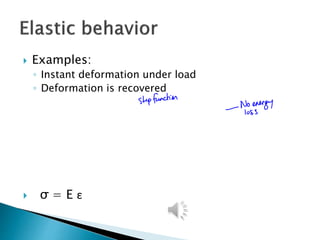
 Examples:
◦ Instant deformation under load
◦ Deformation is recovered
 σ = E ε
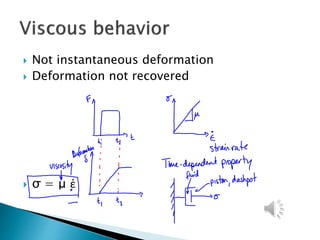
 Not instantaneous deformation
 Deformation not recovered
 σ = μ ἐ
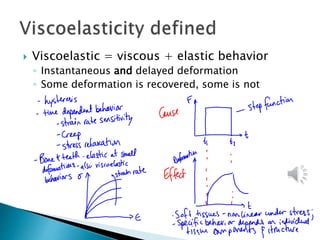
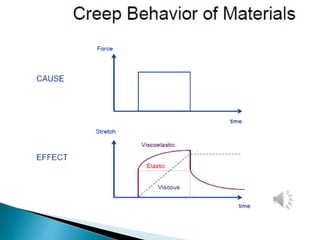
 Viscoelastic = viscous + elastic behavior
◦ Instantaneous and delayed deformation
◦ Some deformation is recovered, some is not
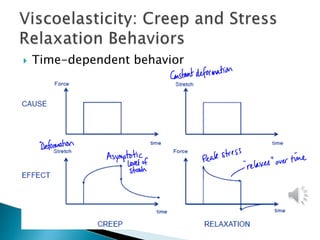
 Time-dependent behavior
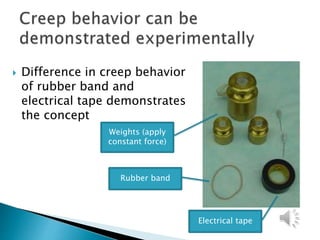
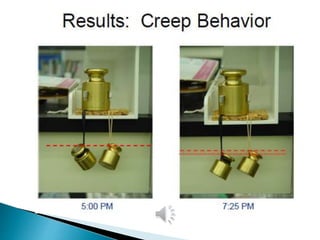
 Difference in creep behavior
of rubber band and
electrical tape demonstrates
the concept
Rubber band
Electrical tape
Weights (apply
constant force)
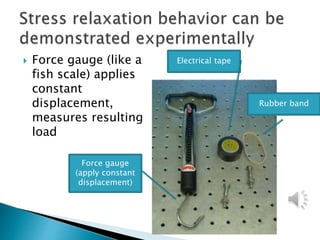
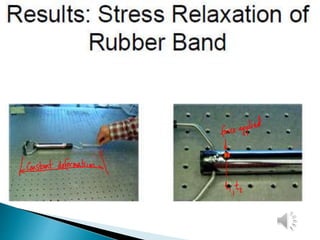
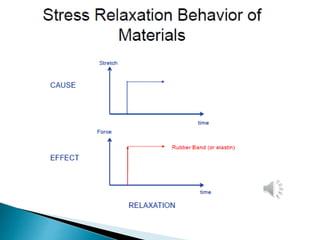
 Force gauge (like a
fish scale) applies
constant
displacement,
measures resulting
load
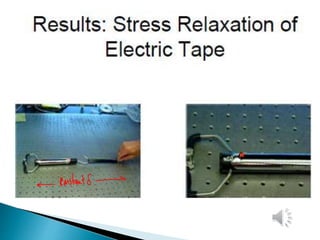
Rubber band
Electrical tape
Force gauge
(apply constant
displacement)
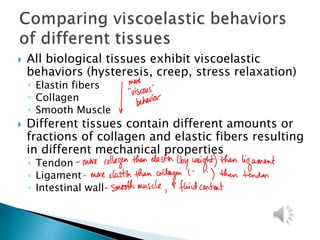
 All biological tissues exhibit viscoelastic
behaviors (hysteresis, creep, stress relaxation)
◦ Elastin fibers
◦ Collagen
◦ Smooth Muscle
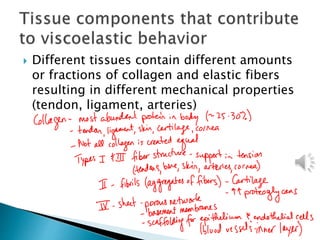
 Different tissues contain different amounts or
fractions of collagen and elastic fibers resulting
in different mechanical properties
◦ Tendon
◦ Ligament
◦ Intestinal wall
 Different tissues contain different amounts
or fractions of collagen and elastic fibers
resulting in different mechanical properties
(tendon, ligament, arteries)
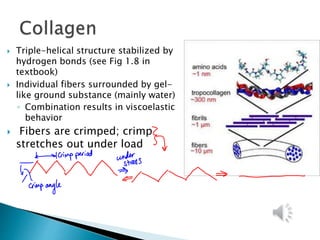
 Triple-helical structure stabilized by
hydrogen bonds (see Fig 1.8 in
textbook)
 Individual fibers surrounded by gel-
like ground substance (mainly water)
◦ Combination results in viscoelastic
behavior
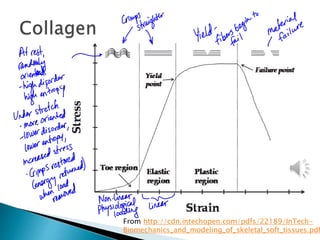
 Fibers are crimped; crimp
stretches out under load
From http://cdn.intechopen.com/pdfs/22189/InTech-
Biomechanics_and_modeling_of_skeletal_soft_tissues.pdf
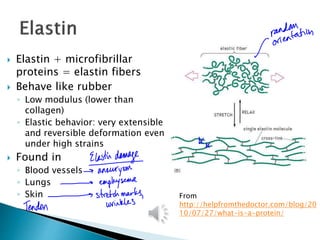
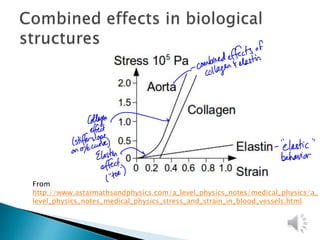
 Elastin + microfibrillar
proteins = elastin fibers
 Behave like rubber
◦ Low modulus (lower than
collagen)
◦ Elastic behavior: very extensible
and reversible deformation even
under high strains
 Found in
◦ Blood vessels
◦ Lungs
◦ Skin From
http://helpfromthedoctor.com/blog/20
10/07/27/what-is-a-protein/
From
http://www.astarmathsandphysics.com/a_level_physics_notes/medical_physics/a_
level_physics_notes_medical_physics_stress_and_strain_in_blood_vessels.html

9 Viscoelasticity and biological tissues

Editor's Notes

  • #4 Stress/strain curves for metal, soft tissue and rubber/elastomers (from pp. 81-87 in text); strains are orders of magnitude higher for soft tissues and elastomers
  • #5 An instantaneous increase in applied force is known as a step-function (See force-time curve for step function above); resulting deformation curve is also a step function for elastic materials Mechanical analogy for elastic material: spring Characterized by straight stress/strain curve, elasticity (constant elastic modulus, or slope of stress/strain curve), no energy loss when loaded and unloaded Metal is linear (direct relation between stress and strain) and elastic – it responds almost instantaneously under load and there is no energy dissipated when it deforms. Bone and teeth are linear under small strains (within physiologic ranges); there are no changes in microstructure, so no change in properties.
  • #6 Force-time curve for step function on top; below is resulting deformation curve for viscous material (linearly increasing deformation from t0 to t1, flat line after t1) Mechanical analogy for viscous material: dashpot Curved stress/strain curve; typically shown as stress and strain rate (change in strain with time); viscous materials have a constant strain rate under constant load
  • #7 - Soft tissues and elastomers are non-linear under stress with no permanent change in structure; this is due to their long-chain polymeric structure. Specific behavior of different tissue types depends on underlying conformations of molecules (inherent order or disorder). Elastin and collagen dominate soft tissue behavior; soft tissue is “nearly elastic” or “pseudoelastic”, meaning it responds almost instantaneously under load, but exhibits hysteresis (different loading and unloading curves due to energy loss). Hysteresis is due to movement of the structural proteins within the viscous ground substance (dominated by proteoglycans). Bones experience small strains (less than .001 during walking) which are necessary for balanced osteoblast/osteoclast activity (compressive strain); higher strain = higher bone production and lower removal of bone, eventually leading to microdamage, which may stimulate growth/healing response. Extremely low strains (unloading) leads to net loss of bone. Strain response to applied stress depends on strain rate (similar to loading rate); strain rate sensitivity is a characteristic of time-dependent behavior of viscoelastic materials.
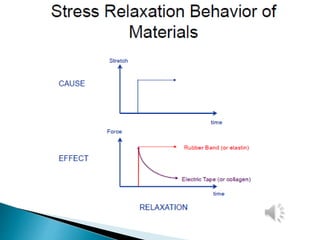
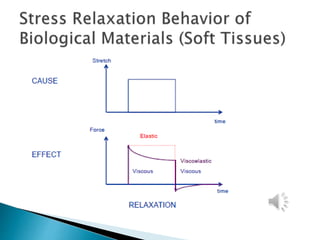
  • #8 Refer to Humphrey and Delange Ch 11.4 for a thorough explanation of creep and stress relaxation curves. Creep: apply a constant force, and resulting deformation is time-dependent. Stress relaxation: apply a constant deformation, and resulting stress within the material is time-dependent.
  • #9 Test set up for measuring creep (known load, measure deformation over time); different for electrical tape vs. rubber band Apply a constant stress and measure resulting strain Strain (creep) will grow with time Modulus is time-dependent Unlike elastic materials - under fixed stress elastic materials will reach a fixed strain and stay at that level
  • #10 Creep – time-dependent deformation under a constant load; (Sort of the inverse of stress relaxation); refers to the general characteristic of viscoelastic materials to undergo increased deformation under a constant stress, until an asymptotic level of strain is reached
  • #11 Creep –constant load (step function for force-time curve); increased deformation to asymptotic level of strain, as shown in stress/strain figure
  • #12 Test set up for measuring stress relaxation (known deformation, measure change in force over time) Apply constant strain and measure resulting stress Stress decreases with time (material relaxes) Modulus is time-dependent Unlike elastic materials - under fixed strain, elastic materials will reach a fixed stress and stay at that level with no relaxation
  • #17 Stress relaxation – time-dependent decrease in load at a constant deformation; refers to the behavior of stress reaching a peak and then decreasing or “relaxing” over time under a fixed level of strain, as shown in stress/strain figure
  • #18 The more viscous a material, the more it relaxes and creeps; more strain rate dependency Different relative fractions of collagen and elastin in each tissue Tendons (muscle – bone) – more collagen than elastin by weight compared to ligament Ligaments (bone – bone) – more elastin than collagen by weight compared to tendon
  • #19  Collagen in tendon, ligament, skin, cartilage, bone, cornea, blood vessels – most abundant protein in the body (~25-30%) Not all collagen is the same (29 types – or more!); most common are I, II, III and IV I and III – fibers – structural support in tension; found in tendons, skin, bone, hear, arteries and cornea II – fibrils – cartilage (which also has lots of proteoglycans) IV – sheet; porous network that forms basement membrane – scaffolding for epithelial and endothelial cells – inner layer of blood vessels
  • #21 Three distinct regions of stress-strain curve for collagen 1 – Toe region – non-linear, physiological level loading 2 – Linear elastic 3 – Yield 4 - Failure At rest: randomly oriented molecules – high disorder, higher entropy Under stretch: more oriented – lower disorder, lower entropy, increased stress (like a spring – energy is stored in stretched fiber, which is released to restore crimp when load is removed)
  • #22 - Damage to elastin: - in blood vessels – aneurysm - in skin – wrinkles (often due to sun damage) - in lung - emphysema
  • #23 Elastin contributes to toe region Collagen contributes to stiffer slope of stress-strain curve