ActiveActive LearningLearning
Active learning เป็นการเรียนการสอนที่ผู้เรียนมีความ
คล่องแคล่วกระตือรือล้นในการเรียน หรือการเรียนการ
สอนที่ผู้เรียนวุ่นทำางานอยู่กับเนื้อหาวิชา โดยการพูดคุย
การเขียน การอ่าน การสะท้อน การตั้งคำาถาม หรือ
ใช้ได้ทั้งกลุ่มเล็ก และห้องเรียนใหญ่ ๆ ผู้เรียนอาจทำางาน
คนเดียวหรือทำาเป็นกลุ่มก็ได้ และอาจใช้ในเวลา 2-3
นาที หรือยาวทั้งหลักสูตรก็ได้ 
Active learning ช่วยให้ผู้เรียนเข้าใจได้ดีขึ้น และสามารถ
เก็บกักข้อมูลข่าวสารไว้ในความทรงจำาได้นานขึ้น
นอกจากนี้ยังมีประสิทธิภาพในการพัฒนากระบวนรับรู้ใน
ลำาดับที่สูงขึ้น เช่น การแก้ปัญหา และการคิดวิเคราะห์
คนที่เรียนรู้ได้จากการเรียนการสอนแบบนี้ เขาจะพอใจผู้
สอนมาก
วิธีการสอนแบบ Active learning ใช้กิจกรรมได้หลายรูป
แบบเช่น group discussions, problem solving, case
studies, role plays, and structured learning groups แต่
ถ้าห้องใหญ่ ๆ อาจจัดกลุ่มอะไรก็ยาก การให้เขียน หรือ
จับคู่กันน่าจะเหมาะสมกว่า
What is Active Learning?What is Active Learning?
“I hear and I forget. I see and I remember. I do
and I understand”
- Confucius
Any instructional activity that involves
students in DOING, and THINKING about
what they are learning.
What is Active Learning?What is Active Learning?
Time of class (min)
10 20 30 40 60
%Retained
50
100
50
0
lecture
active learning
From: McKeachie, Teaching tips: Strategies, research and theory for
for college and university teachers, Houghton-Mifflin (1998)
What is Active Learning?What is Active Learning?
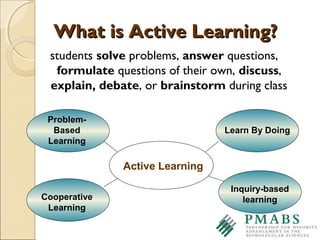
students solve problems, answer questions,
formulate questions of their own, discuss,
explain, debate, or brainstorm during class
Active Learning
Problem-
Based
Learning
Cooperative
Learning
Learn By Doing
Inquiry-based
learning
What is the purpose?What is the purpose?
 Increase student participation
 Increase student engagement
 Increase student retention
 More student ownership in course
 Less lecturing by instructor
 More exciting classroom experience
 Higher level thinking
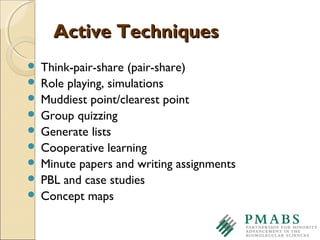
Active TechniquesActive Techniques
 Think-pair-share (pair-share)
 Role playing, simulations
 Muddiest point/clearest point
 Group quizzing
 Generate lists
 Cooperative learning
 Minute papers and writing assignments
 PBL and case studies
 Concept maps
In-Class TeamsIn-Class Teams
Form teams of 2-4, choose recorders. Give
teams 30 seconds--5 minutes to
◦Recall prior material
◦Answer a question
◦Start a problem solution
◦Work out next step in a derivation
◦Think of an example or application
◦ Figure out why a given result may be wrong
◦ Brainstorm (object is quantity, not quality)
◦ Generate a question
◦ Summarize a lecture
Collect some or all answers. This always works,
regardless of class size.
Think-pair-share
Students think of answers individually, then form
pairs to synthesize response. Pairs share
responses.
More time-consuming, more instructive than
immediate group work.
Cooperative Note-Taking Pairs
At several points in the lecture,
pairs summarize & compare
what they have in their notes.
Goal: More accurate & complete notes.
Especially helpful in courses where students need
note-taking support.
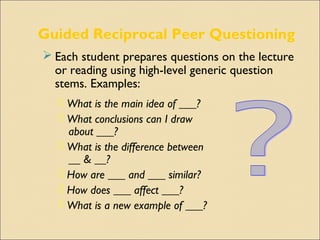
Guided Reciprocal Peer Questioning
 Each student prepares questions on the lecture
or reading using high-level generic question
stems. Examples:
 What is the main idea of ___?
 What conclusions can I draw
about ___?
 What is the difference between
__ & __?
 How are ___ and ___ similar?
 How does ___ affect ___?
 What is a new example of ___?
 What if ___?
 Explain why…
 Explain how…
 How would I use ___ to ___?
 In class, groups of 3-4 students take turns
answering their questions.
 Whole class comes together to discuss
unanswered or interesting questions.
Writing AssignmentsWriting Assignments
Assign frequent, short writing
assignments
Students “write to learn”
gaining deeper understanding
of course material
May be kept in a learning log
Problem-Based LearningProblem-Based Learning
Present real-world problem
or scenario. Ask groups to
◦ define the problem
◦ build hypotheses to initiate the solution process
◦ identify what is known, what must be determined, and what to
do
◦ generate possible solutions and decide on the best one
◦ complete the best solution and defend it
◦ reflect on lessons learned
Minute PaperMinute Paper
Stop the lecture with two minutes to go.Ask
students to write
1. the main point(s)
2. the muddiest (least clear) point(s)
Collect the papers. Use responses to plan
the next lecture.
TAPPS (Thinking-AloudTAPPS (Thinking-Aloud
Pair Problem Solving)Pair Problem Solving)
Students in pairs (dyads)--one problem solver,
one listener
Problem-solver talks through solution. Listener
questions, prompts, gives clues.
Instructor asks questions to make sure
everyone is together.
Pairs reverse roles and continue.
Time-consuming, but powerful.
ImplementingImplementing
Active LearningActive Learning
◦ Explain what you’re doing and why
◦ Call randomly on individuals to report (while
working and after work is complete)
◦ Vary format (pairs, groups, think-pair-share,
intervals between exercises)
◦ Put some course material on handouts, leave gaps
& insert questions. Use time saved to do more
active learning.
What might happen if youWhat might happen if you
start using active learning?start using active learning?
Initial awkwardness (the students & you),
noncompliance
Rapidly increasing comfort level except for a few
students who remain resistant
Much higher levels of energy & participation
More & better answers
Greater learning

Active learning

  • 1.
  • 2.
    Active learning เป็นการเรียนการสอนที่ผู้เรียนมีความ คล่องแคล่วกระตือรือล้นในการเรียนหรือการเรียนการ สอนที่ผู้เรียนวุ่นทำางานอยู่กับเนื้อหาวิชา โดยการพูดคุย การเขียน การอ่าน การสะท้อน การตั้งคำาถาม หรือ ใช้ได้ทั้งกลุ่มเล็ก และห้องเรียนใหญ่ ๆ ผู้เรียนอาจทำางาน คนเดียวหรือทำาเป็นกลุ่มก็ได้ และอาจใช้ในเวลา 2-3 นาที หรือยาวทั้งหลักสูตรก็ได้ 
  • 3.
    Active learning ช่วยให้ผู้เรียนเข้าใจได้ดีขึ้นและสามารถ เก็บกักข้อมูลข่าวสารไว้ในความทรงจำาได้นานขึ้น นอกจากนี้ยังมีประสิทธิภาพในการพัฒนากระบวนรับรู้ใน ลำาดับที่สูงขึ้น เช่น การแก้ปัญหา และการคิดวิเคราะห์ คนที่เรียนรู้ได้จากการเรียนการสอนแบบนี้ เขาจะพอใจผู้ สอนมาก
  • 4.
    วิธีการสอนแบบ Active learningใช้กิจกรรมได้หลายรูป แบบเช่น group discussions, problem solving, case studies, role plays, and structured learning groups แต่ ถ้าห้องใหญ่ ๆ อาจจัดกลุ่มอะไรก็ยาก การให้เขียน หรือ จับคู่กันน่าจะเหมาะสมกว่า
  • 5.
    What is ActiveLearning?What is Active Learning? “I hear and I forget. I see and I remember. I do and I understand” - Confucius Any instructional activity that involves students in DOING, and THINKING about what they are learning.
  • 6.
    What is ActiveLearning?What is Active Learning? Time of class (min) 10 20 30 40 60 %Retained 50 100 50 0 lecture active learning From: McKeachie, Teaching tips: Strategies, research and theory for for college and university teachers, Houghton-Mifflin (1998)
  • 7.
    What is ActiveLearning?What is Active Learning?
  • 8.
    What is ActiveLearning?What is Active Learning? students solve problems, answer questions, formulate questions of their own, discuss, explain, debate, or brainstorm during class Active Learning Problem- Based Learning Cooperative Learning Learn By Doing Inquiry-based learning
  • 9.
    What is thepurpose?What is the purpose?  Increase student participation  Increase student engagement  Increase student retention  More student ownership in course  Less lecturing by instructor  More exciting classroom experience  Higher level thinking
  • 10.
    Active TechniquesActive Techniques Think-pair-share (pair-share)  Role playing, simulations  Muddiest point/clearest point  Group quizzing  Generate lists  Cooperative learning  Minute papers and writing assignments  PBL and case studies  Concept maps
  • 11.
    In-Class TeamsIn-Class Teams Formteams of 2-4, choose recorders. Give teams 30 seconds--5 minutes to ◦Recall prior material ◦Answer a question ◦Start a problem solution ◦Work out next step in a derivation ◦Think of an example or application
  • 12.
    ◦ Figure outwhy a given result may be wrong ◦ Brainstorm (object is quantity, not quality) ◦ Generate a question ◦ Summarize a lecture Collect some or all answers. This always works, regardless of class size.
  • 13.
    Think-pair-share Students think ofanswers individually, then form pairs to synthesize response. Pairs share responses. More time-consuming, more instructive than immediate group work.
  • 14.
    Cooperative Note-Taking Pairs Atseveral points in the lecture, pairs summarize & compare what they have in their notes. Goal: More accurate & complete notes. Especially helpful in courses where students need note-taking support.
  • 15.
    Guided Reciprocal PeerQuestioning  Each student prepares questions on the lecture or reading using high-level generic question stems. Examples:  What is the main idea of ___?  What conclusions can I draw about ___?  What is the difference between __ & __?  How are ___ and ___ similar?  How does ___ affect ___?  What is a new example of ___?
  • 16.
     What if___?  Explain why…  Explain how…  How would I use ___ to ___?  In class, groups of 3-4 students take turns answering their questions.  Whole class comes together to discuss unanswered or interesting questions.
  • 17.
    Writing AssignmentsWriting Assignments Assignfrequent, short writing assignments Students “write to learn” gaining deeper understanding of course material May be kept in a learning log
  • 18.
    Problem-Based LearningProblem-Based Learning Presentreal-world problem or scenario. Ask groups to ◦ define the problem ◦ build hypotheses to initiate the solution process ◦ identify what is known, what must be determined, and what to do ◦ generate possible solutions and decide on the best one ◦ complete the best solution and defend it ◦ reflect on lessons learned
  • 19.
    Minute PaperMinute Paper Stopthe lecture with two minutes to go.Ask students to write 1. the main point(s) 2. the muddiest (least clear) point(s) Collect the papers. Use responses to plan the next lecture.
  • 20.
    TAPPS (Thinking-AloudTAPPS (Thinking-Aloud PairProblem Solving)Pair Problem Solving) Students in pairs (dyads)--one problem solver, one listener Problem-solver talks through solution. Listener questions, prompts, gives clues. Instructor asks questions to make sure everyone is together. Pairs reverse roles and continue. Time-consuming, but powerful.
  • 21.
    ImplementingImplementing Active LearningActive Learning ◦Explain what you’re doing and why ◦ Call randomly on individuals to report (while working and after work is complete) ◦ Vary format (pairs, groups, think-pair-share, intervals between exercises) ◦ Put some course material on handouts, leave gaps & insert questions. Use time saved to do more active learning.
  • 22.
    What might happenif youWhat might happen if you start using active learning?start using active learning? Initial awkwardness (the students & you), noncompliance Rapidly increasing comfort level except for a few students who remain resistant Much higher levels of energy & participation More & better answers Greater learning