Unit I: Active Learning How to Maximize the Retention and Comprehension of Course Content Material in Training
Learning Objective Learners will be able to create an Active Learning plan for their training regimen using the principles and techniques learned in the lesson.
Learning Agenda Section I: Active Learning Section II: Incorporating Learning Preferences VARK Teaching Using VARK Section III: Application
Section I: Active Learning “ Real learning is not memorization. Most of what we memorize is lost in hours. Learning can't be swallowed whole. To retain what has been taught, students must chew on it."  Mel Silberman
Active Vs. Passive  Learning Passive Learning Teacher-Centered Teacher is “Sage on the Stage” Student is “Empty Glass” Traditional Pedagogy
Active Vs. Passive  Learning Active Learning Learner-Centered Teacher is facilitator – “Guide by the Side” Learner is ultimately responsible for learning Progressive Andragogy
How Does Active Learning Work? Input Active Learning involves input from  multiple sources  through  multiple senses  - seeing, hearing, feeling, etc. (VARK). –  Delivery of Content>Learning Activities Process Active Learning involves process:  interacting with other people and materials , stimulating multiple areas of the brain to act. –  Learning Activities Output  Active Learning involves output: requiring students to  produce  a response or a solution or some  evidence  of the interactive learning that is taking place. –  Learning Evaluations
Introducing…. The Sacred Pyramids
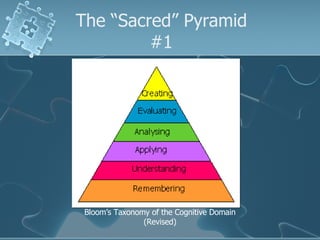
The “Sacred” Pyramid #1 Bloom’s Taxonomy of the Cognitive Domain (Revised)
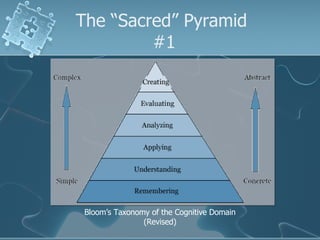
The “Sacred” Pyramid  #1 Bloom’s Taxonomy of the Cognitive Domain (Revised)
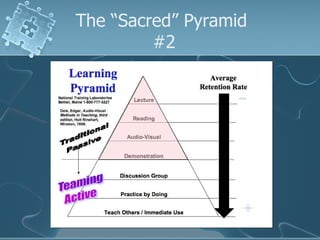
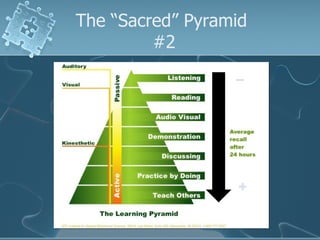
The “Sacred” Pyramid  #2
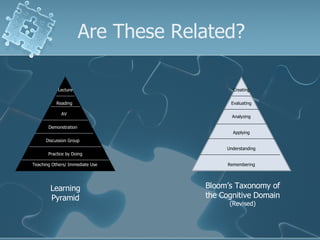
Are These Related? Learning Pyramid Teaching Others/ Immediate Use Practice by Doing Discussion Group Demonstration AV Reading Lecture Remembering Understanding Applying Analyzing Evaluating Creating Bloom’s Taxonomy of the Cognitive Domain (Revised)
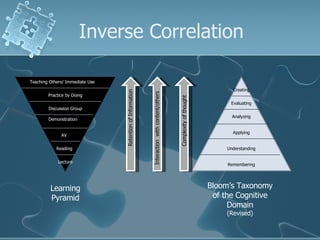
Inverse Correlation Learning Pyramid Bloom’s Taxonomy of the Cognitive Domain (Revised) Complexity of thought Retention of Information Interaction  with content/others Teaching Others/ Immediate Use Practice by Doing Discussion Group Demonstration AV Reading Lecture Remembering Understanding Applying Analyzing Evaluating Creating
So. . . .  Learning Activities that: Use more  complexity of thought , and Force greater  interaction  with  content  and/or  others   Generally  result in: Greater  retention  of course content material
Using Learning Activities The important thing is to: Get them  involved  and  engaged - Thinking  about the subject Doing  something  realistic  with the subject if possible- real world applications or simulations Working   with others  if possible Reflecting  upon what they did and maybe  sharing  with others
Using Learning Activities Thoughts on this model of Active Learning so far?  Do you agree/disagree???
Active Learning Learning Activity Pardon the Palindrome! What kinds of things can an instructor do to: Get students  thinking  about the subject? Get students  doing  something realistic with the subject? Get students  working with others  in learning the subject? Get students  reflecting  on what they have done with the subject? Get students  sharing  and  discussing  ideas and results with others students?
Section II: Incorporating Learning Preferences What is a “Learning Preference"? To put it simply, your learning preference (or learning style) is  the way you tend to learn best . Taking in  Organizing  Making sense of information.
Learning Preferences Benefits  of understanding Learning Preferences: People  learn most effectively  when the learning strategies used are  closely matched with their preferred learning style .  Sometimes we can  improve our teaching  by knowing what our  student’s strengths  are and then  doing more of what they’re good at  . Different situations  and learning environments require  different learning strategies , so it's best to have a large repertoire from which to draw.
Learning Preferences VARK = V isual A ural/Auditory R eading/Writing K inesthetic
Learning Preferences Visual (V) This preference includes the depiction of information in  charts, graphs, flow charts , and all the  symbolic arrows, circles, hierarchies  and other devices that instructors use to  represent what could have been presented in words .
Learning Preferences Aural / Auditory (A) This perceptual mode describes a preference for information that is " heard ." Students with this modality report that they learn best from  lectures, tutorials, tapes, group discussion, speaking, web chat, talking things through.
Learning Preferences Read/write (R) This preference is for information  displayed as words . Not surprisingly, many academics have a strong preference for this modality. This preference emphasizes text-based input and output —  reading and writing in all its forms.
Learning Preferences Kinesthetic (K)   By definition, this modality refers to the perceptual preference related to the  use of experience and practice  (simulated or real). Although such an experience may invoke other modalities, the key is that the student is  connected to reality- either through experience, example, practice or simulation.
Personal Learning Preferences Learning Activity #1: Complete Learning Preference Questionnaire Determine Your Personal Learning Preferences Discuss your results with the group. Class Discussion:  Would you consider using these in your instruction? Why or why not? If yes, how?
VARK Strategies for Teaching Learning Activity #2: Examine the VARK Study Strategy Sheets How can an instructor find ways to reach different students using the information from the study strategies?
Section III: Application Think of the Active Learning principles and techniques we have examined and how they might be applied to training in your own work environment.  If you are a trainer, think of how you might fit these into your current training regimen. If you’re not a trainer, think of how these might be used to train someone how to do your job. Use the Active Learning Application worksheet to create an Active Learning plan for your training.
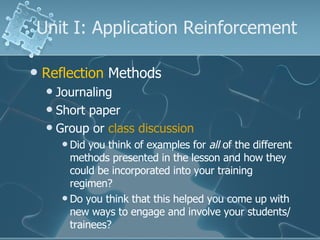
Unit I: Application Reinforcement  Reflection  Methods Journaling Short paper Group or  class discussion Did you think of examples for  all  of the different methods presented in the lesson and how they could be incorporated into your training regimen? Do you think that this helped you come up with new ways to engage and involve your students/trainees?
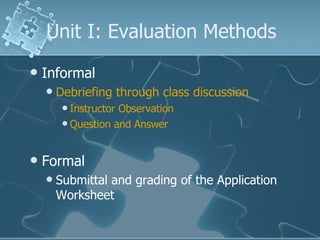
Unit I: Evaluation Methods Informal Debriefing through class discussion Instructor Observation Question and Answer Formal Submittal and grading of the Application Worksheet
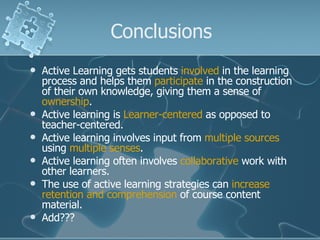
Conclusions Active Learning gets students  involved  in the learning process and helps them  participate  in the construction of their own knowledge, giving them a sense of  ownership . Active learning is  Learner-centered  as opposed to teacher-centered. Active learning involves input from  multiple sources  using  multiple senses . Active learning often involves  collaborative  work with other learners. The use of active learning strategies can  increase retention and comprehension  of course content material. Add???
Sources Active Learning Online http://www.acu.edu/cte/activelearning/focus.htm Active Learning http://honolulu.hawaii.edu/intranet/committees/FacDevCom/guidebk/teachtip/active.htm   VARK http://www.vark-learn.com/documents/general.pdf   Assessment and Instructional Alignment http://thunder1.cudenver.edu/CFD/assessment/module2/index.htm   Learning Pyramid http://www.civil.usyd.edu.au/current/undergraduate/learning.shtml

Active Learning

  • 1.
    Unit I: ActiveLearning How to Maximize the Retention and Comprehension of Course Content Material in Training
  • 2.
    Learning Objective Learnerswill be able to create an Active Learning plan for their training regimen using the principles and techniques learned in the lesson.
  • 3.
    Learning Agenda SectionI: Active Learning Section II: Incorporating Learning Preferences VARK Teaching Using VARK Section III: Application
  • 4.
    Section I: ActiveLearning “ Real learning is not memorization. Most of what we memorize is lost in hours. Learning can't be swallowed whole. To retain what has been taught, students must chew on it." Mel Silberman
  • 5.
    Active Vs. Passive Learning Passive Learning Teacher-Centered Teacher is “Sage on the Stage” Student is “Empty Glass” Traditional Pedagogy
  • 6.
    Active Vs. Passive Learning Active Learning Learner-Centered Teacher is facilitator – “Guide by the Side” Learner is ultimately responsible for learning Progressive Andragogy
  • 7.
    How Does ActiveLearning Work? Input Active Learning involves input from multiple sources through multiple senses - seeing, hearing, feeling, etc. (VARK). – Delivery of Content>Learning Activities Process Active Learning involves process: interacting with other people and materials , stimulating multiple areas of the brain to act. – Learning Activities Output Active Learning involves output: requiring students to produce a response or a solution or some evidence of the interactive learning that is taking place. – Learning Evaluations
  • 8.
  • 9.
    The “Sacred” Pyramid#1 Bloom’s Taxonomy of the Cognitive Domain (Revised)
  • 10.
    The “Sacred” Pyramid #1 Bloom’s Taxonomy of the Cognitive Domain (Revised)
  • 11.
  • 12.
  • 13.
    Are These Related?Learning Pyramid Teaching Others/ Immediate Use Practice by Doing Discussion Group Demonstration AV Reading Lecture Remembering Understanding Applying Analyzing Evaluating Creating Bloom’s Taxonomy of the Cognitive Domain (Revised)
  • 14.
    Inverse Correlation LearningPyramid Bloom’s Taxonomy of the Cognitive Domain (Revised) Complexity of thought Retention of Information Interaction with content/others Teaching Others/ Immediate Use Practice by Doing Discussion Group Demonstration AV Reading Lecture Remembering Understanding Applying Analyzing Evaluating Creating
  • 15.
    So. . .. Learning Activities that: Use more complexity of thought , and Force greater interaction with content and/or others Generally result in: Greater retention of course content material
  • 16.
    Using Learning ActivitiesThe important thing is to: Get them involved and engaged - Thinking about the subject Doing something realistic with the subject if possible- real world applications or simulations Working with others if possible Reflecting upon what they did and maybe sharing with others
  • 17.
    Using Learning ActivitiesThoughts on this model of Active Learning so far? Do you agree/disagree???
  • 18.
    Active Learning LearningActivity Pardon the Palindrome! What kinds of things can an instructor do to: Get students thinking about the subject? Get students doing something realistic with the subject? Get students working with others in learning the subject? Get students reflecting on what they have done with the subject? Get students sharing and discussing ideas and results with others students?
  • 19.
    Section II: IncorporatingLearning Preferences What is a “Learning Preference"? To put it simply, your learning preference (or learning style) is the way you tend to learn best . Taking in Organizing Making sense of information.
  • 20.
    Learning Preferences Benefits of understanding Learning Preferences: People learn most effectively when the learning strategies used are closely matched with their preferred learning style . Sometimes we can improve our teaching by knowing what our student’s strengths are and then doing more of what they’re good at . Different situations and learning environments require different learning strategies , so it's best to have a large repertoire from which to draw.
  • 21.
    Learning Preferences VARK= V isual A ural/Auditory R eading/Writing K inesthetic
  • 22.
    Learning Preferences Visual(V) This preference includes the depiction of information in charts, graphs, flow charts , and all the symbolic arrows, circles, hierarchies and other devices that instructors use to represent what could have been presented in words .
  • 23.
    Learning Preferences Aural/ Auditory (A) This perceptual mode describes a preference for information that is " heard ." Students with this modality report that they learn best from lectures, tutorials, tapes, group discussion, speaking, web chat, talking things through.
  • 24.
    Learning Preferences Read/write(R) This preference is for information displayed as words . Not surprisingly, many academics have a strong preference for this modality. This preference emphasizes text-based input and output — reading and writing in all its forms.
  • 25.
    Learning Preferences Kinesthetic(K) By definition, this modality refers to the perceptual preference related to the use of experience and practice (simulated or real). Although such an experience may invoke other modalities, the key is that the student is connected to reality- either through experience, example, practice or simulation.
  • 26.
    Personal Learning PreferencesLearning Activity #1: Complete Learning Preference Questionnaire Determine Your Personal Learning Preferences Discuss your results with the group. Class Discussion: Would you consider using these in your instruction? Why or why not? If yes, how?
  • 27.
    VARK Strategies forTeaching Learning Activity #2: Examine the VARK Study Strategy Sheets How can an instructor find ways to reach different students using the information from the study strategies?
  • 28.
    Section III: ApplicationThink of the Active Learning principles and techniques we have examined and how they might be applied to training in your own work environment. If you are a trainer, think of how you might fit these into your current training regimen. If you’re not a trainer, think of how these might be used to train someone how to do your job. Use the Active Learning Application worksheet to create an Active Learning plan for your training.
  • 29.
    Unit I: ApplicationReinforcement Reflection Methods Journaling Short paper Group or class discussion Did you think of examples for all of the different methods presented in the lesson and how they could be incorporated into your training regimen? Do you think that this helped you come up with new ways to engage and involve your students/trainees?
  • 30.
    Unit I: EvaluationMethods Informal Debriefing through class discussion Instructor Observation Question and Answer Formal Submittal and grading of the Application Worksheet
  • 31.
    Conclusions Active Learninggets students involved in the learning process and helps them participate in the construction of their own knowledge, giving them a sense of ownership . Active learning is Learner-centered as opposed to teacher-centered. Active learning involves input from multiple sources using multiple senses . Active learning often involves collaborative work with other learners. The use of active learning strategies can increase retention and comprehension of course content material. Add???
  • 32.
    Sources Active LearningOnline http://www.acu.edu/cte/activelearning/focus.htm Active Learning http://honolulu.hawaii.edu/intranet/committees/FacDevCom/guidebk/teachtip/active.htm VARK http://www.vark-learn.com/documents/general.pdf Assessment and Instructional Alignment http://thunder1.cudenver.edu/CFD/assessment/module2/index.htm Learning Pyramid http://www.civil.usyd.edu.au/current/undergraduate/learning.shtml