LEARNING STYLES
Objectives Of Session
• This session is intended to help participants;
– Apply the principles of Adult Learning in the
conduct of their training sessions.
– Identify the four styles of learning and their
effects on training delivery.
– Design and facilitate training to achieve learning
objectives.
Why Adults Learn
• Social relationships.
• External expectations.
• Social welfare.
• Personal
advancement.
• Escape/Stimulation.
• Cognitive interest.
Characteristics Of Adult Learners
• Adults are autonomous and self-directed.
• Adults have accumulated a foundation of life
experiences and knowledge.
• Adults are goal-oriented.
• Adults are relevancy-oriented.
• Adults are practical.
• Adults need to be shown respect.
Learning Principles
• Motivation.
• Reinforcement.
• Retention.
• Transference.
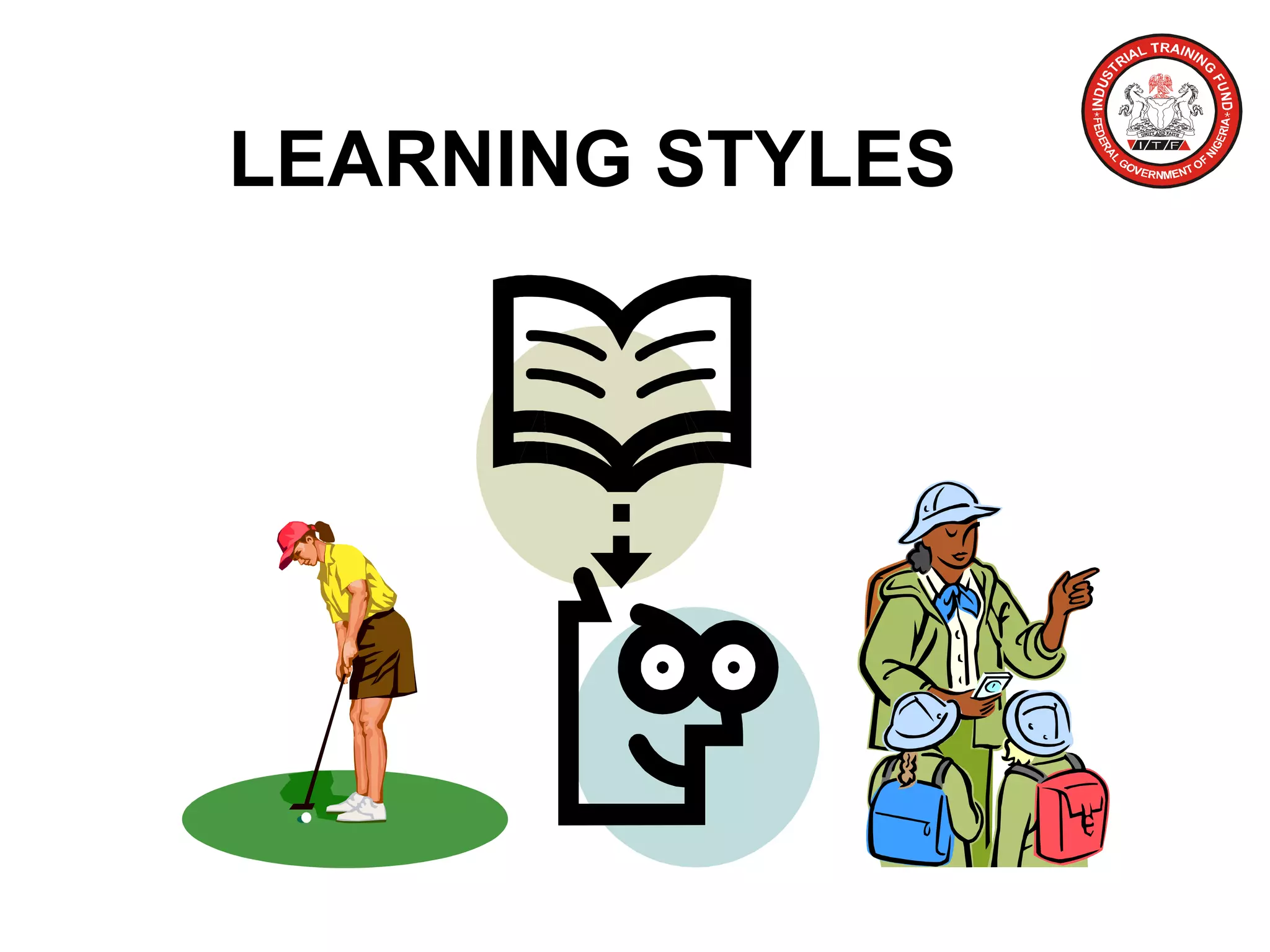
Broad Categories Of Learning Styles
• Visual.
• Auditory.
• Tactile-kinesthetic.
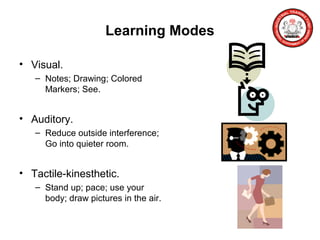
Learning Modes
• Visual.
– Notes; Drawing; Colored
Markers; See.
• Auditory.
– Reduce outside interference;
Go into quieter room.
• Tactile-kinesthetic.
– Stand up; pace; use your
body; draw pictures in the air.
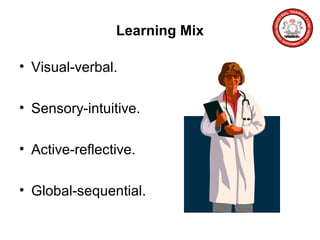
Learning Mix
• Visual-verbal.
• Sensory-intuitive.
• Active-reflective.
• Global-sequential.
Learning Style:
• Visual-Verbal.
• Sensory-Intuitive.
• Active-Reflective.
• Sequential-Global.
Teaching Style:
• Visual-Verbal.
• Concrete-Abstract.
• Active-Reflective.
• Linear-Sweeping.
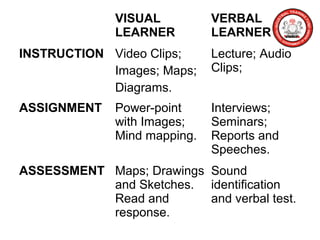
VISUAL
LEARNER
VERBAL
LEARNER
INSTRUCTION Video Clips;
Images; Maps;
Diagrams.
Lecture; Audio
Clips;
ASSIGNMENT Power-point
with Images;
Mind mapping.
Interviews;
Seminars;
Reports and
Speeches.
ASSESSMENT Maps; Drawings
and Sketches.
Read and
response.
Sound
identification
and verbal test.
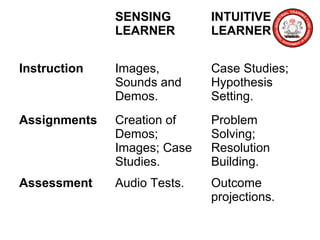
SENSING
LEARNER
INTUITIVE
LEARNER
Instruction Images,
Sounds and
Demos.
Case Studies;
Hypothesis
Setting.
Assignments Creation of
Demos;
Images; Case
Studies.
Problem
Solving;
Resolution
Building.
Assessment Audio Tests. Outcome
projections.
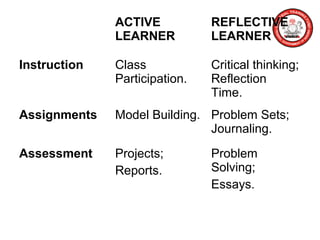
ACTIVE
LEARNER
REFLECTIVE
LEARNER
Instruction Class
Participation.
Critical thinking;
Reflection
Time.
Assignments Model Building. Problem Sets;
Journaling.
Assessment Projects;
Reports.
Problem
Solving;
Essays.
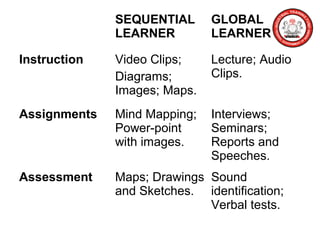
SEQUENTIAL
LEARNER
GLOBAL
LEARNER
Instruction Video Clips;
Diagrams;
Images; Maps.
Lecture; Audio
Clips.
Assignments Mind Mapping;
Power-point
with images.
Interviews;
Seminars;
Reports and
Speeches.
Assessment Maps; Drawings
and Sketches.
Sound
identification;
Verbal tests.
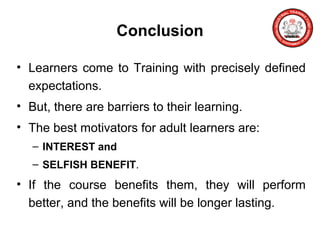
Conclusion
• Learners come to Training with precisely defined
expectations.
• But, there are barriers to their learning.
• The best motivators for adult learners are:
– INTEREST and
– SELFISH BENEFIT.
• If the course benefits them, they will perform
better, and the benefits will be longer lasting.

Adult Learning styles