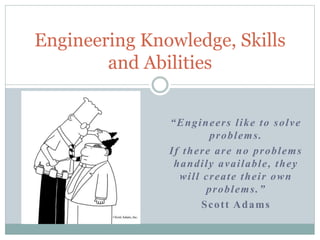
“Engineers like to solve
problems.
If there are no problems
handily available, they
will create their own
problems.”
Scott Adams
Engineering Knowledge, Skills
and Abilities
Learning objectives for this lesson
 Identify knowledge, skills and abilities (KSA) that
engineering students need to develop to prepare
them for successful careers; compare and contrast
different ways these KSAs are defined and prioritized
 Define differences between ways of knowing –
“knowing how”, “knowing that” and “knowing why”
– and describe implications for teaching
 Propose ways that engineering KSAs are addressed
in a course in your discipline
There are distinct ways of knowing:
“Knowing that” and “Knowing how”
 Fundamental courses focus on “knowing that”
 “Declarative knowledge”
 Engineering and science principles, concepts and theories
 Mathematical tools and representations
 Need to know before moving to next series of courses
 “Knowing how” can get buried
 “Procedural knowledge”
 Sophisticated, independent problem-solving
 Project management
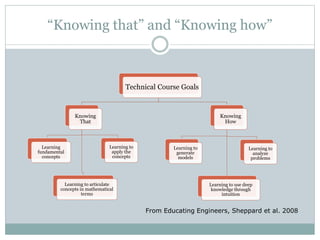
“Knowing that” and “Knowing how”
Technical Course Goals
Knowing
That
Learning
fundamental
concepts
Learning to
apply the
concepts
Learning to articulate
concepts in mathematical
terms
Knowing
How
Learning to
generate
models
Learning to
analyze
problems
Learning to use deep
knowledge through
intuition
From Educating Engineers, Sheppard et al. 2008
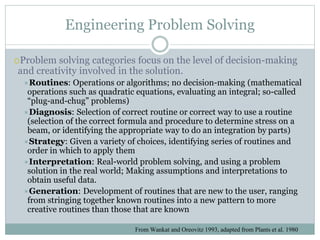
Engineering Problem Solving
Problem solving categories focus on the level of decision-making
and creativity involved in the solution.
Routines: Operations or algorithms; no decision-making (mathematical
operations such as quadratic equations, evaluating an integral; so-called
“plug-and-chug” problems)
Diagnosis: Selection of correct routine or correct way to use a routine
(selection of the correct formula and procedure to determine stress on a
beam, or identifying the appropriate way to do an integration by parts)
Strategy: Given a variety of choices, identifying series of routines and
order in which to apply them
Interpretation: Real-world problem solving, and using a problem
solution in the real world; Making assumptions and interpretations to
obtain useful data.
Generation: Development of routines that are new to the user, ranging
from stringing together known routines into a new pattern to more
creative routines than those that are known
From Wankat and Oreovitz 1993, adapted from Plants et al. 1980
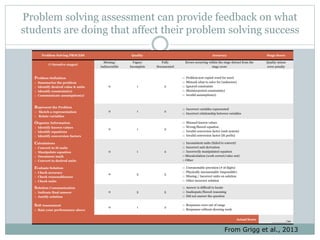
Problem solving assessment can provide feedback on what
students are doing that affect their problem solving success
From Grigg et al., 2013
Problem Solving PROCESS Quality Accuracy Stage Score
(7 iterative stages)
Missing/
Indiscernible
Vague/
Incomplete
Fully
Documented
Errors occurring within the stage detract from the
stage score
Quality minus
error penalty
Problem Definition
□ Summarize the problem
□ Identify desired value & units
□ Identify constraint(s)
□ Communicate assumption(s)
0 1 2
□ Problem text copied word for word
□ Mistook what to solve for (unknown)
□ Ignored constraints
□ Misinterpreted constraint(s)
□ Invalid assumption(s)
Represent the Problem
□ Sketch a representation
□ Relate variables
0 1 2
□ Incorrect variables represented
□ Incorrect relationship between variables
Organize Information
□ Identify known values
□ Identify equations
□ Identify conversion factors
0 1 2
□ Misused known values
□ Wrong/flawed equation
□ Invalid conversion factor (unit system)
□ Invalid conversion factor (SI prefix)
Calculations
□ Convert to SI units
□ Manipulate equation
□ Document math
□ Convert to desired units
0 1 2
□ Inconsistent units (failed to convert)
□ Incorrect unit derivation
□ Incorrectly manipulated equation
□ Miscalculation (work correct/value not)
□ Other
Evaluate Solution
□ Check accuracy
□ Check reasonableness
□ Check units
0 3 5
□ Unreasonable precision (# of digits)
□ Physically unreasonable (impossible)
□ Missing / Incorrect units on solution
□ Other incorrect solution
Solution Communication
□ Indicate final answer
□ Justify solution
0 3 5
□ Answer is difficult to locate
□ Inadequate/flawed reasoning
□ Did not answer the question
Self-Assessment
□ Rate your performance above
0 1 2
□ Responses were out of range
□ Responses without showing work
Actual Score
_______/20
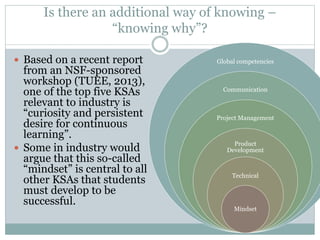
Is there an additional way of knowing –
“knowing why”?
 Based on a recent report
from an NSF-sponsored
workshop (TUEE, 2013),
one of the top five KSAs
relevant to industry is
“curiosity and persistent
desire for continuous
learning”.
 Some in industry would
argue that this so-called
“mindset” is central to all
other KSAs that students
must develop to be
successful.
Global competencies
Communication
Project Management
Product
Development
Technical
Mindset
Reflection essays
Most undergraduate engineering courses focus on foundational knowledge
(knowing that), but recent reports and publications call for engineering education
to consider globalization and systems thinking (knowing how), and even curiosity
(knowing why). There are changes coming in engineering education!
Write two short reflection essays (1 – 2 pages each) :
 1: “What’s past is prologue.” (W. Shakespeare) Identify and describe activities
(up to 3) that you completed in a course, lab or other learning experience in
your discipline that involved “knowing that”, “knowing how“, and “knowing
why”. In your opinion, what principles, theories, or concepts lend themselves to
these different ways of knowing? Support your opinions with references from
the 3 required readings and/or other relevant sources.
 2: “Right now. It’s your tomorrow.” (E. Van Halen) Choose 1 of the top 15
KSAs from the NSF TUEE report and brainstorm ways to develop that KSA in a
course you plan on teaching in the future. What would you teach, and how do
you envision guiding students to develop that KSA through your teaching?
(Note: This is a good point to start thinking about your lesson plan and
microteaching session for the Final Project!)
References
Required readings:
 Educating Engineers for 2020 and Beyond,” by C. Vest, in Educating
the Engineer of 2020, National Academy of Engineering (2005)
 Sheppard, S. D. et al. Educating Engineers: Designing for the Future of
the Field. Hoboken, NJ: Carnegie/Jossey-Bass, 2008.
 NSF/ASEE Workshop Report: Transforming Undergraduate Education in
Engineering, Phase I: Synthesizing and Integrating Industry Perspectives,
May 9-10, 2013
Other references:
 Grigg, S., J. VanDyken, L. Benson and B. Morkos. Process Analysis as a
Feedback Tool for Development of Engineering Problem Solving Skills.
Proceedings of the 2013 ASEE Annual Conference, Atlanta, GA,June 25,
Session T125B.
 Wankat, P.C. and F.S. Oreovicz, Teaching Engineering, McGraw-Hill, NY,
1993. Available free as pdf’s:
https://engineering.purdue.edu/ChE/AboutUs/Publications/TeachingEng
/index.html

Engineering Knowledge, Skills, and Abilities

  • 1.
    “Engineers like tosolve problems. If there are no problems handily available, they will create their own problems.” Scott Adams Engineering Knowledge, Skills and Abilities
  • 2.
    Learning objectives forthis lesson  Identify knowledge, skills and abilities (KSA) that engineering students need to develop to prepare them for successful careers; compare and contrast different ways these KSAs are defined and prioritized  Define differences between ways of knowing – “knowing how”, “knowing that” and “knowing why” – and describe implications for teaching  Propose ways that engineering KSAs are addressed in a course in your discipline
  • 3.
    There are distinctways of knowing: “Knowing that” and “Knowing how”  Fundamental courses focus on “knowing that”  “Declarative knowledge”  Engineering and science principles, concepts and theories  Mathematical tools and representations  Need to know before moving to next series of courses  “Knowing how” can get buried  “Procedural knowledge”  Sophisticated, independent problem-solving  Project management
  • 4.
    “Knowing that” and“Knowing how” Technical Course Goals Knowing That Learning fundamental concepts Learning to apply the concepts Learning to articulate concepts in mathematical terms Knowing How Learning to generate models Learning to analyze problems Learning to use deep knowledge through intuition From Educating Engineers, Sheppard et al. 2008
  • 5.
    Engineering Problem Solving Problemsolving categories focus on the level of decision-making and creativity involved in the solution. Routines: Operations or algorithms; no decision-making (mathematical operations such as quadratic equations, evaluating an integral; so-called “plug-and-chug” problems) Diagnosis: Selection of correct routine or correct way to use a routine (selection of the correct formula and procedure to determine stress on a beam, or identifying the appropriate way to do an integration by parts) Strategy: Given a variety of choices, identifying series of routines and order in which to apply them Interpretation: Real-world problem solving, and using a problem solution in the real world; Making assumptions and interpretations to obtain useful data. Generation: Development of routines that are new to the user, ranging from stringing together known routines into a new pattern to more creative routines than those that are known From Wankat and Oreovitz 1993, adapted from Plants et al. 1980
  • 6.
    Problem solving assessmentcan provide feedback on what students are doing that affect their problem solving success From Grigg et al., 2013 Problem Solving PROCESS Quality Accuracy Stage Score (7 iterative stages) Missing/ Indiscernible Vague/ Incomplete Fully Documented Errors occurring within the stage detract from the stage score Quality minus error penalty Problem Definition □ Summarize the problem □ Identify desired value & units □ Identify constraint(s) □ Communicate assumption(s) 0 1 2 □ Problem text copied word for word □ Mistook what to solve for (unknown) □ Ignored constraints □ Misinterpreted constraint(s) □ Invalid assumption(s) Represent the Problem □ Sketch a representation □ Relate variables 0 1 2 □ Incorrect variables represented □ Incorrect relationship between variables Organize Information □ Identify known values □ Identify equations □ Identify conversion factors 0 1 2 □ Misused known values □ Wrong/flawed equation □ Invalid conversion factor (unit system) □ Invalid conversion factor (SI prefix) Calculations □ Convert to SI units □ Manipulate equation □ Document math □ Convert to desired units 0 1 2 □ Inconsistent units (failed to convert) □ Incorrect unit derivation □ Incorrectly manipulated equation □ Miscalculation (work correct/value not) □ Other Evaluate Solution □ Check accuracy □ Check reasonableness □ Check units 0 3 5 □ Unreasonable precision (# of digits) □ Physically unreasonable (impossible) □ Missing / Incorrect units on solution □ Other incorrect solution Solution Communication □ Indicate final answer □ Justify solution 0 3 5 □ Answer is difficult to locate □ Inadequate/flawed reasoning □ Did not answer the question Self-Assessment □ Rate your performance above 0 1 2 □ Responses were out of range □ Responses without showing work Actual Score _______/20
  • 7.
    Is there anadditional way of knowing – “knowing why”?  Based on a recent report from an NSF-sponsored workshop (TUEE, 2013), one of the top five KSAs relevant to industry is “curiosity and persistent desire for continuous learning”.  Some in industry would argue that this so-called “mindset” is central to all other KSAs that students must develop to be successful. Global competencies Communication Project Management Product Development Technical Mindset
  • 8.
    Reflection essays Most undergraduateengineering courses focus on foundational knowledge (knowing that), but recent reports and publications call for engineering education to consider globalization and systems thinking (knowing how), and even curiosity (knowing why). There are changes coming in engineering education! Write two short reflection essays (1 – 2 pages each) :  1: “What’s past is prologue.” (W. Shakespeare) Identify and describe activities (up to 3) that you completed in a course, lab or other learning experience in your discipline that involved “knowing that”, “knowing how“, and “knowing why”. In your opinion, what principles, theories, or concepts lend themselves to these different ways of knowing? Support your opinions with references from the 3 required readings and/or other relevant sources.  2: “Right now. It’s your tomorrow.” (E. Van Halen) Choose 1 of the top 15 KSAs from the NSF TUEE report and brainstorm ways to develop that KSA in a course you plan on teaching in the future. What would you teach, and how do you envision guiding students to develop that KSA through your teaching? (Note: This is a good point to start thinking about your lesson plan and microteaching session for the Final Project!)
  • 9.
    References Required readings:  EducatingEngineers for 2020 and Beyond,” by C. Vest, in Educating the Engineer of 2020, National Academy of Engineering (2005)  Sheppard, S. D. et al. Educating Engineers: Designing for the Future of the Field. Hoboken, NJ: Carnegie/Jossey-Bass, 2008.  NSF/ASEE Workshop Report: Transforming Undergraduate Education in Engineering, Phase I: Synthesizing and Integrating Industry Perspectives, May 9-10, 2013 Other references:  Grigg, S., J. VanDyken, L. Benson and B. Morkos. Process Analysis as a Feedback Tool for Development of Engineering Problem Solving Skills. Proceedings of the 2013 ASEE Annual Conference, Atlanta, GA,June 25, Session T125B.  Wankat, P.C. and F.S. Oreovicz, Teaching Engineering, McGraw-Hill, NY, 1993. Available free as pdf’s: https://engineering.purdue.edu/ChE/AboutUs/Publications/TeachingEng /index.html

Editor's Notes

  • #4 Knowing that – underlying knowledge that governs engineering and science systems. Examples: Fundamental concepts about materials (metals, ceramics, polymers), starting with chemical compositions, memorization of polymer formulas, material properties, processing methods, etc., and on to bringing those concepts together, such as applications of materials (i.e. how they are used in the body, construction, electronics, etc.) Knowing how – Often developed in semester long projects (individual and group) or research experiences. Examples: identify ways to improve processes, devices, structures; predict failure, analyze real world cases; “systems thinking”. Can be expressed through group presentations (team work, communication).
  • #6 Problem solving is so central to what engineers do – it is the ultimate “knowing how”.
  • #7 Conceptual aspects of problem solving: Problem definition: Student forms an understanding of the problem and sets bounds on what is under investigation, including what is ultimately being solved for, and what restrictions/constraints they are given. Represent the problem: Student conceptualizes the system under investigation; utilizes visual representations (charts, sketches, or diagrams) to help understand problem and relationships between variables. Organize information: (shift from conceptual to analytical evaluation) Student gathers information necessary to solve the problem, including relevant conversion factors or values of standard constants. Analytical aspects of problem solving: Calculations: Main stage of documented work; includes tasks related to transforming data into useable information; mathematical calculations, including converting between unit systems or other forms of data translation. Not all tasks associated with this stage are relevant to every problem; only relevant tasks should be evaluated. Evaluate solution: Student evaluates work in terms of accuracy, level of understanding, or satisfying the goal of the problem. For multiple part and/or incomplete solutions, student checks and justifies intermediate answers. Solution accuracy: Student fulfills goal of problem: correct answer with correct units. Self-assessment: reflection on the extent to which the student felt s/he had the requisite KSAs for solving the problem, and on time management for the problem solution