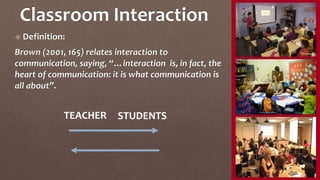
STUDENTSTEACHER
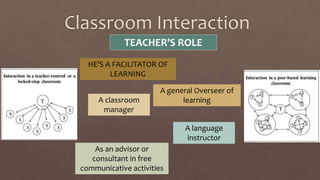
HE’S A FACILITATOR OF
LEARNING
TEACHER’S ROLE
A general Overseer of
learningA classroom
manager
A language
instructor
As an advisor or
consultant in free
communicative activities
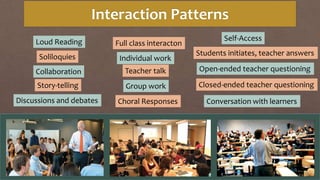
Conversation with learners
Teacher talk
Choral Responses
Open-ended teacher questioning
Closed-ended teacher questioning
Full class interacton
Individual work
Students initiates, teacher answers
Collaboration
Soliloquies
Loud Reading
Discussions and debates
Story-telling
Self-Access
Group work
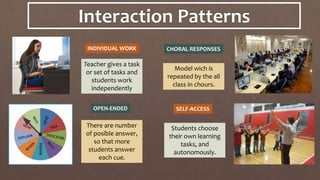
INDIVIDUAL WORK CHORAL RESPONSES
OPEN-ENDED SELF-ACCESS
Teacher gives a task
or set of tasks and
students work
independently
Model wich is
repeated by the all
class in chours.
There are number
of posible answer,
so that more
students answer
each cue.
Students choose
their own learning
tasks, and
autonomously.
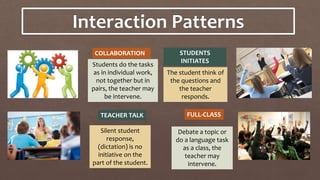
TEACHER TALK
COLLABORATION
FULL-CLASS
Students do the tasks
as in individual work,
not together but in
pairs, the teacher may
be intervene.
Silent student
response,
(dictation) is no
initiative on the
part of the student.
Debate a topic or
do a language task
as a class, the
teacher may
intervene.
STUDENTS
INITIATES
The student think of
the questions and
the teacher
responds.
Detailed Explanation of the
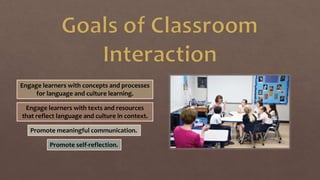
Promote meaningful communication.
Promote self-reflection.
Engage learners with texts and resources
that reflect language and culture in context.
Engage learners with concepts and processes
for language and culture learning.
QUESTIONS:
T: How many horses are in the picture?
T: What color is the barn?
T: Can you name the animals outside the barn?
Ss: It’s red.
Ss: There are two horses.
Ss: Goat, rabbit, duck, pig.
Choose the appropiate topic according to the students.
Teenagers perfer to talk about Sports, Music, video games, movies and so on.
Use English at a level pupils can understand
Show genuine interest in and respond positively to pupil’s answers.
Make them work in pairs so pupils can achieve a common goal.
Help pupils to express their messages by prompting them to say more
Give them motivation to SPEAK.
Encourage pupils to talk relating talks in familiar contexts they can understand.
Classroom interaction

Classroom interaction

  • 2.
  • 6.
    HE’S A FACILITATOROF LEARNING TEACHER’S ROLE A general Overseer of learningA classroom manager A language instructor As an advisor or consultant in free communicative activities
  • 7.
    Conversation with learners Teachertalk Choral Responses Open-ended teacher questioning Closed-ended teacher questioning Full class interacton Individual work Students initiates, teacher answers Collaboration Soliloquies Loud Reading Discussions and debates Story-telling Self-Access Group work
  • 8.
    INDIVIDUAL WORK CHORALRESPONSES OPEN-ENDED SELF-ACCESS Teacher gives a task or set of tasks and students work independently Model wich is repeated by the all class in chours. There are number of posible answer, so that more students answer each cue. Students choose their own learning tasks, and autonomously.
  • 9.
    TEACHER TALK COLLABORATION FULL-CLASS Students dothe tasks as in individual work, not together but in pairs, the teacher may be intervene. Silent student response, (dictation) is no initiative on the part of the student. Debate a topic or do a language task as a class, the teacher may intervene. STUDENTS INITIATES The student think of the questions and the teacher responds.
  • 10.
  • 11.
  • 12.
    Promote meaningful communication. Promoteself-reflection. Engage learners with texts and resources that reflect language and culture in context. Engage learners with concepts and processes for language and culture learning.
  • 13.
    QUESTIONS: T: How manyhorses are in the picture? T: What color is the barn? T: Can you name the animals outside the barn? Ss: It’s red. Ss: There are two horses. Ss: Goat, rabbit, duck, pig.
  • 14.
    Choose the appropiatetopic according to the students. Teenagers perfer to talk about Sports, Music, video games, movies and so on. Use English at a level pupils can understand Show genuine interest in and respond positively to pupil’s answers. Make them work in pairs so pupils can achieve a common goal. Help pupils to express their messages by prompting them to say more Give them motivation to SPEAK. Encourage pupils to talk relating talks in familiar contexts they can understand.