MULTICOMPARTMENT MODELS
Prepared By
Girijesh Kumar Pandey
M.Pharm. (Pharmaceutics)
Contents
• Introduction
• Two-Compartment Open model
• Intravenous bolus administration
• Intravenous Infusion
• Extra vascular administration
• Conclusion
• References
Introduction
• One compartment is described by mono-
exponential term i.e. elimination.
• For large class of drugs this terms is not sufficient
to describe its disposition.
• It needs a bi- or multi- exponential terms
• The body is composed of a heterogeneous group
of tissues each with different degree of blood
flow and affinity for drug and therefore different
rates of elimination.
• Multi-compartment characteristics are best
described by administration as i.v. bolus.
Two Compartment Model
• The simplest and commonest is the two compartment
model which classifies the body tissues in two
categories :
1) Central compartment or Compartment 1
2) Peripheral or Tissue Compartment or Compartment 2.
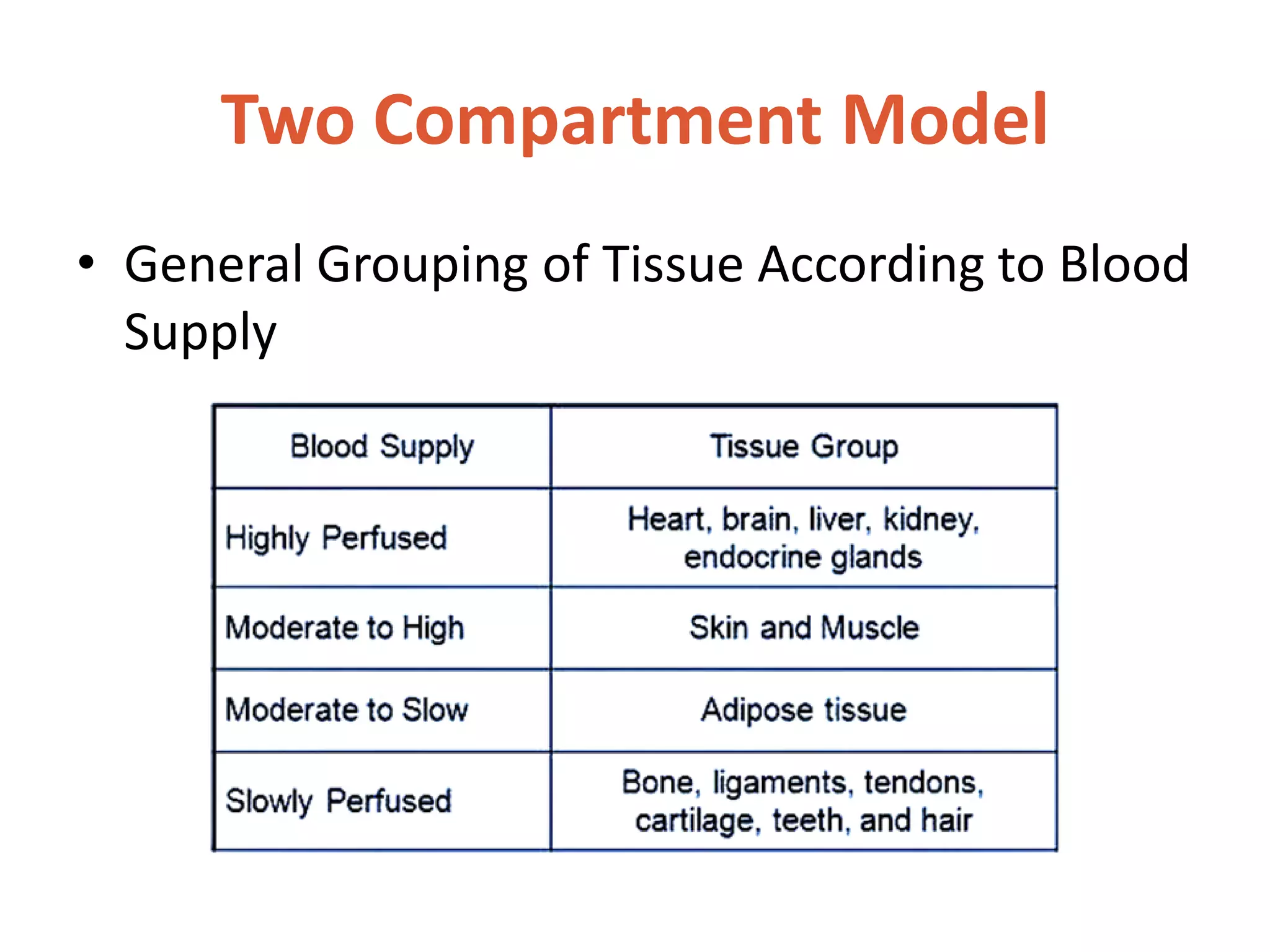
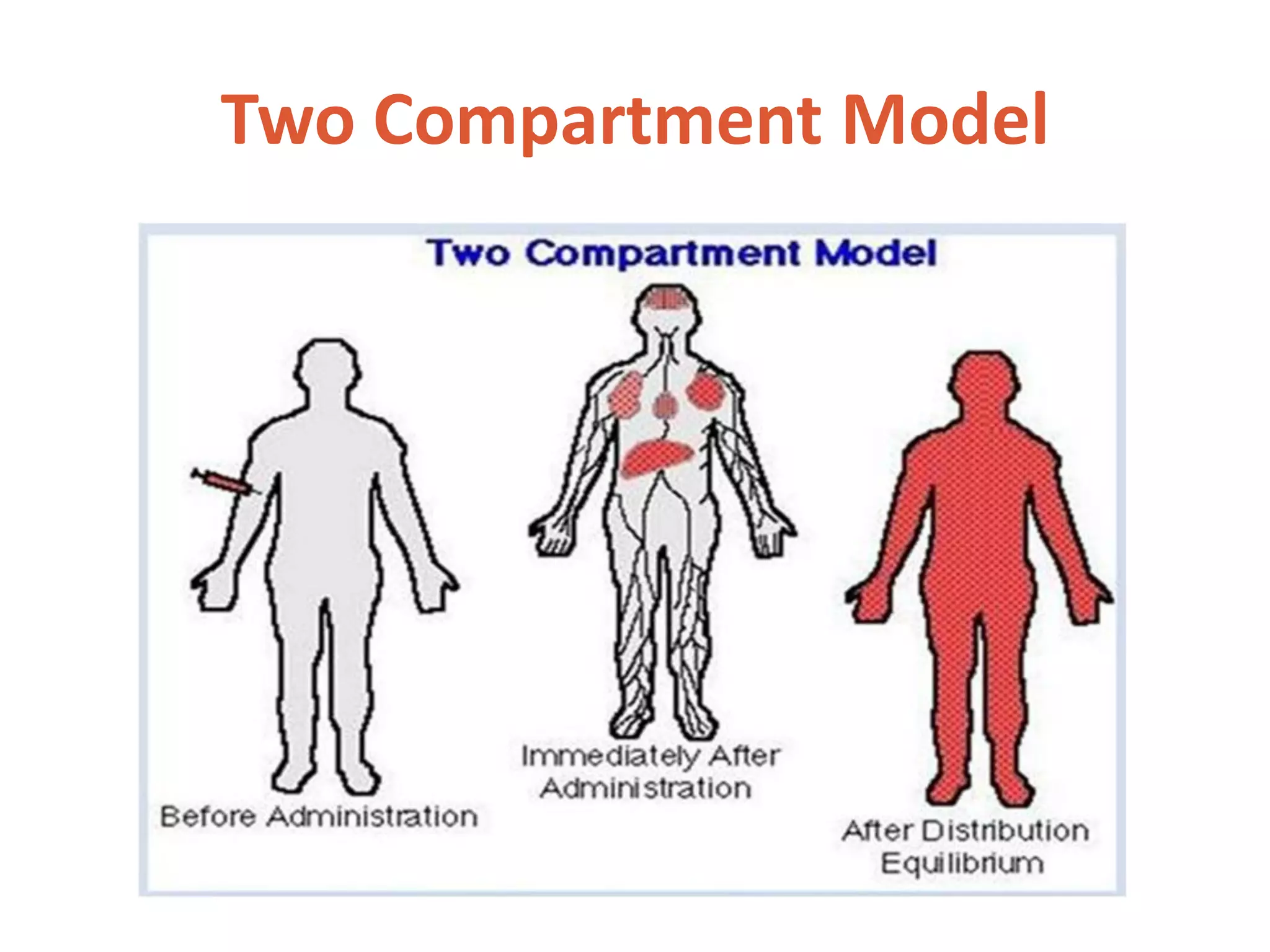
• Compartment 1 comprises of blood and highly
perfused tissues like liver, lungs, kidneys, etc.
• Elimination usually occurs from this compartment.
• Compartment 2 comprises of poorly perfused and slow
equilibriating tissues such as muscles, skin, adipose,
etc.
Two Compartment Model
• General Grouping of Tissue According to Blood
Supply
Two Compartment Model
• Depending upon the compartment from
which the drug is eliminated, the 2
compartment model can be further
categorised into :
- With elimination from Central compartment
- With elimination from peripheral
compartment
- With elimination from both the
compartments
Two Compartment Model
Two compartment Open model-
I.V. bolus administration:
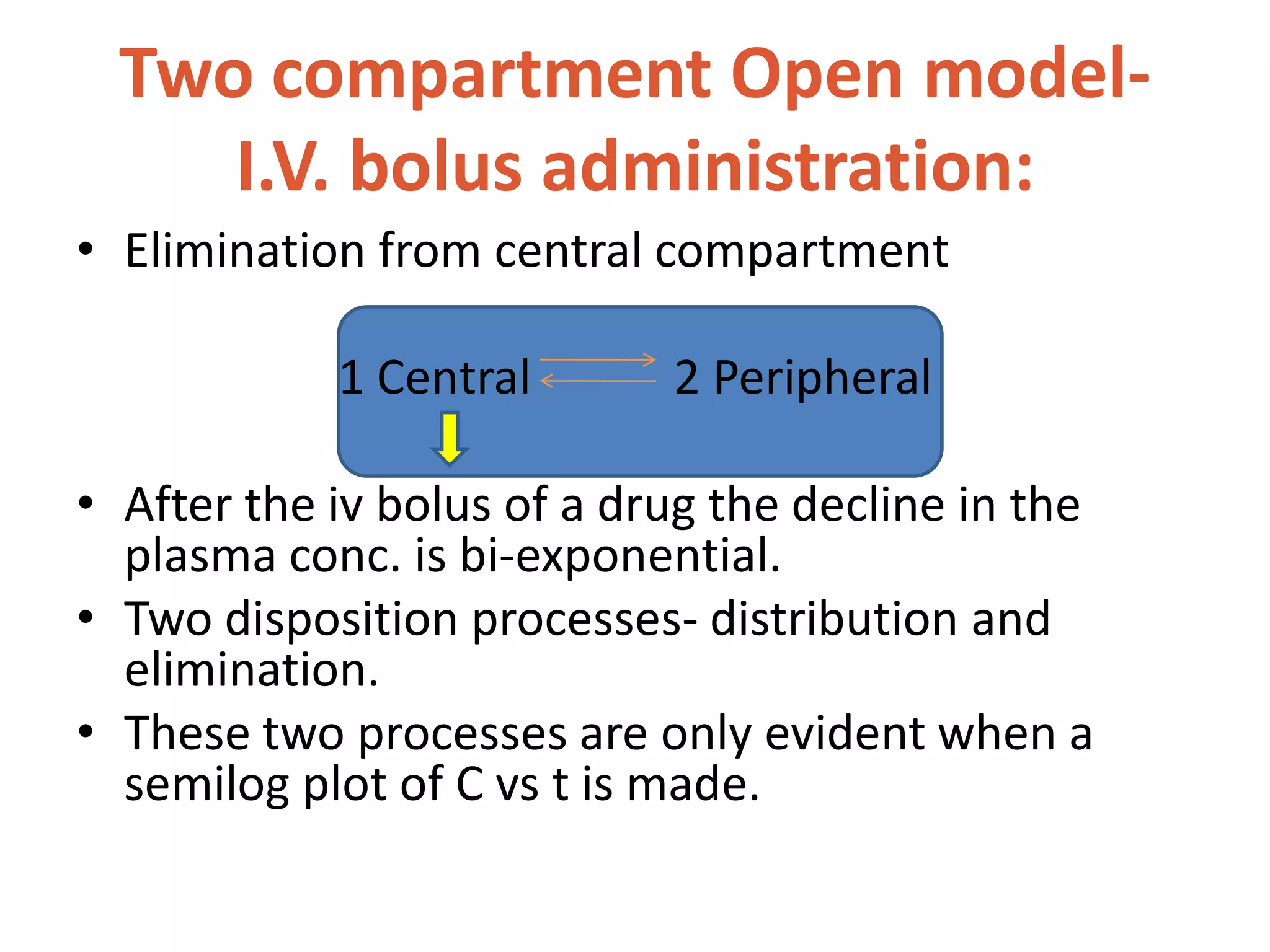
• Elimination from central compartment
1 Central 2 Peripheral
• After the iv bolus of a drug the decline in the
plasma conc. is bi-exponential.
• Two disposition processes- distribution and
elimination.
• These two processes are only evident when a
semilog plot of C vs t is made.
Two compartment Open model-
I.V. bolus administration:
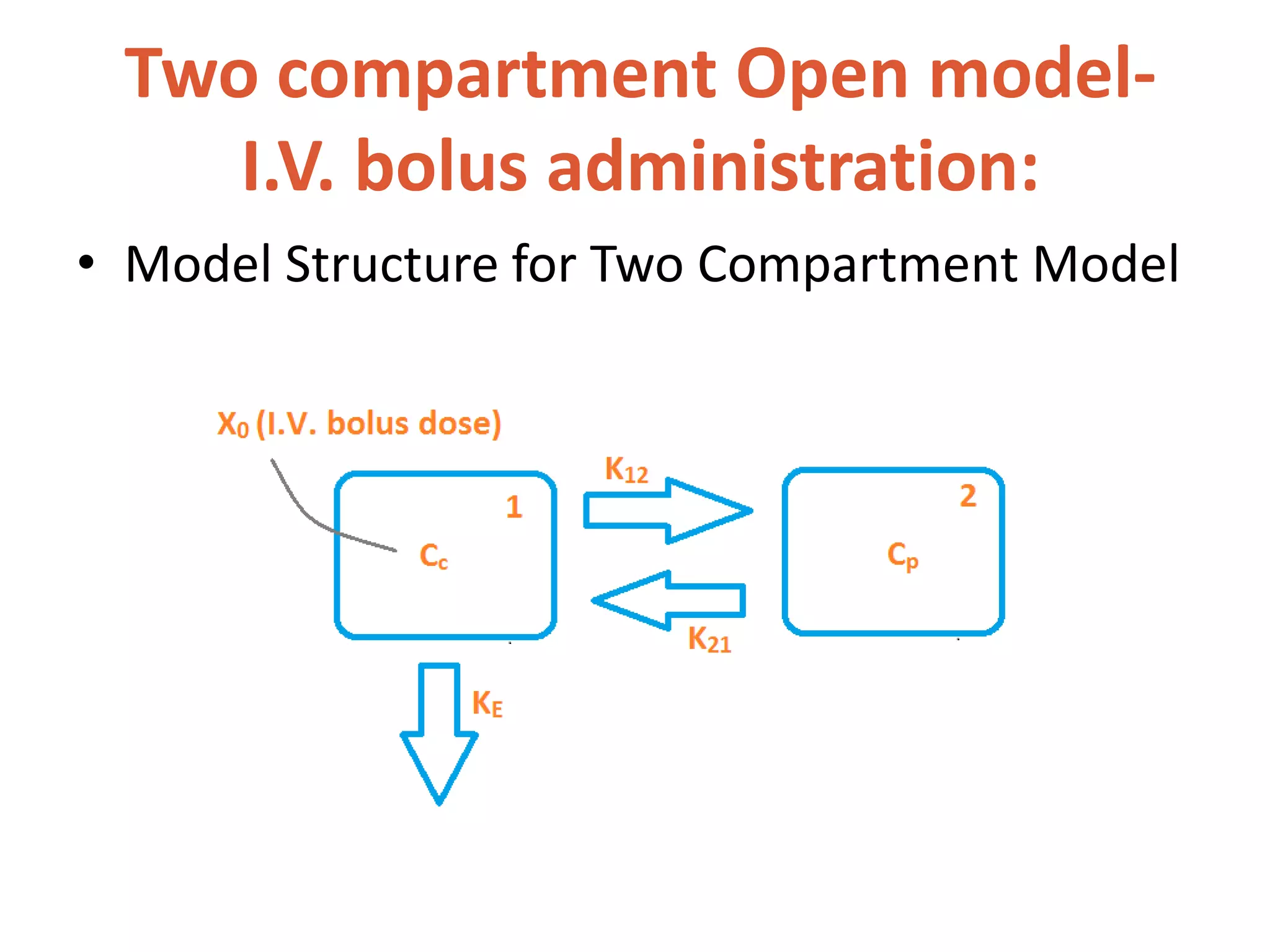
• Model Structure for Two Compartment Model
Two compartment Open model-
I.V. bolus administration:
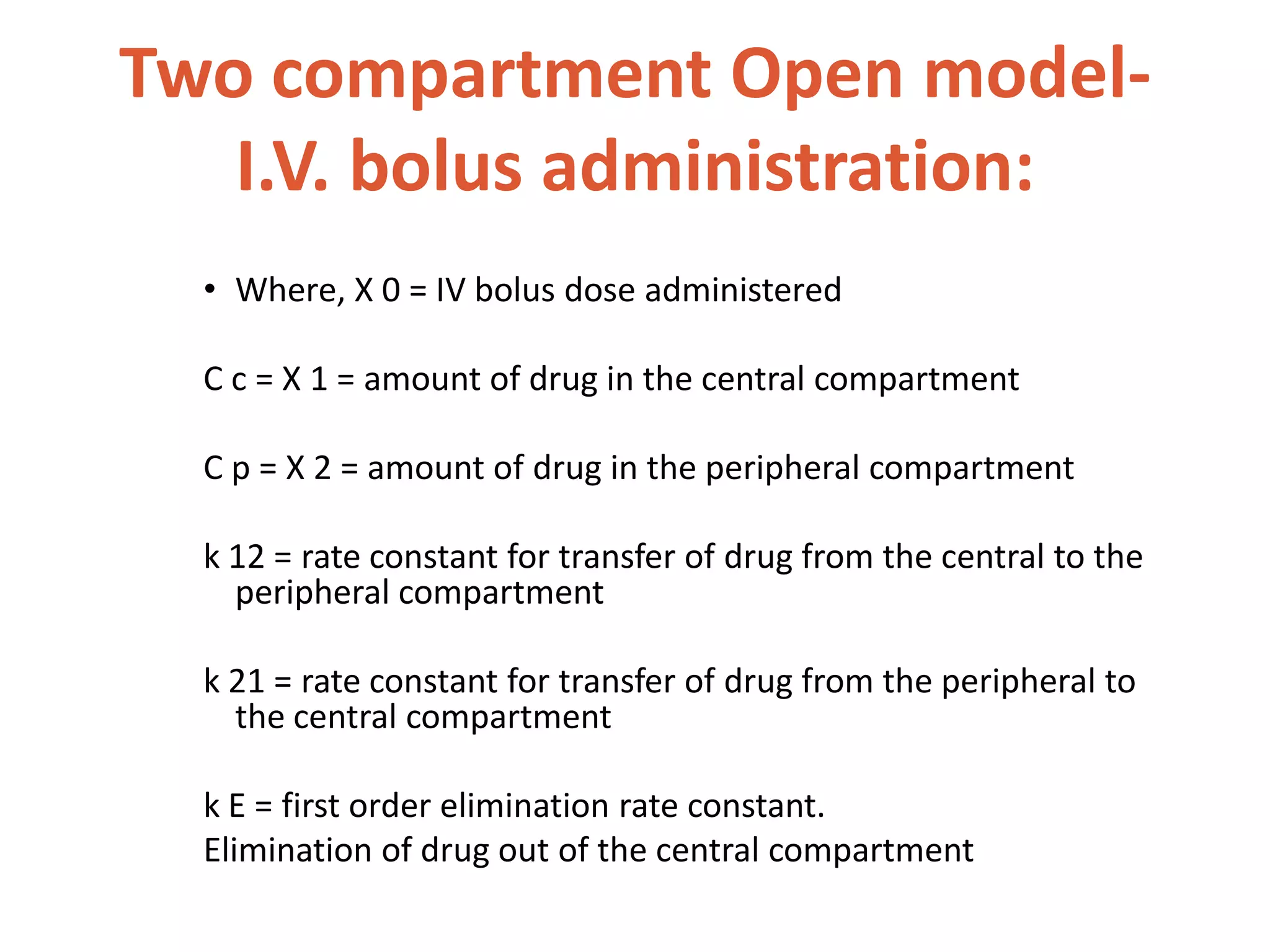
• Where, X 0 = IV bolus dose administered
C c = X 1 = amount of drug in the central compartment
C p = X 2 = amount of drug in the peripheral compartment
k 12 = rate constant for transfer of drug from the central to the
peripheral compartment
k 21 = rate constant for transfer of drug from the peripheral to
the central compartment
k E = first order elimination rate constant.
Elimination of drug out of the central compartment
Two compartment Open model-
I.V. bolus administration:
• The second, slower rate process, is called as the post-
distributive or elimination phase.
• In contrast to central compartment, the conc of drug in
the peripheral compartment first increases and reaches
its max.
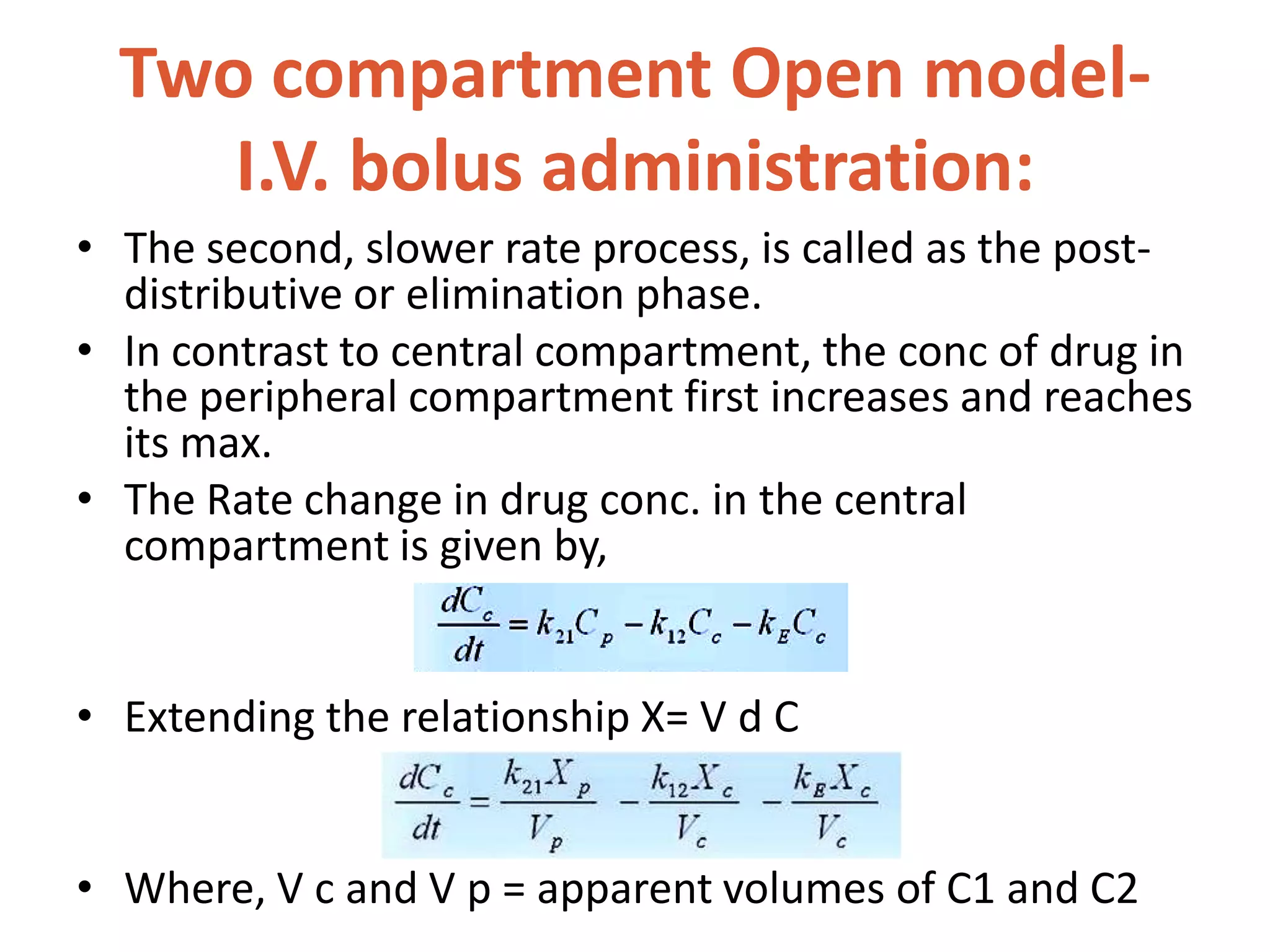
• The Rate change in drug conc. in the central
compartment is given by,
• Extending the relationship X= V d C
• Where, V c and V p = apparent volumes of C1 and C2
Two compartment Open model-
I.V. bolus administration:
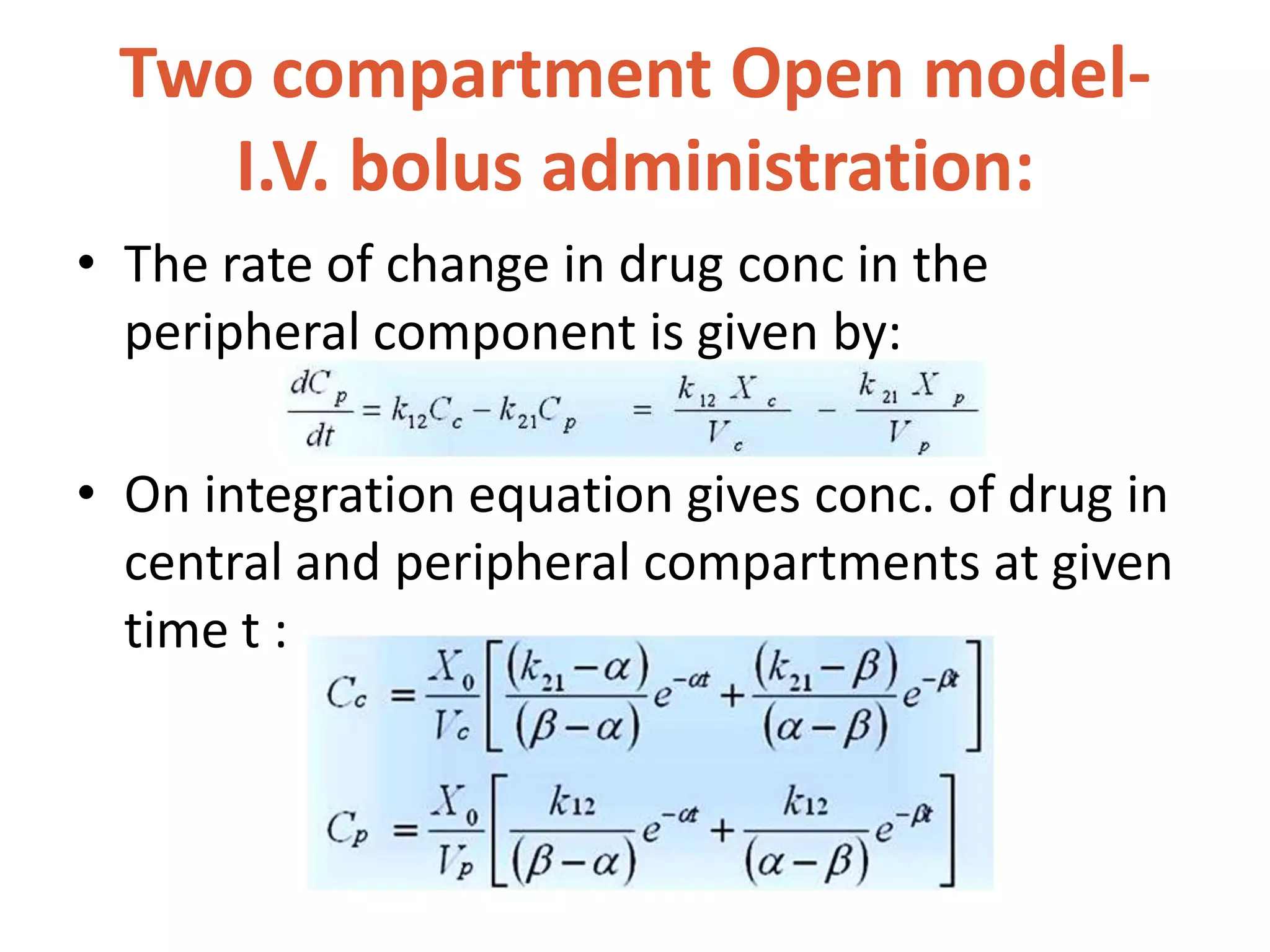
• The rate of change in drug conc in the
peripheral component is given by:
• On integration equation gives conc. of drug in
central and peripheral compartments at given
time t :
Two Compartment Open Model –
Intravenous Infusion
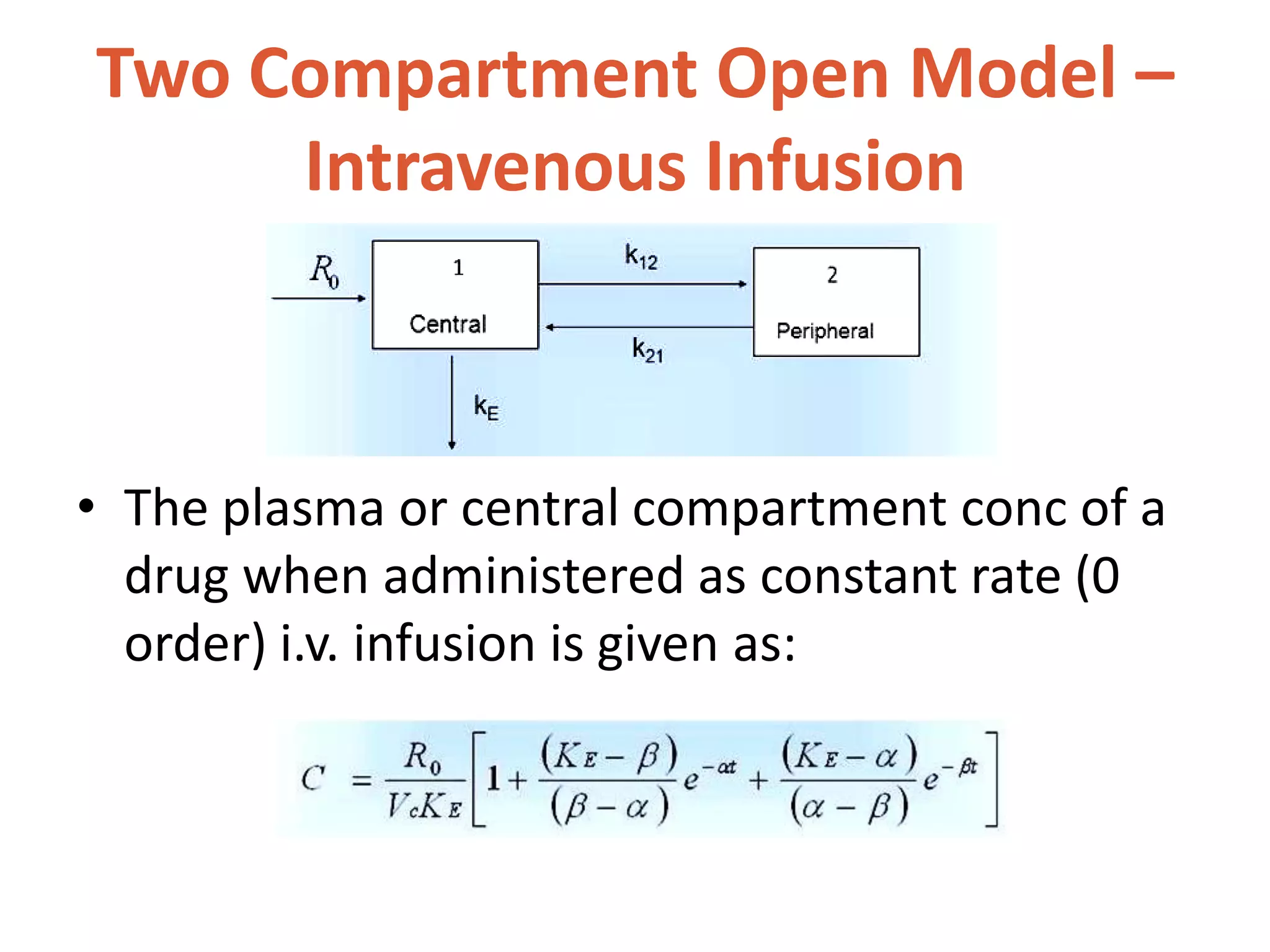
• The plasma or central compartment conc of a
drug when administered as constant rate (0
order) i.v. infusion is given as:
Two Compartment Open Model –
Intravenous Infusion
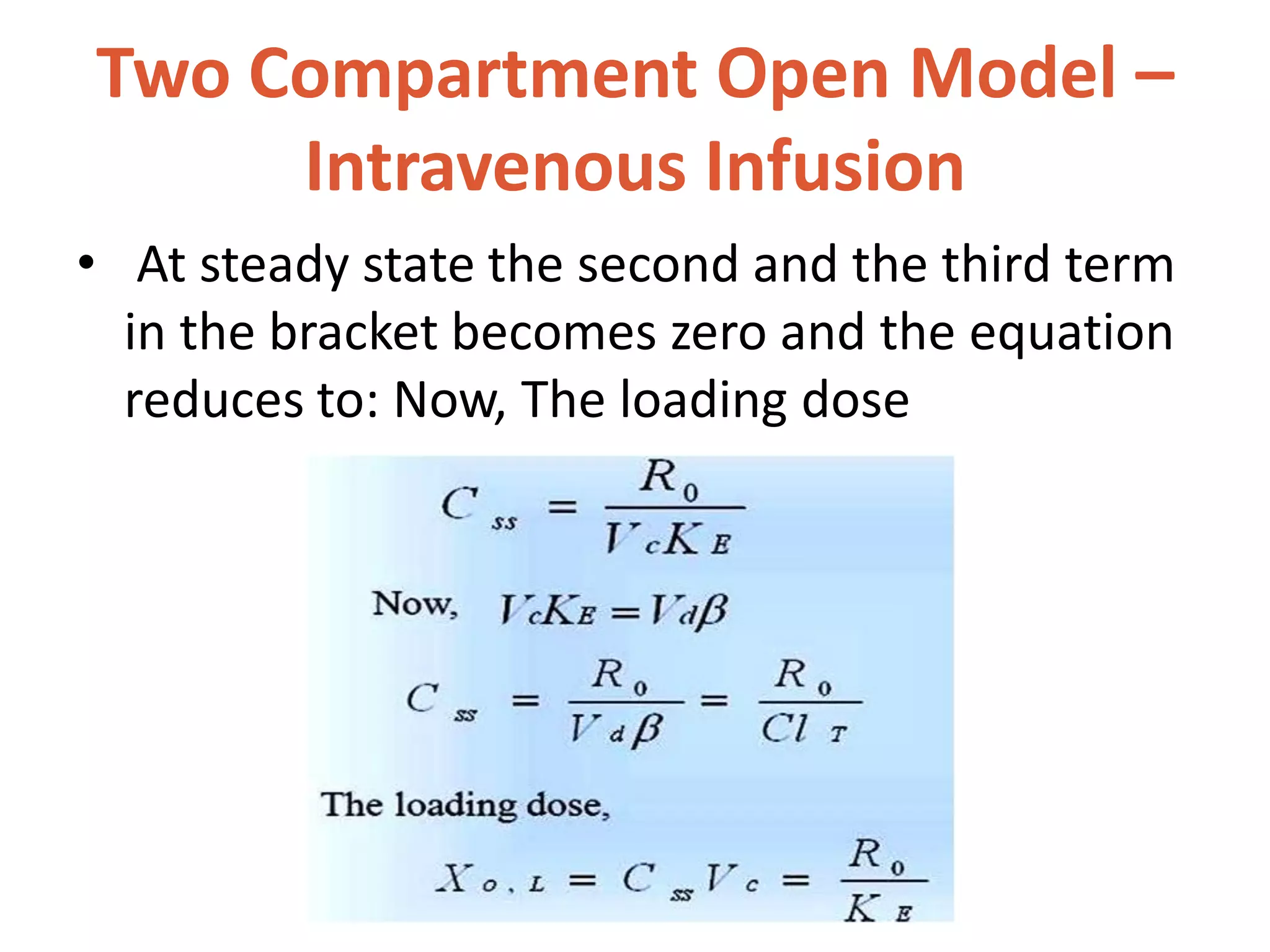
• At steady state the second and the third term
in the bracket becomes zero and the equation
reduces to: Now, The loading dose
Two-Compartment Open Model-
Extravascular administration
• First - Order Absorption
• The model can be depicted as follows :
• The rate of change in drug conc. in the central
compartment is described by three exponents :
An absorption exponent, and
• Two usual exponents that describe drug
disposition.
Two-Compartment Open Model-
Extravascular administration
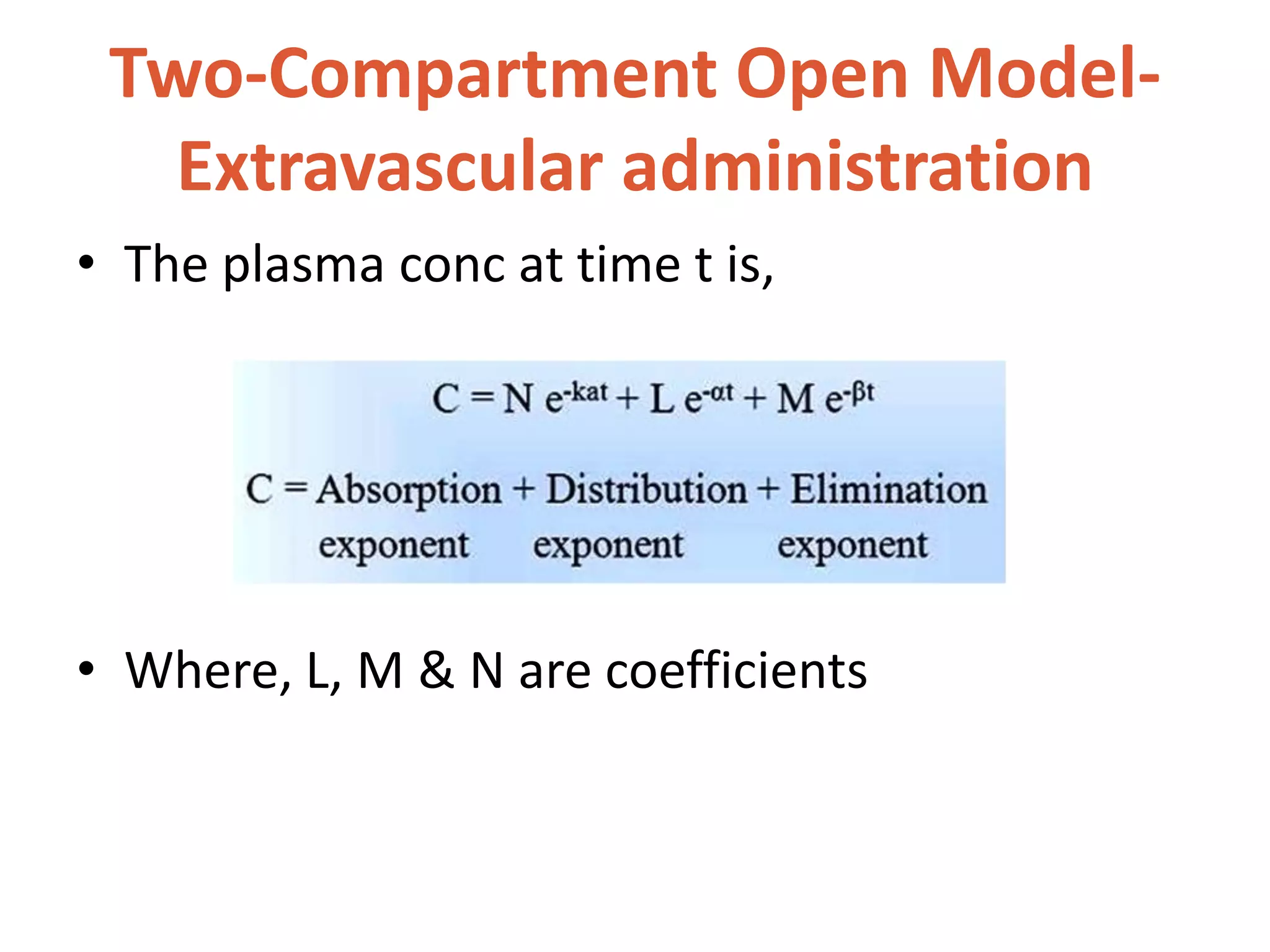
• The plasma conc at time t is,
• Where, L, M & N are coefficients
Conclusion
• The future should involve the use of models
capable of incorporating physico -chemical data
and biological information .
• Compartment modelling is useful in Characterize
the behavior of drug in patient, predicting conc.
of drug in various body fluids with dosage
regimen , calculating optimum dosage regimen
for individual patient, evaluating bioequivalence
between different formulation, explaining drug
interaction.
References
• D.M.Brahmankar & S.B. Jaiswal , Biopharmaceutics &
pharmacokinetics. A.treatise , First edition, Vallabh
Prakashan, P.No . 290-299,
• Leu and febiger , Biopharmaceutics & clinical
pharmacokinetics by Milo Giberldi , Fourth edition,
Philadelphis , 1991. P.No . 213-230.
• Leon shargel and Andrew Yu, A pplied Biopharmaceutics
and pharmacokinetics, Fourth edition. page no. 47-62.
• Milo Gibaldi , Biopharmaceutics and clinical
pharmacokinetics Fourth edition . page no.14-23,
• http://www.authorstream.com/Presentation/abhijit_26-
1830737-multi-compartment-models/

Multicompartment Models

  • 1.
    MULTICOMPARTMENT MODELS Prepared By GirijeshKumar Pandey M.Pharm. (Pharmaceutics)
  • 2.
    Contents • Introduction • Two-CompartmentOpen model • Intravenous bolus administration • Intravenous Infusion • Extra vascular administration • Conclusion • References
  • 3.
    Introduction • One compartmentis described by mono- exponential term i.e. elimination. • For large class of drugs this terms is not sufficient to describe its disposition. • It needs a bi- or multi- exponential terms • The body is composed of a heterogeneous group of tissues each with different degree of blood flow and affinity for drug and therefore different rates of elimination. • Multi-compartment characteristics are best described by administration as i.v. bolus.
  • 4.
    Two Compartment Model •The simplest and commonest is the two compartment model which classifies the body tissues in two categories : 1) Central compartment or Compartment 1 2) Peripheral or Tissue Compartment or Compartment 2. • Compartment 1 comprises of blood and highly perfused tissues like liver, lungs, kidneys, etc. • Elimination usually occurs from this compartment. • Compartment 2 comprises of poorly perfused and slow equilibriating tissues such as muscles, skin, adipose, etc.
  • 5.
    Two Compartment Model •General Grouping of Tissue According to Blood Supply
  • 6.
    Two Compartment Model •Depending upon the compartment from which the drug is eliminated, the 2 compartment model can be further categorised into : - With elimination from Central compartment - With elimination from peripheral compartment - With elimination from both the compartments
  • 7.
  • 8.
    Two compartment Openmodel- I.V. bolus administration: • Elimination from central compartment 1 Central 2 Peripheral • After the iv bolus of a drug the decline in the plasma conc. is bi-exponential. • Two disposition processes- distribution and elimination. • These two processes are only evident when a semilog plot of C vs t is made.
  • 9.
    Two compartment Openmodel- I.V. bolus administration: • Model Structure for Two Compartment Model
  • 10.
    Two compartment Openmodel- I.V. bolus administration: • Where, X 0 = IV bolus dose administered C c = X 1 = amount of drug in the central compartment C p = X 2 = amount of drug in the peripheral compartment k 12 = rate constant for transfer of drug from the central to the peripheral compartment k 21 = rate constant for transfer of drug from the peripheral to the central compartment k E = first order elimination rate constant. Elimination of drug out of the central compartment
  • 11.
    Two compartment Openmodel- I.V. bolus administration: • The second, slower rate process, is called as the post- distributive or elimination phase. • In contrast to central compartment, the conc of drug in the peripheral compartment first increases and reaches its max. • The Rate change in drug conc. in the central compartment is given by, • Extending the relationship X= V d C • Where, V c and V p = apparent volumes of C1 and C2
  • 12.
    Two compartment Openmodel- I.V. bolus administration: • The rate of change in drug conc in the peripheral component is given by: • On integration equation gives conc. of drug in central and peripheral compartments at given time t :
  • 13.
    Two Compartment OpenModel – Intravenous Infusion • The plasma or central compartment conc of a drug when administered as constant rate (0 order) i.v. infusion is given as:
  • 14.
    Two Compartment OpenModel – Intravenous Infusion • At steady state the second and the third term in the bracket becomes zero and the equation reduces to: Now, The loading dose
  • 15.
    Two-Compartment Open Model- Extravascularadministration • First - Order Absorption • The model can be depicted as follows : • The rate of change in drug conc. in the central compartment is described by three exponents : An absorption exponent, and • Two usual exponents that describe drug disposition.
  • 16.
    Two-Compartment Open Model- Extravascularadministration • The plasma conc at time t is, • Where, L, M & N are coefficients
  • 17.
    Conclusion • The futureshould involve the use of models capable of incorporating physico -chemical data and biological information . • Compartment modelling is useful in Characterize the behavior of drug in patient, predicting conc. of drug in various body fluids with dosage regimen , calculating optimum dosage regimen for individual patient, evaluating bioequivalence between different formulation, explaining drug interaction.
  • 18.
    References • D.M.Brahmankar &S.B. Jaiswal , Biopharmaceutics & pharmacokinetics. A.treatise , First edition, Vallabh Prakashan, P.No . 290-299, • Leu and febiger , Biopharmaceutics & clinical pharmacokinetics by Milo Giberldi , Fourth edition, Philadelphis , 1991. P.No . 213-230. • Leon shargel and Andrew Yu, A pplied Biopharmaceutics and pharmacokinetics, Fourth edition. page no. 47-62. • Milo Gibaldi , Biopharmaceutics and clinical pharmacokinetics Fourth edition . page no.14-23, • http://www.authorstream.com/Presentation/abhijit_26- 1830737-multi-compartment-models/