Dr. Prashant L. Pingale
Associate Professor-Pharmaceutics
GES’s Sir Dr. M. S. Gosavi College of Pharmaceutical Education and Research,
Nashik
Significance of Tonicity
Adjustment
Learning outcomes
 On successful completion of this unit learners shall able to:
 Explain in-detailed about significance of tonicity adjustment.
2
Isotonic or Iso–osmotic solutions
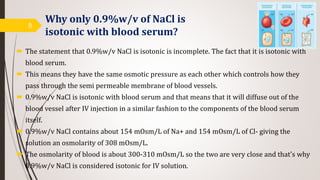
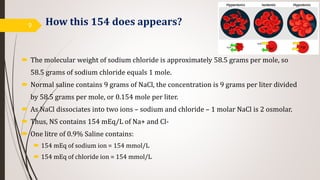
 A solution containing 0.9% of sodium chloride is practically isotonic with blood plasma
and is regarded as standard.
 A solution containing more than 0.9% sodium chloride is called ‘hypertonic’.
 A solution containing less than 0.9% sodium chloride is called ‘hypotonic’.
 Two solutions of different substances having same osmotic pressure at same
temperature are called isotonic solutions.
 When isotonic solutions are separated by Semipermeable membrane, no osmosis takes
place. Isotonic solutions have equal molar concentrations.
3
Isotonic solutions
 An isotonic solution is when two solutions, separated by a semipermeable membrane, have
equal concentrations of solutes and water.
4
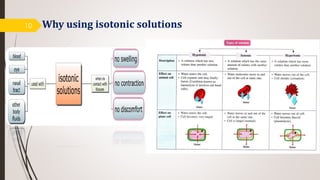
Hypertonic Solution
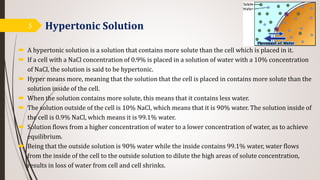
 A hypertonic solution is a solution that contains more solute than the cell which is placed in it.
 If a cell with a NaCl concentration of 0.9% is placed in a solution of water with a 10% concentration
of NaCl, the solution is said to be hypertonic.
 Hyper means more, meaning that the solution that the cell is placed in contains more solute than the
solution inside of the cell.
 When the solution contains more solute, this means that it contains less water.
 The solution outside of the cell is 10% NaCl, which means that it is 90% water. The solution inside of
the cell is 0.9% NaCl, which means it is 99.1% water.
 Solution flows from a higher concentration of water to a lower concentration of water, as to achieve
equilibrium.
 Being that the outside solution is 90% water while the inside contains 99.1% water, water flows
from the inside of the cell to the outside solution to dilute the high areas of solute concentration,
results in loss of water from cell and cell shrinks.
5
Hypotonic Solution
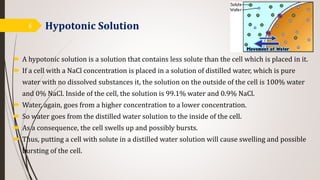
 A hypotonic solution is a solution that contains less solute than the cell which is placed in it.
 If a cell with a NaCl concentration is placed in a solution of distilled water, which is pure
water with no dissolved substances it, the solution on the outside of the cell is 100% water
and 0% NaCl. Inside of the cell, the solution is 99.1% water and 0.9% NaCl.
 Water, again, goes from a higher concentration to a lower concentration.
 So water goes from the distilled water solution to the inside of the cell.
 As a consequence, the cell swells up and possibly bursts.
 Thus, putting a cell with solute in a distilled water solution will cause swelling and possible
bursting of the cell.
6
Tonicity adjusting agents
 Tonicity Agents are used in many parenteral and ophthalmic products
to adjust the tonicity of the solution.
 The goal for every injectable product to be isotonic with physiologic
fluids, this is not an essential requirement for small volume injectables
administered intravenously.
 The products administered by all other routes, especially into the eye
or spinal fluid, must be isotonic.
 Injections into the subcutaneous tissue and muscles should also be
isotonic to minimize pain and tissue irritation.
 The agents most commonly used are electrolytes and mono- or
disaccharides.
 Some solutions are iso-osmotic but not isotonic. This is because the
cell membrane of the red blood cell is not semipermeable to all drugs.
7
Why only 0.9%w/v of NaCl is
isotonic with blood serum?
 The statement that 0.9%w/v NaCl is isotonic is incomplete. The fact that it is isotonic with
blood serum.
 This means they have the same osmotic pressure as each other which controls how they
pass through the semi permeable membrane of blood vessels.
 0.9%w/v NaCl is isotonic with blood serum and that means that it will diffuse out of the
blood vessel after IV injection in a similar fashion to the components of the blood serum
itself.
 0.9%w/v NaCl contains about 154 mOsm/L of Na+ and 154 mOsm/L of Cl- giving the
solution an osmolarity of 308 mOsm/L.
 The osmolarity of blood is about 300-310 mOsm/L so the two are very close and that's why
0.9%w/v NaCl is considered isotonic for IV solution.
8
How this 154 does appears?
 The molecular weight of sodium chloride is approximately 58.5 grams per mole, so
58.5 grams of sodium chloride equals 1 mole.
 Normal saline contains 9 grams of NaCl, the concentration is 9 grams per liter divided
by 58.5 grams per mole, or 0.154 mole per liter.
 As NaCl dissociates into two ions – sodium and chloride – 1 molar NaCl is 2 osmolar.
 Thus, NS contains 154 mEq/L of Na+ and Cl-
 One litre of 0.9% Saline contains:
 154 mEq of sodium ion = 154 mmol/L
 154 mEq of chloride ion = 154 mmol/L
9
Why using isotonic solutions10
Methods to adjust the tonicity11
Tonicity
Methods
NaCl
Equivalent
Method
White-
Vincent
Methods
Molecular
Concentration
Method
Cryscopic
Method
Significance of tonicity adjustment