-ASHLESHA M. SHERE
Roll No. – PD126
FY PHARM D
An emulsion is said to be stable, if it remain as such
after its preparation i.e. the dispersed globules are
uniformly distributed throughout the dispersed medium
During its storage.
Deviation from the ideal behavior of an emulsion is
known as instability of emulsion.
The instability of pharmaceutical emulsion may be
classified into four phenomenons, those are:
 Cracking or Breaking
 Creaming
 Deterioration by microorganism
 Physical and chemical changes.
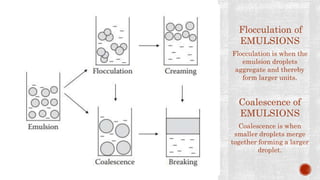
Flocculation of
EMULSIONS
Flocculation is when the
emulsion droplets
aggregate and thereby
form larger units.
Coalescence of
EMULSIONS
Coalescence is when
smaller droplets merge
together forming a larger
droplet.
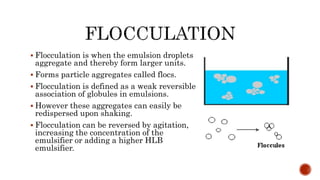
 Flocculation is when the emulsion droplets
aggregate and thereby form larger units.
 Forms particle aggregates called flocs.
 Flocculation is defined as a weak reversible
association of globules in emulsions.
 However these aggregates can easily be
redispersed upon shaking.
 Flocculation can be reversed by agitation,
increasing the concentration of the
emulsifier or adding a higher HLB
emulsifier.
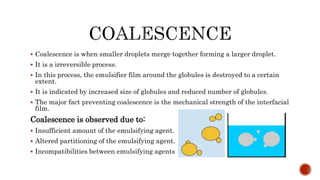
 Coalescence is when smaller droplets merge together forming a larger droplet.
 It is a irreversible process.
 In this process, the emulsifier film around the globules is destroyed to a certain
extent.
 It is indicated by increased size of globules and reduced number of globules.
 The major fact preventing coalescence is the mechanical strength of the interfacial
film.
Coalescence is observed due to:
 Insufficient amount of the emulsifying agent.
 Altered partitioning of the emulsifying agent.
 Incompatibilities between emulsifying agents
 When the dispersed particles come together and form a large globule
we call this phenomenon Coalescence
 When the coalescence increases the phases separate completely, as
two distinct layers ,the emulsion breaks.
 Breaking of emulsions
Causes of breaking
 Addition of an emulsifying agent of opposite type
 Decomposition or precipitation of emulsifying agent
 Temperature
 Freezing
 Addition of a common solvent
Prevention of breaking
 Absence of incompatibility between emulsifying agent and other
ingredient
 Absence of excessive amount of dispersed part
 Absence of increase temperature
 Absence of freezing of the aqueous phase
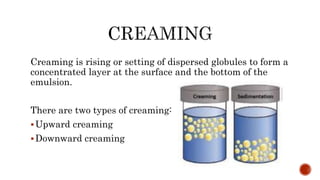
Creaming is rising or setting of dispersed globules to form a
concentrated layer at the surface and the bottom of the
emulsion.
There are two types of creaming:
Upward creaming
Downward creaming
UPWARD CREAMING
 If the globules have lower density,they will tend to concentrate the
upper layer of the system and it is called upward creaming.
 This is common in o/w emulsion
 E.g Creaming of milk
DOWNWARD CREAMING
 Globule settle to the lower layer if they have a greater density than
the continuous phase.
 It is Common in w/o emulsion
 Also known as sedimentation in emulsion
 E.g Water in oil
Causes of Creaming
 Is cause by the influence of gravity of the globules
 Due to density difference
Prevention of Creaming
 By reducing the size of globules
 By reducing density difference
 By increasing the viscosity of continuous phase
Most emulsion are sensitive to growth of bacteria, yeast
and mold, because emulsifying agent is suitable media for
growth of microorganism.
Microorganisms contaminate the aqueous phase and
produce rancidity of the oil phase.
The presence of certain drugs such as benzoic and salicylic
acid or high concentration of alcoholic solutions may
provide adequate protection against microorganisms.
However, it is usually desirable to add an agent which will
act specifically as a preservative.
Causes of Deterioration
 Decomposition of emulsifying agent
 Contamination of aqueous phase
 Produce rancidity of the oil
 Density oil soluble vitamin
Prevention of Deterioration
 To protect these preservation should be added.
 A mixture of parahydro benzoil (0.10.2%), methylester and propyl
ester (0.02 0.05% ) are particularly effective against mold, east and
bacteria.
 In phase inversion o/w type emulsion changes into w/o type and vice versa.
 It is a physical instability.
 It may be brought about by the addition of an electrolyte or by changing the phase
volume ratio or
 By temperature changes.
 Phase inversion can be minimized by using the proper emulsifying agent in
adequate concentration,
 Keeping the concentration of dispersed phase between 30 to 60 percent
 And by storing the emulsion in a cool place.
Various physical and chemical changes include
Deterioration caused by extreme temperature
Deterioration of light
Oxidative and hydrolytic ranicidity of the oil
Change of PH
Care must be taken to protect emulsions against
deterioration by light, extreme temperature, oxidative and
hydrolytic rancidity of the oil.
Freezing and thawing result in a coarsening of globules
and sometimes breaking emulsions. High temperatures
produce the same effects as well.
Light and rancidity influence the colour and odour of oils
and may destroy their vitamin activity.
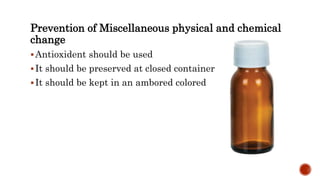
Emulsions should be kept in tight containers and stored at
moderate temperature and if they affected by light they
should be stored in dark containers.
Prevention of Miscellaneous physical and chemical
change
Antioxident should be used
It should be preserved at closed container
It should be kept in an ambored colored
Instability Of Emulsions.pptx