Topic: Hybrid Electric Vehicle
Under The Guidance Of: Dr. Pramod B. Magade.
Group Members:
T612011 Pranav Dhupkar
T612012 Harshit Dixit
T6120 Aryan Fernandes
T6120 Nikhil Gaikwad
Table of Content
 Introduction
 What is Hybrid Electric Vehicle
 History
 Working Principles
 Types of Hybridization
 Types of Hybrid
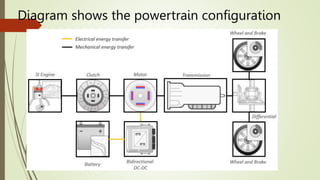
 Diagram of Powertrain configuration
 Parts of HEV Vehicle
 Advantages
 Disadvantages
 Conclusion
Introduction
 A hybrid electric vehicle (HEV) augment an electric vehicle (EV) with a second source of power
referred to as the alternate power unit (APU).
 Accordingly, the hybrid concept, where the alternative power unit is used as a second source of
energy, is gaining acceptance and is overcoming some of the problems of pure electric vehicles.
 Electric propulsion systems in hybrid and electric vehicles utilize the majority of currently used
control systems; on the other hand, it is necessary to use new, and often more sophisticated,
methods for control.
 Fundamentally it is necessary to control the velocity and torque of electrical motors. Hybrid vehicles
(HEV) need energy management systems which switch, to the propulsion mode with the best
efficiency. (IC internal combustion engine, electric motor, both engines, recuperation).
What is Hybrid Electric Vehicle
 Any vehicle that combines two or more sources of power is said to be hybrid. For example, a
moped (a motorized pedal bike).
 Alternative power unit to supply the power required by the vehicle, to recharge the batteries, and to
power accessories like the air conditioner and heater.
 Hybrid electric vehicles (HEVs) combine the benefits of gasoline engines and electric motors. They
can be designed to meet different goals, such as better fuel economy or more power.
History
 1830-battery electric vehicle invented by Thomas davenport, Robert Anderson, others - using non-
rechargeable batteries.
 1890-ev's outsold gas cars 10 to 1 Oldsmobile and Studebaker started as ev companies started as ev
companies.
 1904- Krieger’s company builds first hybrid vehicle.
 1910-mass produced ford cars undercut hand built ev's, ev's persist as status symbols and utility
vehicles until great depression.
Working Principles
Hybrid electric vehicles (HEVs) combine the benefits of gasoline engines and electric motors. They can
be designed to meet different goals, such as better fuel economy or more power.
Most hybrids use several advanced technologies:
• Braking Regenerative. During coasting or braking, regenerative braking restores energy normally lost.
It uses the wheels' forward motion to spin the engine. This provides energy which makes the car slow
down.
• Drive/Assist Electric Motor. In order to help the engine accelerate, move, or hill climb, the electric
motor provides power. This enables the use of a smaller, more-efficient engine. The electric motor alone
propels the vehicle in some hybrids at low speeds, where gasoline engines are the least powerful.
• Stop/Start Automatic. When the car comes to a halt, the engine automatically shuts off and restarts
when the accelerator is pressed. It minimizes wasted energy from idling.
Types of hybridization
Mild/Micro Hybridization:
• The feature idle-stop function.
• Regenerative braking.
• These are not capable of using the electric motor to propel the vehicle.
• These systems are usually 42 volts or less.
Types of hybridization
Medium Hybridization:
• They feature idle-stop function.
• Regenerative braking.
• Most are not capable of using the electric motor alone to propel the vehicle.
• The electric motor usually assists the engine.
• Battery voltages are about 144 to 158 volts.
Types of hybridization
Full Hybridization:
• They feature idle-stop function.
• Regenerative braking.
• Most are not capable of using the electric motor alone to propel the vehicle.
• The electric motor usually assists the engine.
• Battery voltages are about 200 to 300 volts.
Types of hybrid
Series Hybrid:
 The fuel tank goes to the engine, but the engine turns a generator.
 Then the generator can either charge the batteries or power an electric motor that drives the
transmission.
 The gasoline engine does not directly power the car.
Types of hybrid
Series Hybrid:
 Similar to an electric vehicle with an onboard generator.
 The vehicle runs on battery power like a pure electric vehicle until the batteries reach a
predetermined discharged level.
 At that point the APU turns on and begins recharging the battery.
 The APU operates until the batteries are charged to a predetermined level.
 APU never directly powers the vehicle.
 The length of time the APU is on depends on the size of the batteries and the APU itself.
 Since the APU is not directly connected to the drive train, it can be run at its optimal operating
condition; hence, fuel economy is increased and emissions are reduced relative to a pure IC engine
vehicle.
Types of hybrid
Parallel Hybrid:
 Has a fuel tank that supplies gas to the engine like a regular car.
 It also has a set of batteries that run an electric motor.
 Both the engine and electric motor can turn the transmission at the same time.
Types of hybrid
Parallel Hybrid:
 Fuel tank, which supplies gasoline to the engine.
 Set of batteries that supplies power to an electric motor.
 Both the engine and the electric motor can turn the transmission at the same time and the
transmission then turns the wheels.
 When APU is off, the parallel hybrid runs like and electric vehicle.
 When the APU is on, the controller divides energy between the drive train (propulsion) and the
batteries (energy storage).
 Under acceleration, more power is allocated to drive train than to the batteries.
Diagram shows the powertrain configuration
Parts of HEV vehicle
 Engine: It’s much same as other vehicles engines, but the size on hybrid electric vehicle engine is
small and it’s more fuel efficient.
 Battery: it strokes the energy generated from gasoline engine or during regenerative braking, from
the electric motor.
 Electric motor: It’s power the vehicle at low speed and assist the gasoline engine when additional
power is needed.
 Controller: The controller is used to charge the battery or to supply the power to electric motor.
 Generator: It converts mechanical energy from engine into electric energy, which can be used by
electric motor stored in the battery. It’s also used to start the gasoline engine instantly.
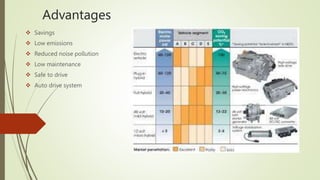
Advantages
 Savings
 Low emissions
 Reduced noise pollution
 Low maintenance
 Safe to drive
 Auto drive system
Dis-Advantages
 Hybrids are more expensive than non-hybrid.
 Hybrids have a much higher risk of exploding because it has a combination of gasoline and ethanol.
 Sometimes they can be pretty ugly.
 Parts can be very expensive to repair (between $1,00,000 till $3,00,000 for a battery).
 Slower than petrol powered cars.
Conclusion
 Hybrid cars are definitely more environmentally friendly than internal-combustion vehicles.
 Batteries are being engineered to have a long life.
 When the hybrid cars become more widespread, battery recycling will become economically
possible.
 Research into other energy sources such as fuel cells and renewable fuels make the future look
brighter for hybrid cars.
Thank You.

HEV Final PPT.pptx

  • 1.
    Topic: Hybrid ElectricVehicle Under The Guidance Of: Dr. Pramod B. Magade. Group Members: T612011 Pranav Dhupkar T612012 Harshit Dixit T6120 Aryan Fernandes T6120 Nikhil Gaikwad
  • 2.
    Table of Content Introduction  What is Hybrid Electric Vehicle  History  Working Principles  Types of Hybridization  Types of Hybrid  Diagram of Powertrain configuration  Parts of HEV Vehicle  Advantages  Disadvantages  Conclusion
  • 3.
    Introduction  A hybridelectric vehicle (HEV) augment an electric vehicle (EV) with a second source of power referred to as the alternate power unit (APU).  Accordingly, the hybrid concept, where the alternative power unit is used as a second source of energy, is gaining acceptance and is overcoming some of the problems of pure electric vehicles.  Electric propulsion systems in hybrid and electric vehicles utilize the majority of currently used control systems; on the other hand, it is necessary to use new, and often more sophisticated, methods for control.  Fundamentally it is necessary to control the velocity and torque of electrical motors. Hybrid vehicles (HEV) need energy management systems which switch, to the propulsion mode with the best efficiency. (IC internal combustion engine, electric motor, both engines, recuperation).
  • 4.
    What is HybridElectric Vehicle  Any vehicle that combines two or more sources of power is said to be hybrid. For example, a moped (a motorized pedal bike).  Alternative power unit to supply the power required by the vehicle, to recharge the batteries, and to power accessories like the air conditioner and heater.  Hybrid electric vehicles (HEVs) combine the benefits of gasoline engines and electric motors. They can be designed to meet different goals, such as better fuel economy or more power.
  • 5.
    History  1830-battery electricvehicle invented by Thomas davenport, Robert Anderson, others - using non- rechargeable batteries.  1890-ev's outsold gas cars 10 to 1 Oldsmobile and Studebaker started as ev companies started as ev companies.  1904- Krieger’s company builds first hybrid vehicle.  1910-mass produced ford cars undercut hand built ev's, ev's persist as status symbols and utility vehicles until great depression.
  • 6.
    Working Principles Hybrid electricvehicles (HEVs) combine the benefits of gasoline engines and electric motors. They can be designed to meet different goals, such as better fuel economy or more power. Most hybrids use several advanced technologies: • Braking Regenerative. During coasting or braking, regenerative braking restores energy normally lost. It uses the wheels' forward motion to spin the engine. This provides energy which makes the car slow down. • Drive/Assist Electric Motor. In order to help the engine accelerate, move, or hill climb, the electric motor provides power. This enables the use of a smaller, more-efficient engine. The electric motor alone propels the vehicle in some hybrids at low speeds, where gasoline engines are the least powerful. • Stop/Start Automatic. When the car comes to a halt, the engine automatically shuts off and restarts when the accelerator is pressed. It minimizes wasted energy from idling.
  • 7.
    Types of hybridization Mild/MicroHybridization: • The feature idle-stop function. • Regenerative braking. • These are not capable of using the electric motor to propel the vehicle. • These systems are usually 42 volts or less.
  • 8.
    Types of hybridization MediumHybridization: • They feature idle-stop function. • Regenerative braking. • Most are not capable of using the electric motor alone to propel the vehicle. • The electric motor usually assists the engine. • Battery voltages are about 144 to 158 volts.
  • 9.
    Types of hybridization FullHybridization: • They feature idle-stop function. • Regenerative braking. • Most are not capable of using the electric motor alone to propel the vehicle. • The electric motor usually assists the engine. • Battery voltages are about 200 to 300 volts.
  • 10.
    Types of hybrid SeriesHybrid:  The fuel tank goes to the engine, but the engine turns a generator.  Then the generator can either charge the batteries or power an electric motor that drives the transmission.  The gasoline engine does not directly power the car.
  • 11.
    Types of hybrid SeriesHybrid:  Similar to an electric vehicle with an onboard generator.  The vehicle runs on battery power like a pure electric vehicle until the batteries reach a predetermined discharged level.  At that point the APU turns on and begins recharging the battery.  The APU operates until the batteries are charged to a predetermined level.  APU never directly powers the vehicle.  The length of time the APU is on depends on the size of the batteries and the APU itself.  Since the APU is not directly connected to the drive train, it can be run at its optimal operating condition; hence, fuel economy is increased and emissions are reduced relative to a pure IC engine vehicle.
  • 12.
    Types of hybrid ParallelHybrid:  Has a fuel tank that supplies gas to the engine like a regular car.  It also has a set of batteries that run an electric motor.  Both the engine and electric motor can turn the transmission at the same time.
  • 13.
    Types of hybrid ParallelHybrid:  Fuel tank, which supplies gasoline to the engine.  Set of batteries that supplies power to an electric motor.  Both the engine and the electric motor can turn the transmission at the same time and the transmission then turns the wheels.  When APU is off, the parallel hybrid runs like and electric vehicle.  When the APU is on, the controller divides energy between the drive train (propulsion) and the batteries (energy storage).  Under acceleration, more power is allocated to drive train than to the batteries.
  • 14.
    Diagram shows thepowertrain configuration
  • 15.
    Parts of HEVvehicle  Engine: It’s much same as other vehicles engines, but the size on hybrid electric vehicle engine is small and it’s more fuel efficient.  Battery: it strokes the energy generated from gasoline engine or during regenerative braking, from the electric motor.  Electric motor: It’s power the vehicle at low speed and assist the gasoline engine when additional power is needed.  Controller: The controller is used to charge the battery or to supply the power to electric motor.  Generator: It converts mechanical energy from engine into electric energy, which can be used by electric motor stored in the battery. It’s also used to start the gasoline engine instantly.
  • 16.
    Advantages  Savings  Lowemissions  Reduced noise pollution  Low maintenance  Safe to drive  Auto drive system
  • 17.
    Dis-Advantages  Hybrids aremore expensive than non-hybrid.  Hybrids have a much higher risk of exploding because it has a combination of gasoline and ethanol.  Sometimes they can be pretty ugly.  Parts can be very expensive to repair (between $1,00,000 till $3,00,000 for a battery).  Slower than petrol powered cars.
  • 18.
    Conclusion  Hybrid carsare definitely more environmentally friendly than internal-combustion vehicles.  Batteries are being engineered to have a long life.  When the hybrid cars become more widespread, battery recycling will become economically possible.  Research into other energy sources such as fuel cells and renewable fuels make the future look brighter for hybrid cars.
  • 19.