Elastromers (Rubbers)

Submitted by: Samyak Suyal
Roll no.
:
R820211030
What are Elastomers
 An elastomer is a polymer with visco-

elasticity (colloquially "elasticity"), generally
having low Young’s modulus and high
failure strain compared with other materials.
The term, which is derived from elastic
polymer, is often used interchangeably with
the term rubber.
 Elastomers are amorphous polymers existing
above their Glass Transition Temperature, so
that considerable segmental motion is
possible.
Types of Elastomers
 Thermosets
 Thermoplastic

Note: Elastomers are
usually Thermosets (requiring vulcanizaton)
but may also be Thermoplastic.
Thermosetting polymer as a pre-polymer in a soft solid or viscous
state that changes irreversibly into an infusible, insoluble polymer
network by curing. Curing can be induced by the action of heat or
suitable radiation, or both. A cured thermosetting polymer is called a
thermoset.
A thermoplastic, or thermosoftening plastic, is a polymer that
becomes pliable or moldable above a specific temperature, and returns
to a solid state upon cooling. Most thermoplastics have a high molecular
weight.
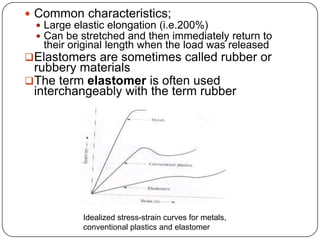
 Common characteristics;
 Large elastic elongation (i.e.200%)
 Can be stretched and then immediately return to
their original length when the load was released
Elastomers are sometimes called rubber or

rubbery materials
The term elastomer is often used
interchangeably with the term rubber

Idealized stress-strain curves for metals,
conventional plastics and elastomer
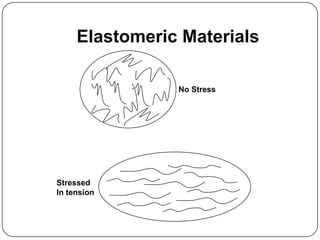
Elastomeric Materials
No Stress

Stressed
In tension
Natural Rubber
 Creep
 Solved by Goodyear in the 1800's
 Discovered that the polymer could be crosslinked

(cured or vulcanized) by heating with sulphur

Synthetic
Polyisoprene or
Isoprene Rubber
•Need
•Used in tires for bicycles and early cars.
•Used the Ziegler-Natta catalyst system to improve
properties.
•The trans- or cis- nature of the rubber could be
controlled up
to 90% in either direction.
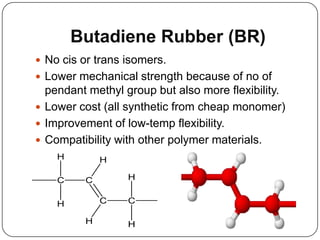
Butadiene Rubber (BR)
 No cis or trans isomers.
 Lower mechanical strength because of no of

pendant methyl group but also more flexibility.
 Lower cost (all synthetic from cheap monomer)
 Improvement of low-temp flexibility.
 Compatibility with other polymer materials.
H
C

H
H

C
C

H
H

C
H

H
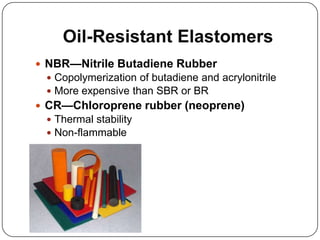
Oil-Resistant Elastomers
 NBR—Nitrile Butadiene Rubber
 Copolymerization of butadiene and acrylonitrile
 More expensive than SBR or BR

 CR—Chloroprene rubber (neoprene)
 Thermal stability
 Non-flammable
Thermoplastic Elastomers (EPM
and EPDM)
 Many of the properties of thermoset

elastomers
 Resiliency
 Elasticity

 More easily processed
 Injection molding, extrusion and other standard
thermoplastic processes.
 Highly compatible with polyolefins.
 EPDM is crosslinked very lightly and may not be
capable of being melted.
Thermoplastic Olefin Elastomers (TP
 Block tripolymers (such as SBS) with hard and

soft domains.
 Poor compatibility with other rubbers.
 Melt processible.

Flouroelastomer
s•Many of the desirable properties of

flouropolymers
•Low solvent effects
-Excellent for chemical and petroleum
handling applications
•High thermal stability
-Good for gaskets and seals
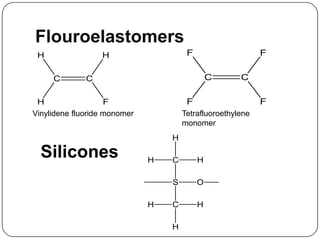
Flouroelastomers
H

F

H
C

F
C

C

C

F
Tetrafluoroethylene
monomer

H
F
Vinylidene fluoride monomer

F

H

Silicones

H

H

H

S

H

C

O

C

H

H

H
THANK YOU

Elastomers(polymer)

  • 1.
    Elastromers (Rubbers) Submitted by:Samyak Suyal Roll no. : R820211030
  • 2.
    What are Elastomers An elastomer is a polymer with visco- elasticity (colloquially "elasticity"), generally having low Young’s modulus and high failure strain compared with other materials. The term, which is derived from elastic polymer, is often used interchangeably with the term rubber.  Elastomers are amorphous polymers existing above their Glass Transition Temperature, so that considerable segmental motion is possible.
  • 3.
    Types of Elastomers Thermosets  Thermoplastic Note: Elastomers are usually Thermosets (requiring vulcanizaton) but may also be Thermoplastic. Thermosetting polymer as a pre-polymer in a soft solid or viscous state that changes irreversibly into an infusible, insoluble polymer network by curing. Curing can be induced by the action of heat or suitable radiation, or both. A cured thermosetting polymer is called a thermoset. A thermoplastic, or thermosoftening plastic, is a polymer that becomes pliable or moldable above a specific temperature, and returns to a solid state upon cooling. Most thermoplastics have a high molecular weight.
  • 4.
     Common characteristics; Large elastic elongation (i.e.200%)  Can be stretched and then immediately return to their original length when the load was released Elastomers are sometimes called rubber or rubbery materials The term elastomer is often used interchangeably with the term rubber Idealized stress-strain curves for metals, conventional plastics and elastomer
  • 5.
  • 6.
    Natural Rubber  Creep Solved by Goodyear in the 1800's  Discovered that the polymer could be crosslinked (cured or vulcanized) by heating with sulphur Synthetic Polyisoprene or Isoprene Rubber •Need •Used in tires for bicycles and early cars. •Used the Ziegler-Natta catalyst system to improve properties. •The trans- or cis- nature of the rubber could be controlled up to 90% in either direction.
  • 7.
    Butadiene Rubber (BR) No cis or trans isomers.  Lower mechanical strength because of no of pendant methyl group but also more flexibility.  Lower cost (all synthetic from cheap monomer)  Improvement of low-temp flexibility.  Compatibility with other polymer materials. H C H H C C H H C H H
  • 8.
    Oil-Resistant Elastomers  NBR—NitrileButadiene Rubber  Copolymerization of butadiene and acrylonitrile  More expensive than SBR or BR  CR—Chloroprene rubber (neoprene)  Thermal stability  Non-flammable
  • 9.
    Thermoplastic Elastomers (EPM andEPDM)  Many of the properties of thermoset elastomers  Resiliency  Elasticity  More easily processed  Injection molding, extrusion and other standard thermoplastic processes.  Highly compatible with polyolefins.  EPDM is crosslinked very lightly and may not be capable of being melted.
  • 10.
    Thermoplastic Olefin Elastomers(TP  Block tripolymers (such as SBS) with hard and soft domains.  Poor compatibility with other rubbers.  Melt processible. Flouroelastomer s•Many of the desirable properties of flouropolymers •Low solvent effects -Excellent for chemical and petroleum handling applications •High thermal stability -Good for gaskets and seals
  • 11.
  • 12.