AUTOMATIC TRANSMISSION
MNNIT
PRESENTED BY:
• SOUMYA KHANNA - 20169040
• SOUMEN MUKHERJEE - 20163022
• SUDHANSHU RANJAN SHUKLA - 20161001
• SUNDARAM KUMAR - 20153115
PRESENTATION ON:
THERMAL ENGINEERING LAB – III (ME 1654)
WHAT IS AUTOMATIC TRANSMISSION?
An Automatic Transmission is a type of
motor vehicle transmission that can
automatically change gear ratios as the
vehicle moves, freeing the driver from
having to shift gears manually.
It allows an Internal Combustion engine,
best suited to run at a relatively high
rotational speed, to provide a range of
speed and torque outputs.
TYPES OF AUTOMATIC TRANSMISSION
AUTOMATIC TRANSMISSION CAN BE CLASSIFIED AS:
• AUTOMATED MANUAL TRANSMISSION:
TRANSMISSION USED IN FERRARI 458 IS A MODERN SAT
Also known as semi-automatic transmission (SAT) and several
other names, this automatic transmission type utilizes a regular
clutch and gear setup but automates the action by the use of
sensors, actuators, processors, and pneumatics.
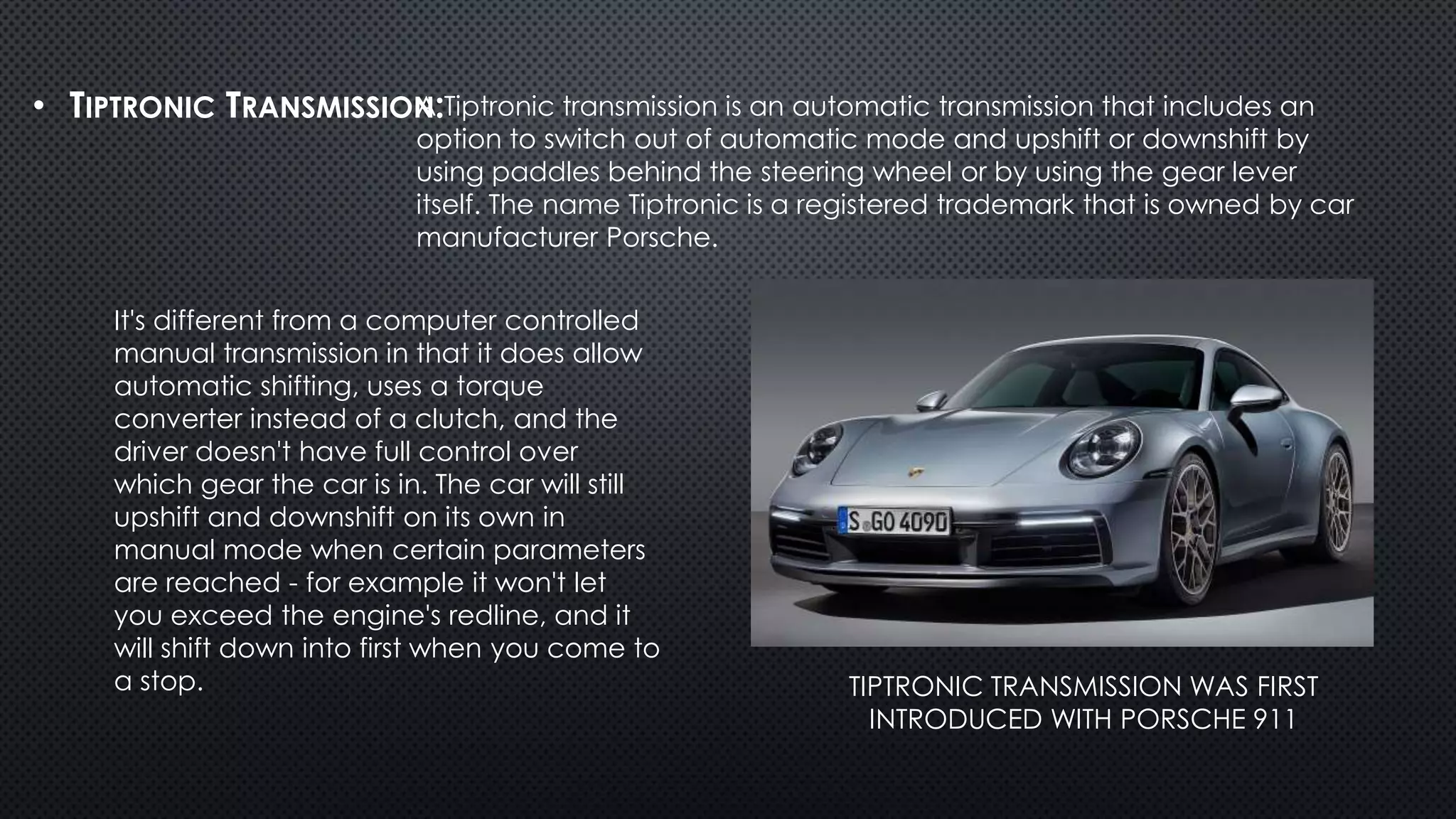
• TIPTRONIC TRANSMISSION:
TIPTRONIC TRANSMISSION WAS FIRST
INTRODUCED WITH PORSCHE 911
A Tiptronic transmission is an automatic transmission that includes an
option to switch out of automatic mode and upshift or downshift by
using paddles behind the steering wheel or by using the gear lever
itself. The name Tiptronic is a registered trademark that is owned by car
manufacturer Porsche.
It's different from a computer controlled
manual transmission in that it does allow
automatic shifting, uses a torque
converter instead of a clutch, and the
driver doesn't have full control over
which gear the car is in. The car will still
upshift and downshift on its own in
manual mode when certain parameters
are reached - for example it won't let
you exceed the engine's redline, and it
will shift down into first when you come to
a stop.
• CONTINUOUSLY VARIABLE TRANSMISSION:The continuously variable transmission, or CVT, can
smoothly and steplessly alter its gear ratio by varying the
diameter of a pair of belt or chain-linked pulleys, wheels or
cones.
TRANSMISSION USED IN 2016 NISSAN
SENTRA
IS THE XTRONIC CVT
• DUAL CLUTCH TRANSMISSION:A dual-clutch transmission, or DCT, uses two separate clutches for odd
and even gear sets. It can fundamentally be described as two separate
manual transmissions (with their respective clutches) contained within one
housing, and working as one unit. They are usually operated in a fully
automatic mode, and many also have the ability to allow the driver to
manually shift gears in semi-automatic mode.
CHRYSLER DODGE DART USES DCT
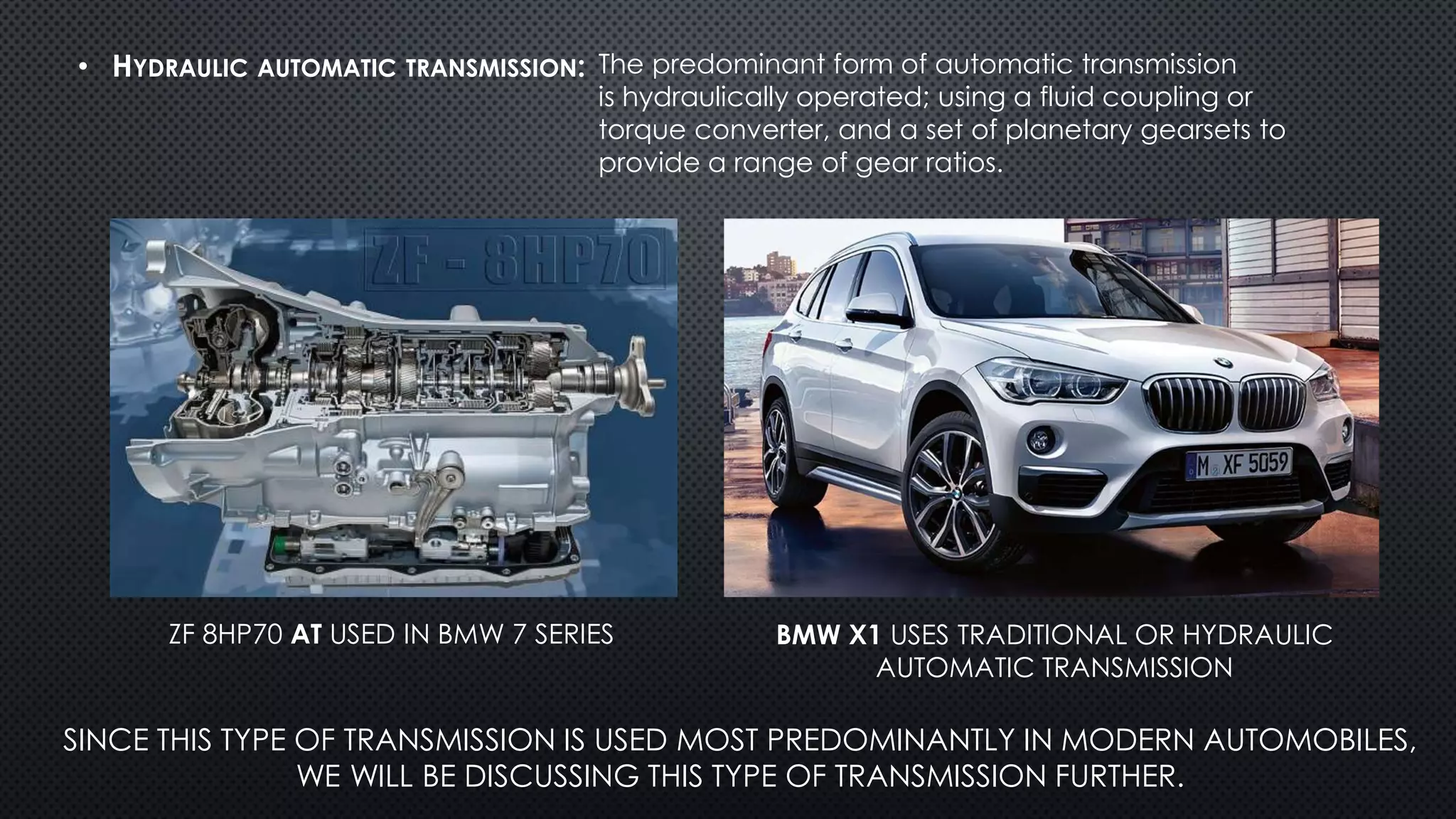
• HYDRAULIC AUTOMATIC TRANSMISSION:
SINCE THIS TYPE OF TRANSMISSION IS USED MOST PREDOMINANTLY IN MODERN AUTOMOBILES,
WE WILL BE DISCUSSING THIS TYPE OF TRANSMISSION FURTHER.
ZF 8HP70 AT USED IN BMW 7 SERIES BMW X1 USES TRADITIONAL OR HYDRAULIC
AUTOMATIC TRANSMISSION
The predominant form of automatic transmission
is hydraulically operated; using a fluid coupling or
torque converter, and a set of planetary gearsets to
provide a range of gear ratios.
PARTS OF HYDRAULIC AUTOMATIC TRANSMISSION
Hydraulic controls: Uses special transmission fluid sent under pressure by an oil
pump to control various clutches
and bands modifying the
speed of the output depending
on the vehicle's running
condition.Governor: is connected to the output shaft and regulates the hydraulic pressure
depending on the vehicle speed. Modern designs have
replaced the mechanical governor with an
electronic speed sensor and computer software.
Transmission Control Unit: In many modern automatic transmissions, the
valves
are controlled by electro-mechanical servos
which are controlled by the electronic [engine
control unit]
(ECU) or a separate TCU.
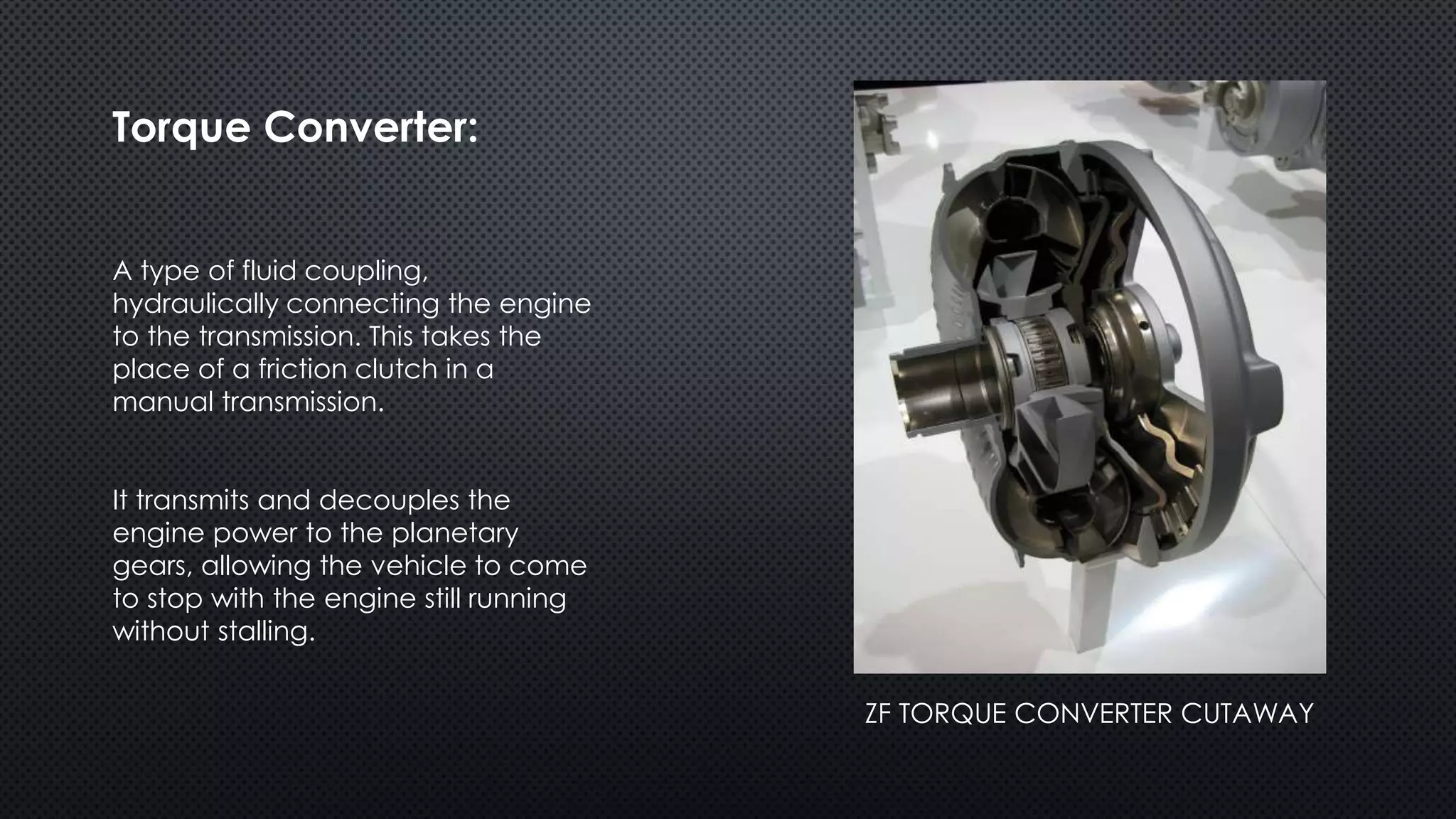
Torque Converter:
A type of fluid coupling,
hydraulically connecting the engine
to the transmission. This takes the
place of a friction clutch in a
manual transmission.
It transmits and decouples the
engine power to the planetary
gears, allowing the vehicle to come
to stop with the engine still running
without stalling.
ZF TORQUE CONVERTER CUTAWAY
Parts of a Torque
Converter:
Pump: Also known as the impeller, it is
mechanically driven by the prime
mover, in this case, the engine. It rotates
the fluid and transfers power to the
turbine.
Turbine: It is the rotating element which
drives the load, i.e. transmits power to
the transmission.
Stator: It is interposed between the
impeller and turbine so that it can alter
oil flow returning from the turbine to the
impeller.
Planetary gears train:
Consisting of planetary gear sets as
well as clutches and bands. These
are the mechanical systems that
provide the various gear ratios,
altering the speed of rotation of the
output shaft depending on which
planetary gears are locked.
To effect gear changes, one of two
types of clutches or bands are used
to hold a particular member of the
planetary gearset motionless, while
allowing another member to rotate,
thereby transmitting torque and
producing gear reductions or
overdrive ratios.
PLANETARY GEAR TRAIN
RING GEAR
PLANET GEAR
SUN GEAR
AUTOMATIC TRANSMISSION MODES
Conventionally, in order to select the transmission operating mode, the driver moves a
selection lever located either on the steering column or on the floor.
Depending on the model and make of the transmission, these controls can take
several forms. However most include the following:
Park: This selection mechanically locks the output shaft of
transmission.
Neutral: Disengages the transmission from the Engine.
Drive: This position allows the transmission to engage the
full range of available forward gear ratios, allowing the
vehicle to move forward and accelerate through its range
of gears.
Reverse: Engages the Reverse gear.
Overdrive: For cruising at sustained speed with lower
Engine RPM.
Sport: (only present in some models) Similar to Drive
mode, but upshifts are carried out at higher engine RPM.
AUTOMATIC TRANSMISSION MODELS
Some of the best known Automatic Transmission families include:
OLD MODELS:
General Motors:
DynaFlow: developed and built by General Motors Buick Motor Division from late 1947 to mid-1963
that used a five-element torque converter, with two turbines and two stators, as well as a
planetary gearset that provided two forward speeds plus reverse.
Ford:
Cruise-O-Matic: a variation of Warner Gear's three-speed unit named Ford-O-Matic continued to
evolve later into Cruise-O-Matic named transmissions in 1958 and finally the FMX named
transmissions in 1968.
NEW MODELS:
ZF 8 speed: The ZF 8HP is an eight-speed automatic transmission designed and built by ZF
Friedrichshafen. It had its debut in the BMW 7 Series fitted with the V12 engine, and since then
each new BMW model in all Series have been equipped with it.
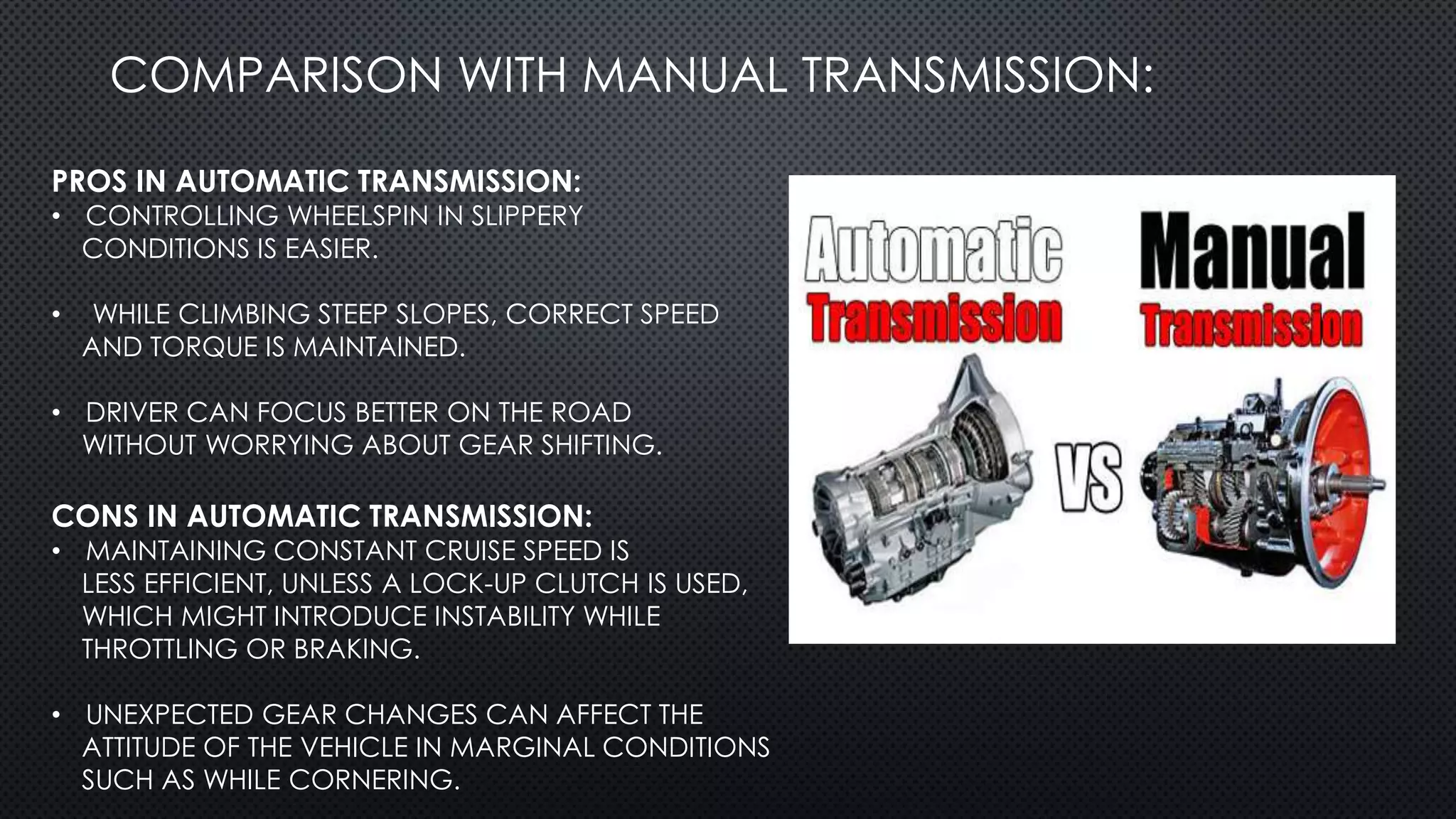
COMPARISON WITH MANUAL TRANSMISSION:
PROS IN AUTOMATIC TRANSMISSION:
• CONTROLLING WHEELSPIN IN SLIPPERY
CONDITIONS IS EASIER.
• WHILE CLIMBING STEEP SLOPES, CORRECT SPEED
AND TORQUE IS MAINTAINED.
• DRIVER CAN FOCUS BETTER ON THE ROAD
WITHOUT WORRYING ABOUT GEAR SHIFTING.
CONS IN AUTOMATIC TRANSMISSION:
• MAINTAINING CONSTANT CRUISE SPEED IS
LESS EFFICIENT, UNLESS A LOCK-UP CLUTCH IS USED,
WHICH MIGHT INTRODUCE INSTABILITY WHILE
THROTTLING OR BRAKING.
• UNEXPECTED GEAR CHANGES CAN AFFECT THE
ATTITUDE OF THE VEHICLE IN MARGINAL CONDITIONS
SUCH AS WHILE CORNERING.
THANK YOU

Automatic transmission

  • 1.
    AUTOMATIC TRANSMISSION MNNIT PRESENTED BY: •SOUMYA KHANNA - 20169040 • SOUMEN MUKHERJEE - 20163022 • SUDHANSHU RANJAN SHUKLA - 20161001 • SUNDARAM KUMAR - 20153115 PRESENTATION ON: THERMAL ENGINEERING LAB – III (ME 1654)
  • 2.
    WHAT IS AUTOMATICTRANSMISSION? An Automatic Transmission is a type of motor vehicle transmission that can automatically change gear ratios as the vehicle moves, freeing the driver from having to shift gears manually. It allows an Internal Combustion engine, best suited to run at a relatively high rotational speed, to provide a range of speed and torque outputs.
  • 3.
    TYPES OF AUTOMATICTRANSMISSION AUTOMATIC TRANSMISSION CAN BE CLASSIFIED AS: • AUTOMATED MANUAL TRANSMISSION: TRANSMISSION USED IN FERRARI 458 IS A MODERN SAT Also known as semi-automatic transmission (SAT) and several other names, this automatic transmission type utilizes a regular clutch and gear setup but automates the action by the use of sensors, actuators, processors, and pneumatics.
  • 4.
    • TIPTRONIC TRANSMISSION: TIPTRONICTRANSMISSION WAS FIRST INTRODUCED WITH PORSCHE 911 A Tiptronic transmission is an automatic transmission that includes an option to switch out of automatic mode and upshift or downshift by using paddles behind the steering wheel or by using the gear lever itself. The name Tiptronic is a registered trademark that is owned by car manufacturer Porsche. It's different from a computer controlled manual transmission in that it does allow automatic shifting, uses a torque converter instead of a clutch, and the driver doesn't have full control over which gear the car is in. The car will still upshift and downshift on its own in manual mode when certain parameters are reached - for example it won't let you exceed the engine's redline, and it will shift down into first when you come to a stop.
  • 5.
    • CONTINUOUSLY VARIABLETRANSMISSION:The continuously variable transmission, or CVT, can smoothly and steplessly alter its gear ratio by varying the diameter of a pair of belt or chain-linked pulleys, wheels or cones. TRANSMISSION USED IN 2016 NISSAN SENTRA IS THE XTRONIC CVT
  • 6.
    • DUAL CLUTCHTRANSMISSION:A dual-clutch transmission, or DCT, uses two separate clutches for odd and even gear sets. It can fundamentally be described as two separate manual transmissions (with their respective clutches) contained within one housing, and working as one unit. They are usually operated in a fully automatic mode, and many also have the ability to allow the driver to manually shift gears in semi-automatic mode. CHRYSLER DODGE DART USES DCT
  • 7.
    • HYDRAULIC AUTOMATICTRANSMISSION: SINCE THIS TYPE OF TRANSMISSION IS USED MOST PREDOMINANTLY IN MODERN AUTOMOBILES, WE WILL BE DISCUSSING THIS TYPE OF TRANSMISSION FURTHER. ZF 8HP70 AT USED IN BMW 7 SERIES BMW X1 USES TRADITIONAL OR HYDRAULIC AUTOMATIC TRANSMISSION The predominant form of automatic transmission is hydraulically operated; using a fluid coupling or torque converter, and a set of planetary gearsets to provide a range of gear ratios.
  • 8.
    PARTS OF HYDRAULICAUTOMATIC TRANSMISSION Hydraulic controls: Uses special transmission fluid sent under pressure by an oil pump to control various clutches and bands modifying the speed of the output depending on the vehicle's running condition.Governor: is connected to the output shaft and regulates the hydraulic pressure depending on the vehicle speed. Modern designs have replaced the mechanical governor with an electronic speed sensor and computer software. Transmission Control Unit: In many modern automatic transmissions, the valves are controlled by electro-mechanical servos which are controlled by the electronic [engine control unit] (ECU) or a separate TCU.
  • 9.
    Torque Converter: A typeof fluid coupling, hydraulically connecting the engine to the transmission. This takes the place of a friction clutch in a manual transmission. It transmits and decouples the engine power to the planetary gears, allowing the vehicle to come to stop with the engine still running without stalling. ZF TORQUE CONVERTER CUTAWAY
  • 10.
    Parts of aTorque Converter: Pump: Also known as the impeller, it is mechanically driven by the prime mover, in this case, the engine. It rotates the fluid and transfers power to the turbine. Turbine: It is the rotating element which drives the load, i.e. transmits power to the transmission. Stator: It is interposed between the impeller and turbine so that it can alter oil flow returning from the turbine to the impeller.
  • 11.
    Planetary gears train: Consistingof planetary gear sets as well as clutches and bands. These are the mechanical systems that provide the various gear ratios, altering the speed of rotation of the output shaft depending on which planetary gears are locked. To effect gear changes, one of two types of clutches or bands are used to hold a particular member of the planetary gearset motionless, while allowing another member to rotate, thereby transmitting torque and producing gear reductions or overdrive ratios. PLANETARY GEAR TRAIN RING GEAR PLANET GEAR SUN GEAR
  • 12.
    AUTOMATIC TRANSMISSION MODES Conventionally,in order to select the transmission operating mode, the driver moves a selection lever located either on the steering column or on the floor. Depending on the model and make of the transmission, these controls can take several forms. However most include the following: Park: This selection mechanically locks the output shaft of transmission. Neutral: Disengages the transmission from the Engine. Drive: This position allows the transmission to engage the full range of available forward gear ratios, allowing the vehicle to move forward and accelerate through its range of gears. Reverse: Engages the Reverse gear. Overdrive: For cruising at sustained speed with lower Engine RPM. Sport: (only present in some models) Similar to Drive mode, but upshifts are carried out at higher engine RPM.
  • 13.
    AUTOMATIC TRANSMISSION MODELS Someof the best known Automatic Transmission families include: OLD MODELS: General Motors: DynaFlow: developed and built by General Motors Buick Motor Division from late 1947 to mid-1963 that used a five-element torque converter, with two turbines and two stators, as well as a planetary gearset that provided two forward speeds plus reverse. Ford: Cruise-O-Matic: a variation of Warner Gear's three-speed unit named Ford-O-Matic continued to evolve later into Cruise-O-Matic named transmissions in 1958 and finally the FMX named transmissions in 1968. NEW MODELS: ZF 8 speed: The ZF 8HP is an eight-speed automatic transmission designed and built by ZF Friedrichshafen. It had its debut in the BMW 7 Series fitted with the V12 engine, and since then each new BMW model in all Series have been equipped with it.
  • 14.
    COMPARISON WITH MANUALTRANSMISSION: PROS IN AUTOMATIC TRANSMISSION: • CONTROLLING WHEELSPIN IN SLIPPERY CONDITIONS IS EASIER. • WHILE CLIMBING STEEP SLOPES, CORRECT SPEED AND TORQUE IS MAINTAINED. • DRIVER CAN FOCUS BETTER ON THE ROAD WITHOUT WORRYING ABOUT GEAR SHIFTING. CONS IN AUTOMATIC TRANSMISSION: • MAINTAINING CONSTANT CRUISE SPEED IS LESS EFFICIENT, UNLESS A LOCK-UP CLUTCH IS USED, WHICH MIGHT INTRODUCE INSTABILITY WHILE THROTTLING OR BRAKING. • UNEXPECTED GEAR CHANGES CAN AFFECT THE ATTITUDE OF THE VEHICLE IN MARGINAL CONDITIONS SUCH AS WHILE CORNERING.
  • 15.