INTERPRETATIINTERPRETATI
REFERENCES
 www.indiana.edu
 ftp://ftp.amberton.edu
 A textbook on Research Methodology by
M.C Baby, Prakash Publications
MEANING
 Interpretation istheprocessof attaching meaning to
thedata.
 Theprocessof drawing conclusionsbased on the
resultsof analysisof dataisknown asinterpretation.
 It revealstheimportanceof research findings.
.
 Interpretation demandsfair and careful judgements.
 Often thesamedatacan beinterpreted in different
ways.
Need for Interpreting information
What did you learn ?
What isnew?What could beconcluded ?
What wasexpected?
Did any findingssurpriseyou?
Aretherethingsyou don’t understand well?
 Wherefurther studiesneeded?
DATA ANALYSIS AND INTERPRETATION
 Analysisof dataand interpretation areinterdependent.
 Analysishelpsto study thecollected dataand derive
resultswhilethrough interpretation wedraw
conclusionsbased on resultsobtained.
 Analysisof dataisnot completewithout interpretation
and interpretation cannot bedonewithout analysisof
data.
PRINCIPLES OF INTERPRETATION
• Ability to read what isin thedata
• Logical thinking
• Communication in simplelanguage
PROCESS
o Reasonableexplanationsshould beprovided for research
findings
o Extraneousinformation collected during thestudy should be
considered
o To identify errorsin arguments, consultation should bemade
with expertsin interpretation
o All factorsaffecting theresearch problem should be
considered.
IMPORTANCE
• It helpsto build continuity in research by linking the
findingsof current research to thefindingsof other
studieshaving thesameunderlying concepts
• To explain theconcept
• To makeothersunderstand thesignificanceof hisstudies
• It helpsto discover new relationshipsand new
concepts
• To makepredictionsabout variousother eventsthat
areunrelated to hisareaof findings
• It helpstheresearcher to explain themeaning of
research findings
PRE-REQUISITESPRE-REQUISITES
 Datashould beadequateand appropriate
 Reflect good homogeneity
 Thereshould bestability of data
 Datataken for interpretation must be relevant to
thetopic
.
 Consistency of data
 Cautiousabout theerrors.
 Useof correct statistical measurefor interpretation
 Useof proper statistical methodsfor interpretation
 Interpretation ismadeby peopleassociated with the
project from thebeginning
ERRORS OF INTERPRETATIONERRORS OF INTERPRETATION
FALSE GENERALISATIONS
• Using improper statistical
methodsfor theanalysis
• Drawing conclusionsfrom an
argument
• Comparison between two set
of datawith unequal base
STATISTICAL MEASURES
• Percentageareused for
comparison, when total numbers
aredifferent
• Using index numberswithout
proper care
• Drawing conclusion on thebasis
of casual correlation
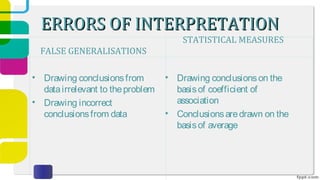
ERRORS OF INTERPRETATIONERRORS OF INTERPRETATION
FALSE GENERALISATIONS
• Drawing conclusionsfrom
datairrelevant to theproblem
• Drawing incorrect
conclusionsfrom data
STATISTICAL MEASURES
• Drawing conclusionson the
basisof coefficient of
association
• Conclusionsaredrawn on the
basisof average
Thank you..!!

Interpretation

  • 1.
  • 2.
    REFERENCES  www.indiana.edu  ftp://ftp.amberton.edu A textbook on Research Methodology by M.C Baby, Prakash Publications
  • 3.
    MEANING  Interpretation istheprocessofattaching meaning to thedata.  Theprocessof drawing conclusionsbased on the resultsof analysisof dataisknown asinterpretation.  It revealstheimportanceof research findings.
  • 4.
    .  Interpretation demandsfairand careful judgements.  Often thesamedatacan beinterpreted in different ways.
  • 5.
    Need for Interpretinginformation What did you learn ? What isnew?What could beconcluded ? What wasexpected? Did any findingssurpriseyou? Aretherethingsyou don’t understand well?  Wherefurther studiesneeded?
  • 6.
    DATA ANALYSIS ANDINTERPRETATION  Analysisof dataand interpretation areinterdependent.  Analysishelpsto study thecollected dataand derive resultswhilethrough interpretation wedraw conclusionsbased on resultsobtained.  Analysisof dataisnot completewithout interpretation and interpretation cannot bedonewithout analysisof data.
  • 7.
    PRINCIPLES OF INTERPRETATION •Ability to read what isin thedata • Logical thinking • Communication in simplelanguage
  • 8.
    PROCESS o Reasonableexplanationsshould beprovidedfor research findings o Extraneousinformation collected during thestudy should be considered o To identify errorsin arguments, consultation should bemade with expertsin interpretation o All factorsaffecting theresearch problem should be considered.
  • 9.
    IMPORTANCE • It helpstobuild continuity in research by linking the findingsof current research to thefindingsof other studieshaving thesameunderlying concepts • To explain theconcept • To makeothersunderstand thesignificanceof hisstudies
  • 10.
    • It helpstodiscover new relationshipsand new concepts • To makepredictionsabout variousother eventsthat areunrelated to hisareaof findings • It helpstheresearcher to explain themeaning of research findings
  • 11.
    PRE-REQUISITESPRE-REQUISITES  Datashould beadequateandappropriate  Reflect good homogeneity  Thereshould bestability of data  Datataken for interpretation must be relevant to thetopic
  • 12.
    .  Consistency ofdata  Cautiousabout theerrors.  Useof correct statistical measurefor interpretation  Useof proper statistical methodsfor interpretation  Interpretation ismadeby peopleassociated with the project from thebeginning
  • 13.
    ERRORS OF INTERPRETATIONERRORSOF INTERPRETATION FALSE GENERALISATIONS • Using improper statistical methodsfor theanalysis • Drawing conclusionsfrom an argument • Comparison between two set of datawith unequal base STATISTICAL MEASURES • Percentageareused for comparison, when total numbers aredifferent • Using index numberswithout proper care • Drawing conclusion on thebasis of casual correlation
  • 14.
    ERRORS OF INTERPRETATIONERRORSOF INTERPRETATION FALSE GENERALISATIONS • Drawing conclusionsfrom datairrelevant to theproblem • Drawing incorrect conclusionsfrom data STATISTICAL MEASURES • Drawing conclusionson the basisof coefficient of association • Conclusionsaredrawn on the basisof average
  • 15.