Interpretation in Research Methodology
Dr. Balamurugan M
Associate Professor
Department of MCA
Acharya Institute of Graduate Studies
Bangalore - 560107
Interpretation refers to the task of showing inferences from the collected facts after a
systematic and/or experimental study. In fact, it is seek out for broader meaning of research
findings.
The Task of Interpretation has two major aspects viz.,
a). the effort to establish link in research through connecting the results of a given study with
those of another.
b). the establishment of some descriptive concepts
Why interpretation
Interpretation is important for the simple reason that the usefulness and utility of research result lie in
suitable interpretation. It is being measured a fundamental module of research procedure because of
the following reasons:
i). It is all the way through interpretation that the researcher can well understand the abstract principle
that works beneath his findings. Through this he can tie up findings with those of other studies, having
the same conceptual principle and thereby can forecast about the real world of events.
ii). Interpretation leads to the concern on descriptive concepts that can provide as a guide for future
research studies; it opens new avenues of intellectual venture and stimulates the hunt for more
knowledge.
iii). Through interpretation, the investigator can better understand why his findings are what they
are and can create others to understand the real significance of his research findings.
iv). The interpretation of the findings of exploratory research study often pave the way for the
formulation of hypotheses for experimental research and as such facilitate the transition from
exploratory to experimental research.
v). Since an exploratory study does not have a hypothesis to start with, the findings of such a
study have to be interpreted on a ‘post-factum’ basis in which case the interpretation is
technically described as ‘post factum’ interpretation.
Techniques of interpretation
Interpretation is an art that one learns through practice and experience. The researcher may, at
times, seek the guidance from experts for accomplishing the task of interpretation.
The technique of interpretation often involves the following steps:
i). Researcher must give reasonable explanations of the relations which he has found and he must
interpret the lines of relationship in terms of the underlying processes and must try to find out the
thread of uniformity that lies under the surface layer of his diversified research findings.
ii). Extraneous information collected during the study, must be considered while interpreting the final
results of research study.
iii). It is advisable, before writing final interpretation, to consult someone having insight into the study
and who is able to give honest opinion and will not hesitate to point out omissions and errors in
logical argumentation.
iv). Researcher must accomplish the task of interpretation after bearing in mind all relevant factors
affecting the problem to avoid false generalization.
Precautions in Interpretation
One should always keep in mind that even if the data are properly collected and analyzed, wrong
interpretation would lead to inaccurate conclusions. It is therefore, absolutely essential that the task
of interpretation be accomplished with patience in an impartial manner and also in correct
perspective.
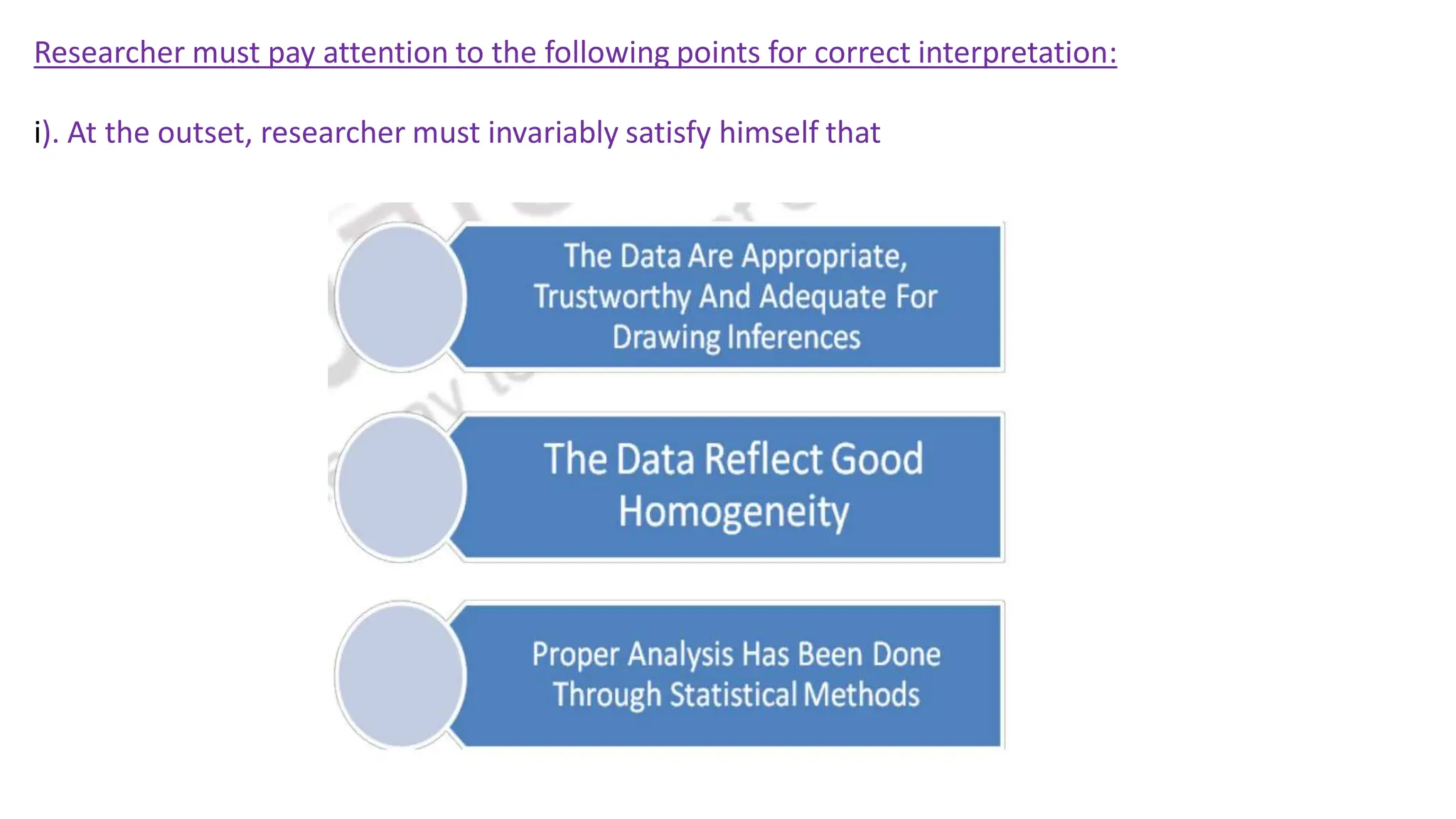
Researcher must pay attention to the following points for correct interpretation:
i). At the outset, researcher must invariably satisfy himself that
ii). The researcher must remain cautious about the errors that can possibly arise in the interpretation of
the results.
iii). He must always keep in view that the task of interpretation is very much tangled with analysis and
cannot be noticeably separated.
iv). The researcher must never lose sight of the fact that his task is not only to make sensitive
observations of relevant occurrences, but also to identify and extricate the factors that are initially hidden
to the eye.
v). The researcher must remember that “ideally in the course of a research study, there should be
constant interaction between initial hypothesis, empirical observation and theoretical conceptions.
Interpretation in Research Methodology.pdf

Interpretation in Research Methodology.pdf

  • 1.
    Interpretation in ResearchMethodology Dr. Balamurugan M Associate Professor Department of MCA Acharya Institute of Graduate Studies Bangalore - 560107
  • 2.
    Interpretation refers tothe task of showing inferences from the collected facts after a systematic and/or experimental study. In fact, it is seek out for broader meaning of research findings. The Task of Interpretation has two major aspects viz., a). the effort to establish link in research through connecting the results of a given study with those of another. b). the establishment of some descriptive concepts
  • 3.
    Why interpretation Interpretation isimportant for the simple reason that the usefulness and utility of research result lie in suitable interpretation. It is being measured a fundamental module of research procedure because of the following reasons: i). It is all the way through interpretation that the researcher can well understand the abstract principle that works beneath his findings. Through this he can tie up findings with those of other studies, having the same conceptual principle and thereby can forecast about the real world of events. ii). Interpretation leads to the concern on descriptive concepts that can provide as a guide for future research studies; it opens new avenues of intellectual venture and stimulates the hunt for more knowledge.
  • 4.
    iii). Through interpretation,the investigator can better understand why his findings are what they are and can create others to understand the real significance of his research findings. iv). The interpretation of the findings of exploratory research study often pave the way for the formulation of hypotheses for experimental research and as such facilitate the transition from exploratory to experimental research. v). Since an exploratory study does not have a hypothesis to start with, the findings of such a study have to be interpreted on a ‘post-factum’ basis in which case the interpretation is technically described as ‘post factum’ interpretation.
  • 5.
    Techniques of interpretation Interpretationis an art that one learns through practice and experience. The researcher may, at times, seek the guidance from experts for accomplishing the task of interpretation. The technique of interpretation often involves the following steps: i). Researcher must give reasonable explanations of the relations which he has found and he must interpret the lines of relationship in terms of the underlying processes and must try to find out the thread of uniformity that lies under the surface layer of his diversified research findings. ii). Extraneous information collected during the study, must be considered while interpreting the final results of research study.
  • 6.
    iii). It isadvisable, before writing final interpretation, to consult someone having insight into the study and who is able to give honest opinion and will not hesitate to point out omissions and errors in logical argumentation. iv). Researcher must accomplish the task of interpretation after bearing in mind all relevant factors affecting the problem to avoid false generalization. Precautions in Interpretation One should always keep in mind that even if the data are properly collected and analyzed, wrong interpretation would lead to inaccurate conclusions. It is therefore, absolutely essential that the task of interpretation be accomplished with patience in an impartial manner and also in correct perspective.
  • 7.
    Researcher must payattention to the following points for correct interpretation: i). At the outset, researcher must invariably satisfy himself that
  • 8.
    ii). The researchermust remain cautious about the errors that can possibly arise in the interpretation of the results. iii). He must always keep in view that the task of interpretation is very much tangled with analysis and cannot be noticeably separated. iv). The researcher must never lose sight of the fact that his task is not only to make sensitive observations of relevant occurrences, but also to identify and extricate the factors that are initially hidden to the eye. v). The researcher must remember that “ideally in the course of a research study, there should be constant interaction between initial hypothesis, empirical observation and theoretical conceptions.