FACTORS AFFECTING
INTERNATIONAL TRADE FLOWS
.
.
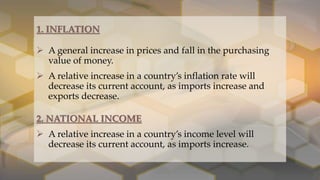
1. INFLATION
 A general increase in prices and fall in the purchasing
value of money.
 A relative increase in a country’s inflation rate will
decrease its current account, as imports increase and
exports decrease.
2. NATIONAL INCOME
 A relative increase in a country’s income level will
decrease its current account, as imports increase.
.
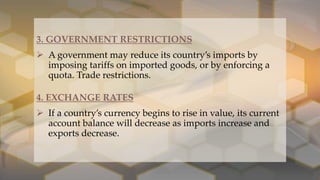
3. GOVERNMENT RESTRICTIONS
 A government may reduce its country’s imports by
imposing tariffs on imported goods, or by enforcing a
quota. Trade restrictions.
4. EXCHANGE RATES
 If a country’s currency begins to rise in value, its current
account balance will decrease as imports increase and
exports decrease.
.
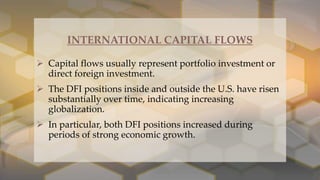
INTERNATIONAL CAPITAL FLOWS
 Capital flows usually represent portfolio investment or
direct foreign investment.
 The DFI positions inside and outside the U.S. have risen
substantially over time, indicating increasing
globalization.
 In particular, both DFI positions increased during
periods of strong economic growth.
.
FACTORS AFFECTING DFI
 Changes in Restrictions
New opportunities may arise from the removal of
government barriers.
 Privatization
DFI has also been stimulated by the selling of government
operations.
 Potential Economic Growth
Countries with higher potential economic growth are more
likely to attract DFI.
.
 Tax Rates
Countries that impose relatively low tax rates on
corporate earnings are more likely to attract DFI.
 Exchange Rates
Firms will typically prefer to invest their funds in a
country when that country’s currency is expected to
strengthen.

Factors affecting international trade flows

  • 1.
  • 2.
    . 1. INFLATION  Ageneral increase in prices and fall in the purchasing value of money.  A relative increase in a country’s inflation rate will decrease its current account, as imports increase and exports decrease. 2. NATIONAL INCOME  A relative increase in a country’s income level will decrease its current account, as imports increase.
  • 3.
    . 3. GOVERNMENT RESTRICTIONS A government may reduce its country’s imports by imposing tariffs on imported goods, or by enforcing a quota. Trade restrictions. 4. EXCHANGE RATES  If a country’s currency begins to rise in value, its current account balance will decrease as imports increase and exports decrease.
  • 4.
    . INTERNATIONAL CAPITAL FLOWS Capital flows usually represent portfolio investment or direct foreign investment.  The DFI positions inside and outside the U.S. have risen substantially over time, indicating increasing globalization.  In particular, both DFI positions increased during periods of strong economic growth.
  • 5.
    . FACTORS AFFECTING DFI Changes in Restrictions New opportunities may arise from the removal of government barriers.  Privatization DFI has also been stimulated by the selling of government operations.  Potential Economic Growth Countries with higher potential economic growth are more likely to attract DFI.
  • 6.
    .  Tax Rates Countriesthat impose relatively low tax rates on corporate earnings are more likely to attract DFI.  Exchange Rates Firms will typically prefer to invest their funds in a country when that country’s currency is expected to strengthen.