How to
Analyze and
Interpret Data
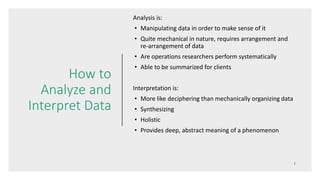
Analysis is:
• Manipulating data in order to make sense of it
• Quite mechanical in nature, requires arrangement and
re-arrangement of data
• Are operations researchers perform systematically
• Able to be summarized for clients
Interpretation is:
• More like deciphering than mechanically organizing data
• Synthesizing
• Holistic
• Provides deep, abstract meaning of a phenomenon
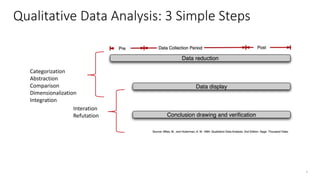
Qualitative Data Analysis: 3 Simple Steps
2
Interation
Refutation
Categorization
Abstraction
Comparison
Dimensionalization
Integration
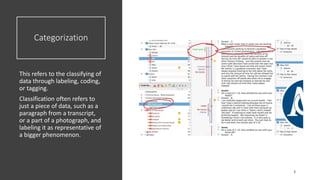
Categorization
This refers to the classifying of
data through labeling, coding,
or tagging.
Classification often refers to
just a piece of data, such as a
paragraph from a transcript,
or a part of a photograph, and
labeling it as representative of
a bigger phenomenon.
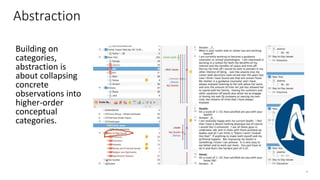
Abstraction
Building on
categories,
abstraction is
about collapsing
concrete
observations into
higher-order
conceptual
categories.
4
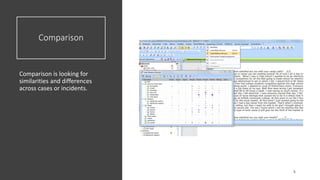
Comparison
Comparison is looking for
similarities and differences
across cases or incidents.
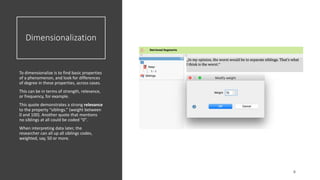
Dimensionalization
To dimensionalize is to find basic properties
of a phenomenon, and look for differences
of degree in these properties, across cases.
This can be in terms of strength, relevance,
or frequency, for example.
This quote demonstrates a strong relevance
to the property “siblings.” (weight between
0 and 100). Another quote that mentions
no siblings at all could be coded “0”.
When interpreting data later, the
researcher can all up all siblings codes,
weighted, say, 50 or more.
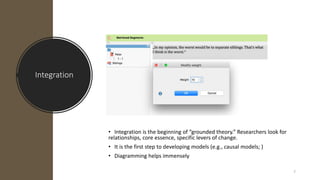
Integration
• Integration is the beginning of “grounded theory.” Researchers look for
relationships, core essence, specific levers of change.
• It is the first step to developing models (e.g., causal models; )
• Diagramming helps immensely
7
Iteration:
Going back
and forth
Iteration refers to the re-structuring of your
operations, based on what you’ve learned.
This could be changing your protocol, or changing
your codes.
It often involves zooming into small, specific
instances, and zooming out to large, holistic
interpretations.
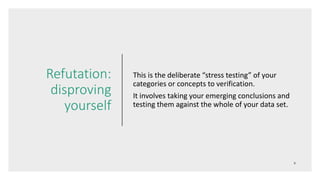
Refutation:
disproving
yourself
This is the deliberate “stress testing” of your
categories or concepts to verification.
It involves taking your emerging conclusions and
testing them against the whole of your data set.
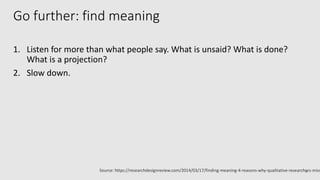
Go further: find meaning
1. Listen for more than what people say. What is unsaid? What is done?
What is a projection?
2. Slow down.
10Source: https://researchdesignreview.com/2014/03/17/finding-meaning-4-reasons-why-qualitative-researchers-miss
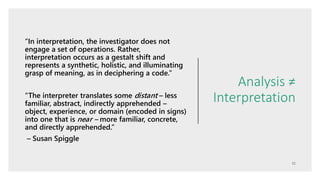
Analysis ≠
Interpretation
“In interpretation, the investigator does not
engage a set of operations. Rather,
interpretation occurs as a gestalt shift and
represents a synthetic, holistic, and illuminating
grasp of meaning, as in deciphering a code.”
“The interpreter translates some distant – less
familiar, abstract, indirectly apprehended –
object, experience, or domain (encoded in signs)
into one that is near – more familiar, concrete,
and directly apprehended.”
– Susan Spiggle
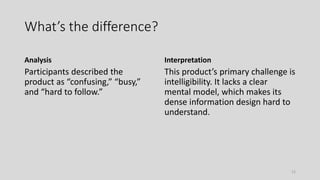
What’s the difference?
Analysis
Participants described the
product as “confusing,” “busy,”
and “hard to follow.”
Interpretation
This product’s primary challenge is
intelligibility. It lacks a clear
mental model, which makes its
dense information design hard to
understand.
12
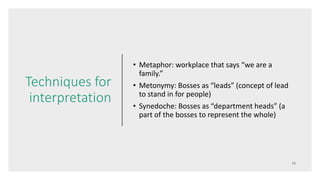
Techniques for
interpretation
• Metaphor: workplace that says “we are a
family.”
• Metonymy: Bosses as “leads” (concept of lead
to stand in for people)
• Synedoche: Bosses as “department heads” (a
part of the bosses to represent the whole)

Qual data analysis and interpretation

  • 1.
    How to Analyze and InterpretData Analysis is: • Manipulating data in order to make sense of it • Quite mechanical in nature, requires arrangement and re-arrangement of data • Are operations researchers perform systematically • Able to be summarized for clients Interpretation is: • More like deciphering than mechanically organizing data • Synthesizing • Holistic • Provides deep, abstract meaning of a phenomenon
  • 2.
    Qualitative Data Analysis:3 Simple Steps 2 Interation Refutation Categorization Abstraction Comparison Dimensionalization Integration
  • 3.
    Categorization This refers tothe classifying of data through labeling, coding, or tagging. Classification often refers to just a piece of data, such as a paragraph from a transcript, or a part of a photograph, and labeling it as representative of a bigger phenomenon.
  • 4.
    Abstraction Building on categories, abstraction is aboutcollapsing concrete observations into higher-order conceptual categories. 4
  • 5.
    Comparison Comparison is lookingfor similarities and differences across cases or incidents.
  • 6.
    Dimensionalization To dimensionalize isto find basic properties of a phenomenon, and look for differences of degree in these properties, across cases. This can be in terms of strength, relevance, or frequency, for example. This quote demonstrates a strong relevance to the property “siblings.” (weight between 0 and 100). Another quote that mentions no siblings at all could be coded “0”. When interpreting data later, the researcher can all up all siblings codes, weighted, say, 50 or more.
  • 7.
    Integration • Integration isthe beginning of “grounded theory.” Researchers look for relationships, core essence, specific levers of change. • It is the first step to developing models (e.g., causal models; ) • Diagramming helps immensely 7
  • 8.
    Iteration: Going back and forth Iterationrefers to the re-structuring of your operations, based on what you’ve learned. This could be changing your protocol, or changing your codes. It often involves zooming into small, specific instances, and zooming out to large, holistic interpretations.
  • 9.
    Refutation: disproving yourself This is thedeliberate “stress testing” of your categories or concepts to verification. It involves taking your emerging conclusions and testing them against the whole of your data set.
  • 10.
    Go further: findmeaning 1. Listen for more than what people say. What is unsaid? What is done? What is a projection? 2. Slow down. 10Source: https://researchdesignreview.com/2014/03/17/finding-meaning-4-reasons-why-qualitative-researchers-miss
  • 11.
    Analysis ≠ Interpretation “In interpretation,the investigator does not engage a set of operations. Rather, interpretation occurs as a gestalt shift and represents a synthetic, holistic, and illuminating grasp of meaning, as in deciphering a code.” “The interpreter translates some distant – less familiar, abstract, indirectly apprehended – object, experience, or domain (encoded in signs) into one that is near – more familiar, concrete, and directly apprehended.” – Susan Spiggle
  • 12.
    What’s the difference? Analysis Participantsdescribed the product as “confusing,” “busy,” and “hard to follow.” Interpretation This product’s primary challenge is intelligibility. It lacks a clear mental model, which makes its dense information design hard to understand. 12
  • 13.
    Techniques for interpretation • Metaphor:workplace that says “we are a family.” • Metonymy: Bosses as “leads” (concept of lead to stand in for people) • Synedoche: Bosses as “department heads” (a part of the bosses to represent the whole)