RESEARCH METHODOLOGY
Meaning Research is an endeavour to discover answers to intellectual and practical problems through the application of scientific method.  “ Research is a systematized effort to gain new knowledge ” .  -Redman and Mory . Research is the systematic process of collecting and analyzing information (data) in order to increase our understanding of the phenomenon about which we are concerned or interested.
Objectives of Research The purpose of research is to discover answers through the application of scientific procedures . The objectives are: To gain familiarity with a phenomenon or to achieve new insights into it –  Exploratory or Formulative Research . To portray accurately the characteristics of a particular individual, situation or a group –  Descriptive Research . To determine the frequency with which something occurs or with which it is associated with something else –  Diagnostic Research . To test a hypothesis of a causal relationship between variables –  Hypothesis-Testing Research .
Characteristics of Research Research is directed towards the  solution   of a problem . Research is based upon  observable experience or empirical evidence . Research demands  accurate observation and description . Research involves  gathering new data  from primary sources or  using existing data  for a new purpose. Research activities are characterized by  carefully designed procedures . Research requires  expertise  i.e., skill necessary to carryout investigation, search the related literature and to understand and analyze the data gathered. Research is  objective and logical  – applying every possible test to validate the data collected and conclusions reached. Research involves the  quest for answers to unsolved problems . Research requires  courage . Research is characterized by  patient and unhurried activity. Research is carefully  recorded and reported.
SCIENTIFIC   METHOD ‘ Science’ refers to the body of systematic and organised knowledge which makes use of scientific method to acquire knowledge in a particular field of enquiry. Scientific method is the systematic collection of data (facts) and their theoretical treatment through proper observation, experimentation and interpretation. Scientific method attempts to achieve a systematic interrelation of facts by experimentation, observation, and logical arguments from accepted postulates and a combination of these three in varying proportions.
BASIC POSTULATES IN SCIENTIFIC METHOD It relies on empirical evidence. It utilizes relevant concepts. It is committed to only objective considerations. It presupposes ethical neutrality. It results into probabilistic predictions. The  methodology is made known. Aims at formulating scientific theories.
Purpose clearly defined. Research process detailed. Research design thoroughly planned. High ethical standards applied. Limitations frankly revealed. Adequate analysis for decision maker’s needs. Findings presented unambiguously. Conclusions justified. Researcher’s experience reflected. CRITERIA OF A GOOD RESEARCH
QUALITIES OF A GOOD RESEARCH   Systematic Logical Empirical Replicable Creative Use of multiple methods
EXPLORATION DESCRIBE DIAGNOSE HYPOTHESIS INDUCTIONS AND DEDUCTIONS NEED FOR RESEARCH
SCOPE / SIGNIFICANCE OF RESEARCH RESEARCH FOR DECISION MAKING Throws light on risks and uncertainty Identify alternative courses of action Helps in economic use of resources  Helps in project identification
Solves investment problems Solves pricing problems Solves allocation problems Solves decision making issues in HR Solves various operational and planning problems of business and industry
Provides the basis for all government policies in our economic system. Helps social scientists in studying social relationships and in seeking answers to various social problems. For students, research means a careerism or a way to attain a high position in the social structure. For professionals in research, it may mean a source of livelihood.
For philosophers and thinkers, research means the outlet for new ideas and insights. For literary men and women, research means development of new styles and creative work. For analysts and intellectuals, research means generalizations of new theories.
Not similar to science Uncontrollable variables Human tendencies Time and money Lack of computerization Lack of scientific training in the methodology of research PROBLEMS IN RESEARCH
Insufficient interaction between university  research departments and business establishments Lack of confidence on the part of business units to give information Lack of code of conduct Difficulty of adequate and timely secretarial assistance
Poor library management and functioning Difficulty of timely availability of published data. Ignorance  Research for the sake of research-limited practical utility though they may use high sounding business jargon.
Decision-making is the process of selecting the best alternative from the available set of alternatives. Management is chiefly concerned with decision-making and its implementation. These decisions should be based on appropriate studies, evaluations and observations. Research provides us with knowledge and skills needed to solve the problems and to meet the challenges of a fast paced decision-making environment.  ROLE OF RESEARCH  IN  DECISION-MAKING
According to Herbert A Simon, decision-making involves three activities: Intelligence Activity  - scanning the environment for identifying conditions necessary for the decision. Designing Activity  - identifying, developing and analyzing the alternative courses of action. Choice Activity  - choosing the best course of action from among the alternatives.
FACTORS THAT AFFECT MANAGERIAL DECISIONS INTERNAL FACTORS  – factors present inside an organisation such as resources, technology, trade unions, cash flow, manpower etc. EXTERNAL FACTORS  – factors present outside the organisation such as government policies, political factors, socio-economic factors, legal framework, geographic and cultural factors etc. QUANTITATIVE FACTORS  – factors that can be measured in quantities such as time, resources, cost factors etc.
QUALITATIVE FACTORS  – factors that cannot be measured in quantities such as organizational cohesiveness, sense of belonging of employees, risk of technological change etc. UNCERTAINITY FACTORS  – factors which cannot be predicted.
TYPES OF RESEARCH Descriptive vs Analytical Research Descriptive Research  is a fact finding investigation which is  aimed at describing the characteristics of individual, situation or a group (or) describing the state of affairs as it exists at present. Analytical Research  is primarily concerned with testing hypothesis and specifying and interpreting relationships, by analyzing the facts or information already available.
Applied vs Fundamental Research Applied Research  or Action Research is carried out to find solution to a real life problem requiring an action or policy decision. Fundamental Research  which is also known as basic or pure research is undertaken for the sake of knowledge without any intention to apply it in practice. It is undertaken out of intellectual curiosity and is not necessarily problem-oriented.
Quantitative vs Qualitative Research Quantitative Research  is employed for measuring the quantity or amount of a particular phenomena by the use of statistical analysis.   Qualitative Research  is a non-quantitative type of analysis which is aimed at finding out the quality of a particular phenomenon.
Conceptual vs Empirical Research Conceptual Research  is generally used by philosophers and thinkers to develop new concepts or to reinterpret existing ones. Empirical Research  is a data based research which depends on experience or observation alone. It is aimed at coming up with conclusions without due regard for system and theory.
Some other types of research.. One-time Research  – Research confined to a single time period. Longitudinal Research  – Research carried on over several time periods. Diagnostic Research  – It is also called clinical research which aims at identifying the causes of a problem, frequency with which it occurs and the possible solutions for it. Exploratory Research  – It is the preliminary study of an unfamiliar problem, about which the researcher has little or no knowledge. It is aimed  to gain familiarity with the problem, to generate new ideas or to make a precise formulation of the problem.  Hence it is also known as formulative research.
Experimental Research  – It is designed to assess the effect of one particular variable on a phenomenon by keeping the other variables constant or controlled. Historical Research  – It is the study of past records and other information sources, with a view to find the origin and development of a phenomenon and to discover the trends in the past, inorder to understand the present and to anticipate the future.
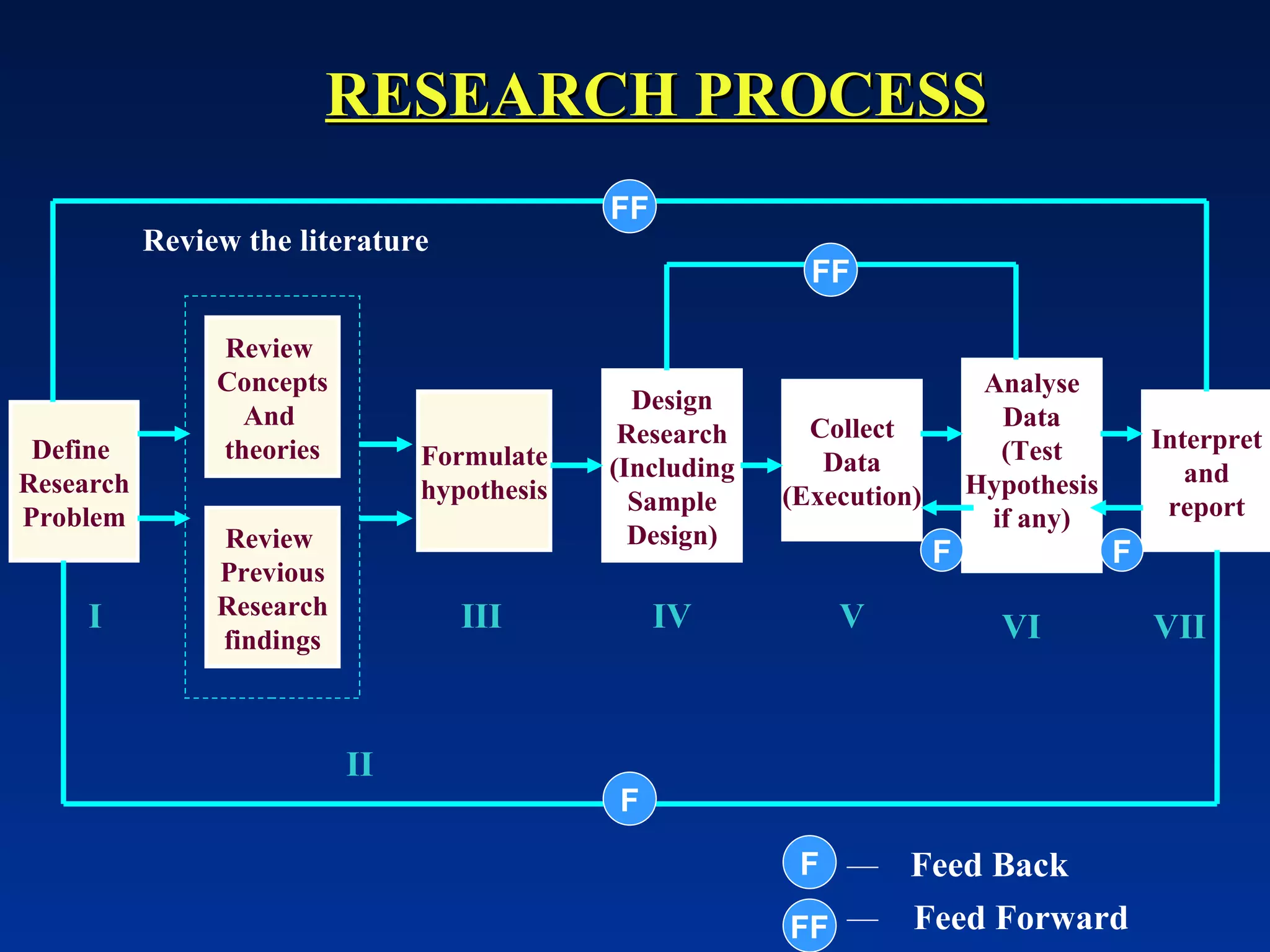
RESEARCH PROCESS Define  Research Problem Review  Concepts And  theories Review  Previous Research findings Formulate hypothesis Design Research (Including Sample Design) Collect Data (Execution) Analyse Data (Test Hypothesis if any) Interpret and report FF F F F FF I II III IV V VI VII F FF Feed Back Feed Forward Review the literature
DEFINITION  OF THE  RESEARCH PROBLEM STEP-1
RESEARCH  PROBLEM What is a research problem? The term ‘problem’ means a question or issue to be examined. Research Problem refers to some difficulty /need which a researcher experiences in the context of either theoretical or practical situation and wants to obtain a solution for the same.
HOW DO WE KNOW WE HAVE A RESEARCH PROBLEM? Customer complaints Conversation with company employees Observation of inappropriate behaviour or conditions  in the firm Deviation from the business plan Success of the firm’s competitor’s Relevant reading of published material (trends,  regulations) Company records and reports .
The first step in the research process –  definition of the problem  involves two activities: Identification / Selection of the Problem Formulation of the Problem
IDENTIFICATION / SELECTION OF THE RESEARCH PROBLEM This step involves identification of a few problems and selection of one out of them, after evaluating the alternatives against certain selection criteria.
SOURCES OF PROBLEMS Reading Academic Experience Daily Experience Exposure to Field Situations Consultations Brainstorming Research Intuition
CRITERIA OF SELECTION The selection of one appropriate researchable problem out of the identified problems requires evaluation of those alternatives against certain criteria. They are: Internal / Personal criteria  – Researcher’s Interest, Researcher’s Competence, Researcher’s own Resource: finance and time. External Criteria or Factors  – Researchability of the problem, Importance and Urgency, Novelty of the Problem, Feasibility, Facilities, Usefulness and Social Relevance, Research Personnel.
DEFINITION / FORMULATION OF THE RESEARCH PROBLEM Formulation is the process of refining the research ideas into research questions and objectives. Formulation means translating and transforming the selected research problem/topic/idea into a scientifically researchable question. It is concerned with specifying exactly what the research problem is.
Problem definition or Problem statement is a clear, precise and succinct statement of the question or issue that is to be investigated with the goal of finding an answer or solution. There are two ways of stating a problem: Posting question / questions Making declarative statement / statements
PROCESS INVOLVED IN DEFINING THE PROBLEM STATEMENT OF THE PROBLEM IN A GENERAL WAY.
UNDERSTANDING THE NATURE Of PROBLEM   SURVEYING  THE  AVAILABLE LITERATURE
DEVELOPING IDEAS THROUGH DISCUSSIONS REPHRASING THE RESEARCH PROBLEM
CRITERIA OF A GOOD RESEARCH PROBLEM Clear and Unambiguous Empirical Verifiable Interesting Novel and Original Availability of Guidance
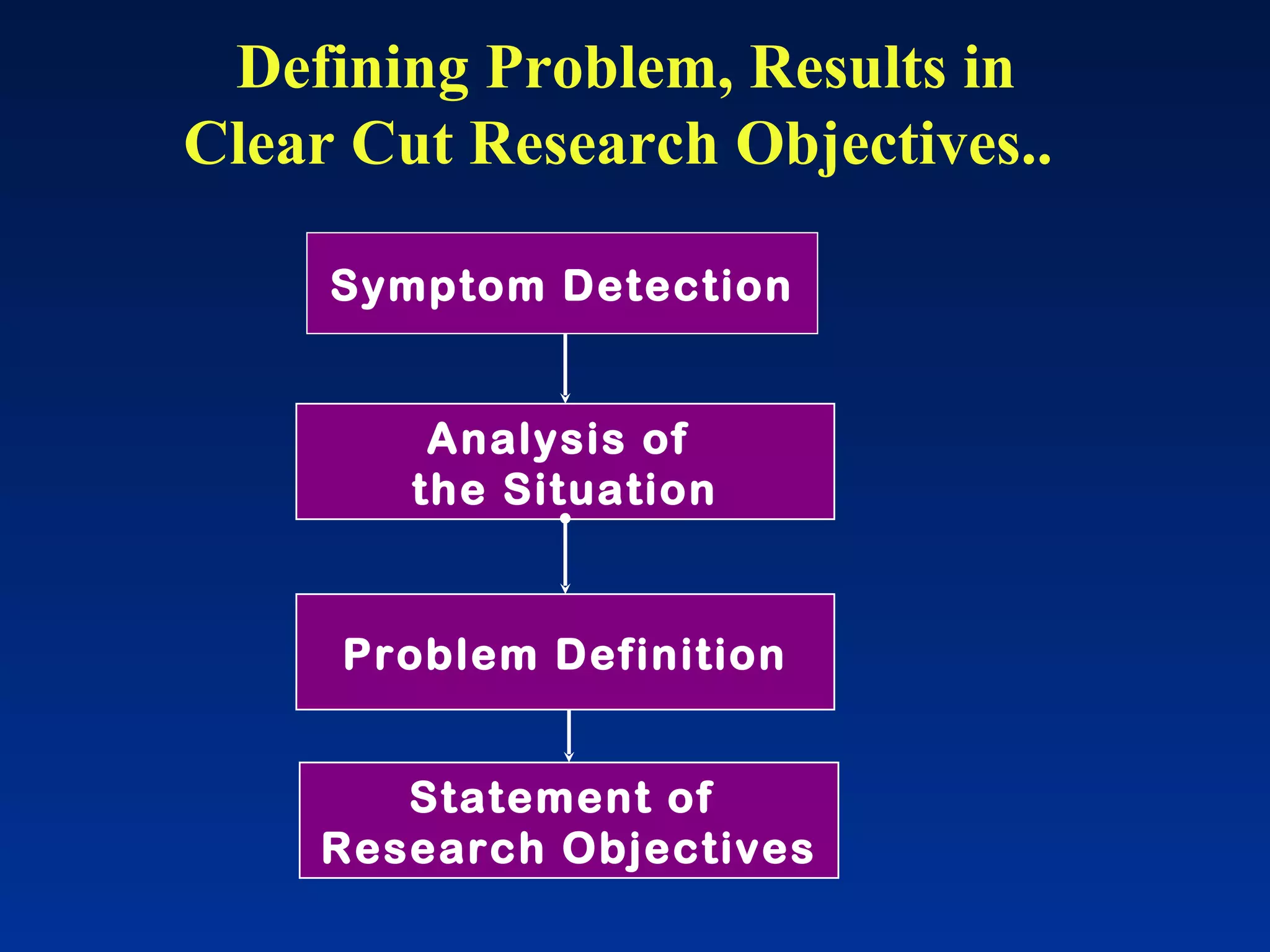
Defining Problem, Results in Clear Cut Research Objectives.. Symptom Detection Statement of  Research Objectives Analysis of  the Situation Problem Definition
ESTABLISHMENT OF RESEARCH OBJECTIVES Research Objectives are the specific components of the research problem, that you’ll be working to answer or complete, in order to answer the overall research problem.  - Churchill, 2001 The objectives refers to the questions to be answered through the study. They indicate what we are trying to get from the study or the expected results / outcome of the study.
ESTABLISHMENT OF RESEARCH OBJECTIVES Research Objectives should be clear and achievable, as they directly assist in answering the research problem. The objectives may be specified in the form of either statements or questions. Generally, they are written as statements, using the word “to”. (For example, ‘to discover …’, ‘to determine …’, ‘to establish …’, etc. )
REVIEW  OF  LITERATURE STEP-2
REVIEW OF LITERATURE Literature Review is the documentation of a comprehensive review of the published and unpublished work from secondary sources of data in the areas of specific interest to the researcher. The main aim is to find out problems that are already investigated and those that need further investigation.
REVIEW OF LITERATURE It is an extensive survey of all available past studies relevant to the field of investigation. It gives us knowledge about what others have found out in the related field of study and how they have done so.
PURPOSE OF REVIEW  To gain a background knowledge of the research topic. To identify the concepts relating to it, potential relationships between them and to formulate researchable hypothesis. To identify appropriate methodology, research design, methods of measuring concepts and techniques of analysis. To identify data sources used by other researchers. To learn how others structured their reports.
How to conduct the Literature Survey?  Identify the relevant sources. Extract and Record relevant information. Write-up the Literature Review.
SOURCES OF LITERATURE Books and Journals Electronic Databases Bibliographic Databases Abstract Databases Full-Text Databases Govt. and Industry Reports Internet Research Dissertations / Thesis
RECORDING THE LITERATURE The most suitable method of recording notes is the  card system. The recording system involves use of two sets of cards: Source cards  (3”x 5”) – used for noting bibliographic information. Note cards  (5”x 8”) – used for actual note taking.
SOURCE CARDS Source Cards serve two purposes: Provide documentary information for foot notes. It is used for compiling bibliography to be given at the end of the report.
SOURCE CARDS Source Cards can be coded by a simple system inorder to relate them to the corresponding note cards. Marking a combination of letters and a number on the right hand top corner that begins with ‘C’. For example; C1, C2 etc. OR Marking the letter ‘B’ or ‘J’ or ‘R’ (B=Books, J=Journal, R=Report) on the left hand top corner.
SOURCE CARDS The recording of bibliographic information should be made in proper bibliographic format. The format for citing a book is: Author’s name, (year), Title of the book, Place of publication, Publisher’s name. For Example; Koontz Harold (1980), Management, New Delhi, McGraw-Hill International. The format for citing a journal article is: Author’s name, (year), Title of the article, Journal name, Volume (number), pages. For Example; Sheth J.N (1973), A Model of Industrial Buying Behaviour, Journal of Marketing, 37(4), 50-56.
NOTE CARDS Detailed Information extracted from a printed source is recorded on the note cards. It is desirable to note a single fact or idea on each card, on one side only.
How to write the review? There are several ways of presenting the ideas of others within the body of the paper. For Example; If  you are referring the major influencing factors in the Sheth’s model of Industrial Buying Behaviour, it can be written as, Sheth (1973, p-50) has suggested that, there are a number of influencing factors …….. According to Sheth (1973) model of industrial buying behaviour, there are a number of influencing factors……..
How to write the review? In some models of industrial buying behaviour, there are a number of influencing factors (Sheth, 1973). In some models of industrial buying behaviour, there are a number of influencing factors 1 . Sheth J.N (1973), A Model of Industrial Buying Behaviour, Journal of Marketing, 37(4), 50-56.
Points to be kept in mind while reviewing literature.. Read relevant literature. Refer original works. Read with comprehension. Read in time. Index the literature.
FORMULATION  OF  HYPOTHESIS STEP-3
HYPOTHESIS A hypothesis is an assumption about  relations  between  variables. Hypothesis can be defined as a logically conjectured  relationship  between two or more  variables  expressed in the form of a testable statement. Relationships are conjectured on the basis of the network of associations established in the  theoretical framework  formulated for the research study.
VARIABLES Anything that can vary can be considered as a variable. A variable is anything that can take on differing or varying values. For example; Age, Production units, Absenteeism, Sex, Motivation, Income, Height, Weight etc.   Note:  The values can differ at various times for the same object or person (or) at the same time for different objects or persons.
Variable / Attribute A variable is a characteristic that takes on two or more values whereas, an attribute is a specific value on a variable (qualitative). For example;  The variable SEX/GENDER has 2 attributes - Male and Female. The variable AGREEMENT has 5 attributes – Strongly Agree, Agree, Neutral, Disagree, Strongly Disagree.
Types of  Variables Explanatory vs Extraneous Variable The variables selected for analysis are called explanatory variables and all other variables  that are not related to the purpose of the study but may affect the dependant variable are extraneous. Dependant vs Independent Variable The variable that changes in relationship to changes in another variable(s) is called  dependant variable . The variable whose change results in the change in another variable is called an  independent variable . OR An independent variable is the one that influences the dependant variable in either a positive or negative way.
HYPOTHESIS Research Hypothesis is a predictive statement that relates an  independent variable  to a  dependant variable. Hypothesis must contain atleast one independent variable and one dependant variable.
HYPOTHESIS Hypothesis are tentative, intelligent guesses as to the solution of the problem.  Hypothesis is a specific statement of prediction. It describes in concrete terms what you expect to happen in the study. Hypothesis is an assumption about the population of the study. It delimits the area of research and keeps the researcher on the right track.
PROBLEM (VS) HYPOTHESIS Hypothesis is an assumption, that can be tested and can be proved to be right or wrong. A problem is a broad question which cannot be directly tested. A problem can be scientifically investigated after converting it into a form of hypothesis.
CHARACTERISTICS OF HYPOTHESIS Conceptual Clarity  - It should be clear and precise. Specificity  - It should be specific and limited in scope. Consistency  - It should be consistent with the objectives of research. Testability  - It should be capable of being tested. Expectancy  - It should state the expected relationships between variables.
CHARACTERISTICS OF HYPOTHESIS Simplicity  - It should be stated as far as possible in simple terms. Objectivity  - It should not include value judgments, relative terms or any moral preaching. Theoretical Relevance  - It should be consistent with a substantial body of established or known facts or existing theory. Availability of Techniques  – Statistical methods should be available for testing the proposed hypothesis.
Discussions with colleagues and experts about the problem, its origin and  objectives in seeking a solution. Examination of data and records for possible trends, peculiarities. Review of similar studies. Exploratory personal investigation / Observation. Logical deduction from the existing theory. Continuity of research. Intuition and personal experience. SOURCES OF HYPOTHESIS
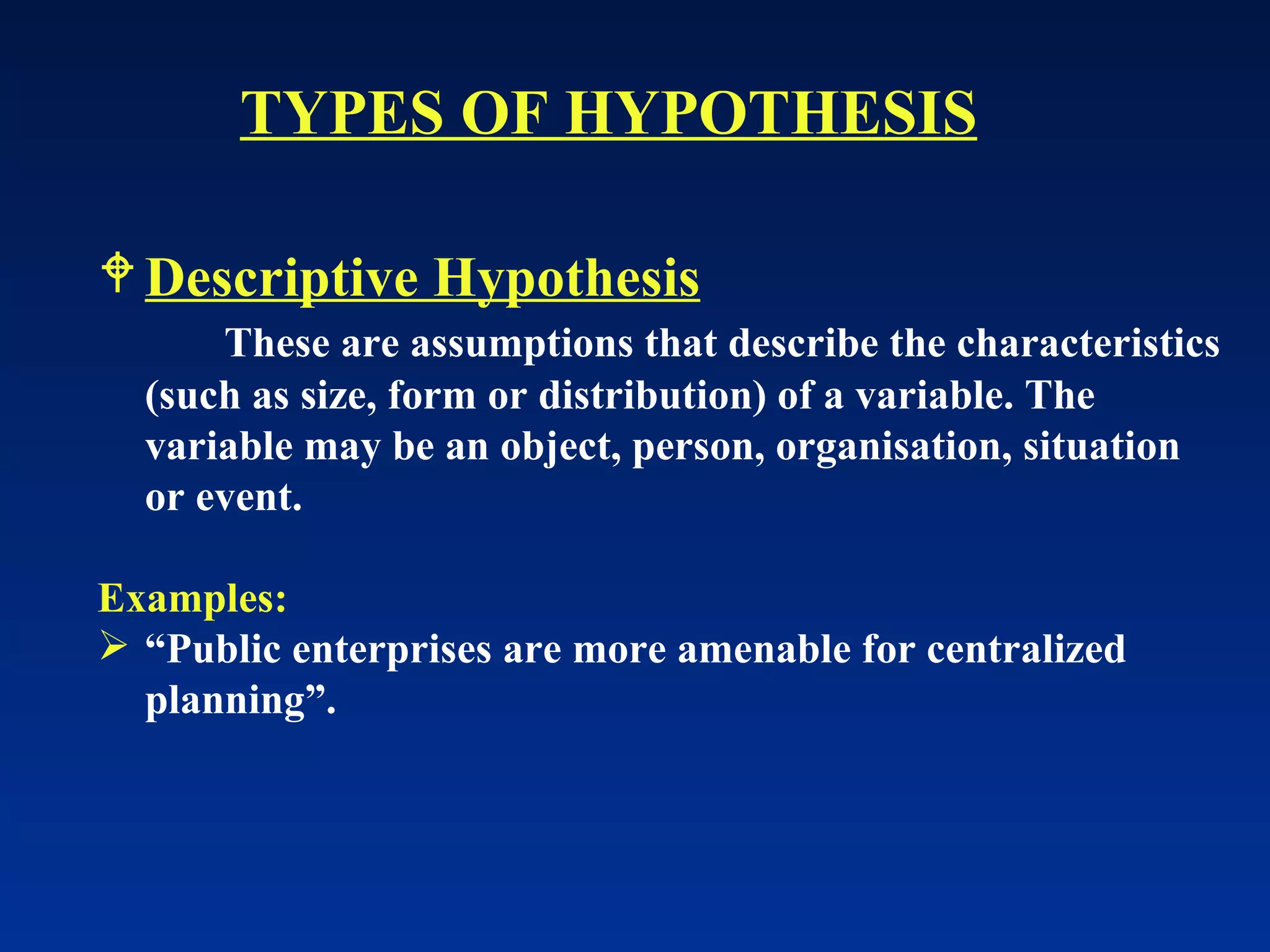
Descriptive Hypothesis These are assumptions that describe the characteristics (such as size, form or distribution) of a variable. The variable may be an object, person, organisation, situation or event. Examples: “ Public enterprises are more amenable for centralized planning”. TYPES OF HYPOTHESIS
Relational Hypothesis  [ Explanatory Hypothesis ] These are assumptions that describe the relationship between two variables. The relationship suggested may be positive, negative or causal relationship.  Examples: “ Families with higher incomes spend more for recreation”. Causal Hypothesis  state that the existence of or change in one variable causes or leads to an effect on another variable. The first variable is called the  independent variable  and the latter is the  dependant variable .
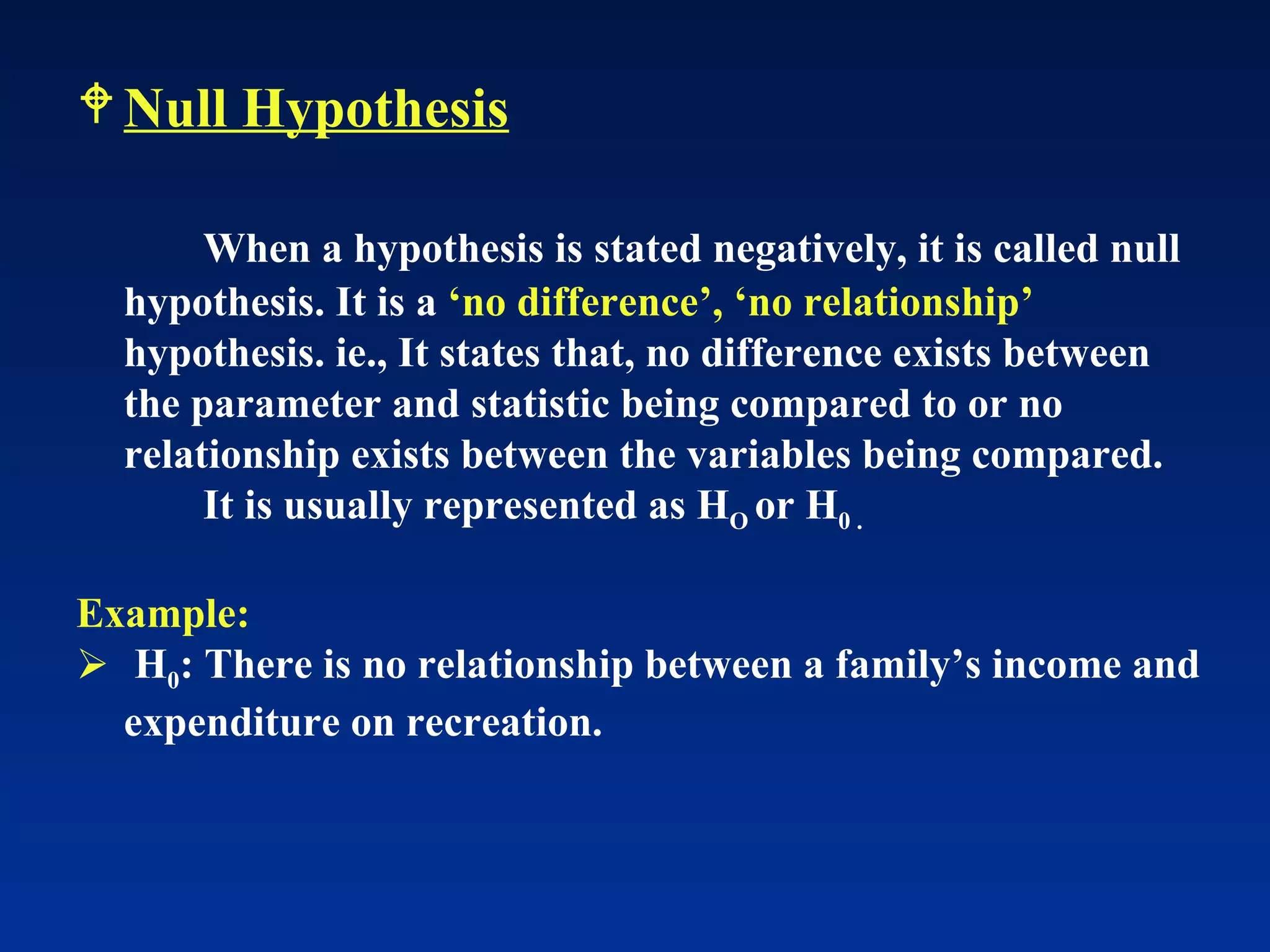
Null Hypothesis When a hypothesis is stated negatively, it is called null hypothesis. It is a  ‘no difference’, ‘no relationship’  hypothesis. ie., It states that, no difference exists between the parameter and statistic being compared to or no relationship exists between the variables being compared. It is usually represented as H O  or H 0 . Example:   H 0 : There is no relationship between a family’s income and expenditure on recreation.
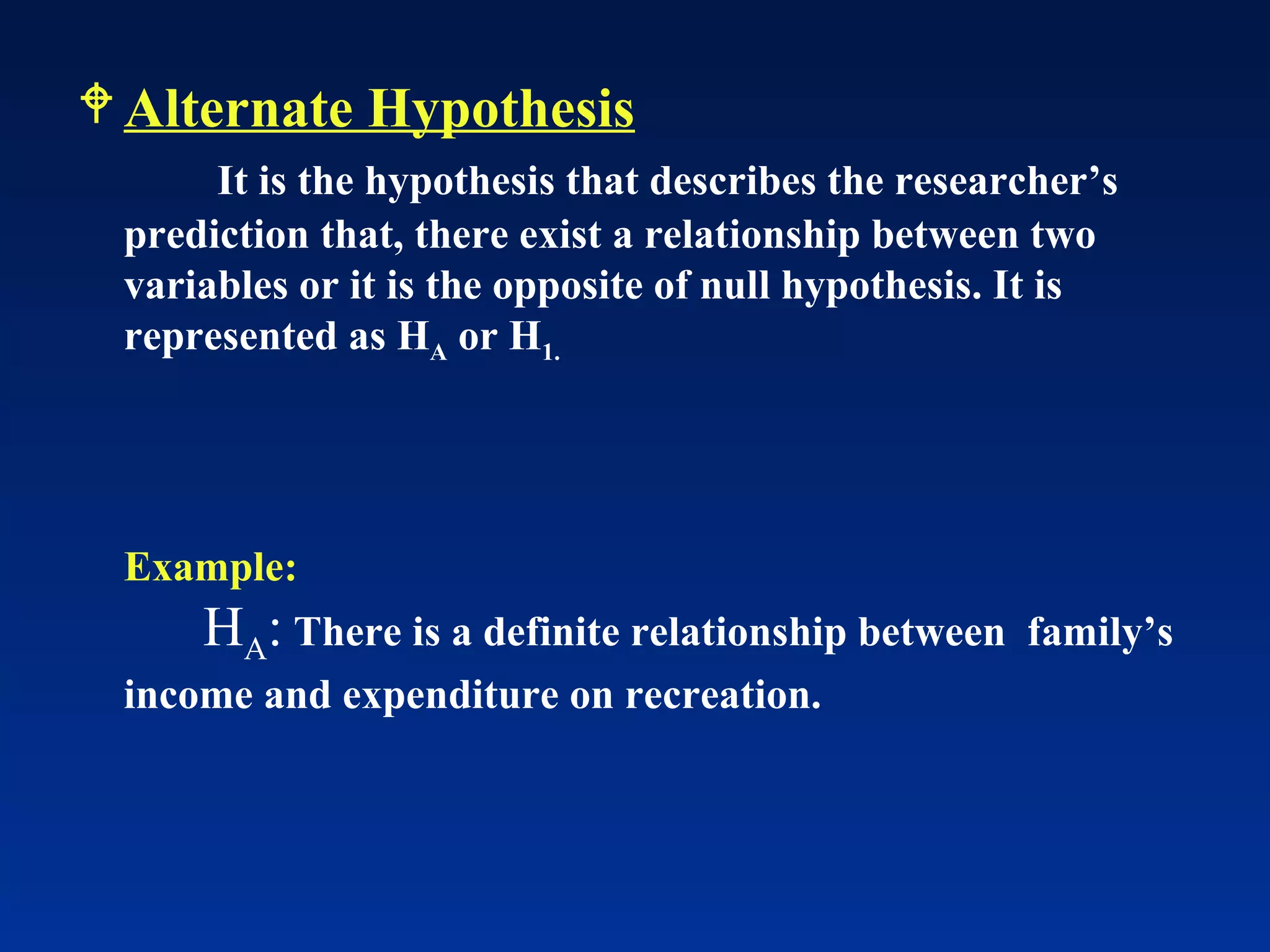
Alternate Hypothesis   It is the hypothesis that describes the researcher’s prediction that, there exist a relationship between two variables or it is the opposite of null hypothesis. It is represented as H A  or H 1. Example: H A :   There is a definite relationship between  family’s income and expenditure on recreation.
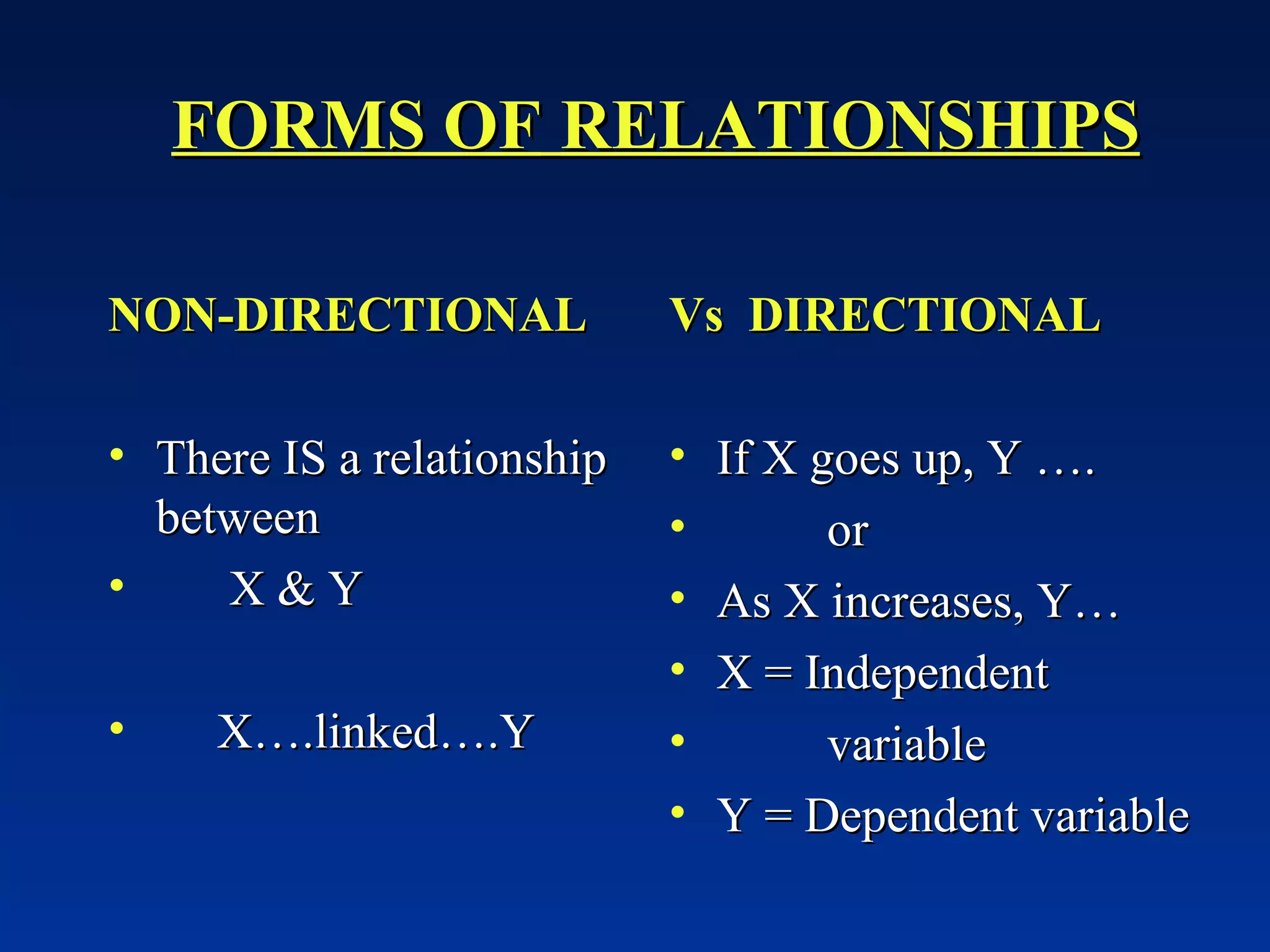
FORMS OF   RELATIONSHIPS NON-DIRECTIONAL There IS a relationship between X & Y X….linked….Y Vs  DIRECTIONAL If X goes up, Y …. or As X increases, Y… X = Independent variable Y = Dependent variable
DIRECTIONAL HYPOTHESES-   “X” causes “Y” to change If X changes  (increases decreases) then Y will ______ (increase or decrease) a causal link
DIRECTION OF RELATIONSHIP If X increases, Y increases A  POSITIVE  relationship If X increase, Y decreases A  NEGATIVE  or  INVERSE    relationship As X changes, Y does NOT change...> No Change...> NO RELATIONSHIP
NON-DIRECTIONAL HYPOTHESES   - the weakest form There Is a relationship between X & Y non-causal correlational statement X…..Y
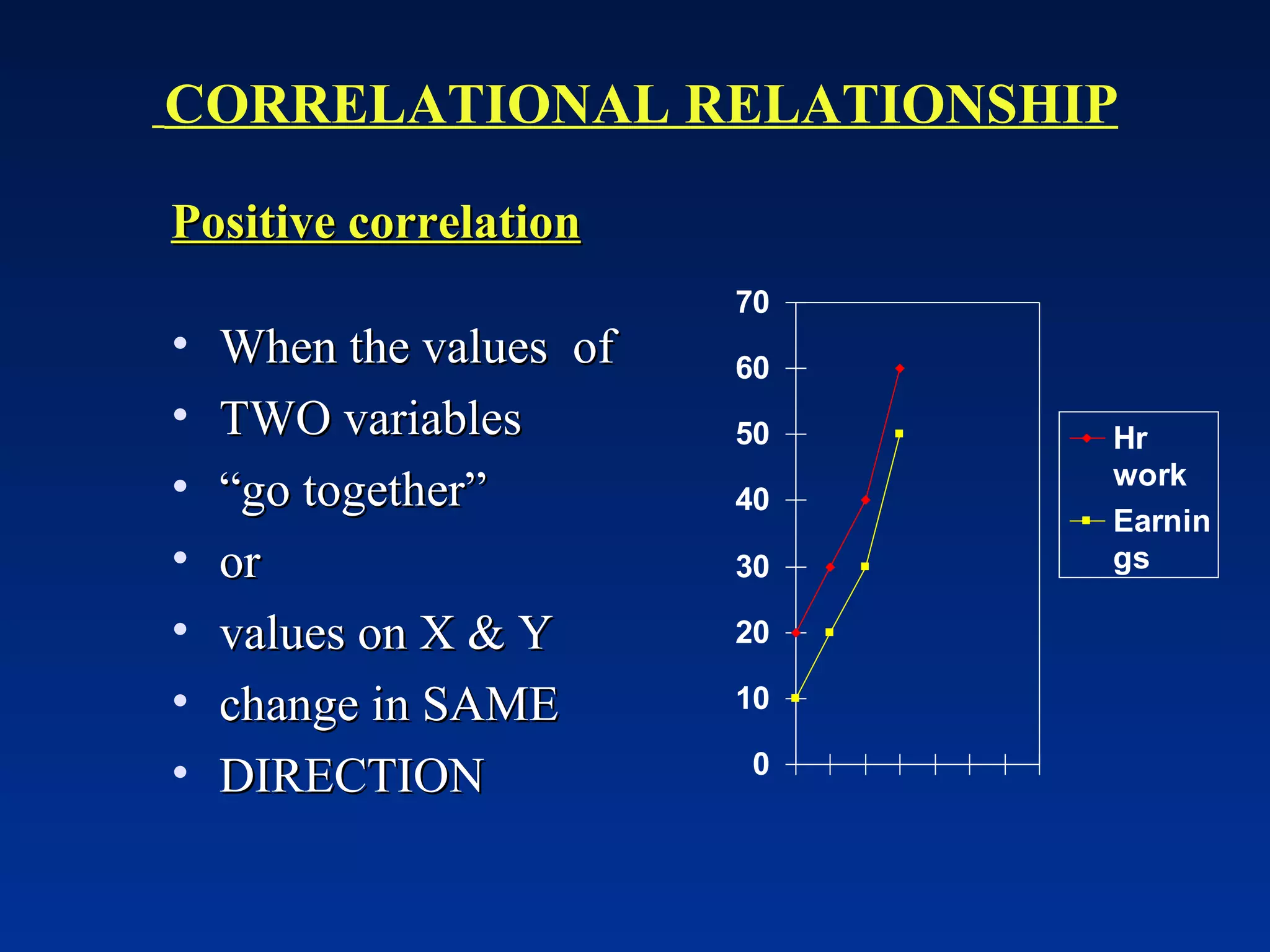
Positive correlation When the values  of  TWO variables “ go together” or values on X & Y change in SAME DIRECTION   CORRELATIONAL RELATIONSHIP
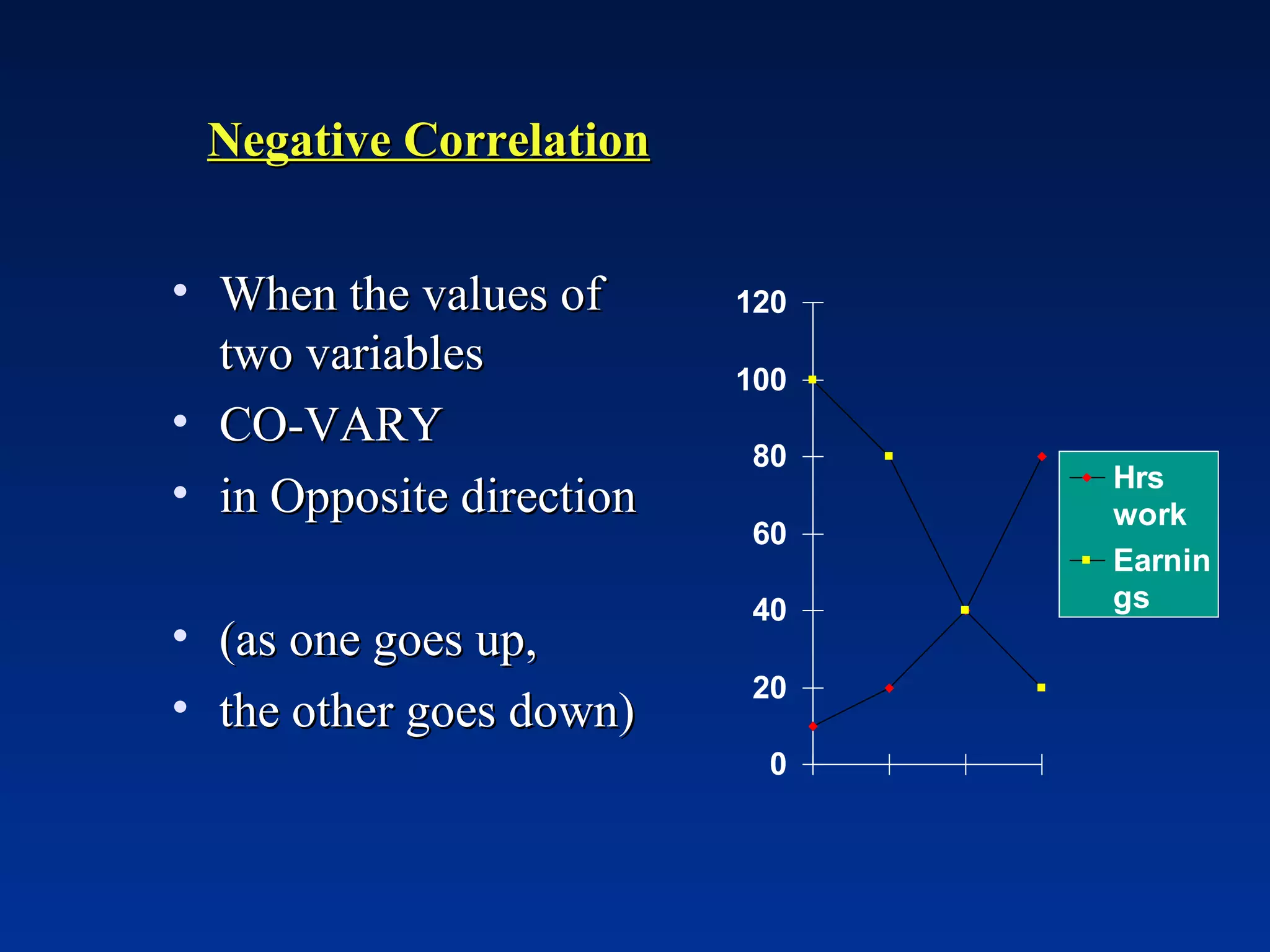
Negative Correlation When the values of two variables CO-VARY  in Opposite direction (as one goes up, the other goes down)
FUNCTIONS OR ROLE OF HYPOTHESIS It gives a definite point to the investigation and provides direction to the study. It determines the data needs. It specifies the sources of data. It suggests which type of research is likely to be more appropriate. It determines the most appropriate technique of analysis. It contributes to the development of theory.

Research methodology unit-1

  • 1.
  • 2.
    Meaning Research isan endeavour to discover answers to intellectual and practical problems through the application of scientific method. “ Research is a systematized effort to gain new knowledge ” . -Redman and Mory . Research is the systematic process of collecting and analyzing information (data) in order to increase our understanding of the phenomenon about which we are concerned or interested.
  • 3.
    Objectives of ResearchThe purpose of research is to discover answers through the application of scientific procedures . The objectives are: To gain familiarity with a phenomenon or to achieve new insights into it – Exploratory or Formulative Research . To portray accurately the characteristics of a particular individual, situation or a group – Descriptive Research . To determine the frequency with which something occurs or with which it is associated with something else – Diagnostic Research . To test a hypothesis of a causal relationship between variables – Hypothesis-Testing Research .
  • 4.
    Characteristics of ResearchResearch is directed towards the solution of a problem . Research is based upon observable experience or empirical evidence . Research demands accurate observation and description . Research involves gathering new data from primary sources or using existing data for a new purpose. Research activities are characterized by carefully designed procedures . Research requires expertise i.e., skill necessary to carryout investigation, search the related literature and to understand and analyze the data gathered. Research is objective and logical – applying every possible test to validate the data collected and conclusions reached. Research involves the quest for answers to unsolved problems . Research requires courage . Research is characterized by patient and unhurried activity. Research is carefully recorded and reported.
  • 5.
    SCIENTIFIC METHOD ‘ Science’ refers to the body of systematic and organised knowledge which makes use of scientific method to acquire knowledge in a particular field of enquiry. Scientific method is the systematic collection of data (facts) and their theoretical treatment through proper observation, experimentation and interpretation. Scientific method attempts to achieve a systematic interrelation of facts by experimentation, observation, and logical arguments from accepted postulates and a combination of these three in varying proportions.
  • 6.
    BASIC POSTULATES INSCIENTIFIC METHOD It relies on empirical evidence. It utilizes relevant concepts. It is committed to only objective considerations. It presupposes ethical neutrality. It results into probabilistic predictions. The methodology is made known. Aims at formulating scientific theories.
  • 7.
    Purpose clearly defined.Research process detailed. Research design thoroughly planned. High ethical standards applied. Limitations frankly revealed. Adequate analysis for decision maker’s needs. Findings presented unambiguously. Conclusions justified. Researcher’s experience reflected. CRITERIA OF A GOOD RESEARCH
  • 8.
    QUALITIES OF AGOOD RESEARCH Systematic Logical Empirical Replicable Creative Use of multiple methods
  • 9.
    EXPLORATION DESCRIBE DIAGNOSEHYPOTHESIS INDUCTIONS AND DEDUCTIONS NEED FOR RESEARCH
  • 10.
    SCOPE / SIGNIFICANCEOF RESEARCH RESEARCH FOR DECISION MAKING Throws light on risks and uncertainty Identify alternative courses of action Helps in economic use of resources Helps in project identification
  • 11.
    Solves investment problemsSolves pricing problems Solves allocation problems Solves decision making issues in HR Solves various operational and planning problems of business and industry
  • 12.
    Provides the basisfor all government policies in our economic system. Helps social scientists in studying social relationships and in seeking answers to various social problems. For students, research means a careerism or a way to attain a high position in the social structure. For professionals in research, it may mean a source of livelihood.
  • 13.
    For philosophers andthinkers, research means the outlet for new ideas and insights. For literary men and women, research means development of new styles and creative work. For analysts and intellectuals, research means generalizations of new theories.
  • 14.
    Not similar toscience Uncontrollable variables Human tendencies Time and money Lack of computerization Lack of scientific training in the methodology of research PROBLEMS IN RESEARCH
  • 15.
    Insufficient interaction betweenuniversity research departments and business establishments Lack of confidence on the part of business units to give information Lack of code of conduct Difficulty of adequate and timely secretarial assistance
  • 16.
    Poor library managementand functioning Difficulty of timely availability of published data. Ignorance Research for the sake of research-limited practical utility though they may use high sounding business jargon.
  • 17.
    Decision-making is theprocess of selecting the best alternative from the available set of alternatives. Management is chiefly concerned with decision-making and its implementation. These decisions should be based on appropriate studies, evaluations and observations. Research provides us with knowledge and skills needed to solve the problems and to meet the challenges of a fast paced decision-making environment. ROLE OF RESEARCH IN DECISION-MAKING
  • 18.
    According to HerbertA Simon, decision-making involves three activities: Intelligence Activity - scanning the environment for identifying conditions necessary for the decision. Designing Activity - identifying, developing and analyzing the alternative courses of action. Choice Activity - choosing the best course of action from among the alternatives.
  • 19.
    FACTORS THAT AFFECTMANAGERIAL DECISIONS INTERNAL FACTORS – factors present inside an organisation such as resources, technology, trade unions, cash flow, manpower etc. EXTERNAL FACTORS – factors present outside the organisation such as government policies, political factors, socio-economic factors, legal framework, geographic and cultural factors etc. QUANTITATIVE FACTORS – factors that can be measured in quantities such as time, resources, cost factors etc.
  • 20.
    QUALITATIVE FACTORS – factors that cannot be measured in quantities such as organizational cohesiveness, sense of belonging of employees, risk of technological change etc. UNCERTAINITY FACTORS – factors which cannot be predicted.
  • 21.
    TYPES OF RESEARCHDescriptive vs Analytical Research Descriptive Research is a fact finding investigation which is aimed at describing the characteristics of individual, situation or a group (or) describing the state of affairs as it exists at present. Analytical Research is primarily concerned with testing hypothesis and specifying and interpreting relationships, by analyzing the facts or information already available.
  • 22.
    Applied vs FundamentalResearch Applied Research or Action Research is carried out to find solution to a real life problem requiring an action or policy decision. Fundamental Research which is also known as basic or pure research is undertaken for the sake of knowledge without any intention to apply it in practice. It is undertaken out of intellectual curiosity and is not necessarily problem-oriented.
  • 23.
    Quantitative vs QualitativeResearch Quantitative Research is employed for measuring the quantity or amount of a particular phenomena by the use of statistical analysis. Qualitative Research is a non-quantitative type of analysis which is aimed at finding out the quality of a particular phenomenon.
  • 24.
    Conceptual vs EmpiricalResearch Conceptual Research is generally used by philosophers and thinkers to develop new concepts or to reinterpret existing ones. Empirical Research is a data based research which depends on experience or observation alone. It is aimed at coming up with conclusions without due regard for system and theory.
  • 25.
    Some other typesof research.. One-time Research – Research confined to a single time period. Longitudinal Research – Research carried on over several time periods. Diagnostic Research – It is also called clinical research which aims at identifying the causes of a problem, frequency with which it occurs and the possible solutions for it. Exploratory Research – It is the preliminary study of an unfamiliar problem, about which the researcher has little or no knowledge. It is aimed to gain familiarity with the problem, to generate new ideas or to make a precise formulation of the problem. Hence it is also known as formulative research.
  • 26.
    Experimental Research – It is designed to assess the effect of one particular variable on a phenomenon by keeping the other variables constant or controlled. Historical Research – It is the study of past records and other information sources, with a view to find the origin and development of a phenomenon and to discover the trends in the past, inorder to understand the present and to anticipate the future.
  • 27.
    RESEARCH PROCESS Define Research Problem Review Concepts And theories Review Previous Research findings Formulate hypothesis Design Research (Including Sample Design) Collect Data (Execution) Analyse Data (Test Hypothesis if any) Interpret and report FF F F F FF I II III IV V VI VII F FF Feed Back Feed Forward Review the literature
  • 28.
    DEFINITION OFTHE RESEARCH PROBLEM STEP-1
  • 29.
    RESEARCH PROBLEMWhat is a research problem? The term ‘problem’ means a question or issue to be examined. Research Problem refers to some difficulty /need which a researcher experiences in the context of either theoretical or practical situation and wants to obtain a solution for the same.
  • 30.
    HOW DO WEKNOW WE HAVE A RESEARCH PROBLEM? Customer complaints Conversation with company employees Observation of inappropriate behaviour or conditions in the firm Deviation from the business plan Success of the firm’s competitor’s Relevant reading of published material (trends, regulations) Company records and reports .
  • 31.
    The first stepin the research process – definition of the problem involves two activities: Identification / Selection of the Problem Formulation of the Problem
  • 32.
    IDENTIFICATION / SELECTIONOF THE RESEARCH PROBLEM This step involves identification of a few problems and selection of one out of them, after evaluating the alternatives against certain selection criteria.
  • 33.
    SOURCES OF PROBLEMSReading Academic Experience Daily Experience Exposure to Field Situations Consultations Brainstorming Research Intuition
  • 34.
    CRITERIA OF SELECTIONThe selection of one appropriate researchable problem out of the identified problems requires evaluation of those alternatives against certain criteria. They are: Internal / Personal criteria – Researcher’s Interest, Researcher’s Competence, Researcher’s own Resource: finance and time. External Criteria or Factors – Researchability of the problem, Importance and Urgency, Novelty of the Problem, Feasibility, Facilities, Usefulness and Social Relevance, Research Personnel.
  • 35.
    DEFINITION / FORMULATIONOF THE RESEARCH PROBLEM Formulation is the process of refining the research ideas into research questions and objectives. Formulation means translating and transforming the selected research problem/topic/idea into a scientifically researchable question. It is concerned with specifying exactly what the research problem is.
  • 36.
    Problem definition orProblem statement is a clear, precise and succinct statement of the question or issue that is to be investigated with the goal of finding an answer or solution. There are two ways of stating a problem: Posting question / questions Making declarative statement / statements
  • 37.
    PROCESS INVOLVED INDEFINING THE PROBLEM STATEMENT OF THE PROBLEM IN A GENERAL WAY.
  • 38.
    UNDERSTANDING THE NATUREOf PROBLEM SURVEYING THE AVAILABLE LITERATURE
  • 39.
    DEVELOPING IDEAS THROUGHDISCUSSIONS REPHRASING THE RESEARCH PROBLEM
  • 40.
    CRITERIA OF AGOOD RESEARCH PROBLEM Clear and Unambiguous Empirical Verifiable Interesting Novel and Original Availability of Guidance
  • 41.
    Defining Problem, Resultsin Clear Cut Research Objectives.. Symptom Detection Statement of Research Objectives Analysis of the Situation Problem Definition
  • 42.
    ESTABLISHMENT OF RESEARCHOBJECTIVES Research Objectives are the specific components of the research problem, that you’ll be working to answer or complete, in order to answer the overall research problem. - Churchill, 2001 The objectives refers to the questions to be answered through the study. They indicate what we are trying to get from the study or the expected results / outcome of the study.
  • 43.
    ESTABLISHMENT OF RESEARCHOBJECTIVES Research Objectives should be clear and achievable, as they directly assist in answering the research problem. The objectives may be specified in the form of either statements or questions. Generally, they are written as statements, using the word “to”. (For example, ‘to discover …’, ‘to determine …’, ‘to establish …’, etc. )
  • 44.
    REVIEW OF LITERATURE STEP-2
  • 45.
    REVIEW OF LITERATURELiterature Review is the documentation of a comprehensive review of the published and unpublished work from secondary sources of data in the areas of specific interest to the researcher. The main aim is to find out problems that are already investigated and those that need further investigation.
  • 46.
    REVIEW OF LITERATUREIt is an extensive survey of all available past studies relevant to the field of investigation. It gives us knowledge about what others have found out in the related field of study and how they have done so.
  • 47.
    PURPOSE OF REVIEW To gain a background knowledge of the research topic. To identify the concepts relating to it, potential relationships between them and to formulate researchable hypothesis. To identify appropriate methodology, research design, methods of measuring concepts and techniques of analysis. To identify data sources used by other researchers. To learn how others structured their reports.
  • 48.
    How to conductthe Literature Survey? Identify the relevant sources. Extract and Record relevant information. Write-up the Literature Review.
  • 49.
    SOURCES OF LITERATUREBooks and Journals Electronic Databases Bibliographic Databases Abstract Databases Full-Text Databases Govt. and Industry Reports Internet Research Dissertations / Thesis
  • 50.
    RECORDING THE LITERATUREThe most suitable method of recording notes is the card system. The recording system involves use of two sets of cards: Source cards (3”x 5”) – used for noting bibliographic information. Note cards (5”x 8”) – used for actual note taking.
  • 51.
    SOURCE CARDS SourceCards serve two purposes: Provide documentary information for foot notes. It is used for compiling bibliography to be given at the end of the report.
  • 52.
    SOURCE CARDS SourceCards can be coded by a simple system inorder to relate them to the corresponding note cards. Marking a combination of letters and a number on the right hand top corner that begins with ‘C’. For example; C1, C2 etc. OR Marking the letter ‘B’ or ‘J’ or ‘R’ (B=Books, J=Journal, R=Report) on the left hand top corner.
  • 53.
    SOURCE CARDS Therecording of bibliographic information should be made in proper bibliographic format. The format for citing a book is: Author’s name, (year), Title of the book, Place of publication, Publisher’s name. For Example; Koontz Harold (1980), Management, New Delhi, McGraw-Hill International. The format for citing a journal article is: Author’s name, (year), Title of the article, Journal name, Volume (number), pages. For Example; Sheth J.N (1973), A Model of Industrial Buying Behaviour, Journal of Marketing, 37(4), 50-56.
  • 54.
    NOTE CARDS DetailedInformation extracted from a printed source is recorded on the note cards. It is desirable to note a single fact or idea on each card, on one side only.
  • 55.
    How to writethe review? There are several ways of presenting the ideas of others within the body of the paper. For Example; If you are referring the major influencing factors in the Sheth’s model of Industrial Buying Behaviour, it can be written as, Sheth (1973, p-50) has suggested that, there are a number of influencing factors …….. According to Sheth (1973) model of industrial buying behaviour, there are a number of influencing factors……..
  • 56.
    How to writethe review? In some models of industrial buying behaviour, there are a number of influencing factors (Sheth, 1973). In some models of industrial buying behaviour, there are a number of influencing factors 1 . Sheth J.N (1973), A Model of Industrial Buying Behaviour, Journal of Marketing, 37(4), 50-56.
  • 57.
    Points to bekept in mind while reviewing literature.. Read relevant literature. Refer original works. Read with comprehension. Read in time. Index the literature.
  • 58.
    FORMULATION OF HYPOTHESIS STEP-3
  • 59.
    HYPOTHESIS A hypothesisis an assumption about relations between variables. Hypothesis can be defined as a logically conjectured relationship between two or more variables expressed in the form of a testable statement. Relationships are conjectured on the basis of the network of associations established in the theoretical framework formulated for the research study.
  • 60.
    VARIABLES Anything thatcan vary can be considered as a variable. A variable is anything that can take on differing or varying values. For example; Age, Production units, Absenteeism, Sex, Motivation, Income, Height, Weight etc. Note: The values can differ at various times for the same object or person (or) at the same time for different objects or persons.
  • 61.
    Variable / AttributeA variable is a characteristic that takes on two or more values whereas, an attribute is a specific value on a variable (qualitative). For example; The variable SEX/GENDER has 2 attributes - Male and Female. The variable AGREEMENT has 5 attributes – Strongly Agree, Agree, Neutral, Disagree, Strongly Disagree.
  • 62.
    Types of Variables Explanatory vs Extraneous Variable The variables selected for analysis are called explanatory variables and all other variables that are not related to the purpose of the study but may affect the dependant variable are extraneous. Dependant vs Independent Variable The variable that changes in relationship to changes in another variable(s) is called dependant variable . The variable whose change results in the change in another variable is called an independent variable . OR An independent variable is the one that influences the dependant variable in either a positive or negative way.
  • 63.
    HYPOTHESIS Research Hypothesisis a predictive statement that relates an independent variable to a dependant variable. Hypothesis must contain atleast one independent variable and one dependant variable.
  • 64.
    HYPOTHESIS Hypothesis aretentative, intelligent guesses as to the solution of the problem. Hypothesis is a specific statement of prediction. It describes in concrete terms what you expect to happen in the study. Hypothesis is an assumption about the population of the study. It delimits the area of research and keeps the researcher on the right track.
  • 65.
    PROBLEM (VS) HYPOTHESISHypothesis is an assumption, that can be tested and can be proved to be right or wrong. A problem is a broad question which cannot be directly tested. A problem can be scientifically investigated after converting it into a form of hypothesis.
  • 66.
    CHARACTERISTICS OF HYPOTHESISConceptual Clarity - It should be clear and precise. Specificity - It should be specific and limited in scope. Consistency - It should be consistent with the objectives of research. Testability - It should be capable of being tested. Expectancy - It should state the expected relationships between variables.
  • 67.
    CHARACTERISTICS OF HYPOTHESISSimplicity - It should be stated as far as possible in simple terms. Objectivity - It should not include value judgments, relative terms or any moral preaching. Theoretical Relevance - It should be consistent with a substantial body of established or known facts or existing theory. Availability of Techniques – Statistical methods should be available for testing the proposed hypothesis.
  • 68.
    Discussions with colleaguesand experts about the problem, its origin and objectives in seeking a solution. Examination of data and records for possible trends, peculiarities. Review of similar studies. Exploratory personal investigation / Observation. Logical deduction from the existing theory. Continuity of research. Intuition and personal experience. SOURCES OF HYPOTHESIS
  • 69.
    Descriptive Hypothesis Theseare assumptions that describe the characteristics (such as size, form or distribution) of a variable. The variable may be an object, person, organisation, situation or event. Examples: “ Public enterprises are more amenable for centralized planning”. TYPES OF HYPOTHESIS
  • 70.
    Relational Hypothesis [ Explanatory Hypothesis ] These are assumptions that describe the relationship between two variables. The relationship suggested may be positive, negative or causal relationship. Examples: “ Families with higher incomes spend more for recreation”. Causal Hypothesis state that the existence of or change in one variable causes or leads to an effect on another variable. The first variable is called the independent variable and the latter is the dependant variable .
  • 71.
    Null Hypothesis Whena hypothesis is stated negatively, it is called null hypothesis. It is a ‘no difference’, ‘no relationship’ hypothesis. ie., It states that, no difference exists between the parameter and statistic being compared to or no relationship exists between the variables being compared. It is usually represented as H O or H 0 . Example: H 0 : There is no relationship between a family’s income and expenditure on recreation.
  • 72.
    Alternate Hypothesis It is the hypothesis that describes the researcher’s prediction that, there exist a relationship between two variables or it is the opposite of null hypothesis. It is represented as H A or H 1. Example: H A : There is a definite relationship between family’s income and expenditure on recreation.
  • 73.
    FORMS OF RELATIONSHIPS NON-DIRECTIONAL There IS a relationship between X & Y X….linked….Y Vs DIRECTIONAL If X goes up, Y …. or As X increases, Y… X = Independent variable Y = Dependent variable
  • 74.
    DIRECTIONAL HYPOTHESES- “X” causes “Y” to change If X changes (increases decreases) then Y will ______ (increase or decrease) a causal link
  • 75.
    DIRECTION OF RELATIONSHIPIf X increases, Y increases A POSITIVE relationship If X increase, Y decreases A NEGATIVE or INVERSE relationship As X changes, Y does NOT change...> No Change...> NO RELATIONSHIP
  • 76.
    NON-DIRECTIONAL HYPOTHESES - the weakest form There Is a relationship between X & Y non-causal correlational statement X…..Y
  • 77.
    Positive correlation Whenthe values of TWO variables “ go together” or values on X & Y change in SAME DIRECTION CORRELATIONAL RELATIONSHIP
  • 78.
    Negative Correlation Whenthe values of two variables CO-VARY in Opposite direction (as one goes up, the other goes down)
  • 79.
    FUNCTIONS OR ROLEOF HYPOTHESIS It gives a definite point to the investigation and provides direction to the study. It determines the data needs. It specifies the sources of data. It suggests which type of research is likely to be more appropriate. It determines the most appropriate technique of analysis. It contributes to the development of theory.